
Every AI Pilot Eventually Becomes an Infrastructure Problem
There is a number that explains most of what is happening to the Cloud Architect role right now: 98% of organizations are exploring generative AI, according to Google Cloud's 2025 State of AI Infrastructure report. Only 39% have it in production. That 59-point gap is not a strategy problem. It is an infrastructure problem, and closing it is precisely what Cloud Architects are hired to do.
We analyzed 1,575 active Cloud Architect postings on the InterviewStack.io job board over a 90-day window through June 2026. (Note: the role classifier captures a broad "architect" category; a minority of postings in this dataset represent hardware, systems, or defense architects rather than cloud-specific roles. Because these non-cloud postings rarely mention AI skills, the AI adoption percentages reported here are a conservative floor, not an overcount.) Fourteen percent of those postings now explicitly require new-wave generative AI skills: that is the share of companies hiring architects specifically to design and operate AI infrastructure, LLM platforms, GenAI pipelines, RAG (retrieval-augmented generation) systems, and vector database clusters. That 14.2% is the "Build AI" signal. What surrounds it is larger: the Flexera 2026 State of the Cloud report found that 58% of cloud organizations are currently using GenAI and 45% are doing so "extensively." Cloud Architects do not need their job description to say "AI" for their daily work to involve it.
Three years ago, the defining Cloud Architect competencies were multi-cloud strategy, infrastructure-as-code (using Terraform, Pulumi), Kubernetes at scale, and cost governance across AWS, Azure, and Google Cloud. That work has not gone away. But layered on top of it is a new set of demands: GPU cluster cost governance, LLM inference endpoint design, RAG pipeline architecture, and the security guardrails that govern AI workloads running on cloud infrastructure that was not originally built for them. Flexera found that AI workloads drove estimated cloud waste up to 29% in 2026, the first increase in five years. That overspend lands on the Cloud Architect's plate.
Key Findings
- 1,575 active Cloud Architect postings analyzed over a 90-day window through June 2026.
- 14.2% of postings explicitly require new-wave generative AI skills (224 of 1,575); 20.6% require any AI including traditional ML.
- AI Agents is the top new-wave AI skill at 7.9% of postings (124), outranking Generative AI (6.5%), LLMs (3.9%), and RAG (3.4%).
- $12,500 US base salary premium for new-wave AI skills: postings requiring GenAI skills show a median of $175,000 vs. $162,500 without (US base salary only; equity excluded).
- Staff-level Cloud Architects carry the highest AI adoption rate at 18.4%; senior (13.9%) and mid-level (14.2%) follow closely.
- India has a 23% AI adoption rate in Cloud Architect postings, nearly double the US rate of 12.1%, despite the US accounting for 38% of global posting volume.
- 98% of organizations are exploring GenAI, only 39% have it in production (Google Cloud 2025): closing that gap is the defining Cloud Architect infrastructure challenge of 2026.
- 58% of cloud organizations are using GenAI, and 45% are doing so extensively (Flexera 2026), making AI-aware architecture a baseline expectation across the market, not a niche specialty.
Which Cloud Architect Roles Are Explicitly Hiring for AI?
The 14.2% figure has a precise meaning: it counts postings that explicitly list generative AI era skills in the job description. Add the traditional ML layer (machine learning, deep learning, MLOps) and the any-AI adoption rate reaches 20.6%.
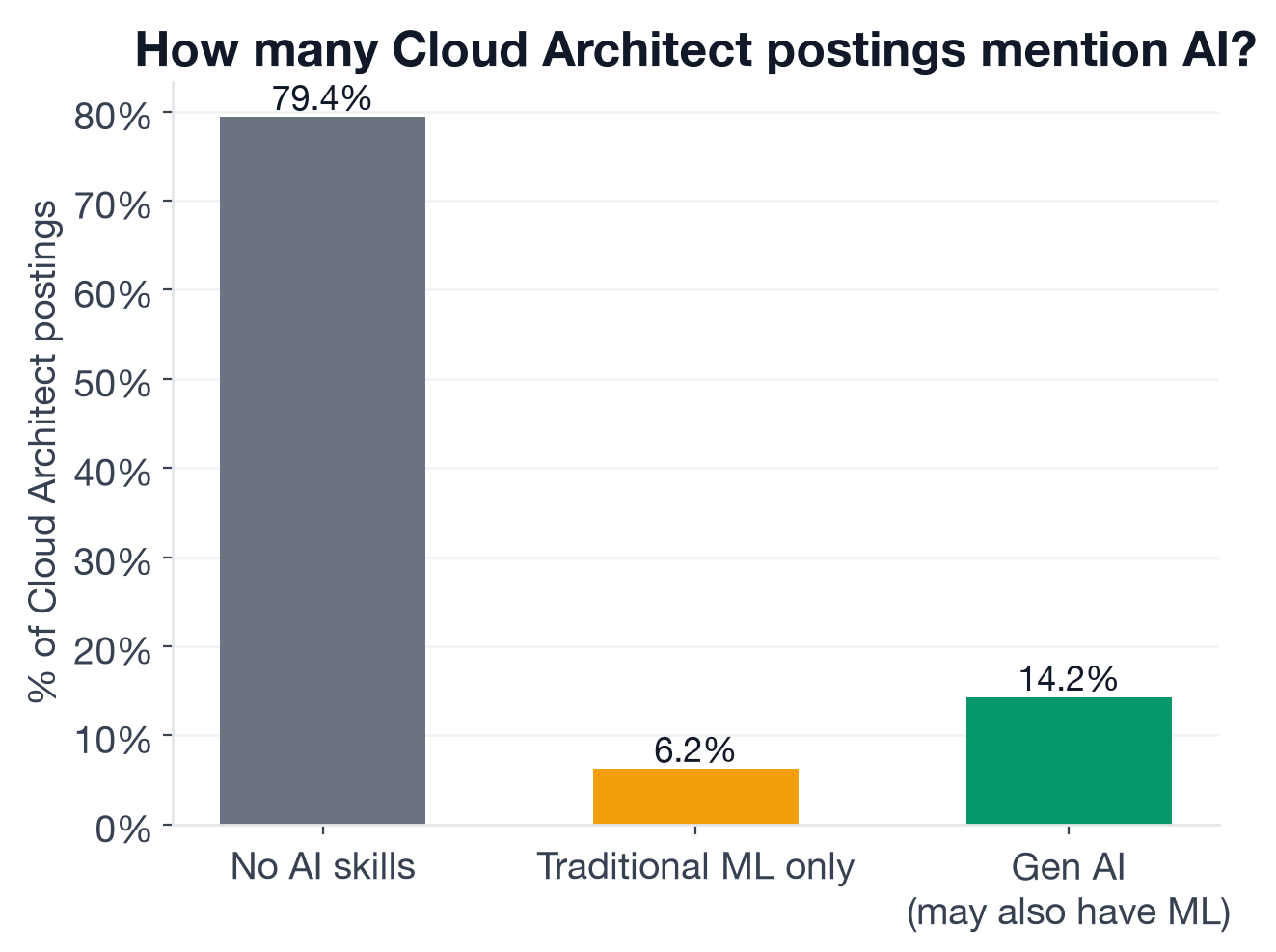
Share of Cloud Architect postings requiring new-wave generative AI, traditional ML, both, or no AI skills at all.
The 79.4% of postings without explicit AI requirements are not a countervailing signal. They reflect the ambient layer: organizations that use AI tools extensively but do not write them into job descriptions because they assume the competency the same way they once assumed internet access. Eighty-five percent of developers now regularly use AI tools (JetBrains State of Developer Ecosystem 2025), and 62% rely on at least one AI coding assistant. Those developers work inside the cloud infrastructure that Cloud Architects build and govern. Designing architecture for AI-generated code, AI-assisted CI/CD pipelines, and AI-powered developer environments is already part of the role at most technology organizations, whether the posting says so or not.
The cleanest way to read this dataset: the 14.2% measures Cloud Architects hired to own AI infrastructure. The 85.8% measures Cloud Architects operating in organizations where AI infrastructure is someone's problem, and that someone usually ends up being them.
Which AI Skills Are Actually Reshaping Cloud Architecture?
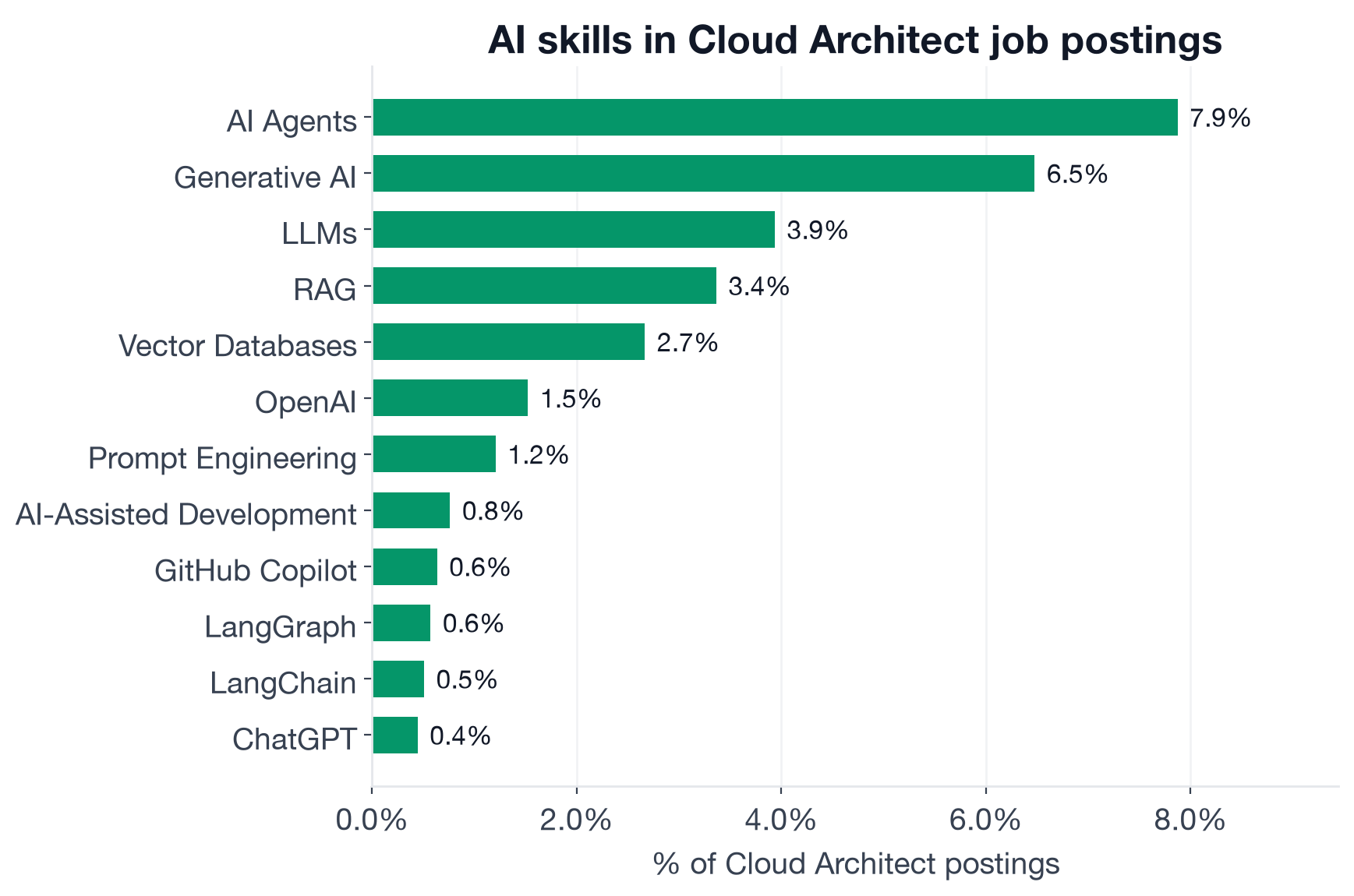
Percentage of 1,575 Cloud Architect postings mentioning each AI skill. Machine Learning is traditional ML (present in postings for several years); skills below it are new-wave generative AI era (2023+).
Machine Learning leads all AI skills at 11.9%, but it occupies a different category from the generative AI signal. When a Cloud Architect posting lists Machine Learning, it typically describes someone who needs to design compute and storage infrastructure for data science teams or support MLOps pipelines, not someone building LLM applications. This is the pre-generative-AI layer in the role, meaningful because it shows how much ML infrastructure work already sits here.
The new-wave skill that most clearly signals where explicit AI demand is heading is AI Agents at 7.9%. When a company adds "AI Agents" to a Cloud Architect job description, it is asking for someone who can design the infrastructure behind autonomous, multi-step AI systems: orchestration layers, message queues, state management, and the reliability engineering that prevents a poorly designed agent loop from cascading into production failures. Browse Cloud Architect postings listing AI Agents and the design challenge is consistent across postings: these are systems architecture roles, not application development roles.
Generative AI (6.5%) and LLMs (3.9%) follow. RAG at 3.4% points to a specific infrastructure competency: retrieval-augmented generation requires a vector database, an embedding pipeline, a reranking layer, and latency governance that most existing cloud architectures were not designed for. Vector Databases appear at 2.7%, confirming that the retrieval infrastructure layer for AI is becoming a distinct hiring criterion. Cloud Architect postings that list LLMs show this demand in practice.
The orchestration frameworks, LangGraph (0.57%) and LangChain (0.51%), are still rare in postings but carry an early signal: when a company names a specific AI agent orchestration framework in an architecture role, it is building something at a scale that requires dedicated architectural ownership.
Does an AI Requirement Change the Salary Offer?
Among US postings with disclosed salary data, yes. (All figures below are US base salary only; equity, bonuses, and sign-on are not captured in job posting disclosures and are excluded from this analysis.)
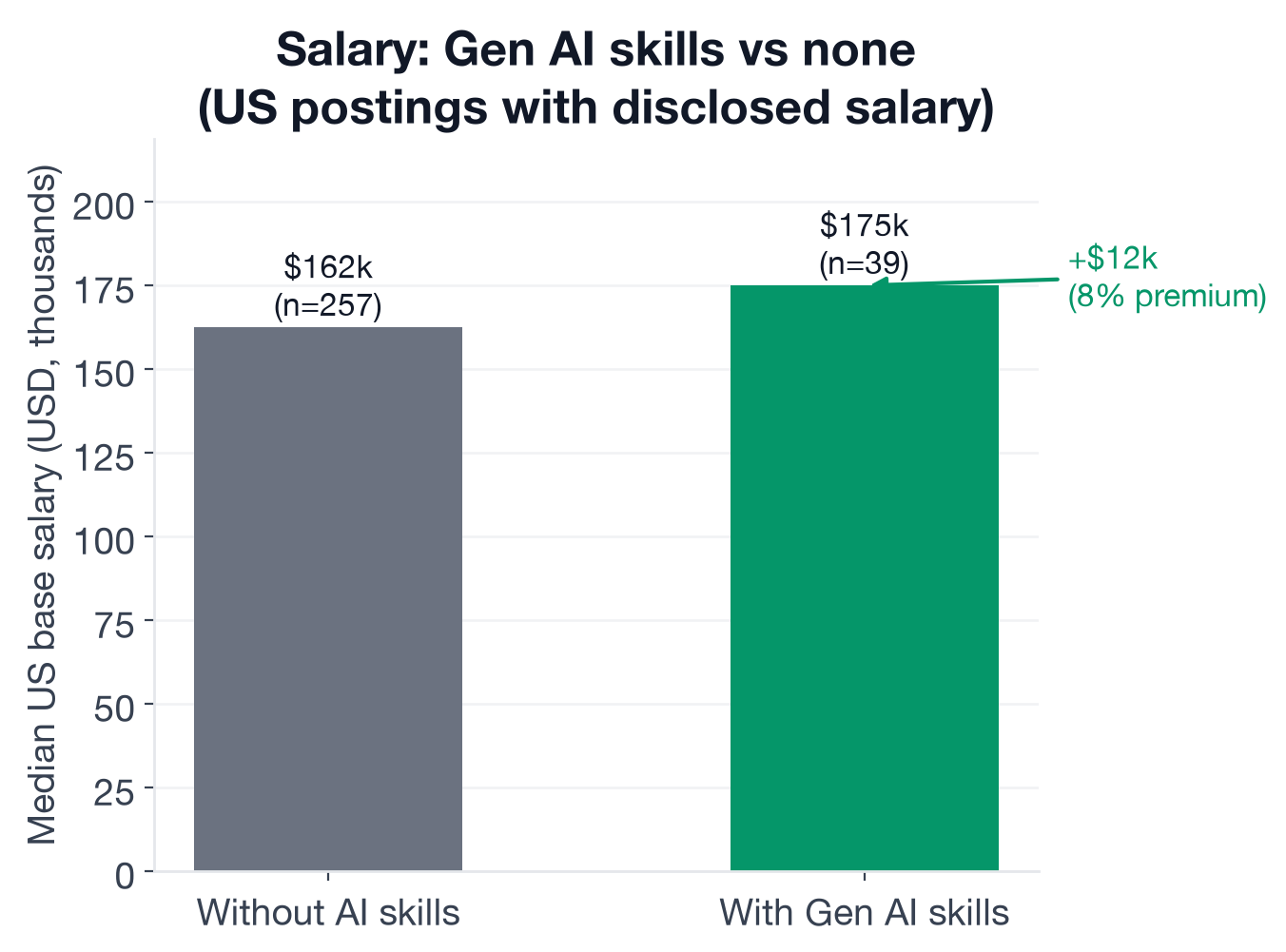
US median base salary for Cloud Architect postings with and without new-wave generative AI skill requirements. US base salary only; equity and bonuses excluded.
Postings requiring new-wave generative AI skills show a median US base of $175,000, compared to $162,500 for postings without AI requirements, a premium of $12,500. The non-AI baseline is already high, which reflects the seniority concentration in this role: 79.6% of Cloud Architect postings are senior-level, so even the no-AI bucket skews toward senior compensation.
The AI salary figure is directional rather than definitive. With n=39 US postings requiring new-wave AI skills carrying disclosed salary data, the $175,000 median reflects a real pattern but should be read as an indicative signal rather than a hard floor. What it does establish: organizations that are explicit enough about AI infrastructure skills to put them in a senior architecture posting are also offering compensation above the already-elevated Cloud Architect baseline. The premium is real even if the sample is not yet large enough to be precise.
Where AI-Fluent Cloud Architects Are Most in Demand
The seniority pattern is the clearest signal in the dataset. Staff-level Cloud Architect postings require AI at 18.4%, compared to 13.9% at senior, 14.2% at mid-level, and 6.7% at the entry level. Junior-level sits nominally higher at 15.0%, but that figure covers only 20 postings and should not be read as a reliable signal. The architects being asked to own AI infrastructure strategy sit at the top of the experience band. This is design work for AI systems at an organizational level, not implementation work on a development team.
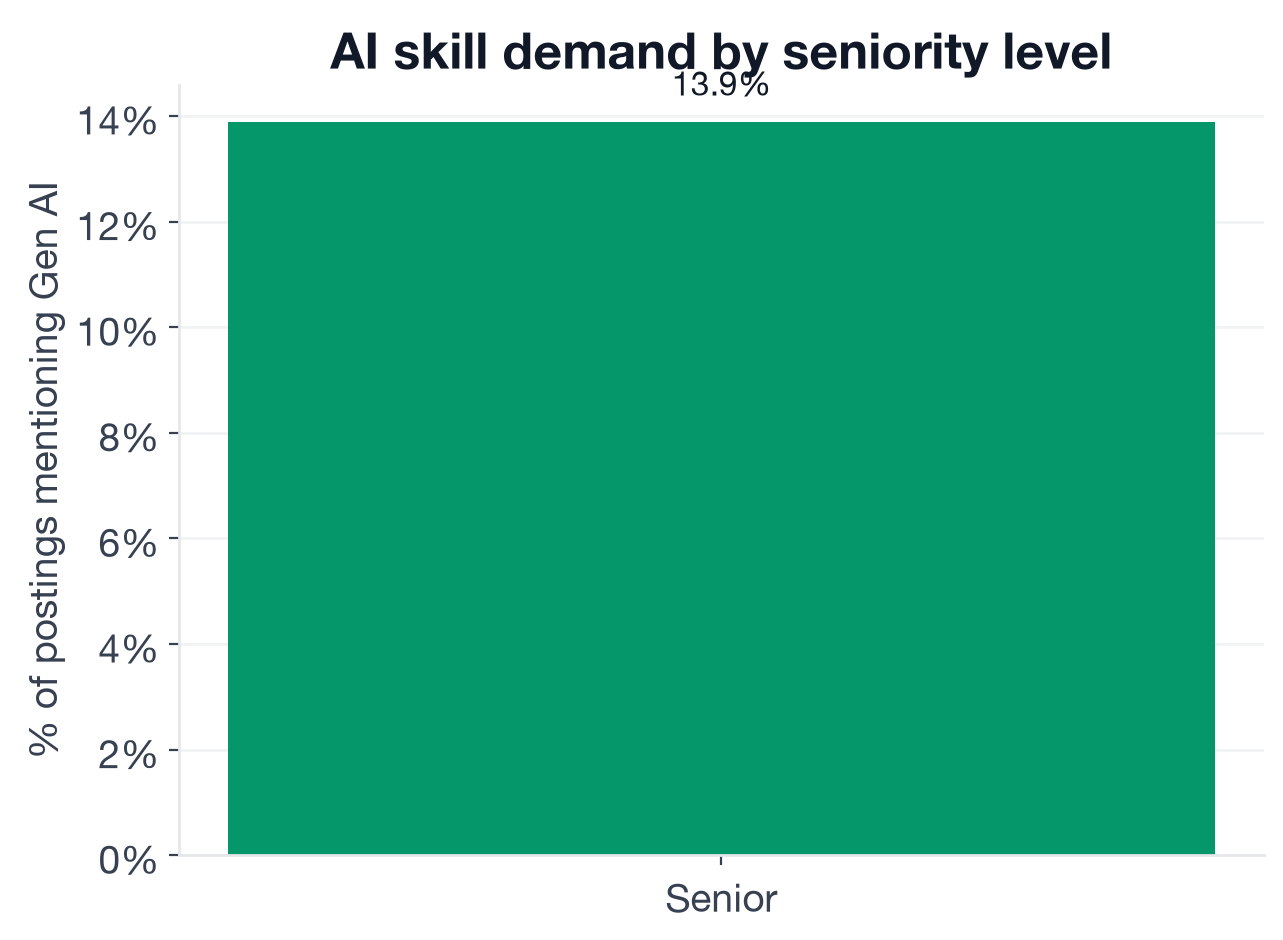
Percentage of Cloud Architect postings at each seniority level that require AI skills. Staff-level carries the highest rate; entry-level represents only 0.95% of the overall Cloud Architect market.
The overall role is not a career entry point: only 15 of 1,575 postings (0.95%) are entry-level, and the vast majority of the market sits at senior (79.6%) or staff (7.9%) levels. Cloud Architect AI demand is primarily a senior professional question, not a career-starter question.
Geographically, the most counterintuitive finding is India's AI adoption rate. India accounts for 12.1% of global Cloud Architect posting volume but carries a 23% AI adoption rate in those postings, nearly double the US rate of 12.1%, despite the US generating 38% of global volume. Canada (19.2%), France (21.1%), and the UK (19.0%) also run above the 14.2% global average. Germany is a notable exception: only 3.5% of German Cloud Architect postings list AI skills, well below the global rate. The posting data does not explain the gap; differences in enterprise AI adoption pace and regulatory environment are factors cited in broader industry analysis, but the gap could reflect other market dynamics or posting conventions.
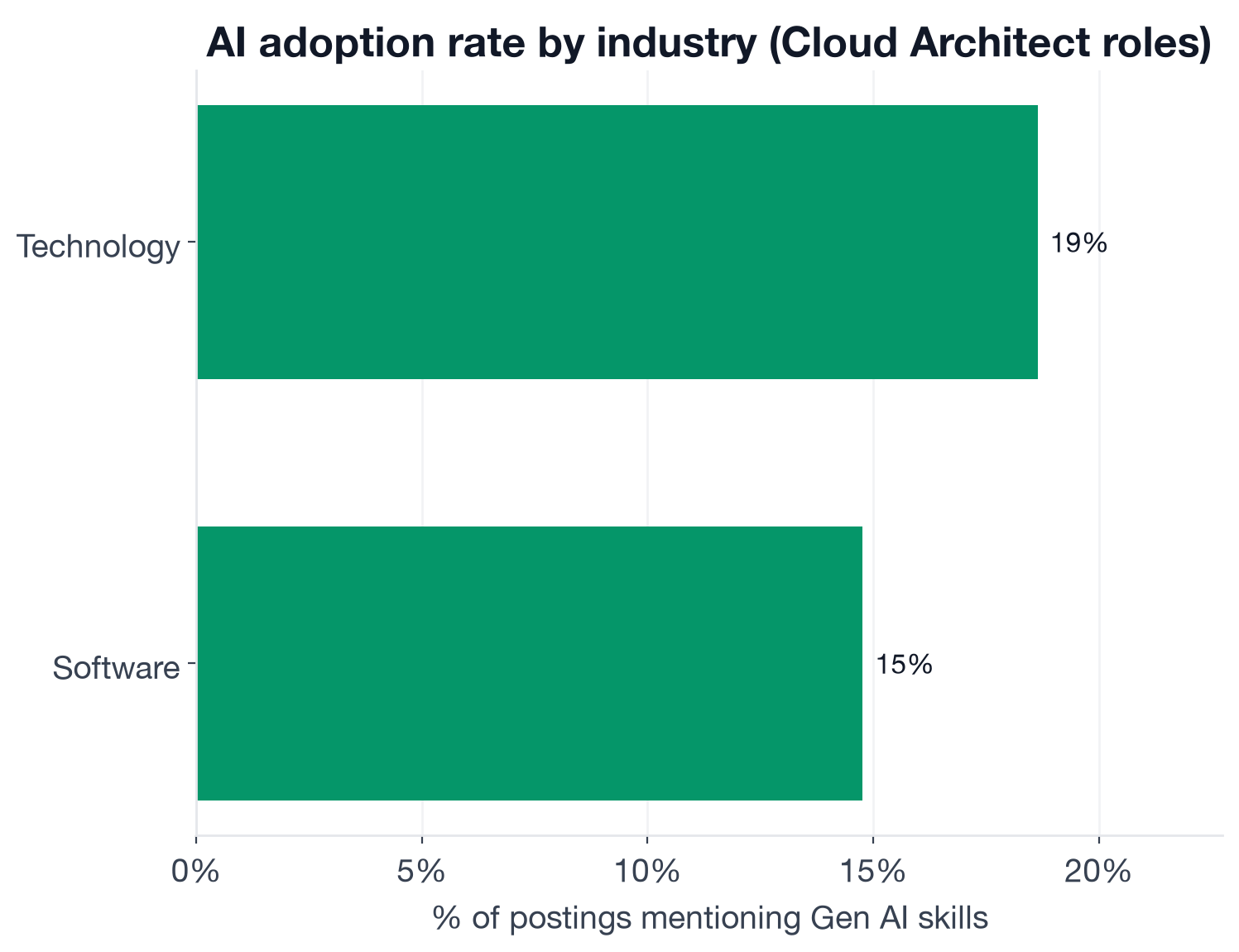
AI adoption rate in Cloud Architect postings by industry. Some sectors in the chart show elevated rates driven by single-firm posting concentration and are not representative of sector-wide demand; the technology (18.6%) and software (14.8%) figures reflect broader firm coverage.
At the industry level, technology (18.6%, 279 postings) and software (14.8%, 149 postings) are the two sectors with enough cross-firm coverage to draw reliable conclusions. Both show meaningful AI adoption across a broad employer base. Several other sectors in the chart carry concentration artifacts (a single firm's reposted job template drives most of the AI-flagged postings in that sector) and should not be read as sector-wide trends.
How to Use This in Your Job Search
The clearest job-search implication from this data: the explicit AI tier in Cloud Architecture is concentrated at the senior and staff level, and it asks for infrastructure design expertise, not application development experience. The relevant skills to demonstrate are architectural: vector database cluster design, RAG pipeline patterns, AI Agent orchestration frameworks (LangGraph, LangChain), and MLOps platform deployment, all in a cloud-native context.
For interview preparation, AI mock interviews cover cloud architecture design questions at the system design level, which is the category these postings test most heavily. If you want to drill specific topic areas, the question bank includes cloud architecture, AI infrastructure, and system design topics organized by role and difficulty. For building foundational fluency in any of the AI infrastructure concepts appearing in postings, interactive courses cover the ML, data systems, and cloud fundamentals that underlie this work.
To see how AI skills cluster in real postings: Cloud Architect openings listing AI Agents and Cloud Architect openings listing LLMs represent two of the highest-intent AI demand tiers in the current market. The full Cloud Architect board lets you compare postings across the complete seniority range to identify where AI requirements appear and how they combine with core infrastructure skills.
FAQ
Q. How is AI changing the Cloud Architect role in 2026?
Cloud Architects now operate on two parallel tracks. In 14.2% of postings, companies explicitly hire architects to design and deploy AI infrastructure: LLM platforms, GenAI pipelines, vector databases, and MLOps stacks. Across the broader market, AI fluency is an ambient expectation: 58% of cloud organizations are already using GenAI and 45% are doing so extensively (Flexera 2026), and architects who cannot navigate AI-aware environments are at a disadvantage regardless of whether the posting mentions it.
Q. What AI skills do Cloud Architect postings require in 2026?
Machine Learning leads all AI skills at 11.9% of postings (188 of 1,575 analyzed). For new-wave generative AI specifically, AI Agents (7.9%), Generative AI (6.5%), LLMs (3.9%), and RAG (3.4%) top the list. The presence of AI Agents at the top signals that companies are hiring architects to design autonomous system infrastructure, not just integrate a single LLM API.
Q. What is the salary premium for Cloud Architects with AI skills?
Among US Cloud Architect postings with disclosed salary data, those requiring new-wave AI skills show a median base of $175,000 versus $162,500 for postings without AI requirements, a $12,500 premium. Both figures are US base salary only; equity and bonuses are not included in posting disclosures.
Q. At what seniority level are Cloud Architect AI roles most common?
Staff-level Cloud Architect postings show the highest AI adoption rate at 18.4%. Senior (13.9%) and mid-level (14.2%) are broadly similar. The overall market is dominated by senior roles at 79.6% of postings, making Cloud Architect one of the most experience-heavy roles on the board. Only 0.95% of postings are entry-level, and those rarely carry AI requirements.
Q. Which countries show the highest Cloud Architect AI demand?
India shows a 23% AI adoption rate in Cloud Architect postings, nearly double the US rate of 12.1%, despite the US accounting for 38% of global posting volume. Canada (19.2%), the UK (19.0%), and France (21.1%) also run above the 14.2% global average. Germany is a notable outlier at just 3.5%.
Q. Is the Cloud Architect role growing because of AI?
The data points to a demand bifurcation: a distinct AI-fluent tier is emerging at the staff and principal level while the majority of postings continue to prioritize core cloud infrastructure skills. The underlying driver is the pilot-to-production gap: 98% of organizations are exploring AI (Google Cloud 2025) but only 39% have it in production, and closing that gap requires cloud infrastructure most organizations do not yet have.
Q. How should a Cloud Architect prepare for AI skill demands in 2026?
Start with the architecture layer most relevant to your current workload: vector databases and RAG for data-intensive systems, AI Agents and LangGraph or LangChain for orchestration, MLOps for teams running ML pipelines. Use the InterviewStack.io job board filtered to Cloud Architect to see which AI skills appear together in the same postings, and pair that with practice on cloud architecture design questions.
Building What the Business Actually Ships
The pilot-to-production gap is not going to close on its own. Every organization that has run GenAI pilots for 18 months without reaching production is eventually going to ask its Cloud Architect what the infrastructure problem is. That question lands on the person who owns the environment where AI runs. The 14.2% explicit AI rate in postings today is the leading edge of a capability demand that the other 85.8% of organizations will have to address as their pilots mature. Getting the architecture right now, before that demand peaks broadly, is what positions Cloud Architects to lead those conversations rather than scramble to catch up.
Topics
Ready to practice?
Put what you've learned into practice with AI mock interviews and structured preparation guides.