
What Has Changed in How Companies Describe the DevOps Engineer Role?
The words "AI Agent" did not appear in a DevOps Engineer posting three years ago. Today they show up in nearly 5% of them. LLMs appear in 2.8%. New-wave generative AI skills of some kind appear in 10.3% of postings, up from effectively zero in 2022. That is the explicit story, the part job postings actually capture.
The ambient story is larger. The 2025 DORA (DevOps Research and Assessment) report found that 90% of software development professionals now use AI tools in their daily work, with 65% describing themselves as heavily reliant on them. The 2026 Perforce State of DevOps report found 87% of practitioners believe AI will shift their role from scripting toward system design and directing outcomes. GitHub Copilot has evolved from a code-autocomplete tool into an agent that can generate Infrastructure-as-Code, troubleshoot pipelines, and triage incidents with minimal human input. What employers now assume without stating has grown larger than what they explicitly ask for in a job description.
To map the explicit half, we analyzed 3,556 active DevOps Engineer postings on the InterviewStack.io job board as of May 2026, with AI skill mentions extracted and categorized as either new-wave generative AI (tools emerging since 2023) or traditional machine learning. The result is a two-layer picture of where the profession stands, and where it is going.
Key Findings
- 3,556 active DevOps Engineer postings analyzed as of May 2026.
- 10.3% (367 postings) explicitly require new-wave generative AI skills: AI Agents, LLMs, Generative AI, RAG, or similar.
- 18.2% (648 postings) ask for any AI skill, combining new-wave tools with traditional Machine Learning and MLOps.
- Machine Learning leads all AI skills at 9.5% of postings (339 of 3,556); AI Agents follow at 4.9% (176), the fastest-growing new-wave entry.
- US median base salary: $150,000 for postings requiring new-wave AI (n=57) vs. $114,000 without (n=423), a $36,000 premium.
- 68% of all postings are explicitly senior-level (2,419 of 3,556), one of the most seniority-heavy distributions in tech.
- Software companies lead the AI shift at 15.7% AI adoption in their DevOps postings; fintech follows at 14.2%.
- 87% of DevOps professionals expect AI to shift their work from scripting to system design, per the Perforce 2026 State of DevOps report.
What Did DevOps Engineering Look Like Before the AI Wave?
In 2021 and 2022, a DevOps Engineer job description was highly predictable: Kubernetes, Terraform (Infrastructure-as-Code), Docker, CI/CD pipelines via GitHub Actions or Jenkins, Prometheus and Grafana for monitoring, Python or Bash for automation. The headline philosophy of the era was "automate everything." The implicit promise was that every manual step that could be written as code, should be. The skill that mattered for that automation was scripting fluency: Bash, Python, Ansible playbooks.
AI played almost no role in that work, except at the edges. Monitoring platforms like Datadog and Splunk had anomaly-detection features, but these ran invisibly in the background and no one listed them as job requirements. MLOps (the practice of deploying and operating machine learning models in production, applying DevOps disciplines to the ML lifecycle) was emerging as a niche specialty but was not a mainstream DevOps expectation. GitHub Copilot launched in June 2022 but barely registered in hiring language for that year.
The Perforce 2026 report captures what has opened up since: 72% of high-DevOps-maturity organizations now report deeply embedded AI practices, versus just 18% in low-maturity counterparts. Mature DevOps teams adopted AI first, and they are widening the capability gap. The DORA 2025 report adds an important nuance: AI adoption correlates with higher deployment throughput, but also with increased change failure rates for teams that lack solid DevOps foundations. AI amplifies existing practices, good and bad. The teams that were already disciplined about testing, observability, and incident response got faster. Teams that skipped those foundations saw their instability amplify. The lesson for the role: AI fluency without operational rigor is a risk multiplier, not a shortcut.
What AI Skills Are Companies Explicitly Requiring from DevOps Engineers Now?
The 10.3% new-wave AI adoption rate separates two distinct job types. At one level is the traditional DevOps Engineer: CI/CD, containers, cloud infrastructure, monitoring. At another level, increasingly, is a DevOps Engineer who manages the infrastructure that AI products run on: model serving pipelines, agent execution environments, vector databases (stores that hold the numerical embeddings retrieval-augmented generation systems search), and LLM API routing.
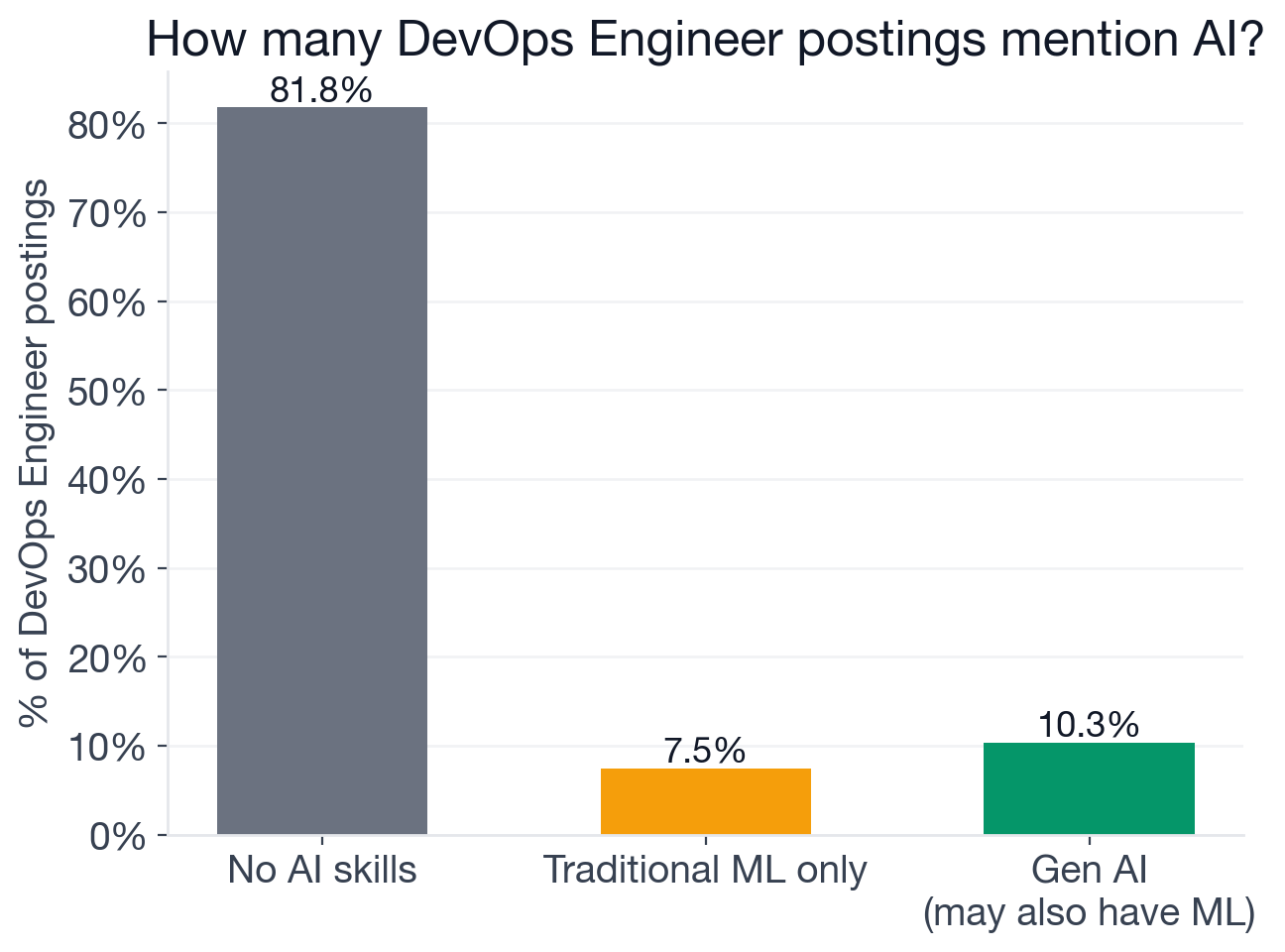
AI skill breakdown across 3,556 active DevOps Engineer postings as of May 2026. "New-wave" covers generative AI era tools (2023+); "Traditional ML" covers machine learning, deep learning, and similar skills that have appeared in postings for five or more years.
The 7.8% slice (278 postings) that asks for new-wave AI without traditional ML is the clearest signal of where demand is heading: postings specifically hiring engineers to work on LLM infrastructure, AI agents, and generative AI tooling, without requiring classical model-training expertise. The 2.5% asking for both (89 postings) represents full-stack AI infrastructure roles where the engineer maintains both classical ML pipelines and newer generative AI systems.
Two layers of AI fluency are now in play for DevOps Engineers:
Layer 1 (Build AI): 10.3% of postings explicitly require engineers to design, deploy, or operate AI systems. These are the roles captured in the chart above. If you take one number from this post, it should be this one, with the understanding that it is a floor, not a ceiling.
Layer 2 (Use AI): The ambient baseline that almost all employers now assume. The Stack Overflow 2025 Developer Survey found 51% of professional developers use AI tools every day; the JetBrains 2025 Developer Ecosystem Survey found 85% use AI regularly for coding. Notably, only 44% of developers (JetBrains 2025) describe AI as fully or partially integrated into their workflows despite that 85% usage rate, which means most engineers are using AI ad-hoc rather than systematically wired into their pipelines. That gap represents both an industry reality and a professional opportunity.
A DevOps Engineer finishing this post should not conclude "90% of DevOps jobs don't need AI." The correct read: 10.3% require you to build AI infrastructure. Virtually all of them expect you to use AI tools.
Which AI Skills Are Appearing Most in DevOps Engineer Postings?
The ranked list reveals two tiers within AI demand: an established ML-infrastructure layer that has been building for several years, and a newer generative AI layer that has accelerated sharply since 2023.
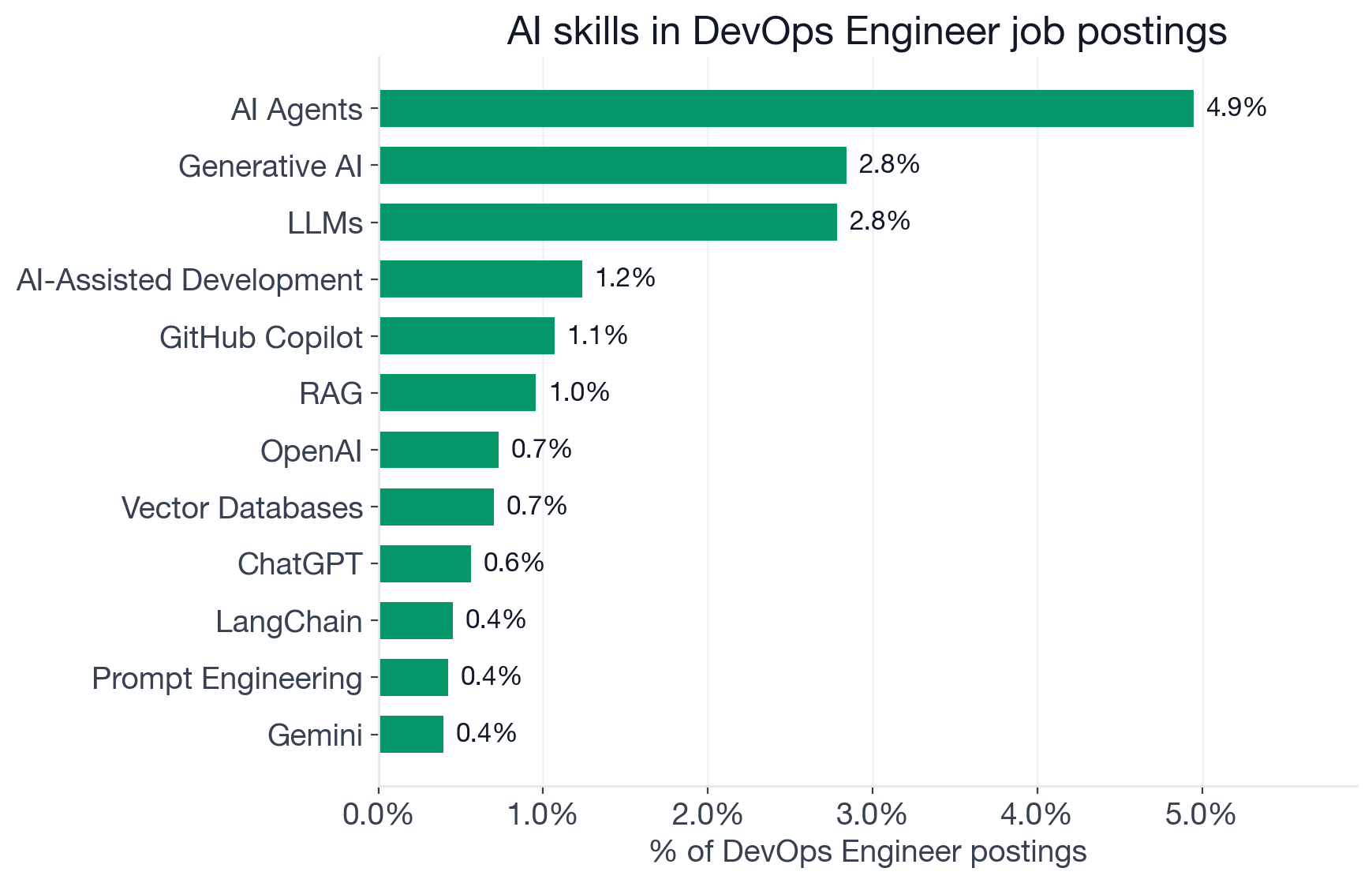
Share of DevOps Engineer postings mentioning each AI skill, ranked by frequency. New-wave generative AI skills (2023+) are distinguished from traditional ML skills present in postings for five or more years.
Machine Learning at 9.5% anchors the established tier. DevOps engineers in these postings are not typically building models; they are managing the pipelines that train, version, and serve them, which requires knowing what a model registry is, how drift monitoring works, and how to deploy model artifacts reliably on a schedule. MLOps (the discipline of applying DevOps rigor to the ML model lifecycle: reproducible training runs, staged deployments, rollback procedures) at 2.7% is the formal version of that work.
AI Agents at 4.9% is the headline of the new-wave tier. Companies using this term are hiring engineers to build or operate autonomous agent infrastructure: task queues, tool registries, stateful execution environments, and observability layers for workflows where an LLM makes sequential decisions and calls external APIs. This is genuinely new infrastructure work that did not exist as a job category three years ago.
Below that, Generative AI (2.8%), LLMs (2.8%), and RAG (1.0%) fill out the generative AI vocabulary. RAG (Retrieval-Augmented Generation, the pattern where an LLM is given relevant documents fetched from a vector database before it generates a response) shows up in DevOps postings because someone has to provision, index, and maintain the vector search infrastructure those systems depend on.
GitHub Copilot at 1.1% and AI-Assisted Development at 1.2% are the ambient-layer tools most engineers already use daily. Their low posting rate is not evidence of low adoption; it confirms the ambient-layer argument. Employers are not listing them as requirements because they expect every engineer to be using them, the same way they no longer list "able to use a search engine" as a skill. Browse DevOps Engineer openings that ask for AI Agents.
Does Adding AI Skills to Your DevOps Profile Change Your Earnings?
The short answer is yes, measurably. Among US postings with disclosed salary data (where wage-transparency laws produce consistent reporting), the gap between AI and non-AI DevOps roles is substantial. These figures are US base salary only; equity, bonuses, RSUs, and sign-on are not disclosed in postings, so total compensation at top employers is meaningfully higher than what we report here.
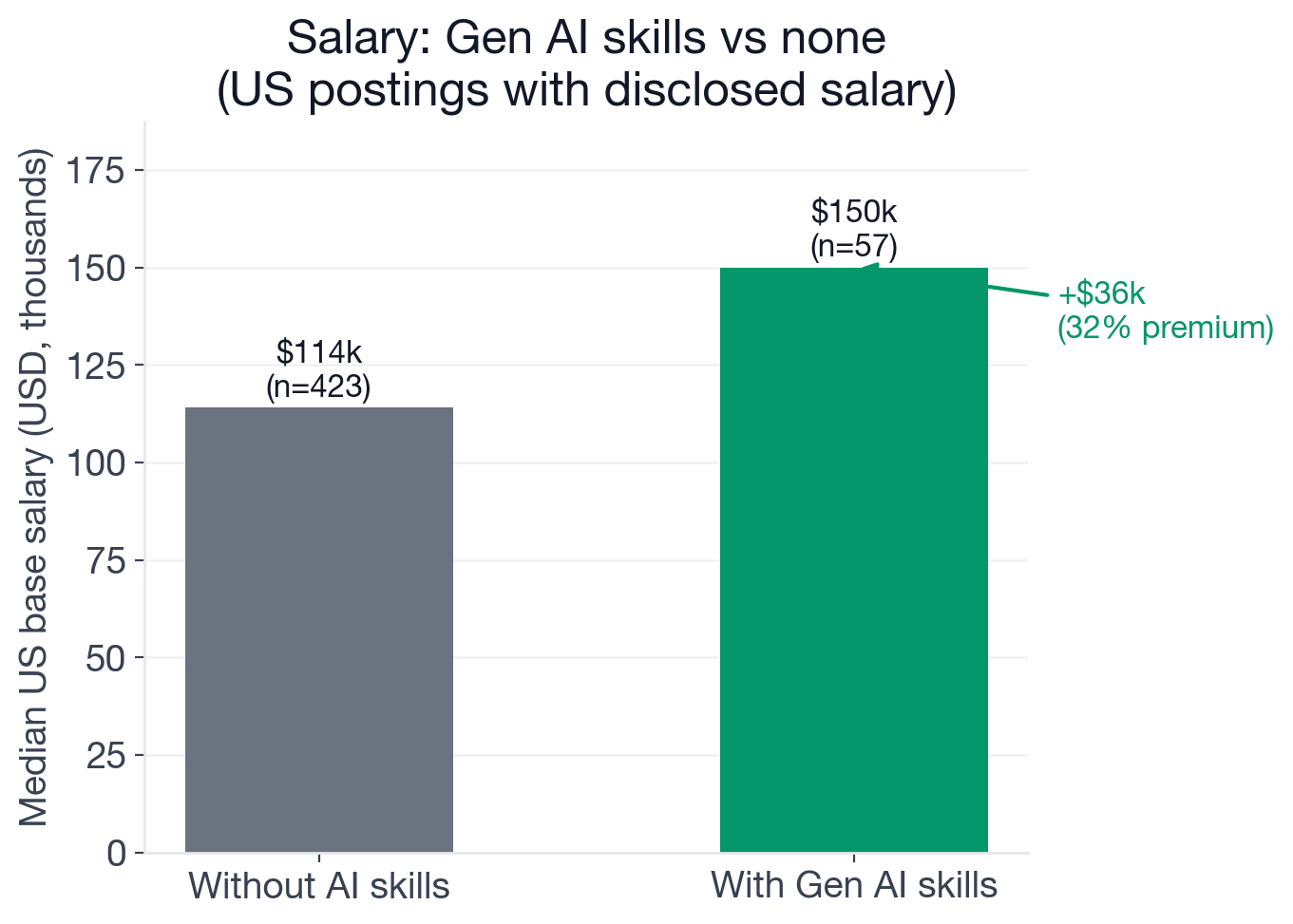
Median US base salary in USD for DevOps Engineer postings with and without new-wave AI skill requirements, among postings with disclosed salary. Base salary only; equity not included.
DevOps Engineer postings explicitly requiring new-wave AI skills show a median US base salary of $150,000 (n=57). Postings with no AI requirement show $114,000 (n=423). The $36,000 premium reflects what the market is attaching to engineers who can operate AI infrastructure alongside traditional cloud and container work.
Two important caveats. First, the AI group sample is n=57, which meets the minimum threshold for reporting but is smaller than the non-AI group. The direction of the gap is clear; treat the exact dollar figure as directional. Second, the premium is partly compositional: postings requiring AI skills also tend to be senior-level, at AI-forward product companies, and in higher-cost US markets, all of which push salaries up independently of the AI skill itself.
The practical read: specializing in AI infrastructure at the right seniority and company type puts you in the high end of the DevOps salary band. Adding "knows ChatGPT" to an otherwise traditional DevOps resume does not. The gap is real, but it comes from genuine infrastructure depth, not surface-level AI familiarity. Browse US DevOps Engineer openings that mention Machine Learning to see the kinds of roles where this premium materializes.
Who Is Leading the AI Shift in DevOps: Seniority, Industry, and Companies?
Seniority
The DevOps Engineer job market has an unusual shape: 68% of all postings are explicitly senior-level (2,419 of 3,556). Most tech roles cluster between 30% and 40% senior; DevOps sits nearly at double that. Production infrastructure experience is the entry requirement for most roles, and the entry-level door is nearly closed at just 1% of postings (35 of 3,556).
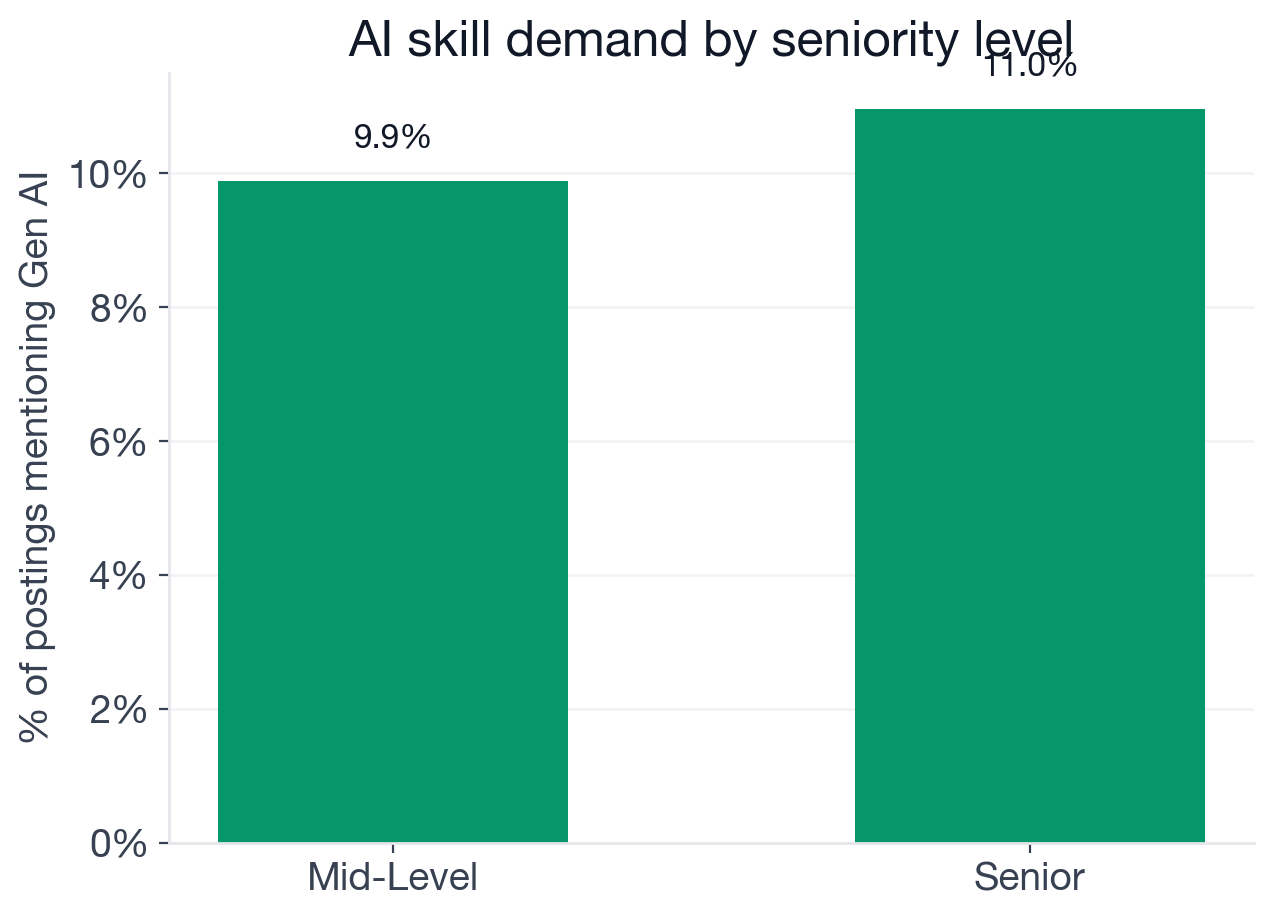
Share of postings at each seniority level that include at least one new-wave AI skill requirement.
AI requirements track the seniority curve closely. Senior roles show an 11.0% AI adoption rate (265 of 2,419); mid-level roles show 9.9% (88 of 890). The concentration at senior level makes sense: companies building AI infrastructure want engineers who can design it, not just operate it. If you are targeting senior DevOps Engineer openings, AI infrastructure familiarity is increasingly part of what separates a strong from a marginal candidate.
Industry
Software companies and fintech firms are driving adoption; consulting trails significantly.
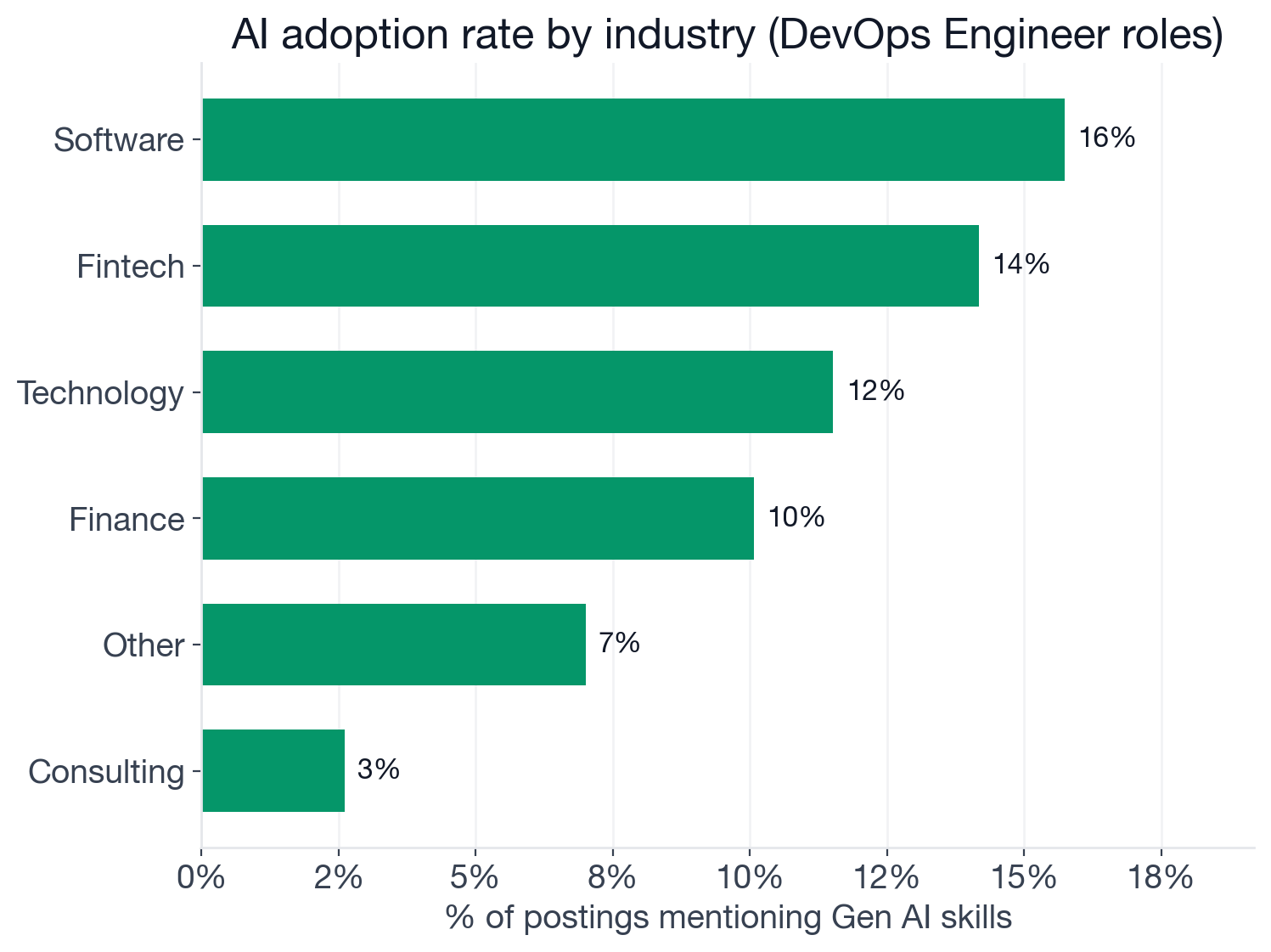
Share of DevOps Engineer postings in each industry that include at least one new-wave AI skill requirement.
Software companies show the highest AI adoption rate at 15.7% (48 of 305 software-industry DevOps postings). Fintech follows at 14.2% (19 of 134). General technology firms sit at 11.5% (47 of 408). Consulting lags at 2.6% (3 of 115), a direct reflection of the client-driven model: consulting firms build what clients request, and most enterprise clients are still asking for traditional DevOps. Software-first companies setting their own product roadmaps are moving much faster.
Companies
Among companies whose DevOps postings show the highest AI concentration, Workato (enterprise workflow automation), Salesforce, Cohere (an AI foundation model company), and Cloudelligent (a cloud-native consultancy) each have 100% AI adoption across their DevOps postings (ranging from 5 to 9 postings each, so treat these as directional signals rather than large-scale measurements). NICE Ltd., which builds contact-center and AI-powered CX software, is at 46% AI across 13 postings. ING, the Dutch bank, illustrates the large-enterprise adoption pattern: 35 DevOps postings with a 14.3% AI rate, consistent with a major financial institution building AI infrastructure at a measured but deliberate pace.
How to Use This in Your DevOps Engineer Job Search
The data draws a clear line between two trajectories for DevOps Engineers in 2026. The first is traditional cloud and container infrastructure: essential, high-demand, and well-compensated, but not where the salary premium or the role transformation lives. The second is AI infrastructure: agent runtimes, model serving, vector search, and MLOps pipelines, where both the premium and the long-term career upside are larger.
If you are targeting the second trajectory, the posting data points to where to start. MLOps and AI Agents are the two highest-frequency new-wave entries. Start with MLOps if you have existing context in ML pipeline work (model registries, deployment tooling, drift monitoring). Start with AI Agents if your background is more API-driven and you are already managing microservices and distributed systems at scale. The InterviewStack.io question bank covers the system design and distributed systems topics that show up consistently in senior DevOps rounds, including the infrastructure design patterns that underlie agent and LLM serving architectures.
For interview practice, AI mock interviews let you run through the infrastructure design and incident-response scenarios that senior DevOps interviews emphasize, with on-demand feedback. Interactive courses cover the cloud architecture and system design foundations that sit underneath both traditional DevOps and AI infrastructure work. The gap between where most DevOps engineers are today and where AI-forward companies need them is still wide enough that investing in this layer now has a measurable payoff. Browse active DevOps Engineer openings on the job board and filter by AI skill to match your target trajectory.
FAQ
Q. What percentage of DevOps Engineer postings require AI skills in 2026?
Across 3,556 active DevOps Engineer postings analyzed in May 2026, 18.2% (648) ask for at least one AI skill of any kind. Of those, 10.3% (367) explicitly require new-wave generative AI tools such as AI Agents, LLMs, or Generative AI. That figure measures engineers hired to build or operate AI systems; ambient AI tool use is now a baseline expectation that most employers assume without stating it.
Q. Which AI skills appear most often in DevOps Engineer job postings?
Machine Learning leads at 9.5% of all DevOps Engineer postings (339 of 3,556), followed by AI Agents at 4.9% (176), Generative AI at 2.8% (101), LLMs at 2.8% (99), and MLOps at 2.7% (97). These skills predominantly appear in postings asking engineers to build and operate the infrastructure that AI products run on: model pipelines, agent execution environments, vector databases, and LLM serving infrastructure.
Q. How much more do DevOps Engineers with AI skills earn in 2026?
Among US postings with disclosed salary analyzed in May 2026, DevOps Engineer postings requiring new-wave AI skills show a median US base salary of $150,000 (n=57), compared to $114,000 for postings without AI requirements (n=423). That is a $36,000 premium. These are base salaries only; equity, bonuses, and sign-on are not captured in posting disclosures, so total compensation at top employers is higher.
Q. Which industries are adding AI requirements to DevOps Engineer postings fastest?
Software companies lead with a 15.7% AI adoption rate in their DevOps postings (48 of 305). Fintech follows at 14.2% (19 of 134) and general technology firms at 11.5% (47 of 408). Consulting lags at 2.6% (3 of 115), reflecting a client-driven model where AI integration is led by product companies, not services firms.
Q. Is the DevOps Engineer role becoming more AI-focused over time?
Yes, at two levels. At the explicit level, 10.3% of postings now require new-wave AI skills, up from near zero three years ago. At the ambient level, the 2026 Perforce State of DevOps report found 87% of DevOps professionals expect AI to shift their role from scripting toward system design and directing outcomes, signaling a structural change in how the work is done, not just which tools appear in listings.
Q. What seniority level sees the most AI requirement in DevOps postings?
Senior-level roles show the highest absolute count of AI postings at 265 of 2,419 senior postings (11.0% AI rate). The DevOps Engineer market is unusually senior overall: 68% of the 3,556 postings analyzed are explicitly senior-level, compared with a more typical 30-40% senior share for most tech roles. AI requirements track that seniority curve, with mid-level roles close behind at 9.9%.
Q. Do DevOps Engineers need to learn AI tools even if their posting does not mention AI?
Yes. The 10.3% figure captures postings where building AI infrastructure is an explicit requirement. The ambient layer is much larger: the 2025 DORA report found 90% of software development professionals use AI in their daily work, and the JetBrains 2025 Developer Ecosystem Survey found 85% of developers regularly use AI tools for coding. For DevOps specifically, AI-assisted IaC, pipeline debugging, and incident triage are increasingly assumed, not stated.
Final Thoughts
DevOps Engineering in 2026 is a role being pulled forward by AI faster than job posting language reflects. The 10.3% explicit-requirement figure captures only the companies that have already crossed the line into building AI infrastructure. The 90% ambient usage figure, and the 87% of practitioners expecting a role transformation, tell the rest of the story. The productive framing is not "does my role need AI" but "at what depth": every DevOps Engineer needs to use AI tools fluently; a growing share need to build and operate the systems those tools run on.
Topics
Ready to practice?
Put what you've learned into practice with AI mock interviews and structured preparation guides.