
AI Went Into the Firmware Before It Got Into the Job Ads
Scan the 2,128 active Embedded Developer postings on the InterviewStack.io job board and the explicit AI signal is modest: 4.8% of postings require new-wave generative AI skills, and 10.6% require any form of AI at all. Those numbers do not describe a role in the middle of a major transformation.
Except they do. A 2025 RunSafe Security survey of more than 200 embedded professionals in the US, UK, and Germany found that 80.5% already use AI tools for code generation, testing, or documentation. More strikingly: 83.5% have deployed AI-generated code into production embedded systems, including medical devices, automotive platforms, and industrial control systems. The job postings and the survey respondents are describing two entirely different realities.
This gap is wider for embedded development than for nearly any other engineering discipline. Software engineers, cloud engineers, and product designers all show a notable spread between explicit posting requirements and ambient tool usage. For embedded developers, the gap is roughly 76 percentage points, likely the widest in engineering. The field has absorbed AI productivity tools while the job descriptions have barely noticed, because in embedded development, the discipline has always been defined by what you understand about the hardware, not what you type into the editor.
Key Findings
- 2,128 active Embedded Developer postings analyzed on the InterviewStack.io job board in June 2026.
- 4.8% of postings (103 of 2,128) explicitly require new-wave generative AI skills such as ChatGPT, LLMs, AI Agents, or Generative AI. Traditional ML and Deep Learning add 6.8%, for 10.6% with any AI requirement.
- 80.5% of embedded developers report using AI tools for code generation, testing, or documentation, with zero survey respondents reporting they avoid AI entirely (RunSafe Security 2025, 200+ professionals).
- 83.5% have deployed AI-generated code to production embedded systems, including safety-critical platforms (RunSafe Security 2025).
- Machine Learning is the most-demanded explicit AI skill at 5.4% (114 postings), reflecting on-device inference demand rather than cloud LLM integration.
- The US baseline salary is $152,500 across 590 postings with disclosed US base salary. No statistically reliable AI salary premium is detectable in the current data.
- 71.3% of postings target senior engineers (1,518 of 2,128); entry-level is 4.7%, making embedded development one of the most senior-skewed roles on the board.
- 93.5% of embedded developers expect their AI usage to increase over the next two years (RunSafe Security 2025).
(Dataset note: The "Embedded Developer" category on the InterviewStack.io job board captures firmware and embedded software engineers alongside hardware design engineers, electronics engineers, and FPGA engineers, consistent with how the embedded discipline is recruited in practice. AI adoption figures represent the embedded-hardware ecosystem broadly rather than firmware-only roles.)
What Did Embedded Development Look Like Before Generative AI?
In 2022, the core job was exactly what it had been for a decade: write C or C++ for a microcontroller, understand the real-time operating system constraints, integrate hardware peripherals, and debug problems that were difficult to reproduce because they involved specific timing on specific silicon. The discipline rewarded deep, narrow expertise. Knowing a specific MCU family (ARM Cortex-M, STM32, NXP i.MX, TI AM series) and its toolchain was worth more than breadth.
What was changing by 2022 was narrow in scope: edge AI, specifically running inference on power-constrained hardware with no cloud connection. TensorFlow Lite and PyTorch Mobile were getting traction for keyword detection, camera-sensor image classification, and vibration-anomaly detection on industrial equipment. This was the domain of ML engineers with embedded backgrounds, not of the typical firmware engineer.
The developer tooling was largely pre-AI. GitHub Copilot launched in late 2021, but C/C++ support in the embedded-specific IDEs (IAR Embedded Workbench, STM32CubeIDE, MCUXpresso) was minimal compared with its Python and JavaScript integration. ChatGPT did not exist. The idea that AI tools would help write interrupt service routines, HAL drivers, or RTOS task scaffolding at scale was still speculative.
Two Populations Hide Inside That 10.6%
Nearly nine out of ten embedded developer postings still require no AI skills at all. The 10.6% that do break into two genuinely different groups.
The first group (6.8% of postings) continues the edge AI tradition that predates the LLM era. They want engineers with Machine Learning (5.4%), Deep Learning (1.8%), and occasionally Transformer Models (0.28%) experience for on-device inference work. Think automotive sensor fusion, industrial anomaly detection, computer vision on a low-power camera module, or keyword spotting on a microphone array. The core competency here is model optimization for constrained hardware: quantization, pruning, ONNX conversion, and deployment through platform-specific toolkits like NXP's eIQ, STMicro's X-CUBE-AI, or Arm's Ethos NPU SDK. This work has appeared in embedded developer postings since 2019.
The second group (4.8%) reflects the newer wave: ChatGPT (1.9%), AI Agents (1.0%), Generative AI (0.75%), LLMs (0.56%), LLM Fine-Tuning (0.56%), and AI-Assisted Development (0.47%). These are roles where the embedded product is designed to incorporate or interface with generative AI components, where the device connects to LLM APIs, or where the team explicitly wants developers who can work with agentic frameworks at the hardware level. Some are IoT products adding AI assistants; some are edge inference platforms running quantized small language models locally.
The 89.4% that require neither are not lagging. They're just not writing it in the ad.
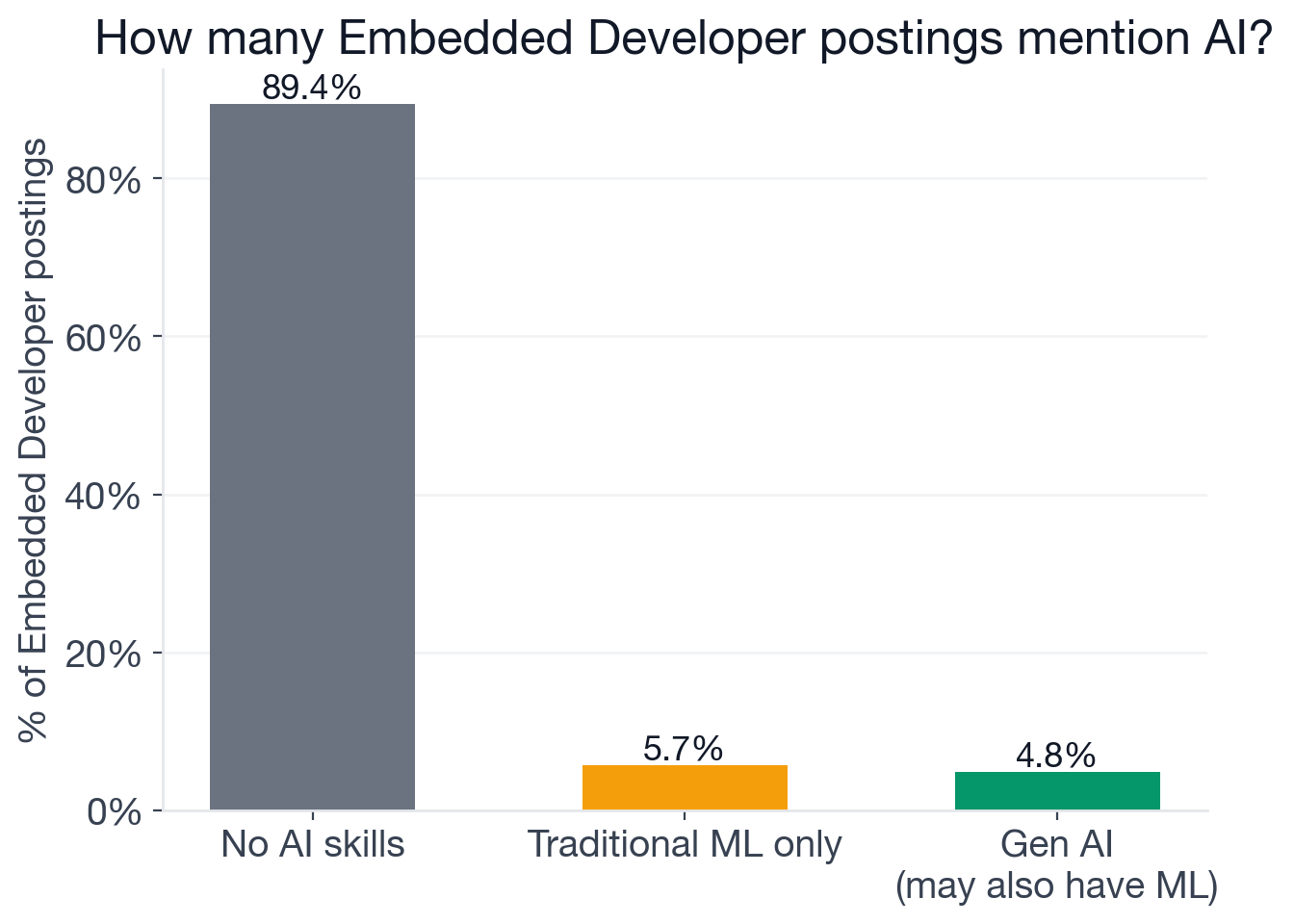
Breakdown of 2,128 Embedded Developer postings by AI requirement type. The majority carry no explicit AI requirement, but RunSafe Security survey data shows ambient AI tool usage runs at 80.5% across the field regardless of what postings say.
Which AI Skills Are Appearing in Embedded Developer Postings?
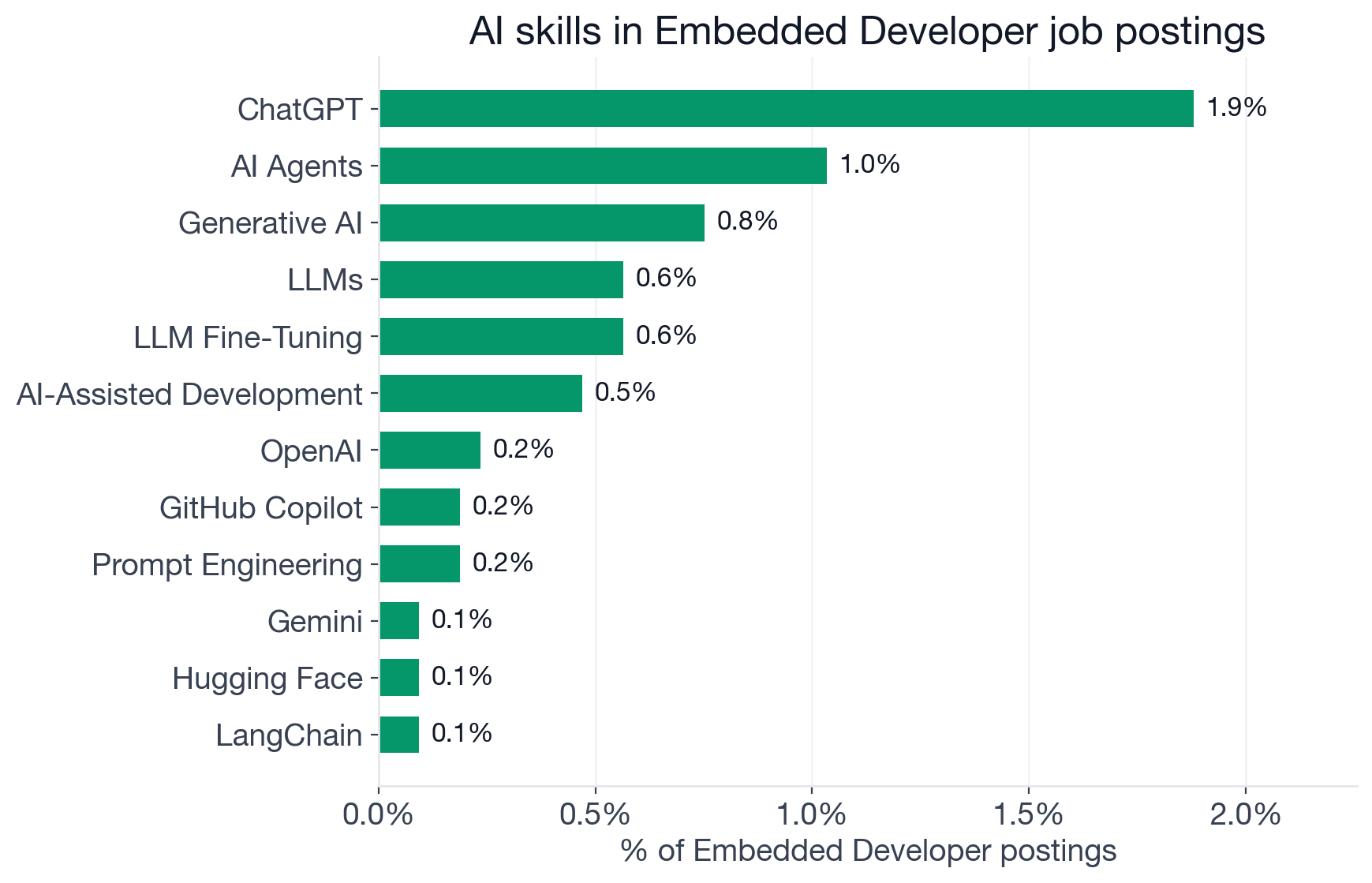
Percentage of 2,128 Embedded Developer postings that mention each AI skill. Traditional ML and Deep Learning dominate by volume; new-wave generative AI tools form a smaller but distinct and growing layer.
The ranked list carries more signal when you read it for what each skill actually signals in context:
Machine Learning (5.4%) is almost entirely the edge inference tier: companies building products where a model runs on the device. The hiring need is for an engineer who can take a trained model and make it fit inside a system with 256 KB of RAM and no GPU, not someone who trains models from scratch.
ChatGPT (1.9%) is the highest-volume new-wave entry. When a posting author reaches for "ChatGPT" as a job requirement, they usually mean general AI fluency and comfort working with LLM APIs, not ChatGPT specifically. It is a shorthand for "has engaged with generative AI in a professional context."
AI Agents (1.0%) represents a more architecturally specific shift: embedded systems being designed to host, coordinate, or interface with AI agent frameworks. This is relatively new and concentrated in robotics, smart-home platforms, and connected industrial equipment.
AI-Assisted Development (0.47%) and GitHub Copilot (0.19%) are the most revealing absences. These are the ambient tools that 80.5% of embedded developers use, yet only a fraction of postings name them. Employers do not list "uses a debugger" as a job requirement either. The assumption of Copilot for C/C++ productivity is now baked into what "an experienced embedded developer" means in practice.
Salary: What the Data Reveals and What It Can't
All salary figures here are US base salary only. Equity, bonuses, and sign-on are not disclosed in job postings and are not in our data; total compensation at top employers is meaningfully higher than these numbers.
The US median baseline for Embedded Developer postings is $152,500 across 590 postings with disclosed salary. That is already a strong figure by any engineering benchmark, reflecting the combination of hardware expertise, real-time systems knowledge, and the difficulty of replacing experienced embedded engineers on a short timeline.
There is no statistically reliable US salary premium for AI skills in the current data. Only 16 US postings with new-wave AI requirements disclose salary (below the 25-posting minimum needed for a defensible median). The global figures tell a similar story: postings with any AI requirement show a median of $145,000 across 69 samples, compared with $146,400 across 680 postings without AI requirements. The slight inversion is noise at these sample sizes, but the direction is consistent: AI skill requirements in embedded developer postings are not currently generating a measurable compensation premium.
This is the opposite of what we see in UX Designer or Cloud Engineer postings, where AI skill requirements carry $30K-40K salary signals. The most likely explanation mirrors the ambient usage gap. When 80.5% of embedded developers already use AI tools, AI tool fluency is a baseline expectation rather than a differentiator worth pricing. What does remain scarce and expensive to replace is the hardware depth itself: RTOS internals, low-level signal processing, silicon bring-up, safety-certification experience. Those competencies drive the $152,500 baseline, and adding AI skills on top has not yet moved the market.
Who Is Posting AI-Required Roles, and at What Level?
By seniority: AI requirements appear at roughly comparable rates across all experience levels, ranging from 1.9% at junior level to 5.1% at senior. Entry-level runs at 3.0% and mid-level at 4.7%; staff-level is at 4.4%.
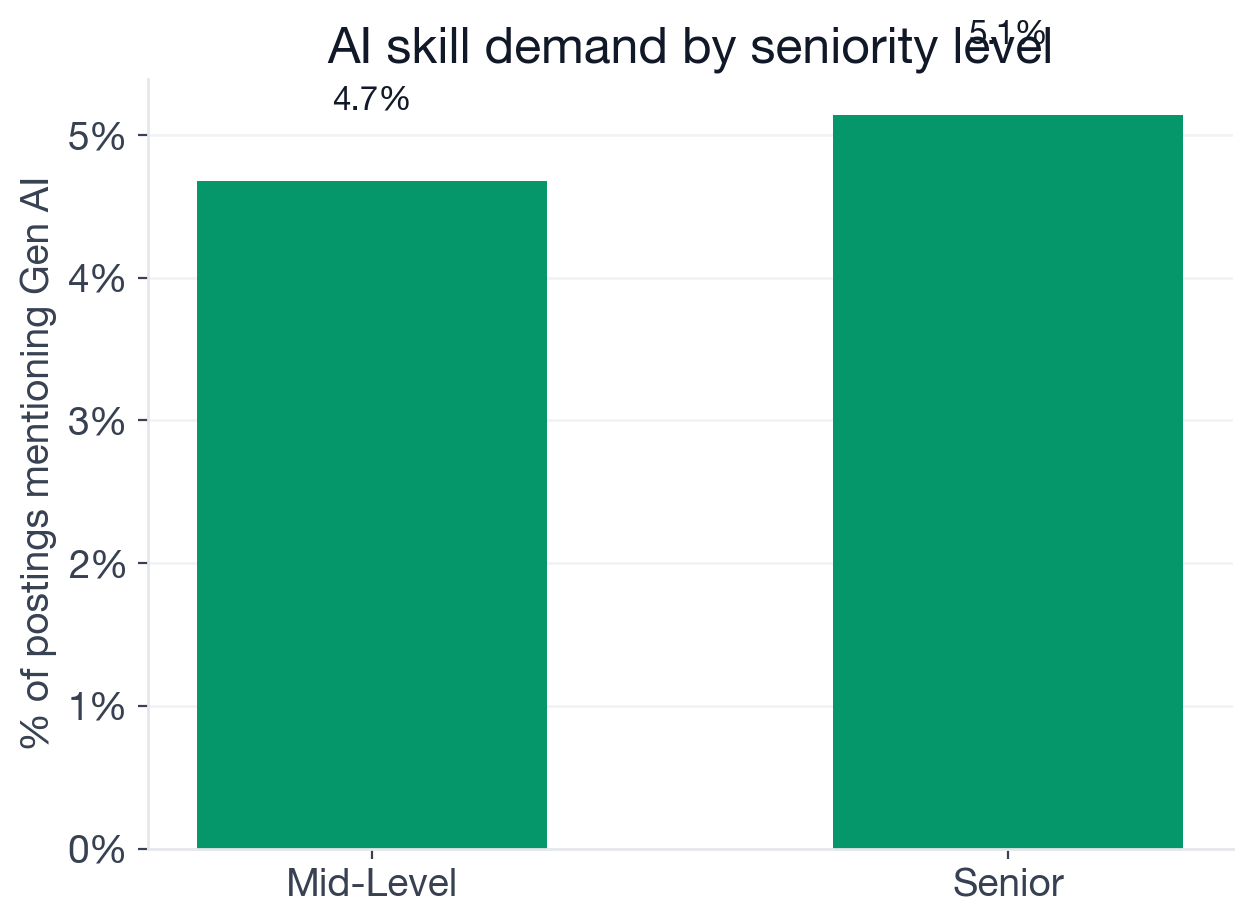
Seniority distribution and AI adoption rates across 2,128 Embedded Developer postings. The field skews heavily senior (71.3%), and AI requirements are distributed across levels without a strong concentration at any tier.
The flat AI distribution across seniority levels carries a practical message: this is not a field where AI skills open an entry-level on-ramp. The overwhelming majority of embedded developer openings, including AI-integrated ones, expect years of hardware and firmware experience as the foundation. The AI layer is additional depth on top of an already demanding core, not a substitute for it.
By industry: The contrast between sectors is substantial. Software product companies (the software industry category in the dataset, at 5.3% any-AI adoption) sit above the 4.8% new-wave baseline but still below the 10.6% field-wide any-AI rate: a pattern consistent with software embedded teams that mix edge-inference and some generative AI work, but haven't broadly pivoted to LLM integration. Aerospace and manufacturing run well below, reflecting the longer qualification cycles, stricter certification requirements, and safety standards (DO-178C, IEC 61508) that slow the introduction of AI-generated code into regulated systems. That said, the EU Cyber Resilience Act now in force and evolving guidance from standards bodies are beginning to formalize AI-assisted development practices in these sectors, so the gap will likely narrow over the next few years.
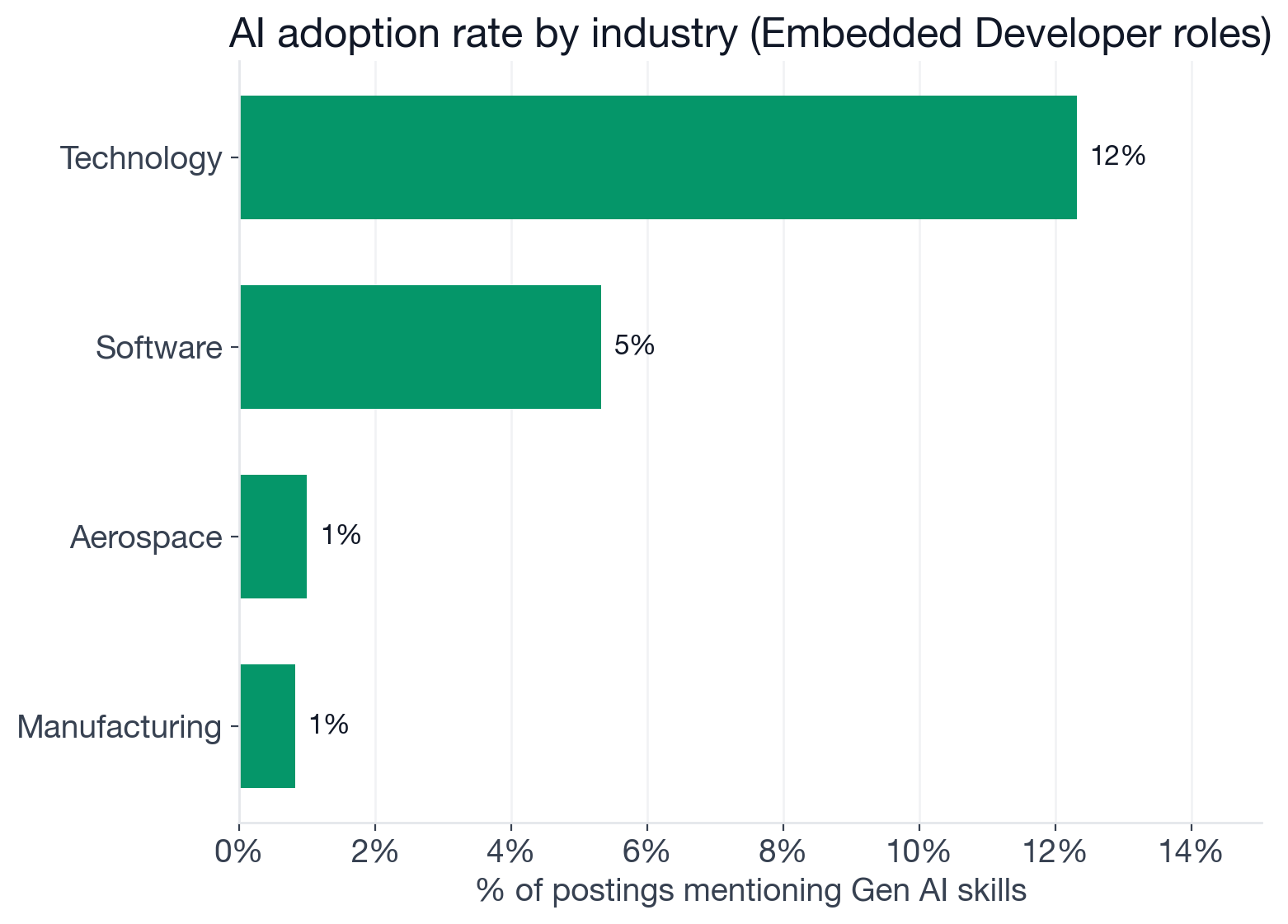
AI adoption rates by industry across Embedded Developer postings. The software sector (5.3%) is the cleaner cross-company signal for software-product embedded teams. The technology sector's figure is elevated by a single company's highly concentrated AI postings (68.6% of that sector's AI postings come from one firm) and is not representative of the technology sector broadly. Aerospace and manufacturing lag, consistent with stricter qualification requirements and longer certification cycles.
How to Use This in Your Job Search
The data tells a two-layer story, and how you present yourself should reflect both.
The ambient layer is now the baseline. If you are not already using AI tools in your embedded workflow, that is the first gap to close. Copilot in VS Code for C/C++, ChatGPT for interrogating datasheets and debugging timing issues, AI-assisted test generation for peripheral drivers: these are the tools the 80.5% are already using. The productivity gains are real, estimated at up to 55% on repetitive driver and protocol stack work, and the teams you're joining are already using them without advertising it. If you are not, you're at a disadvantage that is invisible in the posting but visible on day one.
The explicit AI layer is what moves you into the 10.6% of roles that pay for AI depth. The edge inference track (ML, Deep Learning, on-device model optimization) and the generative AI integration track (LLM APIs, AI Agents, device-level inference) require genuinely different preparation. If you want roles in the edge inference segment, build hands-on experience with TensorFlow Lite, ONNX, or vendor-specific SDKs on actual constrained hardware. If you want roles in the generative AI integration segment, get comfortable with LLM API integration and understand where latency and memory constraints interact with LLM deployment.
For interview preparation, the Embedded Developer question bank covers the core technical domains that still define the role: RTOS concepts, interrupt handling, memory management, hardware communication protocols, and debugging strategies. For roles that include ML or AI components, AI mock interviews let you practice explaining model optimization tradeoffs and embedded AI architectures under interview conditions. Our interactive courses cover ML fundamentals and systems programming concepts useful for the edge inference track.
If security is a concern for your target employers (it is for 53% of embedded developers with respect to AI code): preparation guides for aerospace, automotive, and defense companies cover security-focused technical screens where AI-assisted development review is increasingly on the table.
Browse current openings at the Embedded Developer job board. For roles explicitly building AI into products, the Machine Learning skill filter surfaces the edge inference segment directly. For the newer generative AI integration track, the Deep Learning filter and the AI Agents filter narrow to roles where inference architecture or agentic frameworks are on the job description.
FAQ
Q. How many Embedded Developer job postings explicitly require AI skills in 2026?
Across 2,128 active Embedded Developer postings analyzed in June 2026, 10.6% mention any AI skill (new-wave or traditional ML). New-wave generative AI skills appear in 4.8% of postings (103 of 2,128); traditional ML and deep learning appear in 6.8%. The majority of postings treat AI productivity tools as an assumed baseline rather than an explicit requirement.
Q. Are embedded developers actually using AI even when postings don't require it?
Yes, and at scale. The RunSafe Security 2025 survey of 200+ embedded professionals found that 80.5% already use AI tools for code generation, testing, or documentation, and 83.5% have deployed AI-generated code to production embedded systems. Only 4.8% of active job postings list generative AI as an explicit requirement, making this one of the widest gaps between ambient tool usage and formal posting requirements across engineering disciplines.
Q. Which AI skills appear most often in Embedded Developer job postings?
Machine Learning appears in 5.4% of Embedded Developer postings (114 of 2,128), the most common AI skill by volume. Among new-wave generative AI tools, ChatGPT appears in 1.9% of postings (40), followed by AI Agents at 1.0% (22), Generative AI at 0.75% (16), LLMs and LLM Fine-Tuning each at 0.56% (12), and AI-Assisted Development at 0.47% (10).
Q. Is there a salary premium for Embedded Developers with AI skills in 2026?
Not a measurable one in the current data. The US baseline median for Embedded Developer postings is $152,500 (590 postings with disclosed US base salary; equity and bonus not included). Too few US postings with new-wave AI requirements disclose salary to compute a statistically reliable premium (n=16, below the 25-posting threshold). Globally, postings with any AI requirements show a median of $145,000 versus $146,400 without, suggesting core embedded expertise is the real compensation driver rather than AI skills layered on top.
Q. What seniority level do Embedded Developer roles target in 2026?
Embedded Developer is a deeply senior-skewed field: 71.3% of postings target senior engineers (1,518 of 2,128), with mid-level at 16.1%, staff at 5.4%, and entry-level at just 4.7%. AI-requiring postings follow a similar distribution, with AI adoption rates of roughly 3 to 5% across all seniority levels.
Q. Where are Embedded Developer jobs concentrated geographically?
The United States is the largest single market at 46.4% of postings (988 of 2,128), followed by India at 8.1%, Taiwan at 5.5%, Canada at 4.6%, and the UK at 4.0%. Among US postings, 4.5% include AI requirements. Canada's AI adoption rate is notably higher at 8.2% of its 97 postings.
Q. What is the biggest AI-specific challenge for embedded developers?
Security. The RunSafe Security 2025 survey found 53% of embedded developers cite security as their primary concern with AI-generated code, and 73% rate cybersecurity risk from AI tools as moderate or higher. Embedded systems run on medical devices, automotive platforms, and industrial control systems where a code defect has different consequences than in web applications. The EU Cyber Resilience Act adds a compliance layer that makes AI-code review a genuine engineering discipline for embedded teams.
The Ground Truth for Your 2026 Job Search
The embedded developer market in 2026 is not a field deciding whether to adopt AI. It already has, at 80.5% ambient usage with the job descriptions quietly three steps behind. What the 10.6% of AI-explicit postings measure is narrower: companies that need someone to build intelligence into the hardware, not just use AI tools to ship the hardware faster. Both layers matter, but they call for different preparation. Nail the embedded fundamentals that make you hard to replace, build familiarity with the AI productivity tools the field now assumes, and develop the edge-AI or generative-AI depth that the explicit segment demands, if that is where you want to go. The posting may not say "use Copilot." The team will.
Topics
Ready to practice?
Put what you've learned into practice with AI mock interviews and structured preparation guides.