
The Defender's Dilemma: AI Is Both Tool and Adversary in 2026
The information security role has always had an asymmetric quality: defenders must get everything right, attackers need only one opening. AI has sharpened that asymmetry in both directions.
On one side, security teams are deploying AI as a force multiplier. Microsoft Security Copilot, integrated into Microsoft Defender XDR and Sentinel, brings AI-assisted triage, threat hunting, and policy automation to a growing share of security operations centers. Fifty-five percent of security teams are already running AI copilots in production for alert triage and investigation, per the Cybersecurity Insiders 2025 Pulse of the AI SOC Report. On the other side, adversaries are using the same technology to generate more convincing phishing campaigns, automate vulnerability scanning, and accelerate exploit development.
Job postings capture only one slice of this shift. Across 4,862 active Information Security Analyst listings on the InterviewStack.io job board, just 3.0% explicitly require new-wave generative AI skills. That narrow figure measures analysts hired to build, secure, or govern AI systems; it says nothing about the ambient AI layer already inside most security operations centers. Gartner's top cybersecurity trends for 2026 found 77% of organizations are already running generative AI or LLMs in their security stack, and ISC2's 2025 Cybersecurity Workforce Study found 69% of cybersecurity professionals actively engaged in AI adoption.
Key Findings
- 3.0% of Information Security Analyst postings explicitly require new-wave AI skills (148 of 4,862 analyzed), while 77% of organizations are already running generative AI in their cybersecurity stack (Gartner 2026).
- AI Agents is the leading new-wave AI skill, appearing in 1.6% of postings (79), ahead of LLMs (1.0%, 51 postings) and Generative AI (1.0%, 48 postings).
- Machine Learning leads all AI skill categories at 2.6% of postings (127), reflecting a five-plus-year baseline in behavioral analytics and threat detection.
- Senior roles show the highest reliable explicit AI rate at 3.4% (103 of 3,059 postings); the entry-level rate is nominally higher at 3.48% but rests on just 7 postings (too sparse for confident interpretation). Staff-level roles sit at 0.72% (3 of 418), placing hands-on AI work at the senior IC level.
- Technology sector leads industry AI adoption at 7.7% (21 of 272 postings), followed by finance at 5.7% and software firms at 5.0%; cybersecurity firms sit at 4.6% and the security services sector at 0%.
- US postings sit at 1.8% explicit AI rate (40 of 2,268), well below India's 6.8% (24 of 354) and Canada's 4.7% (9 of 190); the UK and Australia run even lower, consistent with English-speaking markets assuming AI fluency rather than listing it.
- The US non-AI baseline median salary is $70,000 (n=1,160 US postings with disclosed salary); note that the broad role classifier captures some physical security officer postings that likely compress this below the cybersecurity-analyst market rate. The US AI-skills subsample falls below the reporting threshold (n=23), but globally, AI-requiring postings show a $40,542 premium.
- 69% of cybersecurity professionals are engaged in AI adoption (ISC2 2025), and 55% of security teams deploy AI copilots in production, making operational AI fluency a baseline expectation at every level.
The Role Before 2023
Three to four years ago, the Information Security Analyst toolkit was largely rule-based. SIEMs (Security Information and Event Management platforms) like Splunk and IBM QRadar aggregated logs; analysts tuned alert rules and triaged the resulting noise by hand. Threat intelligence meant subscribing to feeds, running correlation queries, and writing incident reports. Vulnerability management meant running a scanner, reviewing the output against patch schedules, and escalating to systems teams.
The work was manual, alert-heavy, and chronically understaffed. The cybersecurity workforce gap, documented annually by ISC2, runs to millions of unfilled roles globally, a shortage driven in part by the sheer volume of alerts no human team can process at scale.
Machine learning had already begun changing detection. Behavioral analytics platforms used anomaly detection to surface threats that signature rules missed. But these were largely vendor-embedded models; analysts consumed ML-generated outputs rather than building or tuning them. Writing detection logic in Python, querying a vector database, or evaluating an LLM prompt for injection risk were not in scope for most roles.
The AI era has since added a second job description on top of the first: understand what the AI tools are doing, catch where they go wrong, and know what attackers are doing with the same technology.
How Many Postings Actually List AI as a Requirement?
Five point one percent of postings mention some form of AI, splitting almost evenly between new-wave generative AI tools (3.0%) and traditional machine learning (2.6%), with a small overlap of postings that require both (0.64%).
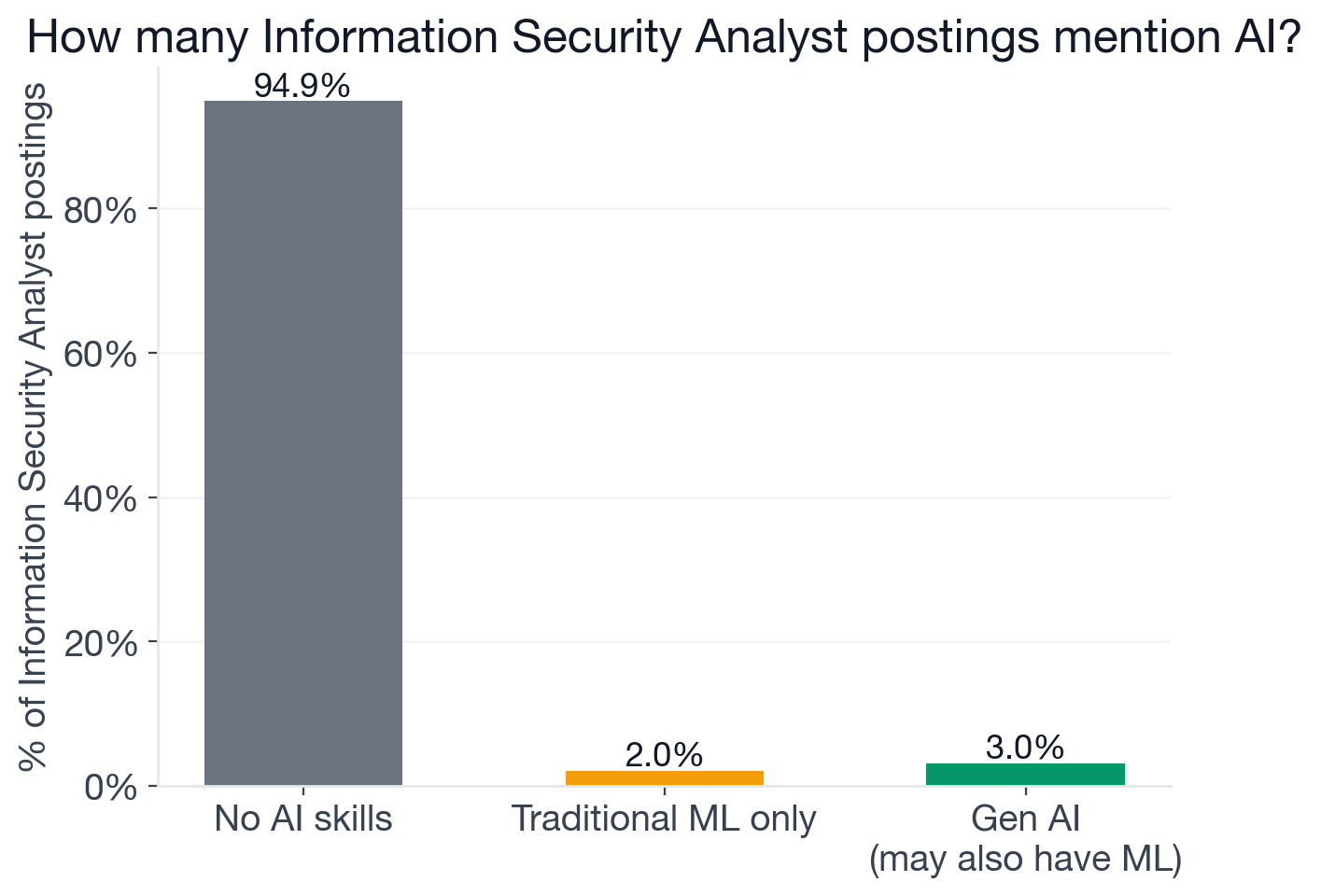
95% of Information Security Analyst postings list no explicit AI requirement; the 5% that do split roughly evenly between generative AI tools and traditional machine learning (4,862 active listings analyzed).
The 3.0% new-wave figure is low compared to roles like Data Scientist or DevOps Engineer, but it is not evidence that AI has not arrived in security. It is evidence that most employers are not yet writing "generative AI required" into security job descriptions, even as they deploy those tools across their operations. The gap between explicit mention (3%) and operational deployment (77%) is wider for this role than for almost any technical function.
The reason is structural. A Security Operations Center deploying Microsoft Security Copilot does not need its analysts to have built an LLM. It needs them to interpret AI-generated triage, recognize when the model flags a false positive, and escalate intelligently. That skill is ambient: expected without being stated, the same way internet research was assumed in every 2005 help-desk posting without appearing in the job requirements.
Which AI Skills Are Appearing in Information Security Analyst Postings?
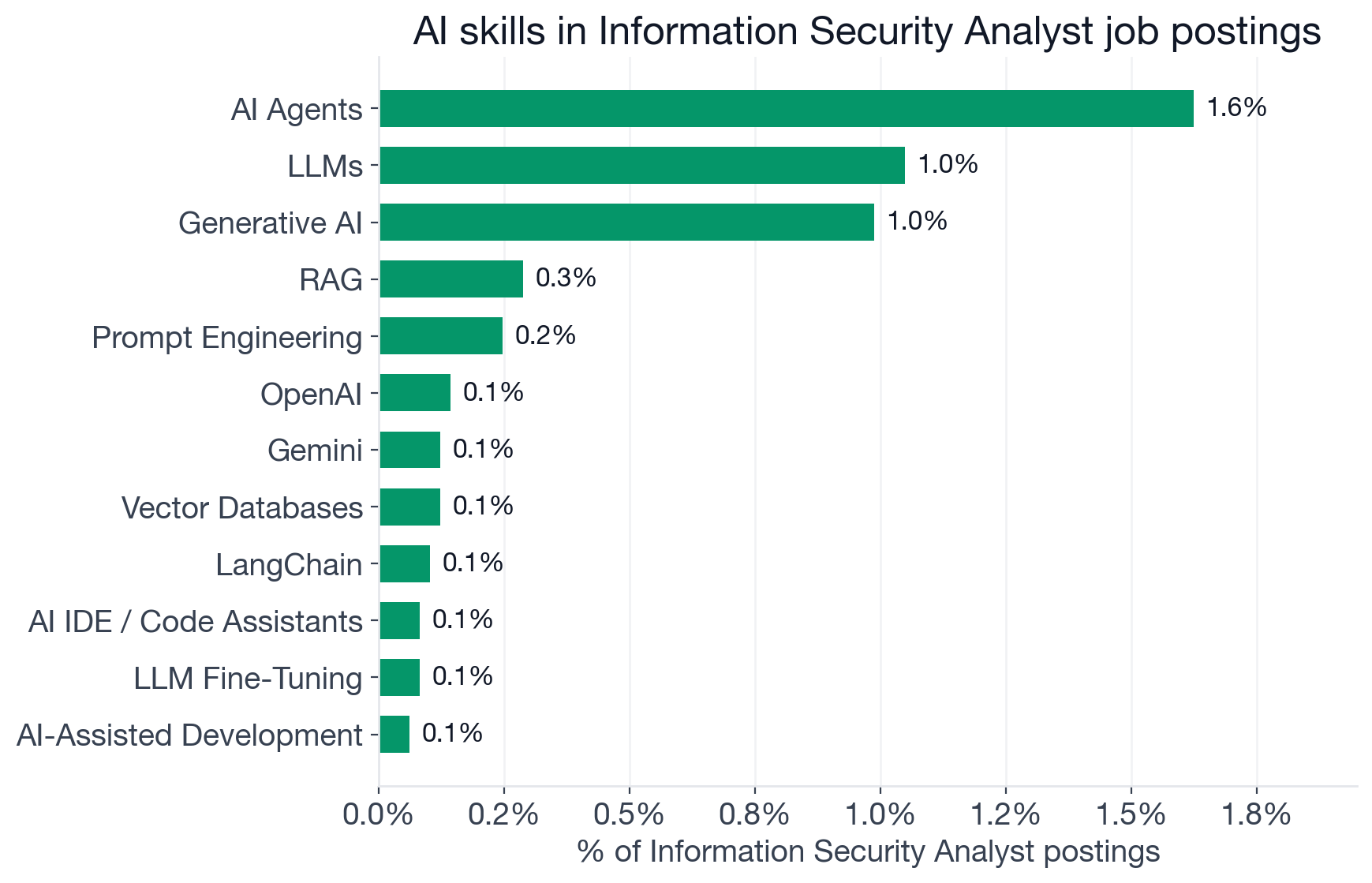
AI Agents leads new-wave skills at 1.6%, signaling demand for analysts who can govern autonomous systems; Machine Learning (2.6%) represents a longer-running baseline in threat detection work.
The skills divide into two pools with very different implications.
The traditional baseline. Machine Learning (2.6%, 127 postings) and Deep Learning (0.23%, 11 postings) have been in security postings for years, embedded in behavioral analytics, anomaly detection, and fraud modeling. Postings asking for ML skills often want someone who can work with vendors building detection models, not build them independently.
The new-wave shift. Among generative AI skills, AI Agents (autonomous AI systems that plan and execute multi-step tasks without direct human steering at each step) leads at 1.6% (79 postings). This is the clearest signal of where security is heading: organizations deploying agentic AI internally now need analysts who can assess the security posture of those agents, monitor for unexpected behavior, and govern their access to sensitive systems. LLMs (1.0%, 51 postings) and Generative AI (1.0%, 48 postings) follow. RAG (retrieval-augmented generation, a technique that grounds LLM responses in a private document corpus) appears in 0.29% of postings (14), and Prompt Engineering in 0.25% (12).
The tail is instructive. LangChain (an open-source framework for building LLM-powered applications) appears in just 0.1% of postings (5). This is a build-AI skill, not a secure-AI skill. What security employers want is analysts who understand the risks of AI systems, not necessarily analysts who can build them from scratch. Browse postings that ask for AI Agents specifically to see what that requirement looks like in practice.
Which Seniority Levels and Industries Show the Highest AI Demand?
Seniority tells a counterintuitive story.
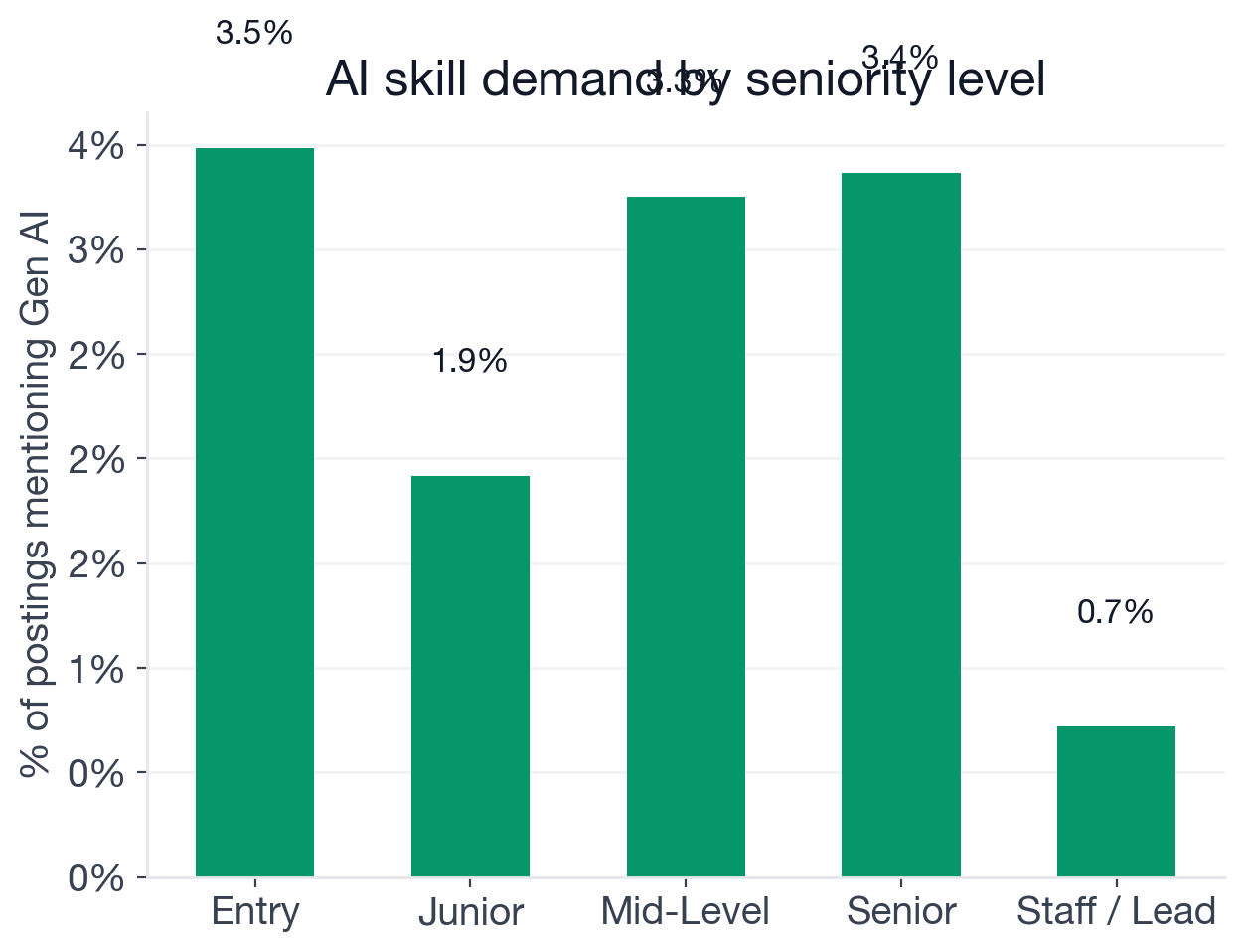
Hands-on AI requirements peak at the senior IC level (3.4%); staff and leadership roles sit near 0.7%, reflecting a governance and program focus over direct tool operation.
Staff-level roles (CISOs, directors, principal security architects) show the lowest AI rate in postings at just 0.72% (3 of 418). Senior individual-contributor roles show the highest reliable AI rate at 3.4%, with mid-level close behind at 3.3%; entry-level shows 3.48% (7 of 201) but that figure rests on just 7 postings and is not a reliable signal. The hands-on AI work is being assigned to senior ICs doing threat detection, incident response, and security engineering, not to organizational leadership. Staff-level security leaders are managing programs and governing risk; day-to-day AI tool operation does not surface in their job descriptions.
The read for career planning: if building hands-on AI security credentials is the goal, the senior IC track is where that credential carries the most weight in the current market.
Industry splits sharply between tech and traditional security.
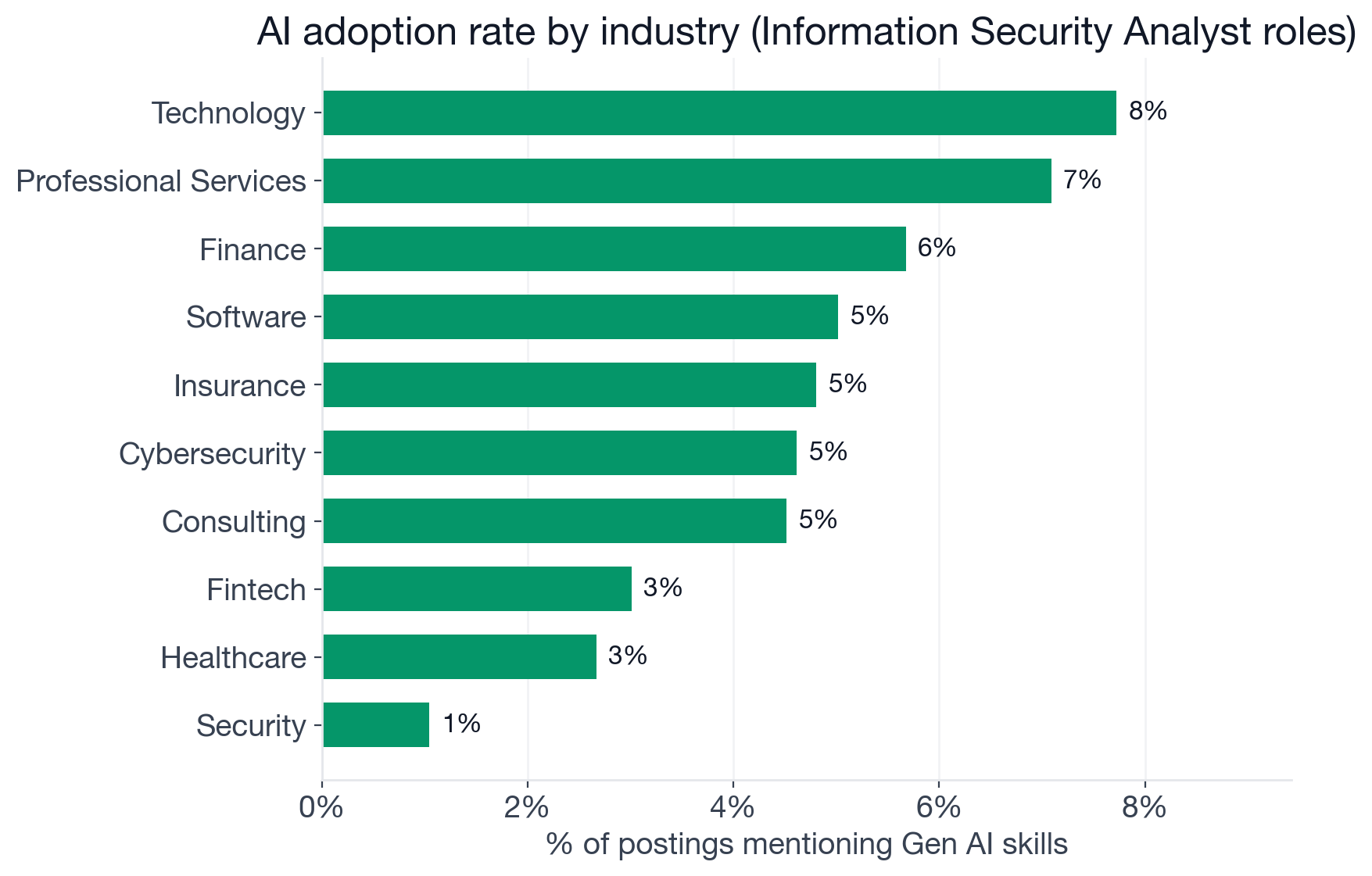
Technology employers are 1.35x more likely to list AI skills (7.7%) than financial services (5.7%); security services firms sit at 0%, marking the dividing line between cyber-focused and traditional employers. Professional services and consulting excluded as single-firm artifacts.
Technology leads at 7.7% (21 of 272), with finance (5.7%, 8 of 141), software firms (5.0%, 13 of 259), insurance (4.8%, 5 of 104), and pure-play cybersecurity companies (cybersecurity vendors, MSSPs, and SOC service providers) at 4.6% (9 of 195) close behind. The security services industry, which covers traditional guard and facilities companies, sits at 0%; those firms are not building AI-augmented SOC platforms. The separate security industry bucket (broader physical and corporate security operations) sits at 1.0% (2 of 191), distinct from the zero-AI security services category. Healthcare (2.7%) and aerospace (0.78%) reflect regulated environments where AI adoption in security operations moves cautiously. Fintech sits at 3.0% (5 of 166).
For job seekers actively pursuing explicit AI security credentials: technology and finance employers are the fastest path. For everyone else, AI fluency is already operational infrastructure, present in most security environments regardless of what the job description says.
What Salary Premium Do AI Skills Add for Information Security Analysts?
Salary figures here are US base salary only; equity, bonuses, and sign-on are not disclosed in postings and are excluded from all numbers.
The median US base for non-AI Information Security Analyst postings is $70,000 (n=1,160). A scope caveat applies: the role classifier captures the full security analyst family, and the title sample confirms that physical security officer roles (postings like "Security Flex Officer, Commercial Property" and "Overnight Mobile Security Officer") are present in the dataset. Physical and guard-services roles typically pay $40,000–$60,000 and likely pull the reported US median below what dedicated cybersecurity ISA postings would show in isolation. The $70,000 figure is best read as a broad-category floor rather than a midpoint for cybersecurity-focused positions. For postings that explicitly require new-wave AI skills, the US sample falls below the 25-posting minimum for reliable median reporting (n=23). That gap is itself informative: AI-requiring security roles are rare enough in US postings that the salary pool has not yet reached a reportable size.
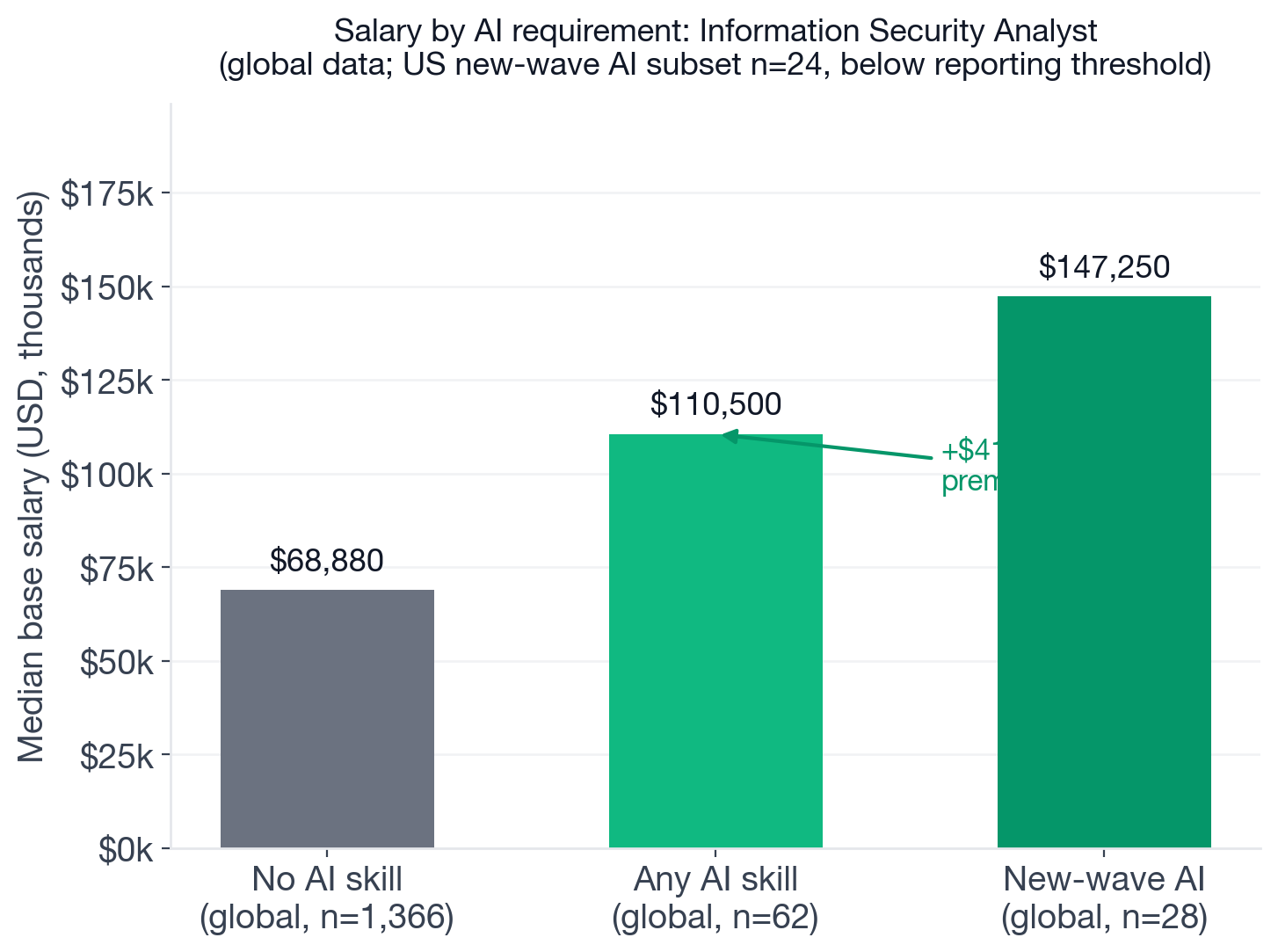
Median base salary for Information Security Analyst postings with and without AI skill requirements. US AI subset is below the reporting threshold; chart reflects global data.
Globally, postings that mention any AI skill show a median of $109,122 (n=62) versus $68,580 for non-AI postings (n=1,340), a $40,542 difference. These figures mix international markets and are not a direct comparison to US base compensation, but the direction is consistent with what appears across other technical roles: postings that explicitly require AI skills tend to be more technically specialized and pay at the upper end of the band.
The practical framing matters. The roles explicitly listing AI skills are largely senior, concentrated in tech and finance, and technically demanding overall. The salary gap reflects that seniority as much as the AI requirement itself. Building AI security expertise is a long-term credential investment, not a short-term salary lever.
How to Build Your AI Security Credentials
Two tracks, not one.
Track one: operational AI fluency. Most security teams are already using AI tools regardless of job description language. Getting proficient with AI-assisted alert triage, learning to evaluate AI-generated summaries for false positives, and recognizing where automated recommendations break down is the baseline for nearly any senior-level role today. This is not about earning a new certification; it is about knowing the tools already deployed in most enterprise environments.
Track two: AI security specialty. The 3% of postings that explicitly require new-wave AI skills are concentrated in technology, finance, and cybersecurity firms at the senior IC level. These roles ask analysts to assess AI agent behavior, model LLM security risks (prompt injection, data exfiltration through RAG pipelines), and govern organizational AI deployments. Building understanding of how LLMs work, how AI agents can be exploited, and what agentic architectures expose to an attacker is the path to these postings.
For preparation: browse open Information Security Analyst roles to see what current postings actually require. AI mock interviews let you practice threat modeling and incident response scenarios under realistic conditions. The question bank covers security architecture, risk analysis, and compliance topics for focused drilling. Interactive courses cover the ML and systems fundamentals that feed directly into AI security work. For company-specific interview processes in tech and finance, preparation guides break down what employers actually test in security rounds.
FAQ
Q. How much of the Information Security Analyst role now involves AI?
Explicitly, just 3.0% of Information Security Analyst postings analyzed require new-wave AI skills (148 of 4,862). The operational picture is wider: per ISC2's 2025 workforce study, 69% of cybersecurity professionals are already engaged in AI adoption, using tools like Microsoft Security Copilot, AI-driven SIEM and SOAR platforms, and AI-assisted threat research, regardless of what the job posting states.
Q. What is the top AI skill in Information Security Analyst job postings?
AI Agents is the leading new-wave AI skill, appearing in 1.6% of postings (79 of 4,862). This reflects growing demand for analysts who can secure, monitor, and govern autonomous AI systems deployed inside organizations. LLMs (1.0%, 51 postings) and Generative AI (1.0%, 48 postings) follow. Machine Learning, a traditional baseline, leads all AI skills at 2.6% (127 postings).
Q. Does using AI security tools require explicit AI skills to get hired?
In most cases, no. Employers running AI copilots and assistants in production rarely list AI as a requirement in the job description, the same way internet access was never listed as a skill in 2005. The 3% explicit figure measures roles where building, securing, or governing AI systems is a core responsibility. The 69% ISC2 engagement figure and 55% Cybersecurity Insiders deployment figure measure how broadly AI tools have already landed in real security teams.
Q. Which seniority level sees the most AI demand in InfoSec Analyst postings?
Senior individual-contributor roles show the highest reliable AI adoption rate in postings at 3.4% (103 of 3,059 senior postings); the entry-level rate is nominally higher at 3.48% (7 of 201), but rests on just 7 postings and is below the threshold for confident interpretation. Staff and principal roles are notably lower at 0.72% (3 of 418), likely because staff-level security leaders focus on governance, risk, and program management rather than hands-on AI integration. Mid-level roles sit at 3.3% and junior at 1.9%.
Q. Which industries are leading AI adoption for Information Security Analysts?
Technology companies lead at 7.7% AI adoption (21 of 272), with finance at 5.7% (8 of 141), software firms at 5.0% (13 of 259), insurance at 4.8% (5 of 104), and the cybersecurity industry at 4.6% (9 of 195). Security services firms show 0% AI adoption in postings, highlighting the split between traditional physical security companies and cyber-focused employers.
Q. What salary premium do AI skills add to Information Security Analyst roles?
The US new-wave AI subsample falls below the threshold for reliable median reporting (n=23 postings with disclosed US salary). The US baseline median for non-AI postings is $70,000 (n=1,160); note that the dataset's broad role scope includes physical security officer roles that likely compress this below the cybersecurity-specialist market rate: treat it as a broad-category floor, not a cybersecurity-analyst midpoint. Globally, postings requiring any AI skill show a median of $109,122 versus $68,580 for non-AI postings, a $40,542 directional premium; these figures mix international markets and are not directly comparable to US base compensation.
Both Sides of the Firewall, One Career Decision
The analyst who learned to use AI tools for triage last year is already ahead of most of the market. The analyst who understands how AI agents can be exploited is where the next wave of explicit job requirements is heading. These are not the same skill set, but they both start from the same foundation: engaging with how AI actually works rather than waiting for a job description to make it mandatory.
Current openings are at the InterviewStack.io Information Security Analyst board.
Topics
Ready to practice?
Put what you've learned into practice with AI mock interviews and structured preparation guides.