
The Stack Doubled. The Title Stayed the Same.
The prediction that circulated through 2023 and 2024 was tidy: "AI Engineer" would gradually absorb or displace "Machine Learning Engineer." The 2026 job-posting data tells a more complicated story. Looking at 3,849 active Machine Learning Engineer postings on the InterviewStack.io job board as of June 2026, the dominant pattern is not substitution but addition: 52.2% of postings now require both the traditional ML foundation and the new generative AI layer on top. The job got bigger. The title barely changed.
That 52.2% measures engineers expected to build AI systems at both levels: train and deploy models, and also orchestrate LLMs, design RAG pipelines, and wire up agentic workflows. It does not capture the ambient layer, the 90% of developers who use Copilot, ChatGPT, or Cursor regularly as part of how they work today, per JetBrains' January 2026 AI Pulse survey. For Machine Learning Engineers, that ambient baseline is arguably denser than for any other engineering discipline. The tools they help build, their colleagues now depend on daily.
The result is a job description that looks quite different from 2022. Here is what the data shows.
Key Findings
- 91.0% of ML Engineer postings (3,503 of 3,849 analyzed) require some form of AI expertise, reflecting the AI-native nature of the title.
- 55.8% explicitly require new-wave generative AI skills: LLMs, Generative AI, AI Agents, RAG, or vector databases.
- 52.2% require both traditional ML/deep learning AND new-wave generative AI simultaneously.
- Only 3.6% require generative AI with no traditional ML background, meaning the "pure AI Engineer" path is rare in MLE postings.
- Median US base salary for postings requiring new-wave AI skills: $152,000 (n=635 postings with disclosed salary).
- Staff-level roles show the highest new-wave AI adoption at 68.9%; senior roles dominate volume at 68.8% of all postings.
- LLMs appear in 30.0% of postings; AI Agents in 24.2%; RAG in 15.4%.
- 90% of developers regularly use at least one AI tool at work (JetBrains AI Pulse, January 2026), a floor that applies to ML Engineers regardless of what their posting says.
What the Job Looked Like Before the LLM Era
Three years ago, a Machine Learning Engineer posting had a stable, recognizable shape. The work was: build feature pipelines, train models using PyTorch or TensorFlow, evaluate them against held-out data, deploy them behind a REST API or batch job, and keep the system observable in production. MLOps (the discipline of versioning, monitoring, and governing the model lifecycle in production) was emerging as a specialty. Transformers existed as a research architecture. Large language models existed too, but GPT-3 was an API curiosity and "prompt engineering" was not a job skill.
LangChain launched in November 2022. ChatGPT launched six weeks later. The technical surface area for anyone working on ML systems expanded almost overnight. Suddenly, "deploy a model" had a second meaning: call a foundation model API, manage context windows, route outputs through a retrieval step, and monitor for drift in a system where the underlying model is a moving target controlled by a vendor. Agentic AI, the pattern where an LLM reasons through sequences of actions using external tools, created an entirely new engineering discipline with no established playbook.
What did not disappear: the underlying ML engineering work. Recommendation systems, computer vision, fraud detection, and search ranking still run on trained models. They still need feature pipelines, gradient descent, cross-validation, and latency budgets. Deep Learning remains in 50.6% of current ML Engineer postings. MLOps shows up in 32.3%. The 2022 job description was not archived. It was extended.
What Are Companies Explicitly Requiring Now?
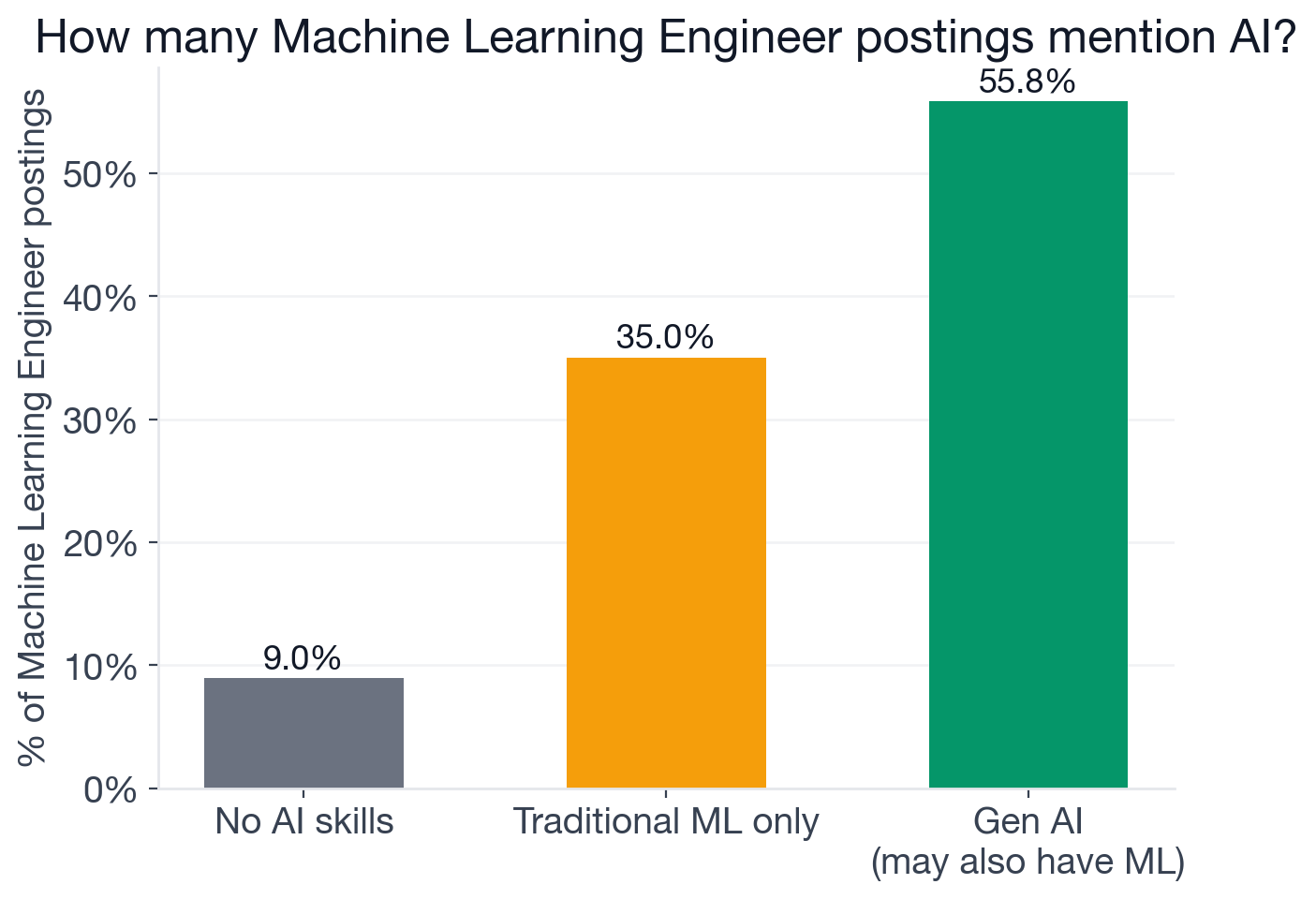
Share of Machine Learning Engineer postings (n=3,849, June 2026) requiring each AI category. A posting can appear in multiple categories.
The near-universal 91.0% reflects the AI-native nature of the title itself: this was always an AI role, just a narrower one. The more meaningful signal is 55.8%, the share now asking for new-wave generative AI specifically. That is more than half the market requiring skills that barely registered in job descriptions two years ago. And critically, 52.2% require both stacks at once. Companies are not choosing between traditional ML and generative AI. They are asking for the engineer who can operate across both.
The 3.6% who want generative AI with no traditional ML background are worth noting precisely because they are a small minority. This "pure AI Engineer" archetype, someone building features on top of foundation model APIs without deeper modeling knowledge, appears rarely in ML Engineer postings. The market has not bifurcated. It has layered.
There is also a layer the job-posting data cannot see. The 55.8% measures engineers hired to build and deploy AI systems. It does not measure the ambient expectation that you use Copilot to accelerate experiment code, ChatGPT to debug a CUDA error, or Claude to summarize a paper. Stack Overflow's 2025 developer survey found 51% of professional developers use AI tools daily. The explicit job-posting figure is a floor on AI involvement in this role, not a ceiling.
The Generative AI Skills Reshaping the MLE Stack
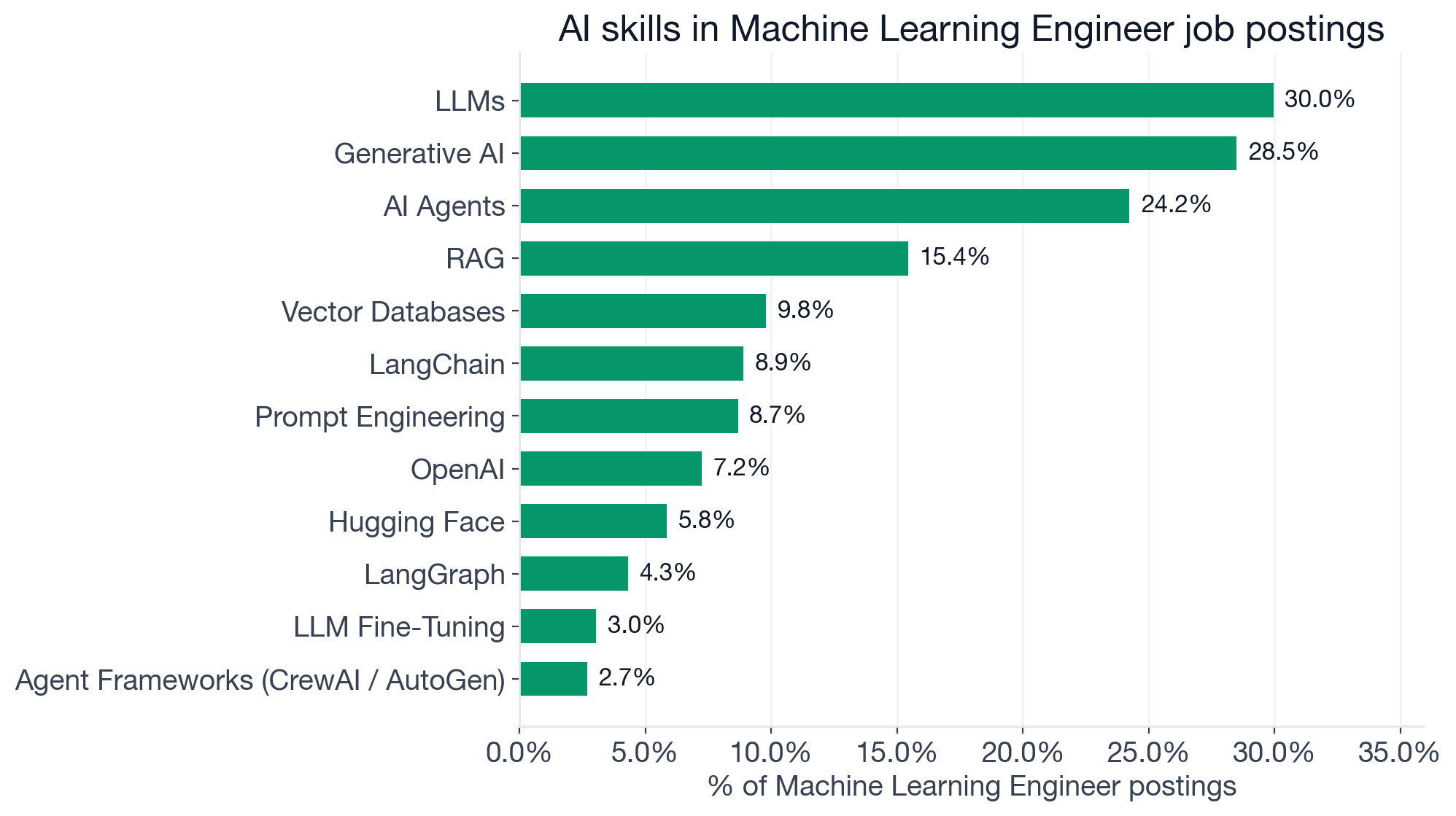
Percentage of ML Engineer postings mentioning each new-wave AI skill. Traditional ML (86.0%) and Deep Learning (50.6%) sit above all of these, anchoring the full stack.
Among the new-wave skills, three sit above 20% and form the practical core of what companies now ask for beyond the traditional ML foundation:
LLMs (30.0%): Not just knowing what a large language model is, but integrating one into a production system: API clients, tokenization, context window management, and evaluation frameworks. This is where the traditional "deploy a model" skill set meets the new "prompt and orchestrate a foundation model" requirement.
Generative AI (28.5%): A broader signal than LLMs alone, covering image generation, audio, and multimodal systems. Often paired with fine-tuning or deployment requirements where the engineer shapes or adapts a pre-trained model for a specific use case.
AI Agents (24.2%): The newest technical discipline of the three above 20%. Agentic AI, the pattern where a model completes multi-step tasks through tools, reasoning steps, and memory, has no equivalent in the 2022 MLE playbook. Tool-calling, orchestration reliability, and debugging non-deterministic agent behavior are skills the market is actively seeking. Nearly 1 in 4 ML Engineer postings now lists them.
Below that core: RAG (15.4%), which grounds LLM outputs with a document retrieval step, and Vector Databases (9.8%) like Pinecone or Weaviate, which are the infrastructure that makes retrieval-augmented pipelines practical. LangChain (8.9%, a framework for chaining LLM calls with tools and memory) and Prompt Engineering (8.7%) round out the top tier.
Browse ML Engineer openings requiring LLM skills or AI Agents to see these requirements in context.
What Does an AI Skill Set Do to Your Salary?
Among US postings with disclosed salary data, the median base salary for ML Engineer roles requiring new-wave generative AI skills is $152,000 (n=635 postings). This is US base pay only; equity and bonuses are not disclosed in job postings, and total compensation at major tech employers runs substantially higher than the base figure, particularly for senior and staff roles.
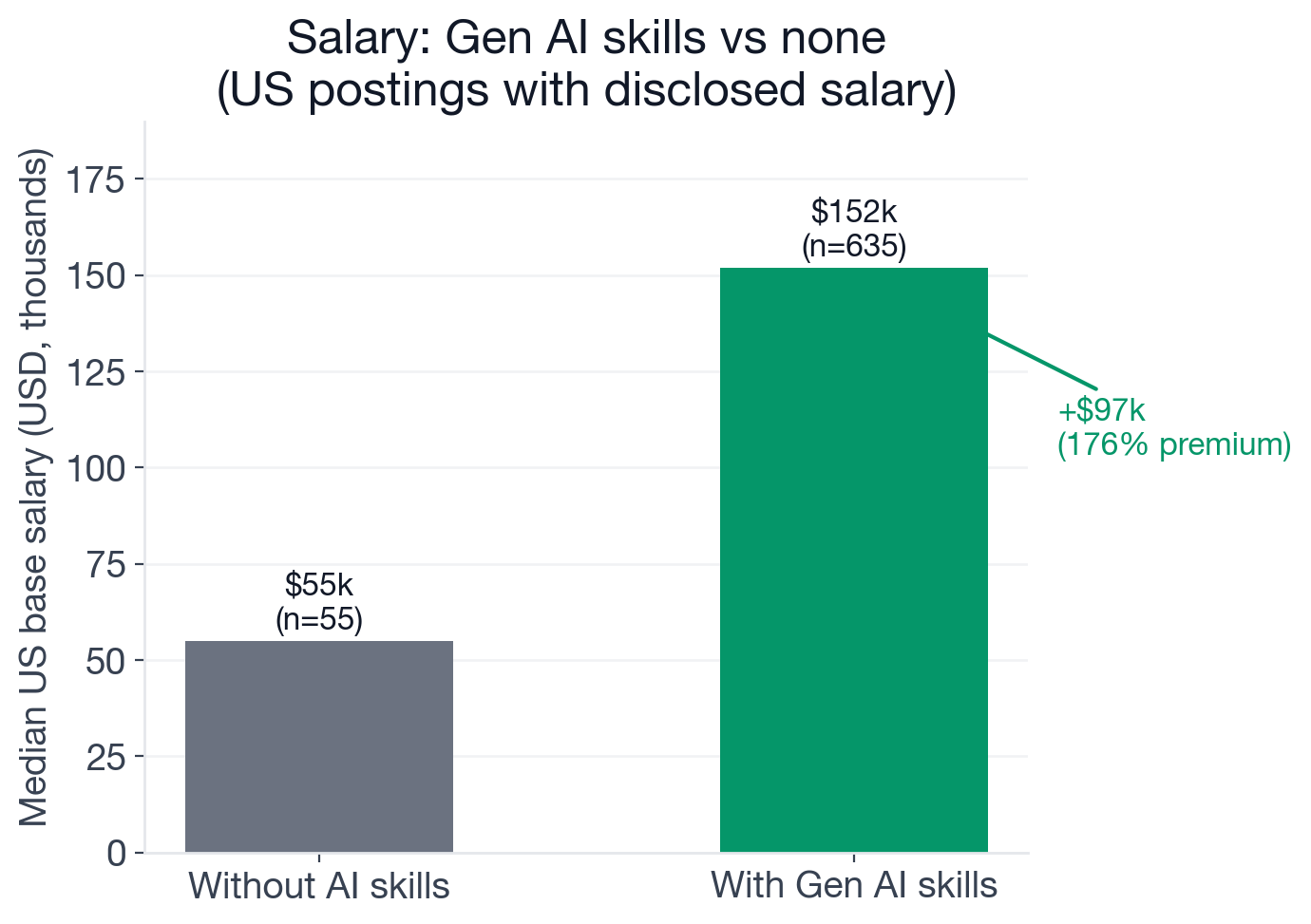
US base salary only, equity and bonuses excluded. Figures drawn from postings with disclosed compensation and a minimum sample size of 25.
The $55,000 figure for postings with no AI language at all (n=55) is technically part of the dataset, but treat it carefully. With only 55 data points, and ML Engineer postings that mention no AI skills whatsoever being an anomalous subset of the title, this group almost certainly reflects non-standard postings: junior contract work, part-time roles, or misclassified listings rather than a real comparison of otherwise-equal engineers. The $152,000 is the more reliable signal: it reflects what the market pays for ML Engineers who can operate across both stacks.
For context, browse ML Engineer openings with US salary data to see how current compensation ranges appear in live postings.
Staff Engineers Are Leading the GenAI Transition
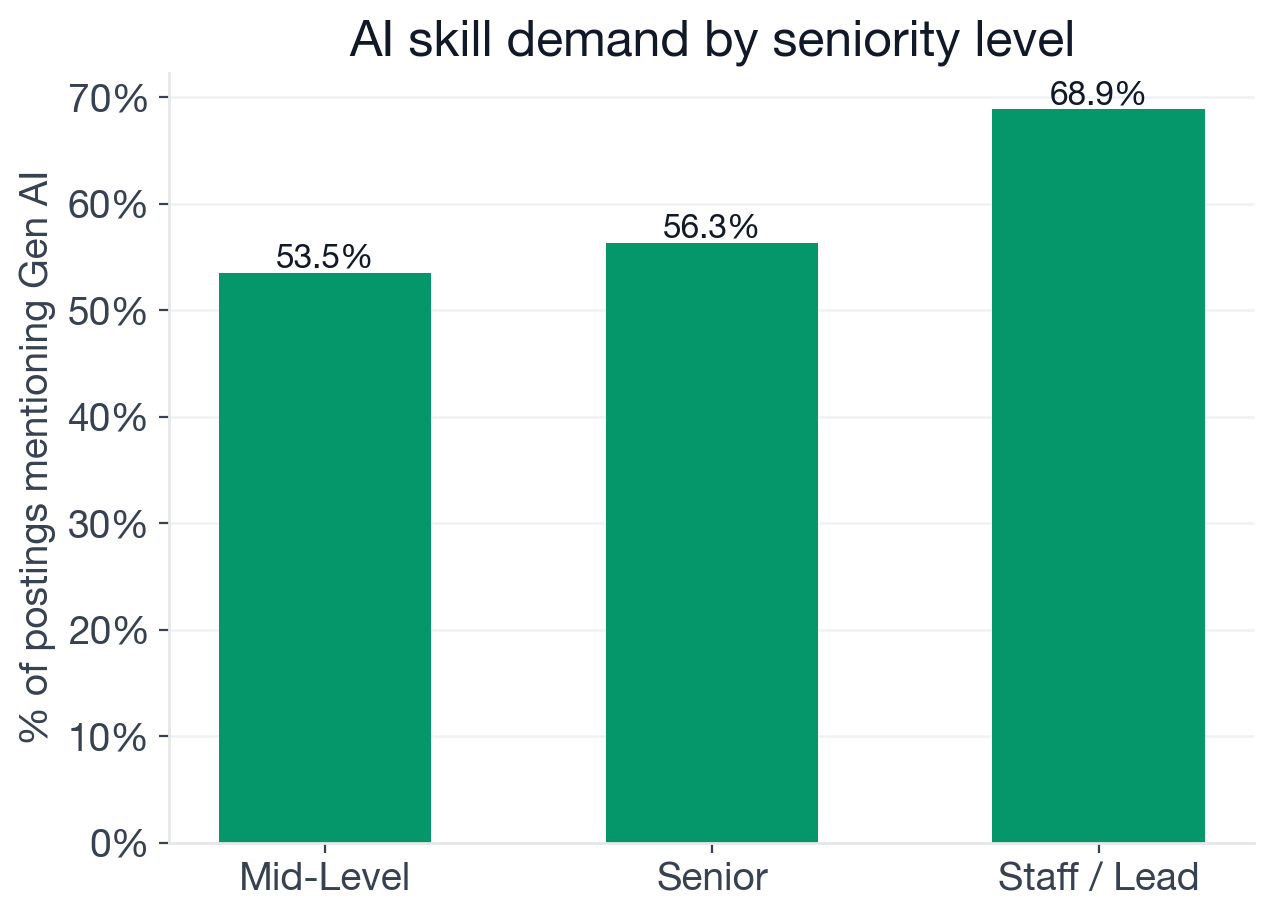
Percentage of postings at each level that require new-wave generative AI skills. Senior postings account for 68.8% of all ML Engineer volume.
Two things stand out in the seniority breakdown.
First, this is one of the most senior-heavy technical roles on the job board. Senior postings dominate at 68.8% of all ML Engineer openings (2,648 of 3,849). Entry-level postings account for just 4.96% of the market, which means breaking into the title without prior production ML experience is genuinely difficult. Mid-level is 16.4%, staff 6.3%.
Second, the new-wave AI adoption rate climbs steadily with seniority. Staff engineers show 68.9% AI adoption, compared to 56.3% at senior, 53.5% at mid-level, and 45.5% at entry. The pattern suggests the more senior the engineer, the more likely they are expected to work across both stacks. Staff and principal-level roles, typically the engineers setting architectural direction and building the platforms others build on, are the ones most frequently asked to combine deep ML expertise with generative AI system design.
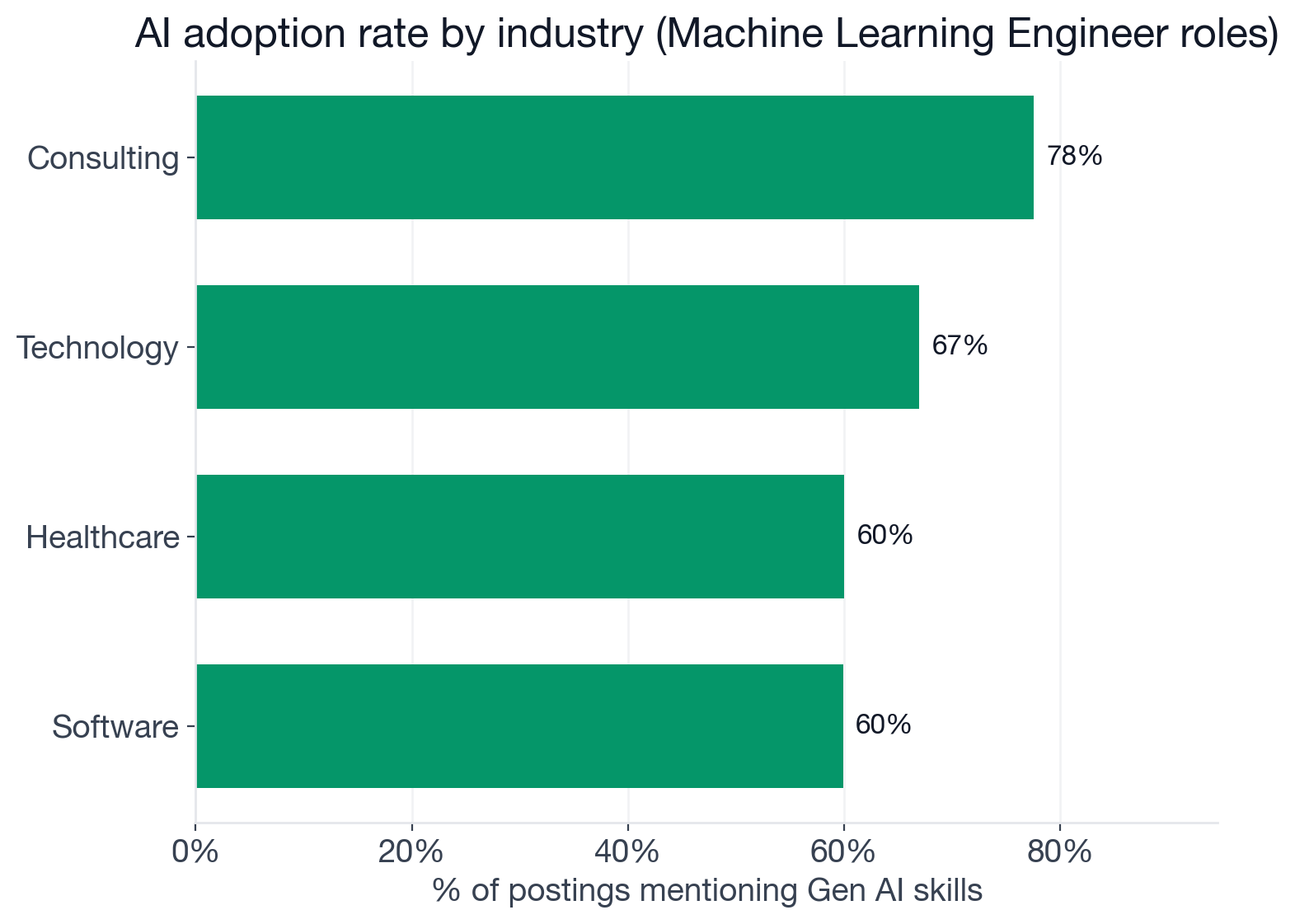
Share of ML Engineer postings in each industry requiring new-wave AI skills. Industries with sufficient posting volume shown.
Among industries with meaningful posting volume, technology companies lead new-wave AI adoption at 67.0% (554 postings, 14.4% of all ML Engineer volume), followed closely by healthcare at 60.0% (135 postings) and software at 59.9% (521 postings). Technology and software together account for more than a quarter of all ML Engineer postings in this dataset. Healthcare at 60% reflects how heavily clinical decision support and diagnostics work has shifted toward LLM-augmented systems over the last two years. (The consulting sector shows a higher headline AI adoption rate of 77.5% across 129 postings, but Accenture alone accounts for 65% of those AI-flagged consulting postings, making this a reflection of Accenture's own hiring priorities rather than a cross-firm consulting sector trend, so it is excluded from the industry comparison above.)
How to Use This in Your 2026 Job Search
The data points to a specific preparation strategy: show fluency across both stacks, and do not let the traditional ML foundation atrophy while you build GenAI skills.
For interview practice, the expanded MLE job description means you may face questions on traditional topics (gradient descent, model evaluation, MLOps and monitoring) alongside newer ones (LLM fine-tuning, RAG pipeline design, agentic system reliability). AI mock interviews let you practice both question types under realistic time pressure, with feedback calibrated to the ML Engineer role.
For targeted drilling, the question bank covers ML systems design, LLM integration patterns, and the model-lifecycle questions that show up consistently in senior and staff-level screens. If you are newer to the generative AI layer specifically, the interactive courses cover the foundations in LLM systems, RAG architecture, and AI agent design, which maps directly to the 24-30% of postings now explicitly asking for those skills.
Browse current Machine Learning Engineer openings to see how the dual-stack requirement appears in live postings. Filtering by AI Agents, LLMs, or RAG shows the postings that have moved furthest into the new layer.
FAQ
Q. What percentage of ML Engineer job postings require AI skills in 2026?
91.0% of Machine Learning Engineer postings (3,503 of 3,849 analyzed) require some form of AI expertise. 55.8% explicitly require new-wave generative AI skills including LLMs, Generative AI, AI Agents, and RAG. Traditional ML and deep learning anchor 87.2% of postings and remain the dominant foundation.
Q. What are the top new-wave AI skills in ML Engineer postings?
Ranked by frequency: LLMs (30.0% of postings), Generative AI (28.5%), AI Agents (24.2%), RAG (15.4%), Vector Databases (9.8%), LangChain (8.9%), and Prompt Engineering (8.7%). These layer on top of a traditional stack still anchored by Machine Learning (86.0%) and Deep Learning (50.6%).
Q. How much does knowing generative AI affect an ML Engineer's salary?
US postings requiring new-wave generative AI skills show a median base salary of $152,000 (n=635 postings with US salary disclosed). This reflects US base pay only; equity and bonuses are not included. The comparison pool of postings without any AI language is small (n=55) and likely captures non-standard roles, so $152,000 is the cleaner headline for AI-fluent ML Engineers.
Q. Is the ML Engineer title being replaced by AI Engineer in 2026?
The data does not support that. 52.2% of ML Engineer postings require both traditional ML/deep learning AND new-wave generative AI skills. Only 3.6% require generative AI with no traditional ML background. The ML Engineer role is absorbing AI skills, not being displaced by a separate AI Engineer title.
Q. Which seniority level has the highest AI adoption in ML Engineer postings?
Staff-level ML Engineer postings show the highest new-wave AI adoption at 68.9% (168 of 244 staff postings). Senior roles, which make up 68.8% of all ML Engineer postings, show 56.3% AI adoption. Entry-level postings account for just 4.96% of the market and show 45.5% AI adoption.
Q. Do all ML Engineers need to use AI tools, or only those with AI listed in job postings?
Both layers apply, but for different reasons. The 55.8% explicit figure measures engineers hired to build and deploy AI systems. The ambient layer covers daily use of Copilot, ChatGPT, and similar tools, which JetBrains' January 2026 AI Pulse survey found 90% of developers already do regularly, regardless of job-posting language.
Q. Where are most ML Engineer jobs located in 2026?
The US is the largest market at 44.2% of postings (1,703 of 3,849), with 57.6% of those requiring new-wave AI skills. India is second at 12.7% (489 postings) with the highest AI adoption rate at 67.1%. Canada (5.4%), the UK (5.1%), and Germany (2.9%) round out the top five global markets.
The Bottom Line
The Machine Learning Engineer job in 2026 is not what it was in 2022, but it is not a completely different job either. Traditional ML runs in 87.2% of postings because the systems that recommendation, vision, and fraud detection teams depend on did not go anywhere. What changed is the second floor: 55.8% of postings now expect you to also work with LLMs, orchestration frameworks, and agentic pipelines. The title that absorbed all of this is still "Machine Learning Engineer." For anyone already in the role, that expansion is worth taking seriously. For anyone targeting it, demonstrating fluency across both stacks is the most direct path to the $152,000 median that AI-fluent MLEs command in the current US market.
Topics
Ready to practice?
Put what you've learned into practice with AI mock interviews and structured preparation guides.