
For a Research Scientist, AI Isn't a Skill. It's the Subject.
Every other role in this series answers the same question: does this job require AI, yes or no. Research Scientist breaks that question. For this role, AI usually isn't a tool bolted onto the job description, it's the thing being researched. Ninety-one percent of active Research Scientist postings on the InterviewStack.io job board mention some form of AI or machine learning, drawn from 853 active listings over the trailing 90 days. Only 8.6% describe a role you could plausibly do without touching AI at all. (The "Research Scientist" title also picks up some adjacent titles, quantitative researchers, biotechnology research scientists, product researchers, so read these figures as directionally representative of AI/ML-focused research roles rather than a perfectly filtered slice.)
That number alone would make Research Scientist the most AI-saturated role tracked in this series. But it hides a fault line: companies aren't unanimous about which era of AI they want. 85.0% of postings ask for traditional machine learning and deep learning, the discipline that predates the generative AI wave by a decade, while 56.2% ask for new-wave skills like LLMs, AI agents, and retrieval-augmented generation. Those two groups overlap heavily, but they aren't the same job, and the gap between them is the real story.
Key Findings
- 91.4% of Research Scientist postings (780 of 853) require some form of AI or ML; only 8.6% show no AI/ML skill at all.
- 85.0% of postings require traditional ML/deep learning, ahead of the 56.2% that require new-wave generative AI (LLMs, agents, RAG, fine-tuning).
- 49.8% of postings require both traditional ML and generative AI; just 6.3% ask for generative AI with no traditional ML background.
- Machine Learning is the single most-requested skill at 79.7% of postings, with AI Agents (24.5%) edging out LLMs (23.8%) among new-wave skills.
- US postings requiring new-wave AI report a $206,124 median base salary (n=234) versus $179,000 without AI (n=34), a $27,124 premium.
- Entry-level postings show a 39.5% new-wave AI rate, higher than junior-level (27.3%); staff-level postings have the highest rate overall at 71.4%.
- Anthropic and OpenAI require new-wave AI skills in 100% of their Research Scientist postings; Google (55.1%) and Meta (59.5%) run lower, reflecting broader research portfolios beyond generative AI.
What Research Scientist Meant Before ChatGPT
Three or four years ago, a Research Scientist posting described a fairly stable job: design experiments, build and train models (often in TensorFlow or PyTorch), and publish or document results that pushed a model class forward. "AI" meant classical machine learning and deep learning research: computer vision, pre-LLM NLP, recommendation systems, reinforcement learning. Generative AI existed as a research subfield, not the industry's default framing for the whole job.
That baseline shifted fast once ChatGPT-class tools went mainstream. Survey data on researchers broadly (not limited to industry job titles) shows AI tool adoption jumping from 57% in 2024 to 84% in 2025, with usage specific to research and publication tasks growing from 45% to 62% over the same window, per Wiley's 2025 survey of 2,430 researchers. That is a one-year swing, and it lines up with what the posting data now shows: AI in some form is close to universal, but the generative-AI-specific slice is still catching up to the traditional-ML majority.
The Real Split: Traditional ML vs. Generative AI
The headline number, 91.4% "any AI," is really two overlapping populations. 85.0% of postings require traditional ML/deep learning, standard Research Scientist work for years. 56.2% require new-wave generative AI: LLMs, AI agents, RAG, prompt engineering, or a named platform like OpenAI, Anthropic, or Gemini. 49.8% ask for both, meaning half the role now expects researchers to move between classic model training and generative-AI systems work. Only 6.3% ask for generative AI with no traditional ML background at all, so the "AI-native, no ML fundamentals" researcher is still rare; the generative-AI track is mostly an extension of ML expertise, not a replacement for it.
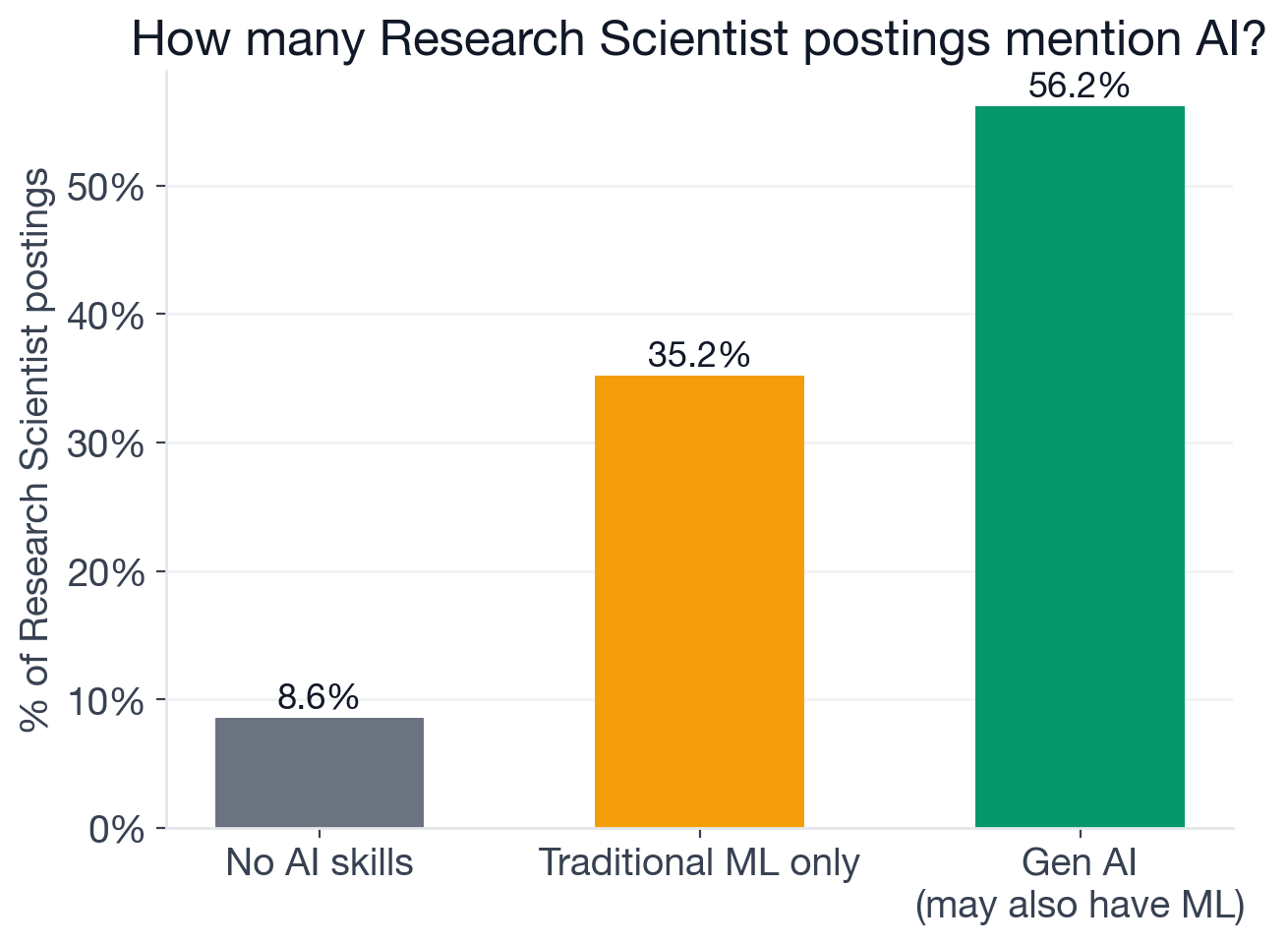 91.4% of postings require some AI/ML skill; the traditional-ML majority (85.0%) still outpaces the new-wave generative AI slice (56.2%).
This is Layer 1: what companies explicitly write into the posting, who's hired to build, train, fine-tune, or evaluate AI systems as the deliverable, not who merely uses an AI tool to work faster. The title sample makes the split visible: postings like "Elite Research Scientist, Frontier AI Evaluation" and "Researcher, Misalignment Research" sit alongside "ML Research Scientist, Co-Folding and Affinity" and "Research Scientist, Catalyst Simulation," where deep learning is the method but the subject is chemistry or biology, not AI itself.
The Skills That Separate Classic Research From Frontier Research
Machine Learning is the closest thing this role has to table stakes: it appears in 79.7% of postings, nearly 1.7x the rate of the next most-common individual skill. Deep Learning/Neural Nets follows at 47.9%, still solidly traditional. Below that, the new-wave cluster has an order worth noticing: Generative AI leads at 29.1%, but AI Agents (24.5%) edges out LLMs (23.8%) for second place. Companies aren't just asking for researchers who understand language models, they're asking for researchers who can build systems that act, chain reasoning steps, and operate with some autonomy. Everything past that (MLOps at 4.5%, RAG at 3.8%, LLM Fine-Tuning at 2.2%, named platforms like Anthropic/Claude and Hugging Face at 2.1% each) is a differentiator, not a baseline.
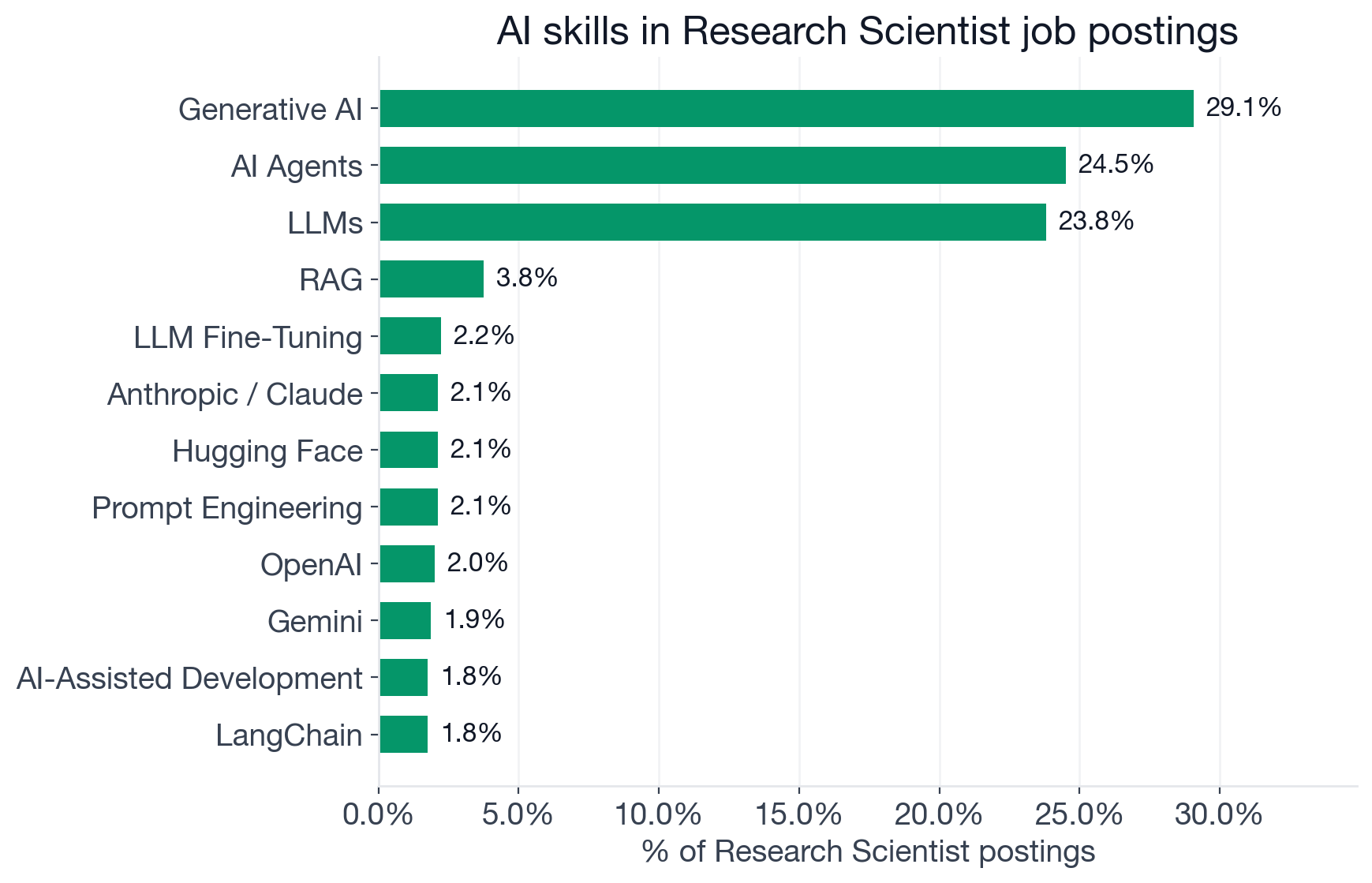 AI Agents (24.5%) now outranks LLMs (23.8%) as an individually named skill, a signal that companies are hiring for agentic system-building, not just LLM familiarity.
| Skill | % of postings | What it signals |
|---|---|---|
| Machine Learning | 79.7% | Baseline expectation across the role |
| Deep Learning / Neural Nets | 47.9% | Standard for anyone touching modern architectures |
| Generative AI | 29.1% | The umbrella term for LLM-era work |
| AI Agents | 24.5% | Autonomous, multi-step systems, not single-turn chat |
| LLMs | 23.8% | Direct language-model research or application |
| MLOps | 4.5% | Production deployment, not just research |
| RAG | 3.8% | Retrieval-augmented systems specifically |
| LLM Fine-Tuning | 2.2% | Model customization as a named deliverable |
Do You Get Paid More for Building the Frontier?
Among US postings with disclosed salary (base salary only; equity, bonus, and other compensation aren't captured in job listings), Research Scientist roles that require new-wave generative AI skills report a median of $206,124 (n=234). Roles with no AI requirement at all report a median of $179,000, though that figure rests on a thin sample (n=34) and should be read as directional rather than definitive. That's a $27,124 gap, roughly 15% above the no-AI baseline, for postings that specifically ask for LLM, agent, or generative-AI experience over classic ML alone.
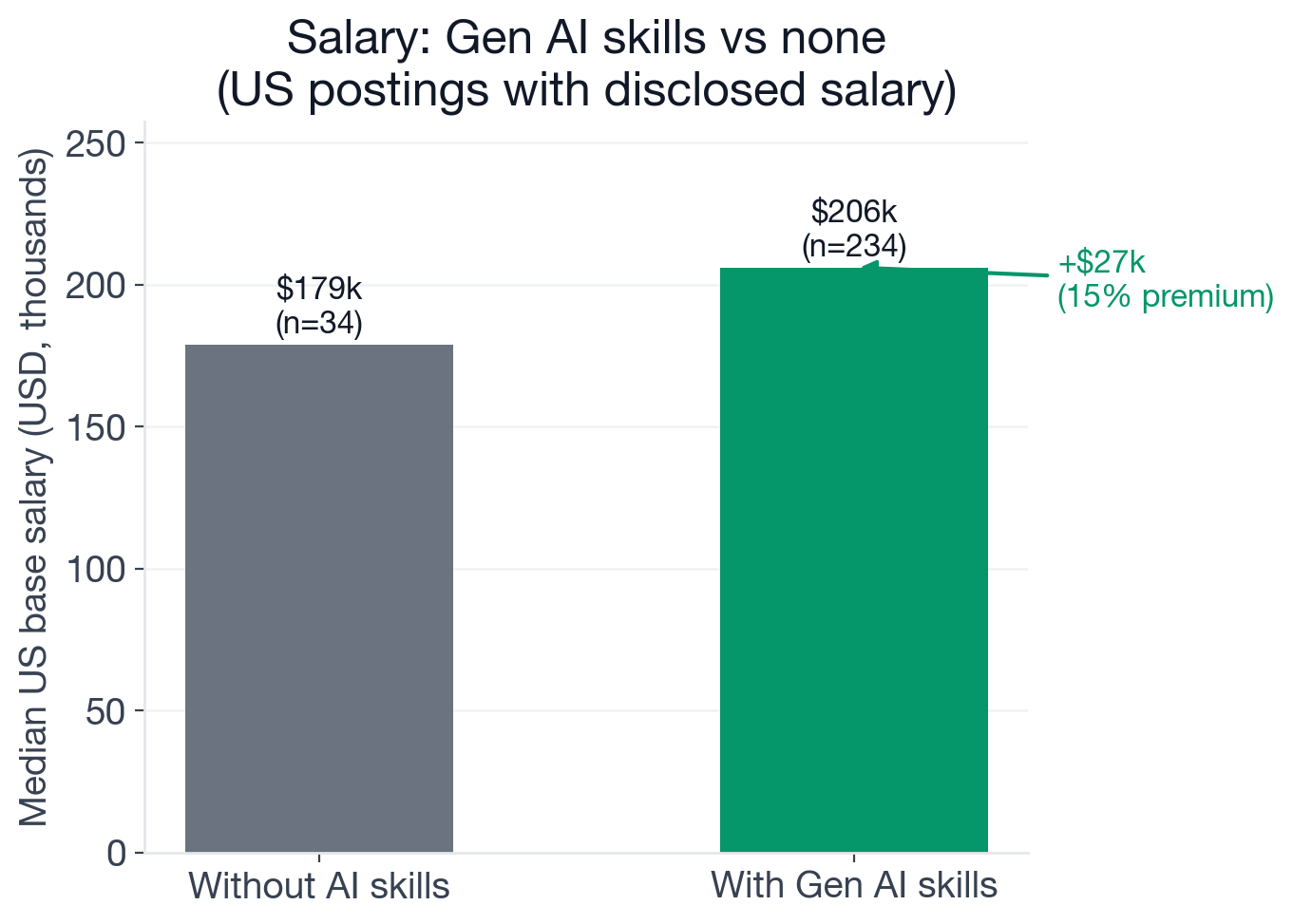 Postings requiring new-wave AI skills report a $27,124 higher US base salary median than postings with no AI requirement at all.
That premium is smaller than some other roles in this series show, which tracks with the rest of the data: Research Scientist salaries are already high across the board, because the baseline job (any ML/DL research) commands a premium versus most engineering roles. The generative-AI skew adds meaningfully on top of that, but it's closer to the gap between a strong ML researcher and one who can also ship agentic or LLM-based systems than to the gap between entry-level and senior pay.
Even the Traditional-ML Half Uses AI Every Day
It would be easy to read the 91.4% "any AI" figure and the 56.2% new-wave figure and conclude that the remaining postings, especially the 8.6% with no AI mention at all, describe scientists who don't touch AI in daily work. That conclusion doesn't hold up.
The explicit posting numbers only capture Layer 1: what a company writes down as a hiring requirement, researchers hired specifically to build, fine-tune, or evaluate AI systems. They miss Layer 2, the ambient layer: the AI tools a researcher reaches for regardless of whether the posting ever says "AI." Wiley's 2025 survey found 85% of researchers report AI improved their efficiency, and they overwhelmingly reach for general-purpose tools over specialized ones: 80% use mainstream tools like ChatGPT, versus just 25% using dedicated AI research assistants. More than half now report using AI for peer review, a workflow that has nothing to do with whether their job title mentions generative AI, and a nationally representative survey cited in Nature put general research-tool use at 65% of academic scientists. None of that shows up in a posting that lists "TensorFlow" and "experimental design."
So the honest reading is this: 56.2% of postings require you to build generative AI systems as the deliverable. Effectively all Research Scientists, including the ones in postings that only mention classic ML/DL, are now expected to use AI tools like ChatGPT or Copilot-class assistants to write analysis code, synthesize literature, and speed up experimentation. What varies isn't whether AI matters, it's whether AI is the subject of the research or the tool used to do it faster. Adoption is also outpacing trust: concerns about AI inaccuracy and hallucination among researchers rose from 51% to 64% year over year alongside the adoption jump, a useful check against unqualified enthusiasm.
Who's Leading the Shift?
Seniority tells a more layered story than "senior roles lead." Senior postings carry the largest share of the role by volume (68.0% of all 853 postings) and a solid 58.3% new-wave AI rate. Staff-level postings are rare (3.3% of the total) but carry the highest AI rate of any tier at 71.4%, a sign that the most senior research roles skew hardest toward generative AI. The more interesting wrinkle sits at the bottom: entry-level postings show a 39.5% AI rate, notably higher than the 27.3% rate for junior-level postings, likely because PhD-track entry hires ("Research Scientist Intern" and similar) get staffed directly onto frontier AI projects, while the junior tier, still building foundational research experience, skews more traditional.
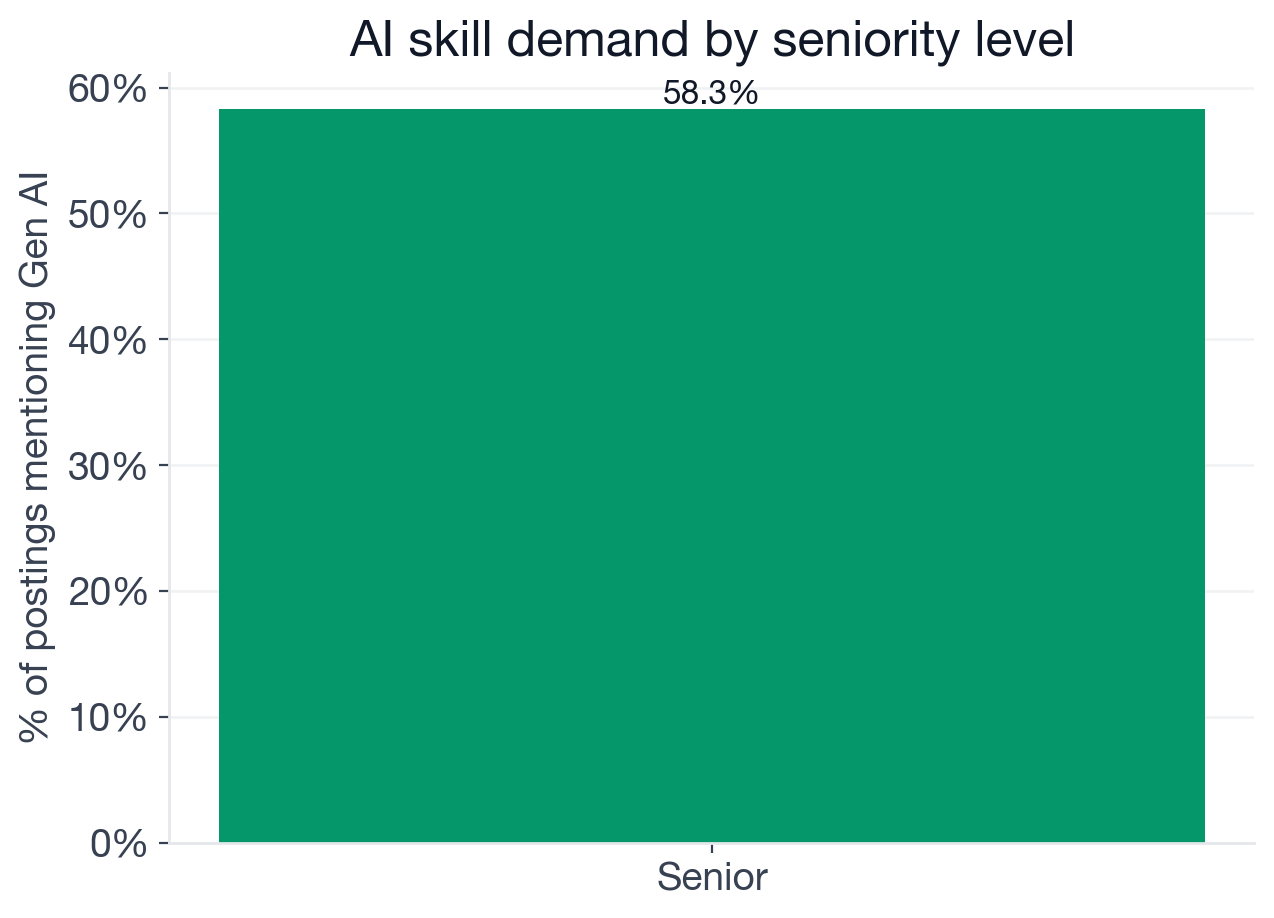 Staff-level postings lead at 71.4% AI adoption; entry-level (39.5%) surprisingly outpaces junior-level (27.3%).
Industry data only clears a credible sample size in two categories, both broadly "tech": technology (29.7% of postings, 68.0% AI rate) and software (15.9% of postings, 57.0% AI rate). Both run well above the role-wide 56.2% baseline, which is expected given how much of this role's demand sits inside AI-native companies to begin with.
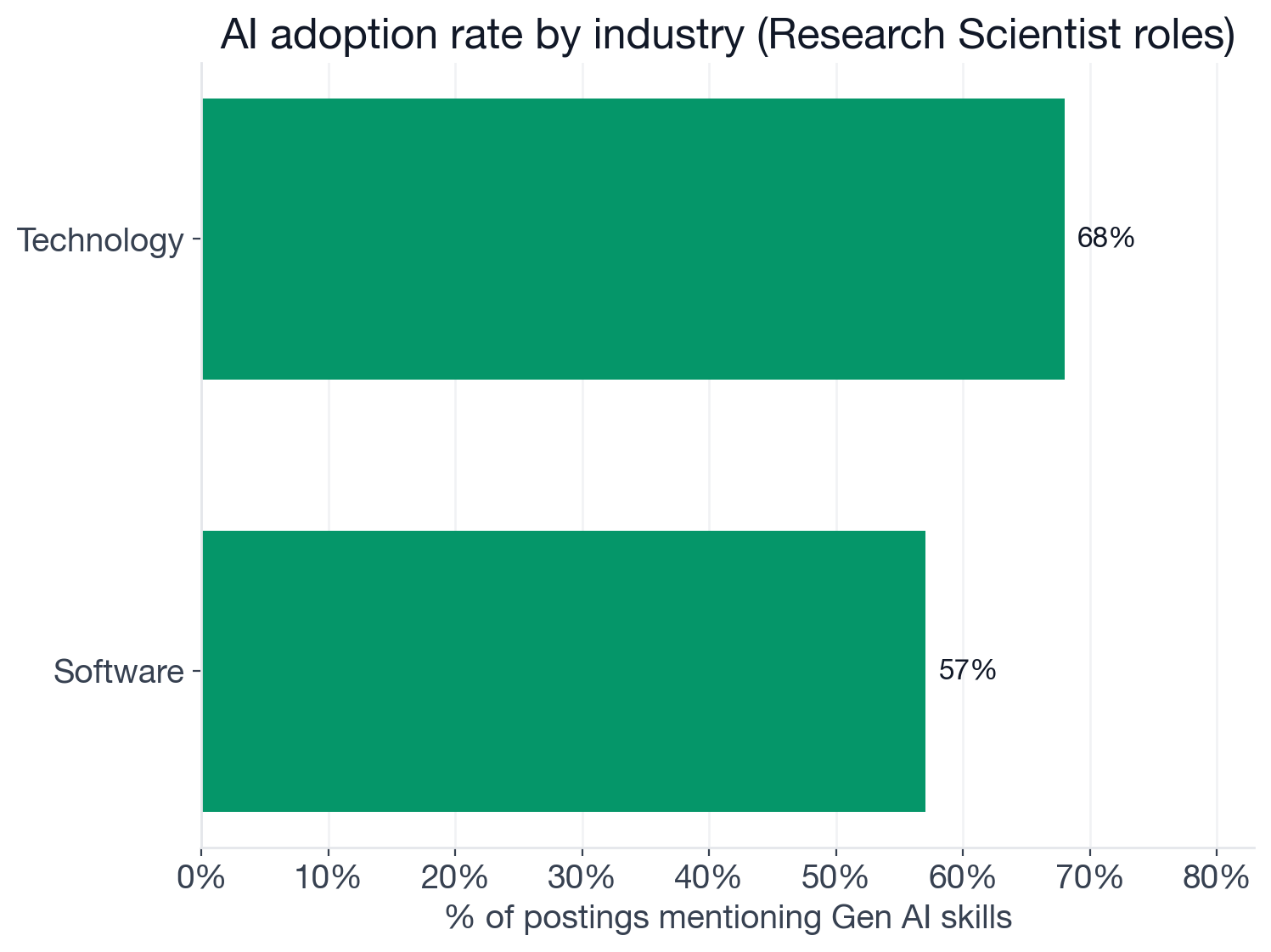 Technology (68.0%) and software (57.0%) both post AI rates above the 56.2% role-wide baseline.
The company data draws the same distinction sharper. Google (49 postings) and Meta (42 postings) hire the most Research Scientists overall, but their AI rates, 55.1% and 59.5%, sit close to the role-wide average, because both run large research organizations that span far beyond generative AI. Frontier AI labs look different: Anthropic (13 postings) and OpenAI (10 postings) each require new-wave AI skills in 100% of their listed roles. At a lab built entirely around generative AI, there is no "traditional-only" research track left to hire for.
| Company | Postings | New-wave AI rate |
|---|---|---|
| 49 | 55.1% | |
| Meta | 42 | 59.5% |
| NVIDIA | 30 | 80.0% |
| Adobe | 23 | 69.6% |
| Microsoft | 14 | 85.7% |
| Anthropic | 13 | 100% |
| Huawei Technologies Canada | 11 | 90.9% |
| OpenAI | 10 | 100% |
| ifm | 10 | 100% |
| SandboxAQ | 10 | 50.0% |
Adobe's two dataset entries ("Adobe" and "Adobe Inc.") are combined here (14+9 postings, 9+7 AI-requiring). A staffing/recruiting marketplace that appeared in the raw data at the same posting volume as Adobe and Microsoft was excluded from this table; its listings are contractor postings on behalf of AI labs, not its own headcount.
How to Use This in Your Job Search
If you're aiming at frontier AI labs (the Anthropic/OpenAI end of this data), assume every posting is a generative-AI posting: prepare for LLM, agent, and evaluation-focused technical rounds, not general ML theory. If you're aiming at Google, Meta, or a research org with a broader mandate, expect a mix, and read the posting closely rather than assuming either. Either way, treat AI-assisted research tools (literature synthesis, code generation, experiment analysis) as baseline fluency rather than a differentiator; the survey data above suggests most of your competition already uses them.
To close the gap between "familiar with ML" and "can build the systems these postings describe," practice technical and research-methodology interviews with AI mock interviews that simulate the evaluation-and-reasoning questions frontier labs ask. Use the question bank to drill AI agents, RAG, and model evaluation, and lean on interactive courses if you need foundational ML or deep learning depth before layering generative AI skills on top. When you're ready, browse current Research Scientist openings, or narrow to a differentiator skill with a filtered search for AI Agents or Generative AI roles.
FAQ
Q. How many Research Scientist jobs require AI skills in 2026?
Among the 853 active Research Scientist postings analyzed on the InterviewStack.io job board, 91.4% require some form of AI or machine learning (780 postings). 85.0% require traditional ML or deep learning, and 56.2% require new-wave generative AI skills like LLMs, AI agents, or RAG.
Q. Is Research Scientist mostly a generative AI role now?
Not entirely. Traditional machine learning and deep learning still appear in more postings (85.0%) than new-wave generative AI (56.2%). Roughly half of postings (49.8%) require both, and only 6.3% ask for generative AI skills without any traditional ML background, meaning classic ML expertise remains the more common baseline.
Q. Which AI skill shows up most in Research Scientist postings?
Machine Learning tops the list at 79.7% of postings, followed by Deep Learning/Neural Nets at 47.9%. Among new-wave skills, Generative AI (29.1%) and AI Agents (24.5%) lead, with AI Agents edging out LLMs (23.8%) as the more commonly named skill.
Q. Do Research Scientists earn more with generative AI skills?
Among US postings with disclosed salary, Research Scientist roles requiring new-wave generative AI skills report a median base salary of $206,124 (n=234), compared to $179,000 (n=34) for roles without any AI requirement, a $27,124 premium. The no-AI figure rests on a thin sample (n=34) and should be read as directional rather than definitive. This is US base salary only; equity and bonus are not included.
Q. Do entry-level Research Scientist jobs require AI?
Yes, and more than you'd expect: 39.5% of entry-level postings require new-wave AI skills, actually higher than the 27.3% rate for junior-level postings. Senior roles carry the largest AI-skill volume overall (68.0% of all postings), and staff-level roles have the highest AI rate of any tier at 71.4%.
Q. Which companies are hiring the most AI-focused Research Scientists?
Google (49 postings) and Meta (42 postings) post the most Research Scientist openings overall, but frontier AI labs show the sharpest AI concentration: Anthropic and OpenAI each require new-wave AI skills in 100% of their Research Scientist postings, compared to 55.1% at Google and 59.5% at Meta.
Q. If a Research Scientist posting doesn't mention AI, does that mean the role doesn't use it?
No. Only 8.6% of postings mention no AI or ML skill at all, and even that figure likely overstates how many Research Scientists work without AI day to day. Survey data on researchers broadly shows AI tool adoption jumped from 57% to 84% between 2024 and 2025 (Wiley 2025), with most of that usage running through general-purpose tools like ChatGPT rather than specialized research-AI products that job postings rarely bother to state.
Pick Your Half of the Stack
Research Scientist isn't splitting into "AI roles" and "non-AI roles," it's splitting into classic ML/DL research and generative-AI systems research, with half the market now asking for both. The traditional track isn't going away (it's still the more common requirement), but the generative-AI track carries the salary premium, the staff-level concentration, and the frontier-lab hiring. Figure out which half of the stack you're building toward, and prepare for that one specifically rather than treating "AI skills" as a single box to check.
Topics
Ready to practice?
Put what you've learned into practice with AI mock interviews and structured preparation guides.