
How Has the Software Engineer Job Description Changed in 2026?
Open any Software Engineer job posting from 2022 and you will see roughly the same checklist: a primary language, Git, a CI/CD pipeline, a cloud provider, REST APIs, testing, Agile. Open one from May 2026 and the checklist still starts there, but a new layer has been added on top: build with AI Agents, work with LLMs, ship retrieval-augmented systems, use AI-assisted development tools daily. The role did not get replaced. It got widened.
To put numbers on it, we looked at every active Software Engineer posting on the InterviewStack.io job board over the trailing 90 days as of May 2026, 45,318 listings, with AI skills extracted from descriptions and synonyms collapsed (so "GPT-4", "Claude", and "OpenAI API" each get counted under the right canonical concept).
The headline: one in five Software Engineer postings now explicitly asks for new-wave generative AI skills, the role pays a measurable premium for them, and the demand is concentrated at the senior end of the career ladder. This post shows exactly what changed, who is hiring for it, and how to position yourself.
Key Findings
- 45,318 active Software Engineer postings analyzed across the live job board in May 2026.
- 20.5% of postings explicitly mention new-wave generative AI skills (9,287 of 45,318). When traditional machine learning is included, the share rises to 28.3% (12,806 postings).
- AI Agents is the #1 new-wave skill, in 9.7% of all postings (4,415 listings), ahead of LLMs (7.4%) and Generative AI broadly (5.3%).
- Median US base salary is $151,000 for postings that require new-wave AI skills (n=2,361), versus $130,000 for postings without AI (n=7,454). That is a $21,000 premium, or 16.2% above the non-AI baseline.
- Staff and Lead engineers see the highest AI demand at 27.2%, while mid-level sits lowest at 16.9%, a clear senior skills gap.
- Biotech leads industries with 42.7% of its Software Engineer postings asking for AI skills, followed by Energy (35.5%) and SaaS (35.0%).
- AI-native companies post at 100% AI density: OpenAI, Anthropic, and Cobblestone Energy ask for AI skills in every Software Engineer role.
What Did the Software Engineer Role Look Like in 2022?
Three or four years ago the consensus job description was remarkably uniform across companies. Industry surveys at the time captured it well: the Stack Overflow Developer Survey 2022, which polled more than 70,000 developers, found that JavaScript, Python, TypeScript, and SQL were the most-used languages, that Git was used by roughly 94% of professional developers, and that Docker was the most-used non-language tool. The GitHub Octoverse 2022 report mirrored the same picture: cloud-native development, microservices, REST APIs, and pull-request-based code review were the defaults.
A 2022 Software Engineer posting almost always asked for some combination of: a primary language (usually JavaScript / TypeScript, Python, Java, or Go), Git, a CI/CD system (Jenkins, GitHub Actions, CircleCI), Docker and Kubernetes, AWS or GCP or Azure, REST API design, unit and integration testing, and Agile / Scrum experience. Machine learning sometimes appeared, but it was a specialist track. Generative AI as a job requirement was essentially nonexistent: ChatGPT did not launch until November 2022, and "LLM" was not in the working vocabulary of most hiring managers.
The result was that "Software Engineer" meant something narrow and stable. You could read a posting from Stripe and a posting from a regional bank and the top half of the checklist would be near-identical. That stability is what changed first.
What Are Companies Asking For Now?
The first thing the 2026 data shows is that AI is no longer a specialist requirement bolted onto ML roles. It is showing up inside generalist Software Engineer descriptions, written by hiring managers who expect their next backend or platform engineer to also build with LLMs.
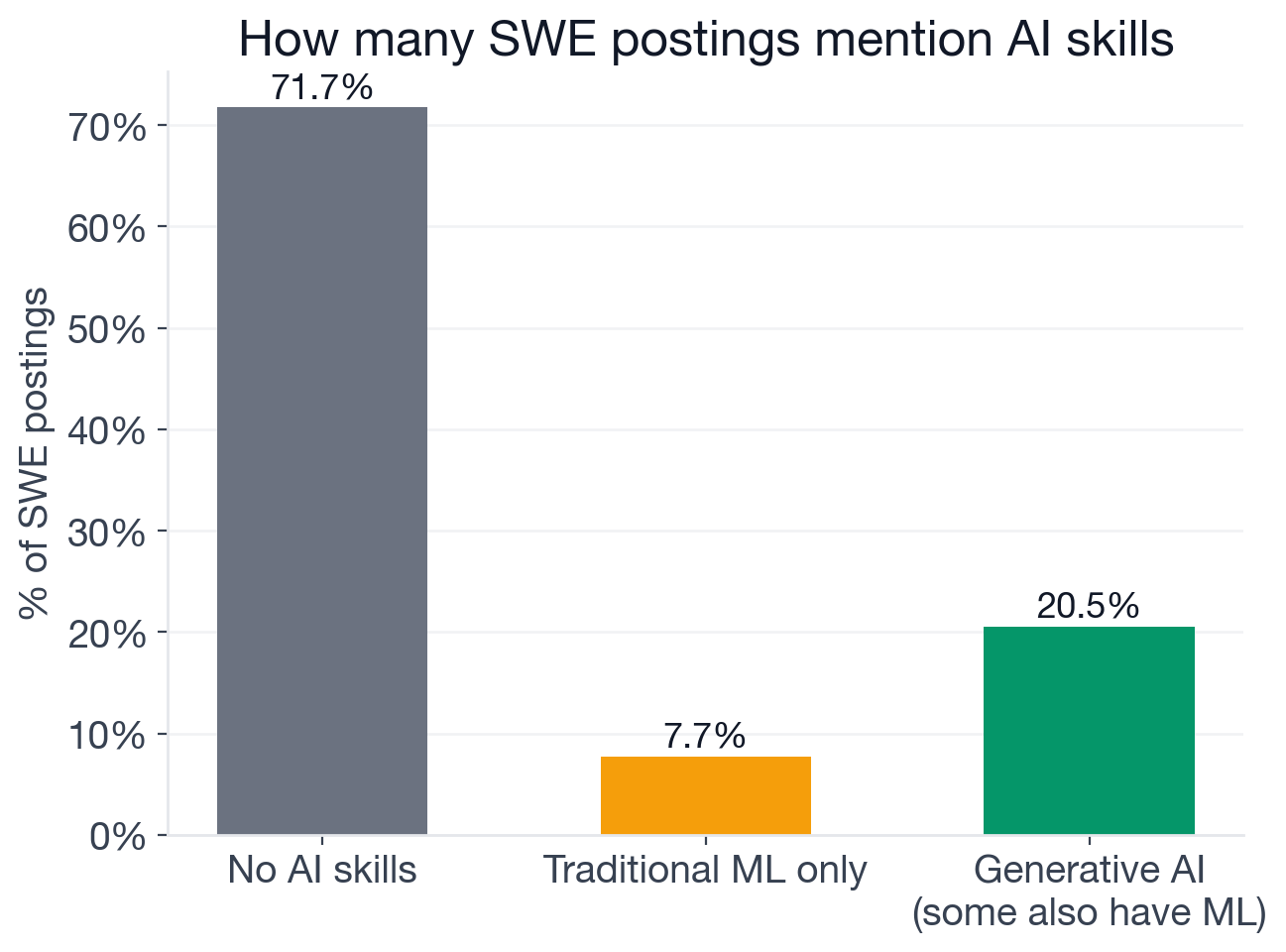
Of 45,318 active Software Engineer postings, 28.3% mention some form of AI. New-wave generative AI (the LLM-era stack of Agents, RAG, Prompt Engineering, Vector DBs) appears in 20.5%, with 7.1% of postings asking for both new-wave AI and traditional ML.
Three things to pull out of that chart. First, the new-wave generative AI stack (13.4% of postings, no traditional ML) is already larger than the pure traditional-ML cohort (7.8%). In just over three years since ChatGPT, the LLM-era toolkit has overtaken the deep-learning toolkit as a hiring requirement for general Software Engineers. Second, 7.1% of postings ask for both, usually senior platform or applied-AI roles at companies that already had ML and are layering generative AI on top. Third, 71.7% of postings still ask for neither. AI is not yet universal: backend, frontend, mobile, and embedded work without AI requirements still make up the majority of the market.
The "any AI" number (28.3%) is the right framing for an engineer deciding whether to invest in AI skills as a career hedge. Roughly one in three open roles already screens for some form of AI competency.
Which AI Skills Are Reshaping the Role?
Drill into the new-wave generative AI category and a clear ranking emerges. This is not just "everyone wants ChatGPT users". The top demand is for engineers who can build with AI as infrastructure, not just consume it as a productivity tool.
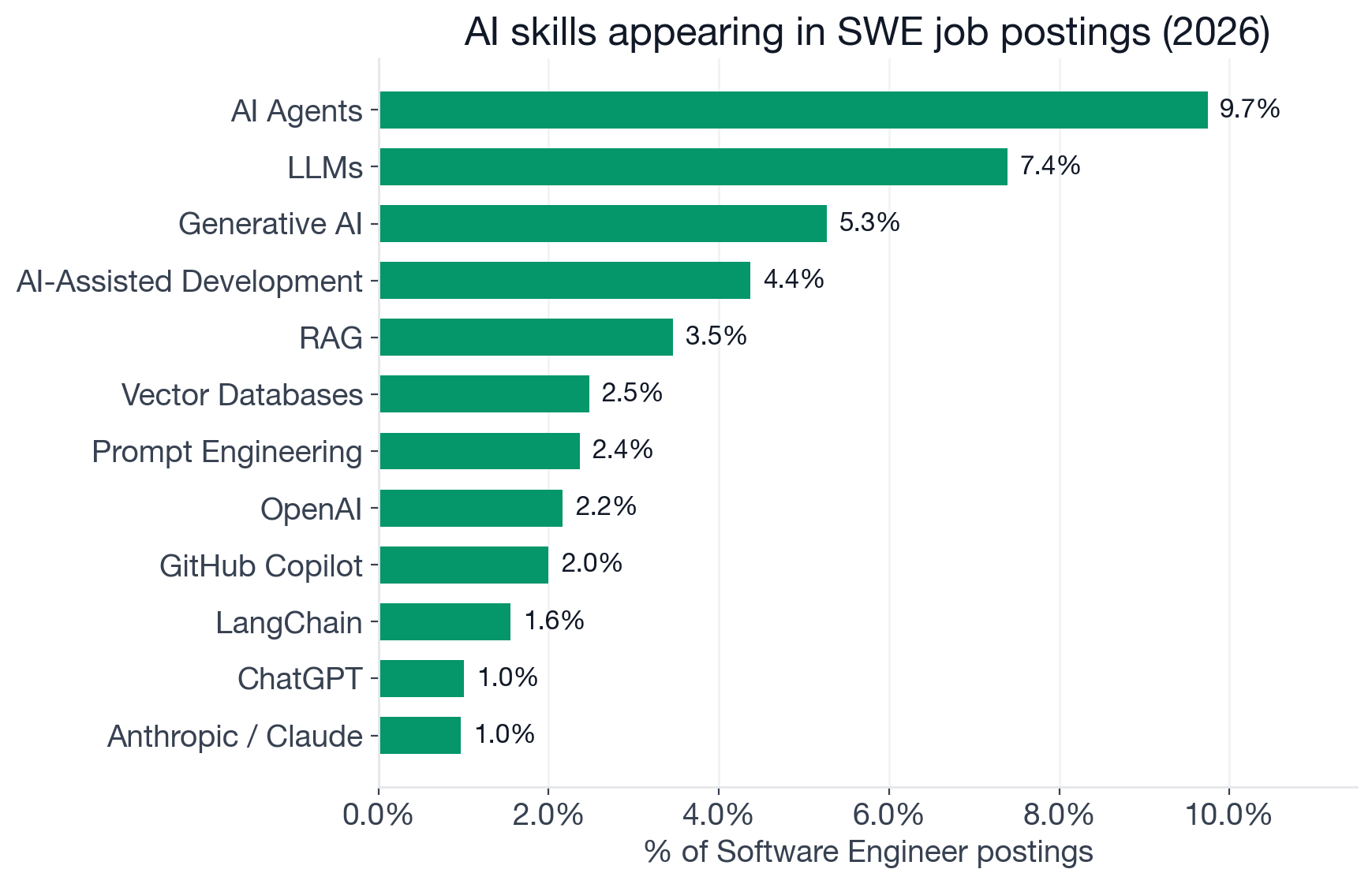
Share of Software Engineer postings that mention each AI skill. Traditional ML (gray) has been in postings for years; the new-wave generative AI stack (highlighted) is what changed since 2023.
The ranking tells a clear story:
AI Agents (9.7%, 4,415 postings) is the #1 new-wave AI skill. Companies are not just asking engineers to use AI, they are asking them to build agentic systems: pipelines where LLMs make decisions, call tools, and orchestrate workflows. This is a builder-level requirement, not a consumer-level one. (Browse Software Engineer roles asking for LLMs.)
LLMs (7.4%) and Generative AI (5.3%) are the next tier. Postings in this band expect familiarity with at least one foundation-model API and a working understanding of context windows, token costs, and evaluation. RAG (3.5%) and Vector Databases (2.5%) follow as the infrastructure expectations bundled with serious LLM work.
AI-Assisted Development (4.4%) and GitHub Copilot (2.0%) are a separate category. These postings expect engineers to use AI in their own workflow: writing code with GitHub Copilot, reviewing PRs with AI assistants, accelerating onboarding to unfamiliar codebases. It is now an explicit hiring signal, not an unstated assumption.
Prompt Engineering (2.4%), OpenAI API (2.2%), and LangChain (1.6%) round out the practical stack. Specific frameworks stay niche; most postings ask for underlying concepts (RAG, Agents) rather than framework brands, which is what you would expect in a fast-moving stack.
The clearest signal across the ranking: the new role expects builders, not just users. The premium skills are AI Agents, RAG, Vector DBs, and LLM-application engineering, which require systems-level thinking about retrieval, evaluation, and orchestration, the same thinking that defined "good backend engineer" a decade ago. Traditional Machine Learning at 14.1% is still the largest single AI-related skill, but it has been at roughly that level for years. The change in 2026 is not that ML demand grew, it is that an entirely new stack appeared next to it.
Does AI Expertise Actually Pay More?
This is the question that decides whether the shift matters to a working engineer's career, not just to LinkedIn. The answer in the data is unambiguous.
Among US postings (where wage-transparency laws produce consistent disclosure), the median Software Engineer base salary in postings that do not require AI skills is $130,000 (n=7,454). In postings that require new-wave generative AI skills, the median jumps to $151,000 (n=2,361), a $21,000 difference, or 16.2% above the non-AI baseline. Equity, bonus, and sign-on are not disclosed in postings, so total compensation at AI-heavy employers (think OpenAI, Anthropic, NVIDIA) runs materially higher than these base figures suggest.
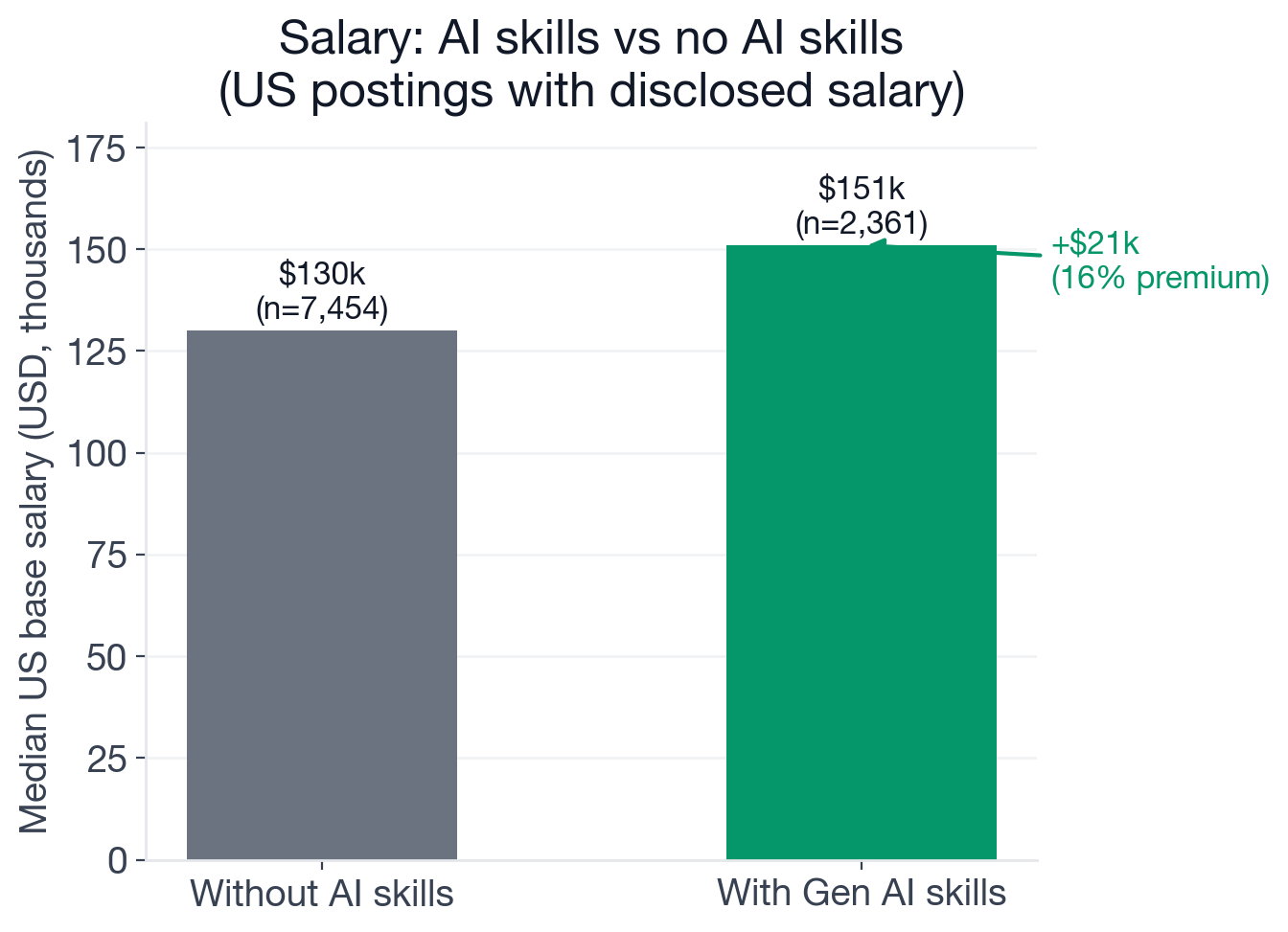
Median US base salary for Software Engineer postings with and without new-wave AI skill requirements. Equity and bonus are not in this dataset.
A few caveats when reading that premium. It is a median, not a ceiling: specific AI-heavy roles at top employers price well above $200K base, and total comp with equity at frontier labs is in a different bracket entirely. It also compounds with seniority. AI demand is highest at the Staff/Lead level (27.2%, see next section), which is also where base salaries are highest, so some of the $21K premium reflects that AI-requiring postings skew senior, not just that AI itself pays more. With 2,361 US-salary postings in the new-wave AI cohort and 7,454 in the non-AI cohort, this is a broad pricing signal across the market, not a small-N artifact.
For a mid-level engineer deciding whether to invest a quarter or two of focused learning in LLM application development, the salary delta is large enough that the payback period is short, especially if you target Software Engineer roles that ask for AI skills on your next job search.
Who Is Leading the Shift: Which Engineers and Which Industries?
The shift is not happening evenly. Two cuts of the data make that obvious: by seniority and by industry.
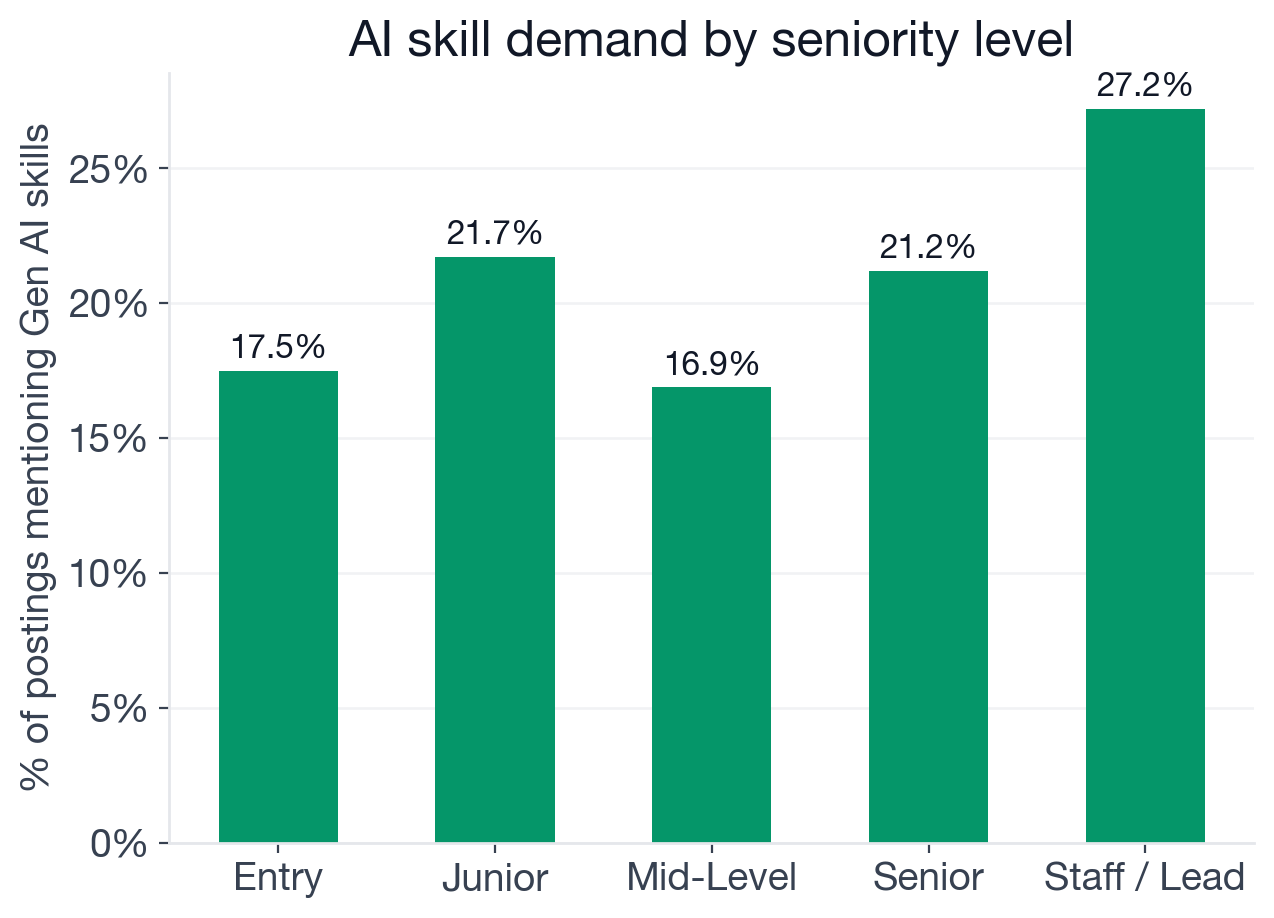
Share of postings at each seniority level that ask for AI skills. Staff/Lead is the clear leader.
The seniority pattern is bimodal and tells a coherent story:
- Staff and Lead engineers (27.2%) are the most-asked group. Companies need experienced systems thinkers to design the agent architectures, retrieval pipelines, and evaluation harnesses that production AI requires. This is where the senior skills gap shows up most sharply.
- Junior engineers (21.7%) and Senior engineers (21.2%) sit in the middle, both above the overall 20.5% baseline.
- Mid-level engineers (16.9%) are the lowest cohort. That is the opportunity. A mid-level engineer who adds AI Agent, RAG, and LLM-application skills can leapfrog peers competing for the same senior-track promotion, because the senior-track demand is exactly where the AI requirement clusters.
The industry view tells a parallel story.
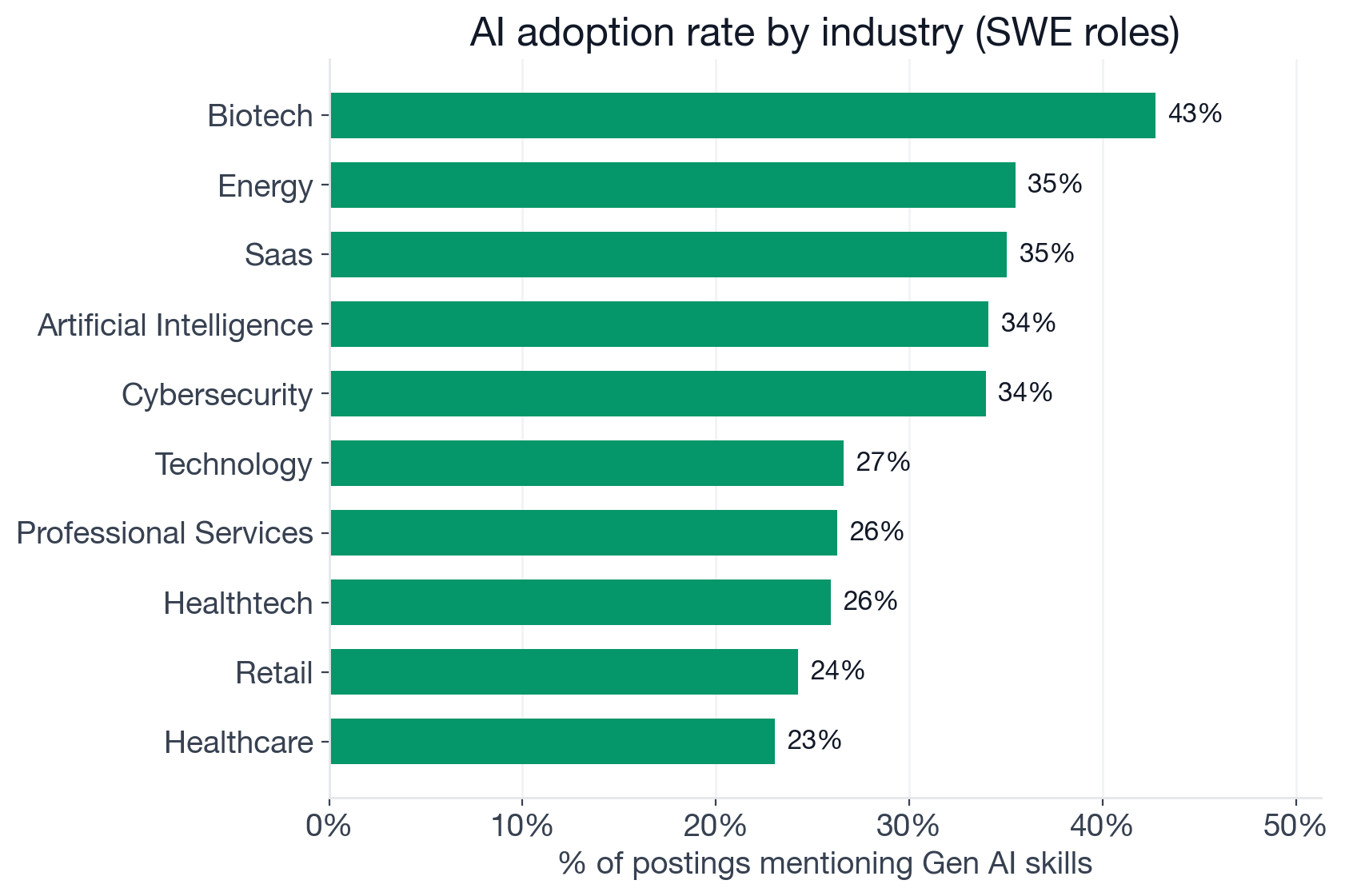
Share of Software Engineer postings within each industry that require AI skills. Biotech, Energy, and SaaS are the highest-density adopters.
The leaders are revealing:
- Biotech (42.7%) tops the list. Drug discovery, protein design, and lab automation are pulling Software Engineers into AI work faster than any other industry.
- Energy (35.5%) and SaaS (35.0%) are close behind. Energy is using AI for grid optimization, forecasting, and trading desks; SaaS is racing to embed AI features into every existing product surface.
- Cybersecurity (34.0%) is using LLMs for threat detection, alert triage, and automated response.
- Mainstream Technology (26.6%) sits right around the dataset average.
- Insurance (21.8%) and Media (21.8%) trail, but are still above the 20.5% baseline.
The companies hiring most aggressively for AI-capable Software Engineers cluster into two groups. The first is large enterprises that hire at scale and now require AI skills in a meaningful fraction of their postings: Accenture (596 AI postings, 21% of its Software Engineer roles), AgileEngine (290 postings, 67%), NVIDIA Corporation (122 postings, 26%), Adobe (74 postings, 56%), Cisco (70 postings, 34%), and Walmart (45 postings, 35%). The second is AI-native or AI-pivoted firms where essentially every Software Engineer role requires AI skills: OpenAI (100%), Anthropic (100%), Cobblestone Energy (100%), CyberArk (97%), Marvell (98%), Salesforce (86%), and Snowflake (69%). If you want to optimize for AI exposure in your next role, the second cluster is the obvious target.
How To Use This in Your Job Search
Three things follow from the data that you can act on this quarter.
First, treat AI as an extension of your stack, not a separate career path. The data shows AI requirements appearing inside generalist Software Engineer postings, not just inside ML Engineer or Applied AI roles. That means a backend engineer who adds AI Agent and RAG skills is competing for higher-paying generalist roles, not switching tracks. Practice the systems-design side of AI (retrieval pipelines, agent orchestration, eval harnesses) the same way you practiced microservices and distributed systems a few years ago. Our AI mock interviews include scenarios for designing RAG systems, agentic workflows, and LLM-powered backends, and the feedback is calibrated to what hiring managers at AI-heavy companies are actually asking.
Second, drill the specific concepts that recur in the postings. AI Agents, LLM application design, prompt engineering, vector retrieval, RAG patterns, and LLM evaluation come up over and over again, and they have well-defined question patterns. The Question Bank groups questions by topic so you can drill these specifically rather than wandering through generic interview prep. Pair the conceptual drilling with one or two real LLM-application projects on GitHub: the postings overwhelmingly ask for "built with" not "read about", and a portfolio link compresses a recruiter screen by minutes.
Third, filter your search. Generic "Software Engineer" feeds will be 79% non-AI roles. If your goal is to find the AI premium, search the job board with AI-skill filters explicitly: Software Engineer + LLMs and Software Engineer + GitHub Copilot are good starting filters; broaden to RAG and Vector Databases as you build the matching projects. The full role feed lives at Software Engineer roles on InterviewStack.io when you want the wider view.
FAQ
Q. How many software engineer jobs require AI skills in 2026?
20.5% of active Software Engineer postings explicitly mention new-wave generative AI skills (9,287 of 45,318 postings analyzed in May 2026). When traditional machine learning is included, the share rises to 28.3% (12,806 postings). The fastest-growing single requirement is AI Agents, which appears in 9.7% of postings.
Q. Do AI skills increase software engineer salaries?
Yes. The median US base salary for Software Engineer postings that ask for new-wave AI skills is $151,000 (n=2,361 postings with US salary disclosed), compared with $130,000 for postings without AI requirements (n=7,454). That is a $21,000 premium, or 16.2% above the non-AI baseline. Equity and bonuses are not disclosed in postings, so total compensation at top employers runs higher than these numbers.
Q. Which AI skills do software engineering employers ask for most?
The top new-wave generative AI skills by share of all Software Engineer postings are AI Agents (9.7%), LLMs (7.4%), Generative AI (5.3%), AI-Assisted Development (4.4%), RAG (3.5%), Vector Databases (2.5%), Prompt Engineering (2.4%), OpenAI API (2.2%), GitHub Copilot (2.0%), and LangChain (1.6%). Traditional Machine Learning, which has been in postings for years, still leads at 14.1%.
Q. Is AI replacing software engineers or changing the role?
The data points clearly to role change, not replacement. Hiring volume for Software Engineer is still high (45,318 active postings in May 2026), and AI-related skills are showing up as additions to the job description, not as substitutes for core software engineering. The largest single new requirement is building AI Agents (9.7% of postings), which presupposes someone writing the systems, not someone being written out of them.
Q. Which seniority levels are most affected by the AI shift?
Staff and Lead engineers see the highest AI demand at 27.2%, followed by Junior (21.7%) and Senior (21.2%). Mid-level engineers sit at the bottom at 16.9%, with Entry-level at 17.5%. The bimodal pattern points to a senior skills gap (companies need experienced engineers who can architect AI systems) and an opportunity for mid-level engineers to differentiate by adding AI skills.
Q. Which industries hire the most AI-capable software engineers?
Biotech leads at 42.7% AI adoption among its Software Engineer postings, followed by Energy (35.5%), SaaS (35.0%), Cybersecurity (34.0%), and the broader Technology industry (26.6%). Highly regulated and research-driven sectors are absorbing AI skills faster than retail or insurance.
Q. What was a software engineer expected to know in 2022 versus 2026?
In 2022, a Software Engineer job description revolved around Git, CI/CD, cloud basics, REST APIs, testing, and Agile, with AI rarely mentioned outside ML specialist roles (see the Stack Overflow Developer Survey 2022 for the language and tooling baseline). In 2026, those skills are still required, but 20.5% of postings additionally ask for new-wave generative AI skills like AI Agents, LLMs, RAG, and Vector Databases.
Final Thoughts
The Software Engineer title in 2026 is not narrower than it was in 2022, it is wider. The Git-CI-Cloud-REST baseline is still there, and on top of it a new layer has settled in for one in five postings: build with Agents, design retrieval pipelines, integrate LLM APIs, evaluate outputs. The engineers who treat that layer as an extension of systems design (not a separate ML career) will track with where the role is going next.
Topics
Ready to practice?
Put what you've learned into practice with AI mock interviews and structured preparation guides.