
How Has the Systems Engineer Job Description Changed Since 2022?
Systems engineering spans more ground than almost any other title in tech. A scan of active postings reveals satellite and radar engineers in aerospace, reliability engineers at hyperscalers, embedded specialists in defense programs, and a growing slice of engineers applying classic SE discipline to AI systems. The aggregate new-wave AI adoption rate is 4.4%. That number masks a split that tells the real story.
We analyzed every active Systems Engineer posting on the InterviewStack.io job board as of May 2026 (8,964 listings), extracting AI skill signals from job descriptions.
A note on dataset scope: "Systems Engineer" is one of the broadest role titles in the market, spanning aerospace, defense, cloud infrastructure, embedded systems, and AI platform work. The title also appears in adjacent engineering disciplines (power systems, manufacturing, and quality management) that sit outside the traditional IT, aerospace, and software SE audience and rarely carry AI signals. These postings contribute to the non-AI denominator without being the primary audience for this analysis. The figures below represent patterns across this full population; sector-level breakdowns in later sections reveal the wide variation underneath the aggregate.
The low headline figure is not a sign of a field standing still. It reflects a role where most of the market operates under constraints, clearance requirements, regulatory frameworks, and long development cycles, that slow generative AI adoption significantly. Within software and technology companies, the adoption rate reaches 7.6-7.8%. The story of how AI is changing systems engineering is not a universal transformation. It is a selective one, concentrated at companies where "system" is increasingly synonymous with "AI system."
Key Findings
- 8,964 active Systems Engineer postings analyzed across the live job board as of May 2026.
- 4.4% of postings (394 of 8,964) explicitly require new-wave generative AI skills, with AI Agents (1.9%, 172 postings) and LLMs (1.4%, 125 postings) as the top new-wave signals.
- Machine Learning (the skill) remains the largest individual AI signal at 5.9% (533 postings), reflecting multi-year demand in signal processing, embedded intelligence, and ML-enabled systems.
- Systems Engineers with new-wave AI skills earn a $28,000 US salary premium: $140,000 median vs. $112,017 for non-AI postings (base salary only, equity excluded).
- Senior roles dominate at 71% of all postings; AI adoption is flat across all levels (3-5%), driven by company type rather than career stage.
- Aerospace (11.7% of all SE postings) shows just 0.6% AI adoption; software and technology companies lead at 7.8% and 7.6%, defining the sector divide.
- OpenAI, Anthropic, and Helsing post 87-100% of their Systems Engineer roles with AI requirements, defining the leading edge of the shift.
What Did the Systems Engineer Role Look Like Before Generative AI?
In 2021 and 2022, systems engineering was defined by its disciplinary framework: requirements management, functional decomposition, interface control, verification and validation, and lifecycle management. In defense and aerospace, which has historically been the hiring backbone of the discipline, the role operated inside contractual and regulatory structures that made toolchain changes slow and deliberate. Model-Based Systems Engineering (MBSE) was the innovation conversation of the moment. AI, where it appeared at all, was a payload the systems engineer helped integrate into a broader architecture, not something they were expected to build or deploy.
In tech companies, the title "systems engineer" covered infrastructure, site reliability, network architecture, and platform engineering. The Stack Overflow Developer Survey 2022 showed that only about 6% of developers across all roles regularly worked with ML or AI tools; infrastructure-focused roles ran even lower. The GitHub Octoverse 2022 report showed no meaningful AI tooling signal in systems-level workflows. The SE role in tech was about scale, uptime, and deployment reliability. The AI models running on that infrastructure were someone else's concern.
That bifurcated baseline matters. The role was already two things before AI arrived: a formal engineering discipline for complex physical systems, and a catch-all for platform reliability in tech. The AI wave is now touching both, but at very different speeds.
What Are Companies Actually Asking Systems Engineers to Do with AI Now?
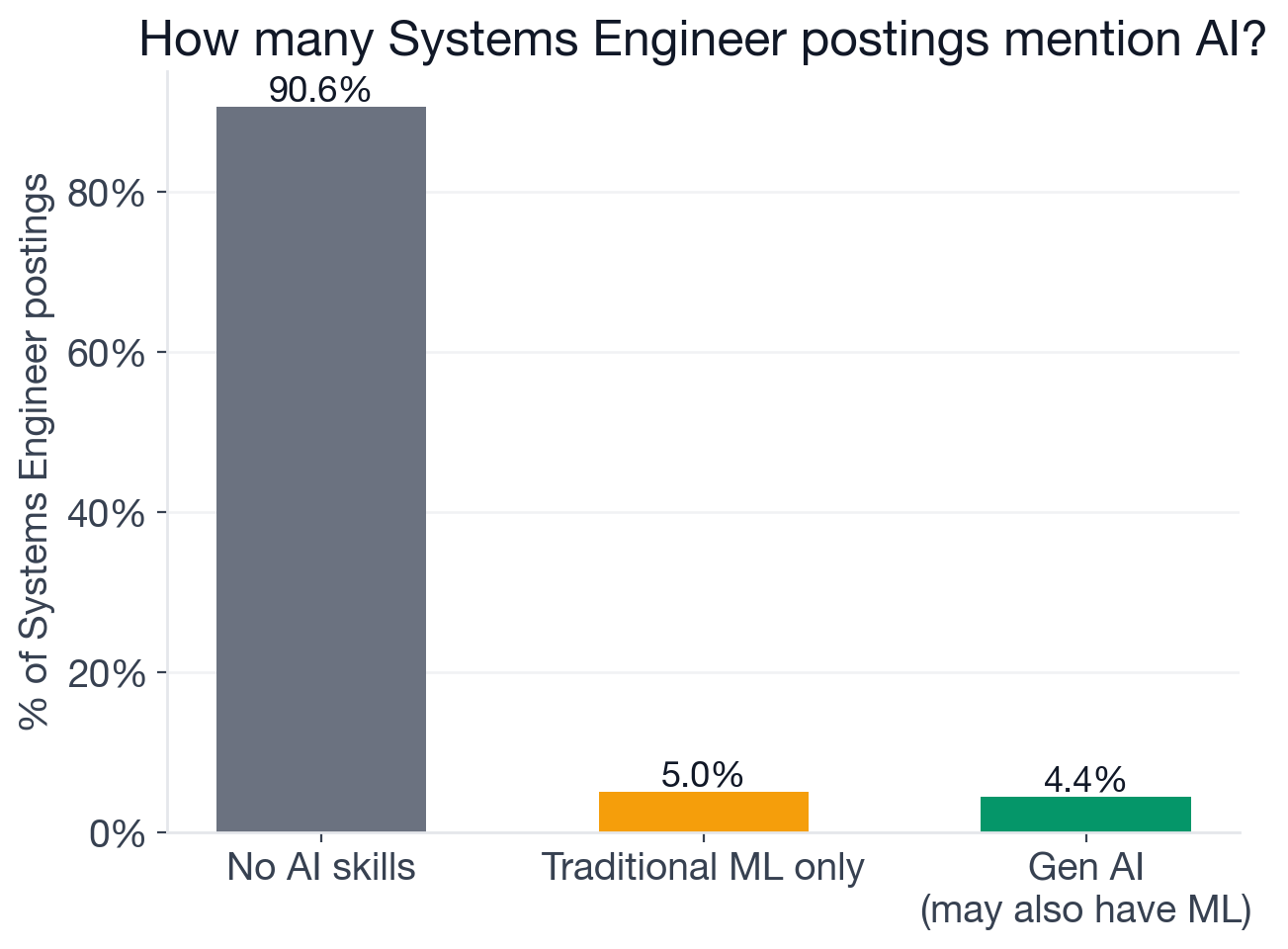
Share of active Systems Engineer postings by AI signal type, May 2026. "New-wave" covers generative AI tools and concepts introduced since 2022; "traditional ML" covers Machine Learning, Deep Learning, and related skills present in postings for five or more years.
The full picture: 9.4% of postings (845) mention any AI signal at all, including traditional ML. The new-wave generative AI slice is 4.4% (394 postings). Traditional ML at 6.2% (554 postings) is actually larger than the new-wave count, reflecting how long machine learning has been embedded in signal processing, sensor fusion, and pattern recognition work that systems engineers have managed for years in defense and aerospace.
What is shifting is the application layer. The traditional ML signal means "this role touches machine learning systems as part of a broader architecture." The new-wave signal means "this role involves building infrastructure for, integrating, or managing LLM-based or agent-based systems." That is a meaningfully different job function.
Browse Systems Engineer postings and the AI-specific listings cluster around two patterns: AI-native companies applying SE rigor to their model infrastructure, and defense-tech firms (most notably Helsing) building AI into physical systems. The 90.6% of postings without any AI signal reflects a labor market where the majority of systems engineering demand still comes from sectors that are genuinely not there yet.
Which AI Skills Are Actually Reshaping the Systems Engineer Role?
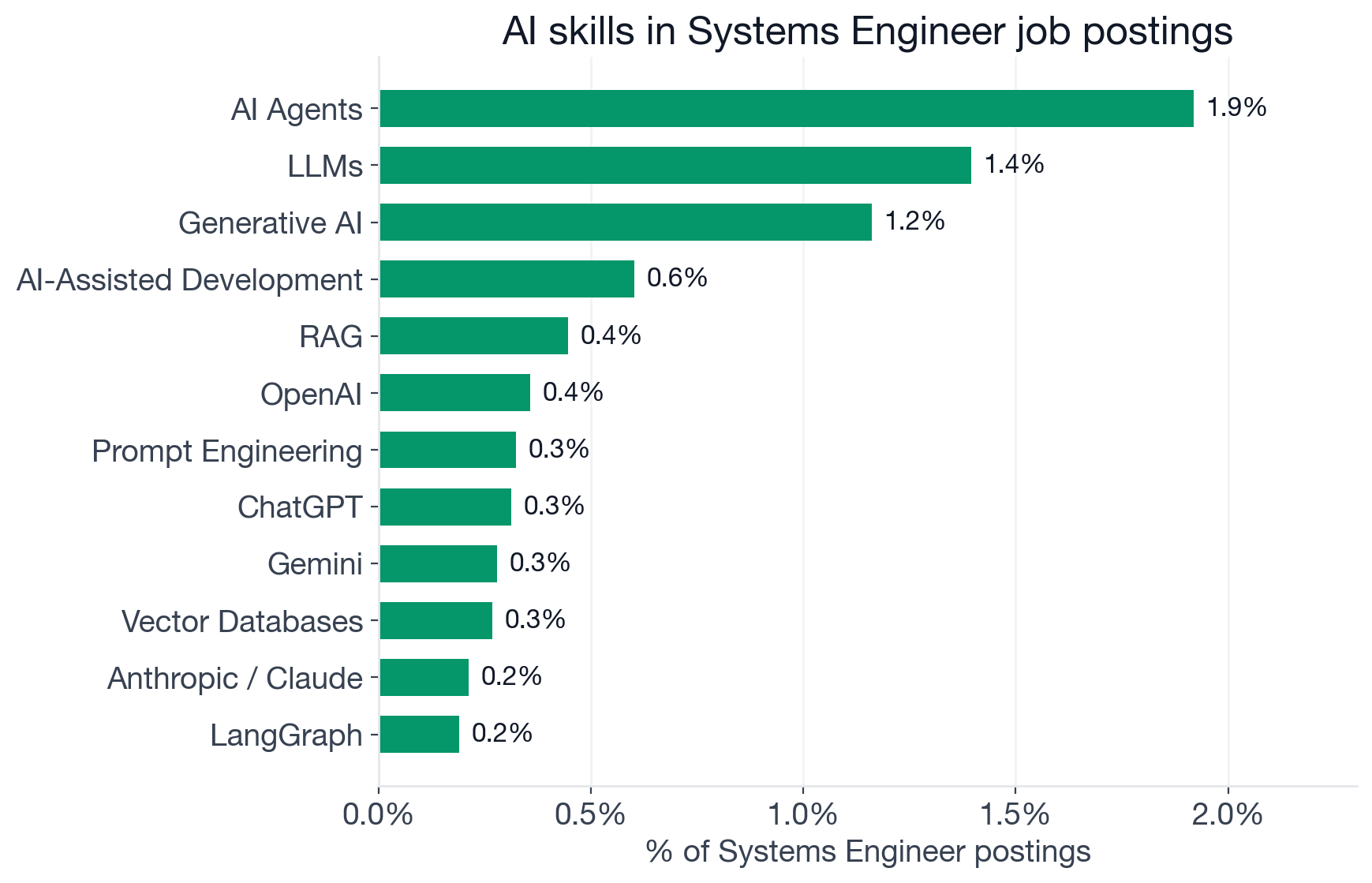
Share of active Systems Engineer postings that mention each AI skill, May 2026. New-wave generative AI skills (post-2022) are shown separately from traditional ML infrastructure.
Machine Learning at 5.9% leads the overall list, but it represents a long-established requirement in signals work, sensor fusion, and embedded intelligence rather than a recent shift. Its presence in roughly 1 in 17 postings reflects the discipline's deep history in defense electronics, where ML-enabled classification and detection have been standard for years.
The new-wave signals point to a more specific transformation. AI Agents at 1.9% is the clearest leading indicator. The postings requiring this are mostly at AI-native companies and tech firms hiring systems engineers to design and operate the infrastructure for agent-based systems: orchestration layers, tool registries, reliability frameworks for non-deterministic pipelines. This is classic systems engineering work applied to a genuinely new class of system. Browse Systems Engineer postings with AI Agents requirements and the descriptions read like reliability engineering specifications for probabilistic software.
LLMs at 1.4% and Generative AI at 1.2% indicate the broader LLM integration requirement: architectural literacy about model APIs, context limits, inference latency, and deployment patterns. This is not research depth; it is enough technical grounding to make informed tradeoffs when an LLM is a component in a larger system architecture.
MLOps at 0.6% (the discipline of putting ML models into production reliably, including monitoring, drift detection, and retraining pipelines) appears at the low end but represents a real skill gap. At tech companies where systems engineers own the ML serving layer, model lifecycle concerns that didn't exist five years ago now fall squarely in scope.
Do AI Skills Pay More for Systems Engineers?
The figures below are US base salary only, drawn from postings with structured salary disclosure. Equity, RSUs, bonuses, and sign-on are not captured in job postings and not in this data; total compensation at top employers is meaningfully higher than what these numbers show.
Among US postings with disclosed salary data, the median base salary for Systems Engineer roles requiring new-wave generative AI skills is $140,000 (n=131). For postings with no AI requirement, the median is $112,017 (n=2,975). The gap is roughly $28,000, about 25% above the non-AI baseline.
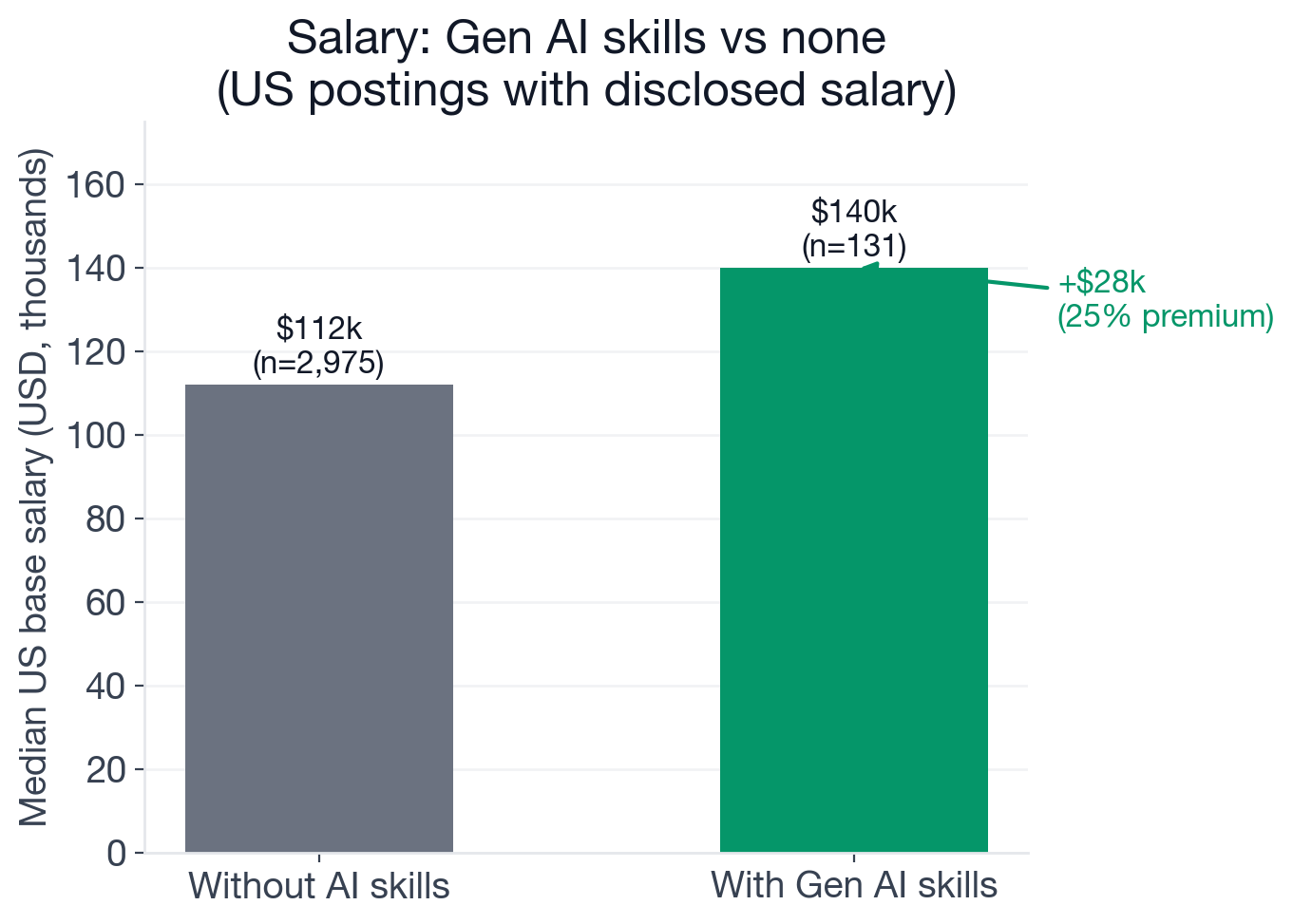
Median US base salary for Systems Engineer postings with and without new-wave AI requirements. US postings with disclosed salary data only; equity and bonuses excluded.
The sample size on the AI-skilled side (n=131) is worth noting. This is a thin market. The $140K median reflects genuine scarcity: the postings driving this figure are almost entirely at AI-native companies or tech firms, where base salaries run higher regardless of any AI requirement. The scarcity premium and the compensation-tier premium compound. Still, a $28K gap on a $112K baseline is the kind of signal that says this specialization is being rewarded, and competition for people who have it is real.
Who Is Leading the AI Shift in Systems Engineer Hiring?
Is AI adoption concentrated at senior levels?
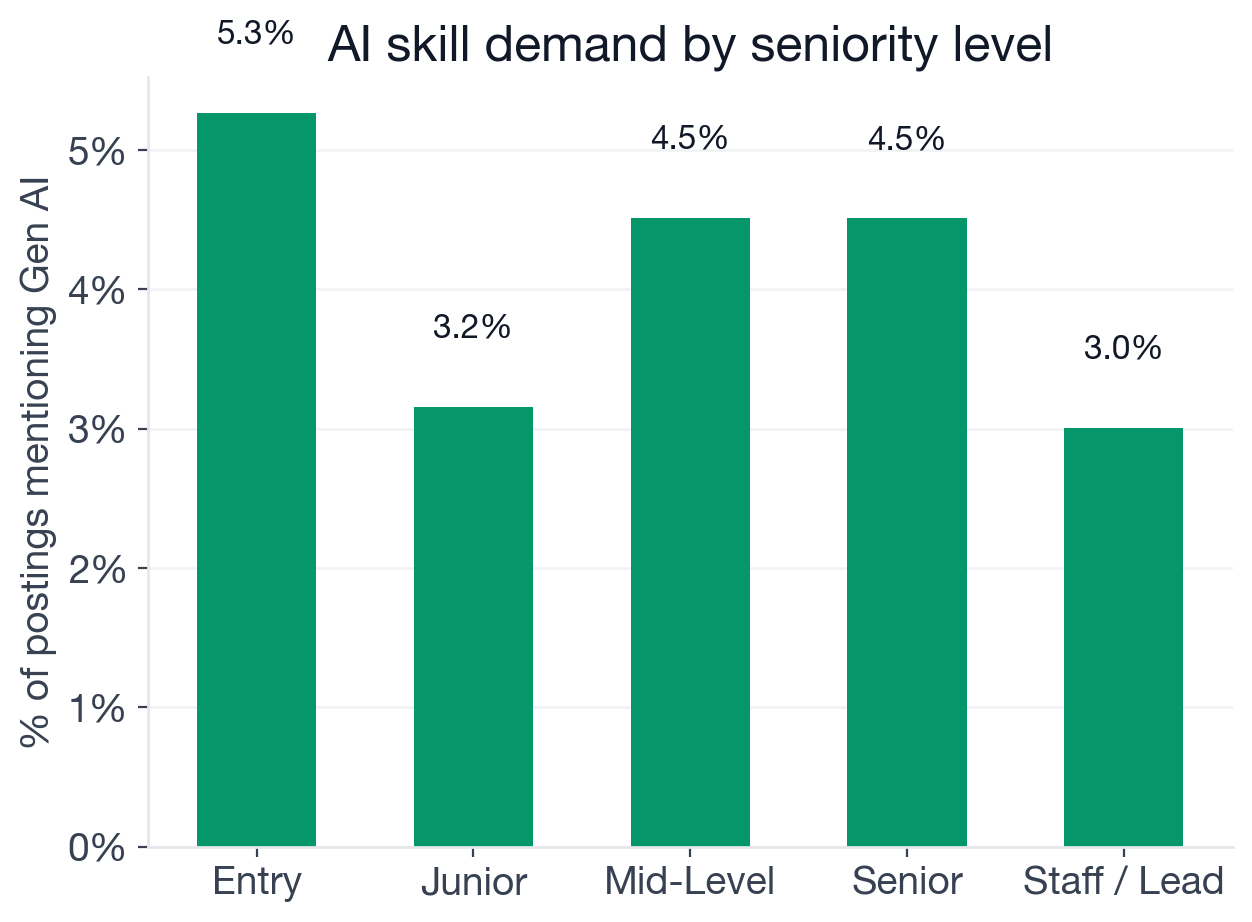
Share of Systems Engineer postings that mention new-wave AI skills, broken down by seniority level, May 2026.
Two things stand out from the seniority data. First, senior roles make up 71% of all Systems Engineer postings, far higher than in most other technical disciplines. Entry-level accounts for just 2.3% of all postings, and junior just 3.5%. Systems engineering is, structurally, a senior-dominated field with a steep entry bar.
Second, AI adoption is flat across all levels: entry at 5.3%, mid-level and senior both at 4.5%, staff at 3.0%. The AI requirement does not cluster at the senior tier. An entry-level systems engineer at an AI-native company will encounter an AI requirement; a senior systems engineer at a defense prime probably won't. Level doesn't predict AI exposure. Employer does.
Which industries are driving the shift?
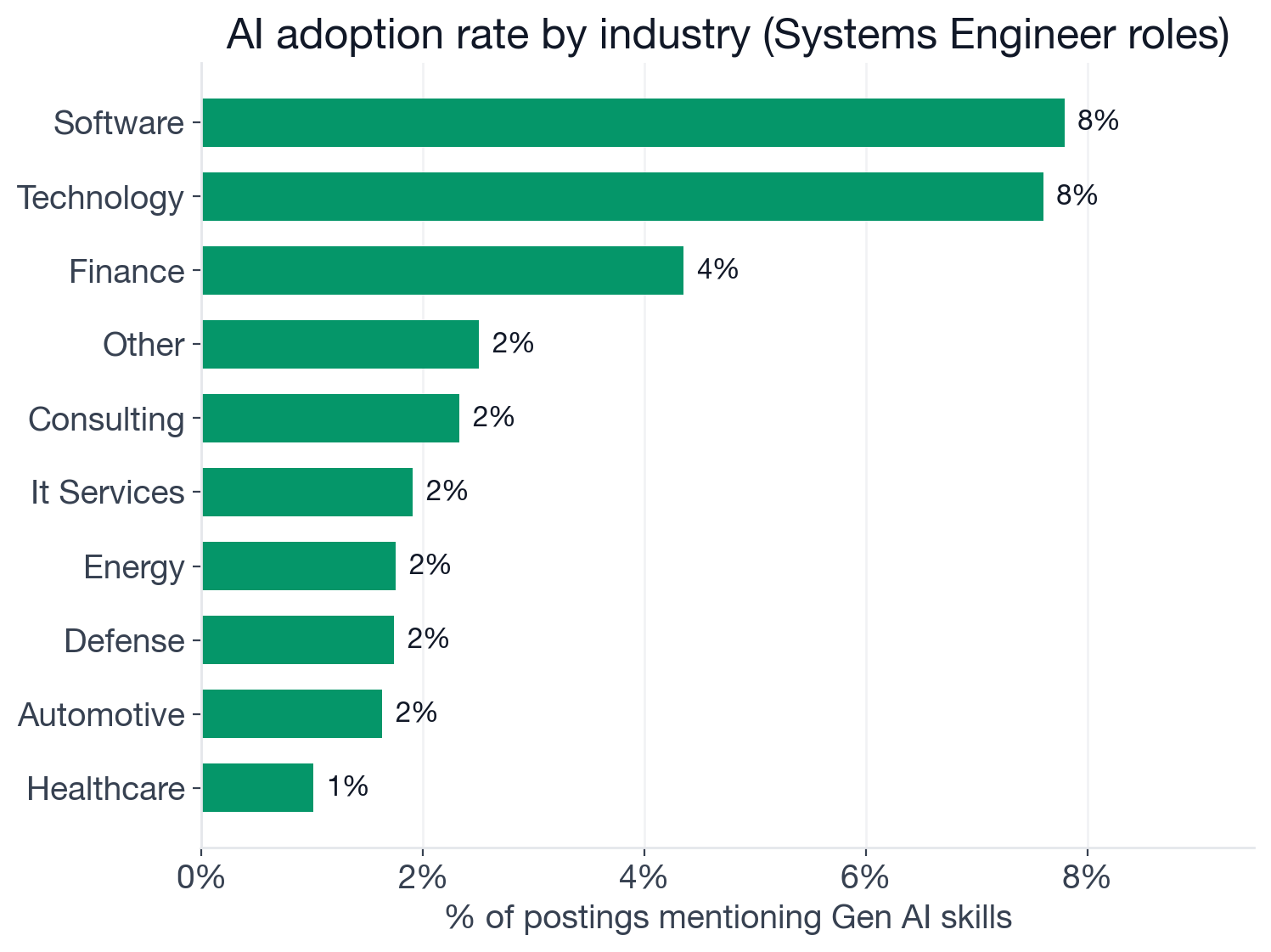
Share of Systems Engineer postings that mention new-wave AI skills, by industry sector, May 2026.
The industry breakdown tells the most revealing story in the dataset. Software companies show 7.8% AI adoption and technology firms 7.6%, meaningful numbers that reflect a genuine redefinition of what systems engineering means in those environments. Finance sits at 4.3%.
Then the gap: defense at 1.7%, aerospace at 0.6%.
Aerospace alone accounts for 11.7% of all Systems Engineer postings: 1,050 of 8,964. With only 6 of those postings mentioning new-wave AI skills, aerospace is the sector that pulls the aggregate figure down. The reasons are structural. Aerospace systems engineering operates under frameworks like DO-178C and AS9100 where novel tooling requires rigorous qualification before it enters the design process. AI-assisted development and LLM-based tools don't fit neatly into those workflows yet. This is not complacency; it is a controlled environment where the cost of a tooling failure is measured in flight safety, not sprint velocity.
Which companies are at the leading edge?
Among companies with meaningful Systems Engineer postings in the dataset, the highest AI adoption rates belong to firms where AI is literally the product. OpenAI and Anthropic post 100% of their Systems Engineer roles with AI requirements. Helsing, an AI-focused defense-tech company building machine learning into physical defense systems, reaches 87.5% (14 of 16 postings): the most interesting entry on this list because it represents the intersection of traditional defense systems engineering and the new AI wave. Salesforce shows 100% across its 7 postings.
NVIDIA at 19.2% (5 of 26 postings) bridges the hardware and AI worlds: a company with deep roots in systems-level GPU engineering now requiring AI skills in a meaningful share of its SE roles. Royal Bank of Canada at 53.8% (7 of 13 postings) stands out as the highest financial services adopter, suggesting that some banks are treating their AI infrastructure with the same systematic rigor they applied to trading systems.
Defense primes like Leidos (4.7%, 5 of 107 postings) show low but real AI signals. Small fractions of very large posting volumes: a sign that even the traditional defense segment is beginning to hire for AI-aware systems engineers, even if it is not yet a primary requirement.
How Should You Apply This to Your Systems Engineer Job Search?
The data draws a clear picture of a divided market. The roughly 90% of Systems Engineer roles without any AI requirement are concentrated in the segments that have always hired most systems engineers: defense, aerospace, embedded systems, and infrastructure. Those roles remain plentiful. But the 4-5% requiring new-wave AI skills are concentrated at the companies with the strongest compensation, the fastest growth, and the most technically novel environments.
If you are targeting AI-forward Systems Engineer roles, the gap to close is not ML research depth. It is architectural literacy about AI systems: how LLMs are deployed and monitored, how agent workflows are structured, how to apply classic verification and validation thinking to probabilistic systems. Our interview-prep courses cover AI systems design and reliability engineering concepts that translate directly to SE panel interviews at companies like OpenAI, Anthropic, and Helsing.
If you are in traditional defense or aerospace SE, the short-term impact on your day-to-day is limited. But the Leidos and defense-prime signal matters: even the largest contractors are beginning to hire systems engineers who can manage AI components within larger system architectures. Building that literacy now, before it becomes a hard requirement, is how you stay ahead of the shift without abandoning the domain expertise you have accumulated.
For the interview process, the question bank includes system design and integration topics that are now showing up in SE panel interviews at tech and AI-native companies, including AI infrastructure scenarios around reliability, observability, and agent-system design. AI mock interviews let you practice the kind of systems design round with AI infrastructure constraints that you will encounter at AI-first employers.
Filter for your current level of fluency. Systems Engineer postings requiring Machine Learning represent the accessible entry point for candidates with adjacent ML experience. Postings requiring AI Agents are the higher-bar target for candidates ready to define and manage agent-first system architectures.
FAQ
Q. How is AI changing the Systems Engineer role in 2026?
About 1 in 23 active Systems Engineer postings (4.4%, or 394 of 8,964 analyzed in May 2026) now explicitly require new-wave generative AI skills. The shift is concentrated at software and technology companies (7.6-7.8% AI adoption) and pure-play AI firms, while the larger defense and aerospace segment (which accounts for over 15% of postings) barely registers. The practical change is that a growing minority of systems engineers are being asked to apply classic SE discipline: requirements definition, architecture, verification, and integration to AI systems rather than traditional software.
Q. What is the salary premium for Systems Engineers with AI skills in 2026?
Among US postings with disclosed salary data, Systems Engineer roles requiring new-wave generative AI skills show a median base salary of $140,000 (n=131), compared with $112,017 (n=2,975) for postings without any AI requirement. That is a premium of roughly $28,000, or about 25% above the non-AI baseline. These figures are US base salary only; equity and bonuses are not included.
Q. Which AI skills are most in demand for Systems Engineer roles?
Machine Learning leads overall at 5.9% of postings (533 of 8,964), though it reflects a multi-year baseline requirement rather than a recent shift. Among new-wave generative AI skills, AI Agents tops the list at 1.9% (172 postings), followed by LLMs at 1.4% (125 postings), Generative AI at 1.2% (104 postings), and AI-Assisted Development at 0.6% (54 postings). RAG and Prompt Engineering each appear in under 0.5% of postings.
Q. Which industries show the most AI adoption in Systems Engineer postings?
Software companies lead at 7.8% AI adoption in their Systems Engineer postings, followed closely by technology firms at 7.6%. Finance sits at 4.3%. The sectors that dominate Systems Engineer hiring volume, defense and aerospace, show the lowest AI adoption rates: 1.7% and 0.6% respectively. Aerospace alone accounts for 11.7% of all Systems Engineer postings but only 0.6% mention new-wave AI skills.
Q. Is AI adoption in Systems Engineer roles concentrated at senior levels?
No. AI adoption rates are nearly flat across seniority levels: entry at 5.3%, mid-level at 4.5%, senior at 4.5%, and staff at 3.0%. Senior roles dominate overall at 71% of all Systems Engineer postings, but the AI adoption rate within the senior tier matches mid-level almost exactly. This suggests the AI requirement follows company type and industry sector more than career stage.
Q. Which companies are leading the AI shift in Systems Engineer hiring?
Pure-play AI companies show the highest rates: OpenAI and Anthropic post 100% of their Systems Engineer roles with AI requirements. Helsing, an AI defense-tech company, reaches 87.5% (14 of 16 postings). Salesforce shows 100% across its 7 Systems Engineer postings. NVIDIA sits at 19.2% (5 of 26 postings). Royal Bank of Canada shows 53.8% (7 of 13 postings), making financial services a notable outside-tech adopter.
Q. How much of the Systems Engineer job market requires AI skills in 2026?
Of 8,964 active Systems Engineer postings analyzed in May 2026, 9.4% (845) mention any AI signal including traditional ML. The new-wave generative AI slice reaches 4.4% (394 postings). Roughly 90% of the Systems Engineer market does not require any AI at all, reflecting the role's deep roots in defense, aerospace, and embedded systems where AI adoption is significantly slower than in software-native industries.
Final Thoughts
Systems engineering is one of the few technical disciplines where AI's arrival looks completely different depending on which corner of the market you inhabit. For most systems engineers, particularly those in aerospace and defense, the day-to-day work has not fundamentally changed yet. For the growing minority at AI-native companies and tech firms, the role has evolved into something genuinely new: applying classic systems engineering rigor to probabilistic, LLM-powered, agent-driven products that don't behave like the systems the discipline was built to manage. The $28,000 salary gap between those two populations is the market's clearest signal of where the pressure is building and where it will arrive next.
Topics
Ready to practice?
Put what you've learned into practice with AI mock interviews and structured preparation guides.