
The Information Security Analyst Compliance Frameworks and Certification Standards Interview Is Won by What You Don't Pursue
In the first eight minutes of a mid-level Information Security Analyst interview on compliance frameworks and certification standards, the interviewer hands you a scenario built to tempt you into promising everything: a B2B SaaS company that enterprise customers want SOC 2 from, and a handful of U.S. public sector prospects who might eventually need FedRAMP. The instinct is to commit to both, then map in ISO 27001, PCI DSS, and NIST CSF for good measure so the answer sounds comprehensive. The rubric punishes exactly that instinct. This walkthrough runs on the real interview package InterviewStack.io's AI interviewer uses for a mid-level Information Security Analyst round on compliance frameworks and certification standards, the same blueprint scored by the Information Security Analyst question bank if you want to drill the underlying concepts first.
Every one of this interview's three phases tests some version of the same discipline: can you choose one credible, defensible path instead of chasing the appearance of covering every framework in the room. A candidate who reaches for the safer-sounding answer, more certifications, wider scope, more evidence than anyone asked for, loses points phase after phase, even when every individual fact they state is technically correct.
Key Findings
- This mid-level interview runs 30 minutes across 3 phases: framework selection (0-8 min), control mapping and readiness planning (8-20 min), and tradeoffs and steady-state operations (20-30 min).
- Interviewer Objectives Alignment and Level-Specific Expectations each carry 30 of the 100 rubric points, 60 combined, versus 20 each for Technical Proficiency and Communication and Problem Solving.
- The scenario puts 7 named frameworks in play (SOC 2, ISO 27001, NIST CSF, NIST 800-53, PCI DSS, CIS Controls, and FedRAMP) that a mid-level candidate has to reconcile without committing to all of them.
- Phase 1's checklist has 4 items and explicitly rewards avoiding overcommitment to unnecessary certifications in year one.
- Phase 2 runs 12 of the 30 minutes, the interview's longest block, and expects named evidence across control domains including IAM, logging, and vulnerability management.
- Phase 3 covers the final 10 minutes and scores whether a compensating control genuinely offsets risk, or is just an exception in disguise.
- The interviewer has 6 follow-up prompts available; this walkthrough dramatizes 4 of them.
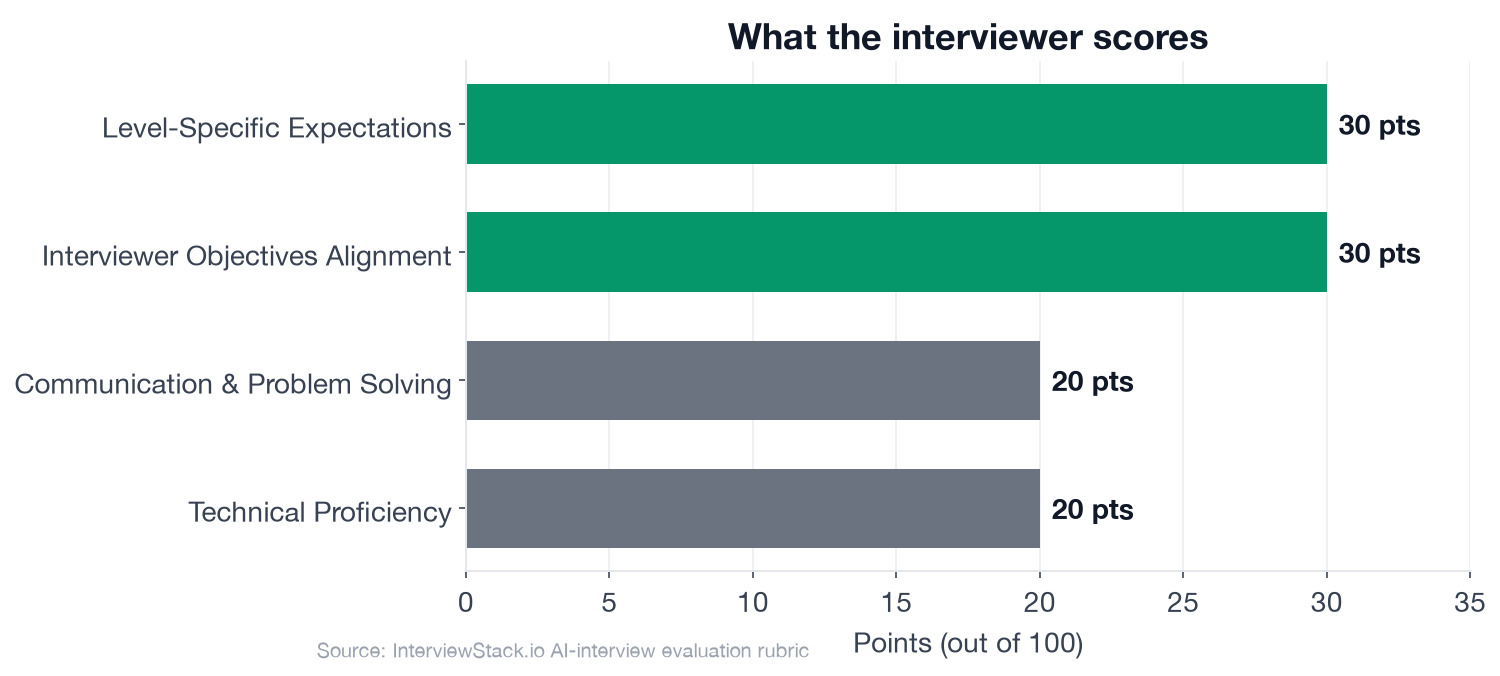
The two highest-weighted dimensions, worth 60 of the 100 points, score how credibly you frame and sequence the compliance program, not how many frameworks you can name.
What Is the Interviewer Actually Testing With This SaaS Scenario?
Here's the scenario as it appears in the live blueprint:
The interview question
Your company is preparing to launch a B2B SaaS product that processes customer support tickets, stores limited payment-related data through an external payment processor, and wants to sell to both enterprise customers and a small number of U.S. public sector customers within the next 12 months. The product runs in a public cloud environment, uses SSO for employees, has a small security team, and engineering has asked for the lightest-weight path that still supports sales goals.
You have been asked to define the compliance and certification approach for the first year. How would you approach selecting the right compliance framework or frameworks and getting the organization ready for a successful assessment?
The interviewer is scoring whether you frame the decision around business drivers and data types before naming any framework, propose a credible sequencing and scope instead of an exhaustive one, and reason like someone accountable for a small team's actual bandwidth. This isn't a penetration-testing or forensics round: the blueprint keeps hands-on exploitation techniques, deep coding exercises, malware reverse engineering, and freestanding legal privacy analysis out of scope, staying focused on program judgment instead.
Four Follow-Ups, Same Test: What You Choose Not to Do
The candidate below, Sasha, is dramatized to show where mid-level answers commonly lose points on this scenario, not a transcript of a real session. These four follow-ups move from choosing what to sequence first, to defining what stays out of scope, to proving evidence actually holds up, to deciding when engineering's pushback is legitimate.
Turn 1: Sequencing SOC 2 and FedRAMP
Interviewer: "If sales says enterprise prospects are asking for SOC 2 while the public sector opportunity may require FedRAMP-related planning, how would you recommend sequencing the work and explain that recommendation to leadership?"
Turn 2: Drawing the Assessment Boundary
Interviewer: "What would you include in scope for the first assessment, and what would you deliberately keep out of scope to reduce risk and effort without undermining credibility?"
Turn 3: Making Evidence Auditor-Grade
Interviewer: "What evidence would you expect to collect for a few key control areas, and how would you validate that the evidence will actually satisfy an auditor rather than just look complete internally?"
Turn 4: Judging a Compensating Control
Interviewer: "Suppose engineering says one required control will slow down release velocity or require tooling they do not have yet. How would you handle that tradeoff and decide whether a compensating control is acceptable?"
Why Doesn't Spotting the Overcommitment on the Page Stop You From Doing It Live?
Every mistake above reads obviously wrong once it's sitting on the page with the fix written right underneath it. Live, there's no fix underneath the question, just an interviewer who follows up on whatever scope you just claimed and a checklist you can't see. Knowing "don't chase every framework" in the abstract is different from not reaching for FedRAMP the moment public sector gets mentioned, under a clock, with three more follow-ups still coming. The only way to build that instinct is reps in the AI mock interview itself.
What Does a Credible Year-One Compliance Plan Actually Include?
The chart below maps how the interview's 13 checklist items are distributed across framing, control mapping, and steady-state operations.
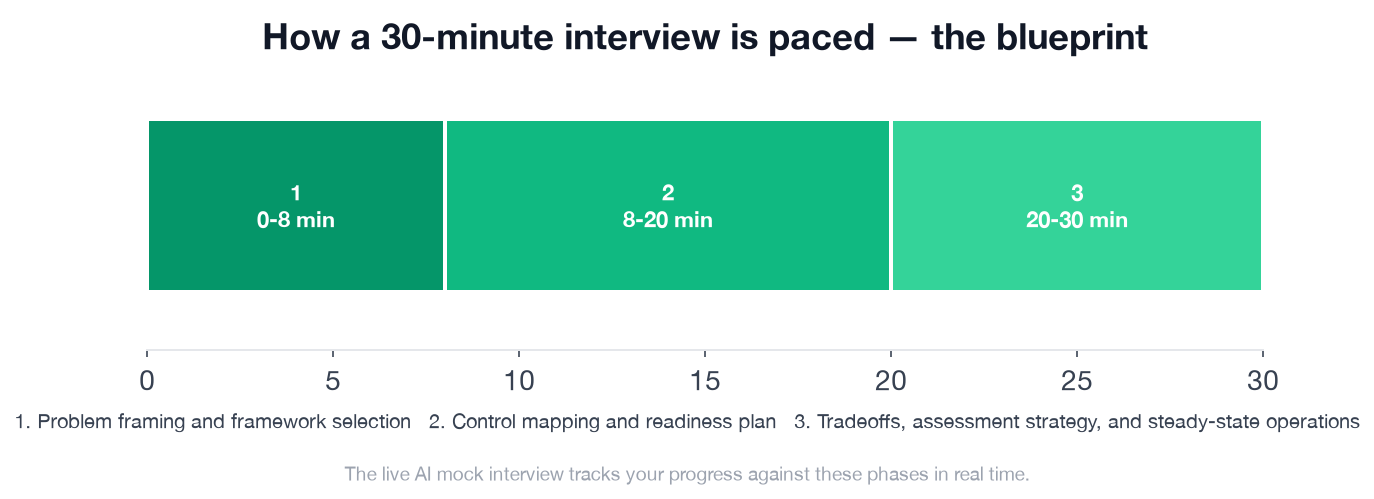
Control mapping and readiness planning, the middle 12 minutes, carries the most checklist items of the three phases at 5 of 13, and it's where the scope decisions from Turn 2 either hold up or unravel.
This is the blueprint a strong candidate hits, phase by phase, and the exact structure the AI mock interview tracks you against while you're answering, not after:
- ✓Asks or states key assumptions about customers, data handled, deployment model, and sales timeline
- ✓Identifies likely relevance of SOC 2 for enterprise trust, PCI DSS implications based on payment data flow, and higher bar or preparatory value of NIST/FedRAMP concepts for public sector pursuits
- ✓Avoids overcommitting to unnecessary certifications in year one without business justification
- ✓Explains why one framework may be primary while others are mapped or deferred
- ✓Outlines a sequence such as current-state assessment, scope definition, control inventory, remediation plan, evidence collection, and readiness review
- ✓Maps common controls across frameworks into shared domains like IAM, logging, vulnerability management, secure change management, vendor management, business continuity, and incident response
- ✓Discusses system boundaries, in-scope people/processes/technology, and treatment of third-party services
- ✓Names concrete evidence examples such as access reviews, onboarding/offboarding records, ticket approvals, vulnerability scan results, training completion, policy approvals, incident exercises, and vendor due diligence artifacts
- ✓Assigns or mentions control ownership across security, engineering, IT, HR, and legal or procurement
- ✓Explains how to evaluate compensating controls and when auditor acceptance may be uncertain
- ✓Prioritizes high-risk gaps and distinguishes must-have controls from maturity improvements
- ✓Describes a realistic cadence for recurring access reviews, evidence collection, control testing, policy review, vendor reassessment, and audit prep
- ✓Communicates sequencing and residual risk in business terms appropriate for leadership and go-to-market teams
Practice the Sequencing Call Before It's Live
Reading Sasha's four mistakes is the easy part. The AI mock interview for Information Security Analyst compliance frameworks and certification standards runs this same SOC 2 versus FedRAMP scenario, follows up based on what you actually propose, and scores you across all four rubric dimensions the moment the 30 minutes end, not on a re-read of this post. For focused drilling first, the question bank for compliance frameworks and certification standards covers framework selection, control mapping, and evidence planning with worked answers, and the InterviewStack.io preparation guide maps how this topic fits into the broader Information Security Analyst prep path.
FAQ
Q. What does a mid-level Information Security Analyst compliance frameworks and certification standards interview actually test?
The interview runs 30 minutes across 3 phases: problem framing and framework selection (0-8 min), control mapping and readiness plan (8-20 min), and tradeoffs, assessment strategy, and steady-state operations (20-30 min). The rubric weights Interviewer Objectives Alignment and Level-Specific Expectations at 30 points each, so business-first judgment accounts for 60 of 100 points, with Technical Proficiency and Communication and Problem Solving worth 20 points each.
Q. Should a company pursue SOC 2 and FedRAMP at the same time in year one?
Not according to this blueprint's checklist. Phase 1 rewards avoiding overcommitment to unnecessary certifications in year one without business justification, and explaining why one framework should be primary while others are mapped or deferred. For a small security team with only a handful of public sector prospects, SOC 2 Type II is the faster path to the larger enterprise pipeline, while NIST 800-53-aligned control design keeps a future FedRAMP push from starting at zero, without committing to the full authorization process, which typically involves a third-party assessor and a sponsoring agency, before the business case justifies it.
Q. How should scope be defined for a first compliance assessment?
Narrow enough to stay defensible for a small security team, not the whole company. The Phase 2 checklist expects the candidate to discuss system boundaries, in-scope people, processes, and technology, and treatment of third-party services, which in practice means production systems that touch customer data, the specific employees with access, and the payment processor treated as a vendor covered by its own attestation rather than pulled directly into scope.
Q. How do you map overlapping controls across frameworks like ISO 27001, NIST, and PCI DSS?
By building one shared control inventory instead of implementing the same requirement multiple times in different language. The Phase 2 checklist rewards mapping common controls into shared domains such as identity and access management, logging and monitoring, vulnerability management, secure change management, vendor management, business continuity, and incident response, then pointing each framework's specific language back to that one domain.
Q. What evidence does an auditor actually expect for a compliance assessment?
Concrete, dated, traceable artifacts, not screenshots and policy PDFs. The Phase 2 checklist names examples like access reviews, onboarding and offboarding records, ticket approvals, vulnerability scan results, training completion, policy approvals, incident exercises, and vendor due diligence artifacts. A strong candidate also describes validating the evidence with a pre-audit walkthrough, sampling one control and tracing it end to end the way an auditor would.
Q. How should a compliance analyst handle engineering pushback on a required control?
By evaluating whether a compensating control genuinely offsets the risk rather than granting a blanket exception. The Phase 3 checklist rewards explaining how to evaluate compensating controls and when auditor acceptance may be uncertain, prioritizing high-risk gaps over maturity improvements, and communicating the resulting sequencing and residual risk in business terms leadership can act on.
Q. How should I prepare for an Information Security Analyst compliance frameworks and certification standards interview?
Practice naming which framework is primary and why within the first few minutes, scoping an assessment to a defensible system boundary, naming auditor-grade evidence instead of generic artifacts, and evaluating compensating controls on their merits instead of rubber-stamping engineering's request. The InterviewStack.io AI mock interview for Information Security Analyst compliance frameworks and certification standards tracks you against the live blueprint in real time.
What You Don't Chase Earns the Points
Nothing in this scenario asks you to name every framework you've heard of. It asks you to notice, four separate times, that the safer-sounding answer commits to more than a small team can defend: more certifications, more scope, more evidence than anyone asked for. That's a judgment call, not a compliance-trivia one, and it only sharpens under the same time pressure and unscripted follow-ups a live interview actually applies.
Topics
Ready to practice?
Put what you've learned into practice with AI mock interviews and structured preparation guides.