
A Closed Ticket Is Not a Fixed Finding
Picture a mid-level Information Security Analyst interview where the dashboard shows thousands of open items, leadership sees no risk reduction, and you have two quarters to fix it. A well-prepared candidate, Marcus, sails through the lifecycle diagram and then loses points on four small answers nobody warned them about. Below is an illustrative walkthrough built from a real InterviewStack.io AI mock interview package. The answers are dramatized, not a transcript.
Key Findings
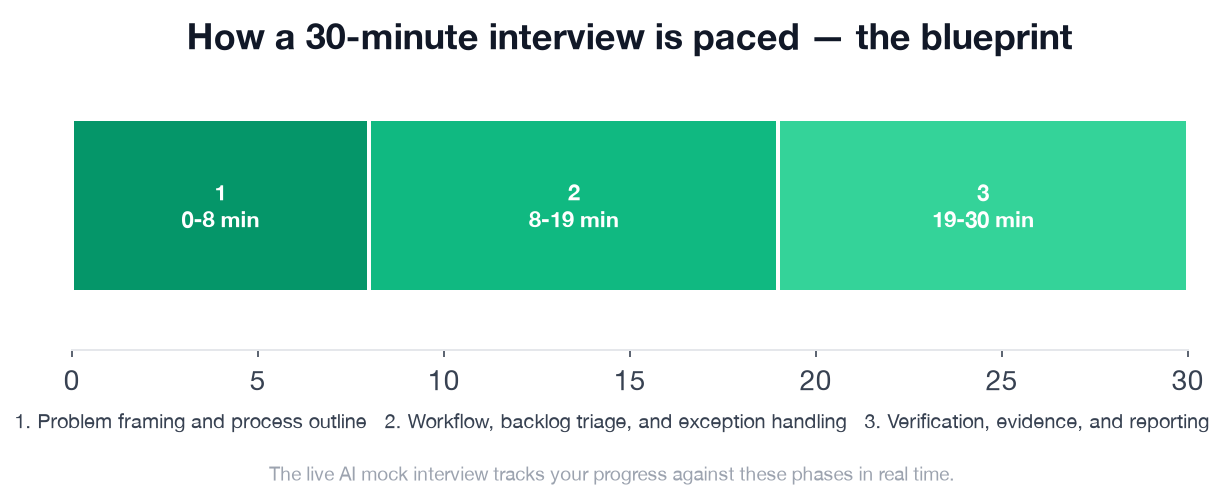
- The interview runs 30 minutes in 3 phases: 0-8, 8-19, and 19-30 minutes.
- The rubric totals 100 points: Interviewer Objectives Alignment 30, Level-Specific Expectations 30, Technical Proficiency 20, Communication & Problem Solving 20.
- Process judgment carries 60 of 100 points; Technical Proficiency only 20.
- The middle phase (workflow, backlog triage, exceptions) runs 11 minutes and has 6 checklist items, tying the final phase on both counts; framing is the shortest at 8 minutes with 5 items.
- The scenario spans about 250 engineering teams and 5 finding sources.
- Phase 3 (verification, evidence, reporting) has 6 checklist items, including at least 1 metric pitfall you must name.
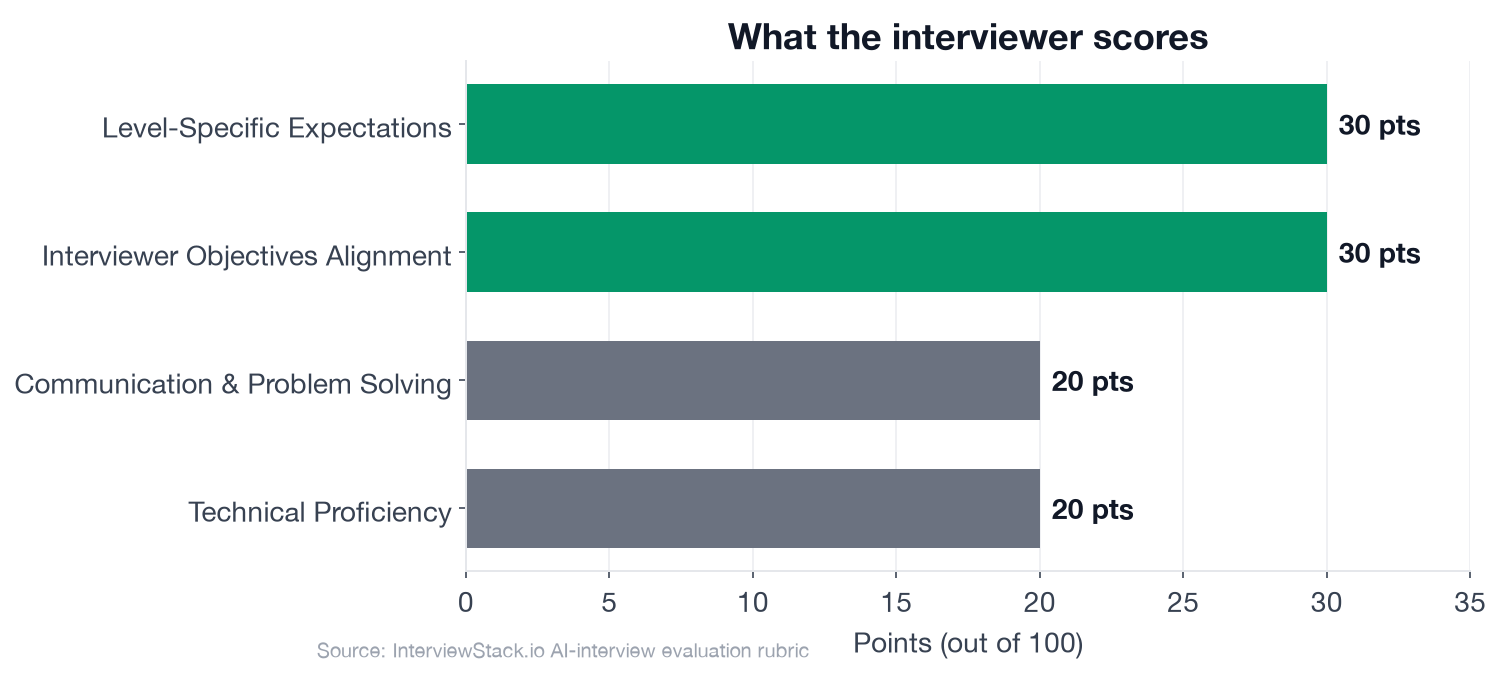
Process judgment outweighs technical depth three to one, so the winning answers are about decisions, not about which scanner you know.
What Is the Interviewer Really Testing in an Information Security Analyst Remediation Interview?
The interview question
You join the product security team for a cloud SaaS company with about 250 engineering teams and several finding sources: weekly infrastructure scans, container image scans in CI, annual penetration tests, bug bounty submissions, and post-incident corrective actions. Findings are tracked inconsistently across Jira projects and spreadsheets, duplicates are common, remediation SLAs vary by team, and leadership is frustrated that dashboards show lots of open items but do not reflect actual risk reduction.
How would you design and run a findings management process so findings move from intake to verified closure in a way that works for engineers, gives security useful visibility, and stands up to audit scrutiny? Your proposal should be rolled out over the next two quarters.
The interviewer is probing whether you can build a workable lifecycle for a defined environment, prioritize by business impact, control premature closure and exceptions, and report honestly to engineers, executives, and auditors. Finding or scoring vulnerabilities is off the table.
Four Turns Where Mid-Level Candidates Lose Points
Turn 1: The Thousand-Ticket Backlog
Interviewer: "If one business unit has a backlog of thousands of aging findings, how would you triage it without creating noise or losing genuinely urgent issues?"
Turn 2: Closed Before Fixed
Interviewer: "What workflow states and ownership model would you use, and how would you prevent tickets from appearing closed before remediation is actually verified?"
Turn 3: The Vendor Won't Patch
Interviewer: "How would you handle time-bound risk acceptance when a team cannot meet SLA because of a vendor dependency or an upcoming production freeze?"
Turn 4: What the Dashboard Hides
Interviewer: "What metrics would you report to engineering leaders versus auditors, and what are the common ways those metrics get misinterpreted?"
Why Isn't Reading This Enough?
Spotting these mistakes on the page is easy. Avoiding them live is the real skill: the clock runs, the interviewer asks an unscripted follow-up, and the answer you rehearsed no longer fits. Only reps close that gap, ideally against something that pushes back.
The Complete Blueprint a Strong Candidate Hits
This is the pacing and checklist a strong answer covers. It is also exactly what the AI mock interview tracks you against in real time.
- ✓Clarifies at least a few key assumptions such as finding sources, ticketing system, team ownership model, or audit expectations
- ✓Outlines a lifecycle from intake through closure rather than focusing only on one step
- ✓Separates finding intake from remediation tracking and notes the need to link them
- ✓Anchors prioritization in business impact and service context, not just severity labels
- ✓Keeps the proposal practical for a two-quarter rollout
- ✓Proposes concrete workflow states such as new, triaged, assigned, in progress, pending verification, closed, duplicate, exception approved, or blocked
- ✓Defines who owns triage versus who owns remediation and when ownership transfers
- ✓Describes a triage method for large backlogs that groups by asset criticality, control family, root cause, team, or recurring issue pattern
- ✓Explains how exceptions are time-bound, approved by appropriate owners, and revisited before expiration
- ✓Includes escalation behavior for SLA breaches, blocked items, or high-risk aging findings
- ✓Distinguishes blocked or vendor-dependent findings from accepted risk and from active remediation
- ✓Requires objective closure evidence such as scan results, configuration evidence, code or PR references, deployment confirmation, or retest notes
- ✓Describes when automated re-scan is sufficient versus when manual validation or penetration retest is needed
- ✓Explains a basic deduplication approach using stable identifiers or matching dimensions like asset, weakness type, location, and source correlation
- ✓Chooses metrics that reflect remediation progress and risk reduction, such as aging by critical asset group, SLA attainment by finding class, reopened rate, exception volume, and verification lag
- ✓Notes at least one metric pitfall, such as open-count dashboards driving ticket splitting behavior or closure-rate metrics hiding high-risk aging items
- ✓Mentions preserving auditor-ready history: timestamps, approvers, evidence links, state changes, and mapping to compliance controls
Run the Mock Interview Before the Real One
Start the AI mock interview for this exact scenario and get scored against the 100-point rubric above, with follow-ups that adapt to what you actually say. To drill the underlying concepts first, work through the findings management question bank, browse the security analyst prep guides, or see current Information Security Analyst openings.
FAQ
Q. What does a mid-level Information Security Analyst findings management interview test?
It tests whether you can run the full lifecycle from intake to verified closure: normalization, deduplication, prioritization by business impact, ownership, SLAs, time-bound exceptions, retest, and reporting for engineers, executives, and auditors. Discovering and scoring vulnerabilities is out of scope.
Q. How is the AI mock interview scored?
Out of 100 points: Interviewer Objectives Alignment 30, Level-Specific Expectations 30, Technical Proficiency 20, and Communication & Problem Solving 20. Process judgment carries 60 points, tooling only 20.
Q. How long is the interview and how is it paced?
30 minutes in three phases: problem framing and process outline (0-8 minutes), workflow, backlog triage and exceptions (8-19), and verification, evidence and reporting (19-30).
Q. How should I handle a backlog of thousands of aging findings?
Do not work it top to bottom. Group by asset criticality, root cause, owning team, and recurring pattern, so one fix closes many items, and escalate genuinely urgent aging items separately instead of burying them in the pile.
Q. What is the difference between a blocked finding and an accepted risk?
A blocked finding still has an owner and a remediation plan waiting on a dependency such as a vendor. An accepted risk is a deliberate decision, approved by the right owner, time-bound, and revisited before it expires. Mixing them hides real exposure.
Q. Which remediation metrics get misread most often?
Open-count dashboards can reward ticket splitting, and closure-rate figures can hide high-risk items that keep aging. Better signals are aging on critical assets, SLA attainment by finding class, reopened rate, exception volume, and verification lag.
Q. Are these the real questions a specific company asks?
No. The blueprint is illustrative of how a strong findings management interview runs. The dramatized answers are common patterns, not transcripts of real candidates.
Your Move Before the Next Scan Runs
You now know where the points leak: backlog ranking, premature closure, muddy exceptions, and misleading metrics. One live attempt will show you which of the four is yours.
Topics
Ready to practice?
Put what you've learned into practice with AI mock interviews and structured preparation guides.