
Same Size Job Market, Very Different Paychecks
Two titles that sound like adjacent rungs on the same ladder turn out to describe two different jobs with two different paychecks, sitting on top of a job market that is, by count, nearly identical in size. Cybersecurity Engineer postings carry a median US base salary of $165,000, a full $66,000 above the $99,000 median for Information Security Analyst postings, even though the two roles post almost the same number of openings.
We looked at every active posting for both titles on the InterviewStack.io job board as of July 2026: 5,649 Information Security Analyst listings and 5,513 Cybersecurity Engineer listings, with skills extracted from descriptions and normalized. That is a volume ratio of 1.02, the two markets are within 2.5% of each other in raw size. The pay gap is not a supply story. It is a scope story.
| Information Security Analyst | Cybersecurity Engineer | |
|---|---|---|
| Median US base salary | $99,000 | $165,000 |
| Active postings | 5,649 | 5,513 |
| Top skill | Monitoring (34%) | Automation (46%) |
| Remote share | 8.4% | 20.7% |
| Entry-level share | 3.6% | 1.5% |
| Skill overlap (Jaccard) | 50% (pairwise) | 50% (pairwise) |
Key Findings
- Cybersecurity Engineer's median US base salary ($165,000, n=1,529) is $66,000 above Information Security Analyst's ($99,000, n=1,456), a 40% gap.
- The two roles post at nearly identical volume: 5,649 Analyst listings vs. 5,513 Engineer listings (ratio 1.02).
- Skill overlap is moderate-to-high at 0.50 Jaccard, with 20 skills, including Monitoring, SIEM, Incident Response, and AWS, shared above the 5% threshold in both roles.
- Automation appears in just 13.1% of Analyst postings but 45.6% of Engineer postings, a 3.5x gap that is the clearest single signal of the operate-versus-build divide.
- Entry-level access favors the analyst track: 3.6% of Analyst postings are entry-level versus 1.5% for Engineer, and Engineer postings skew far more senior (40% senior/staff vs. 18.3%).
- Remote work is more common on the engineering side: 20.7% of Engineer postings are remote versus 8.4% for Analyst.
What Does Each Role Actually Do?
An Information Security Analyst spends most of the week inside the tools someone else built: triaging SIEM alerts, running risk assessments, documenting incidents, and translating security posture into language an auditor or a non-technical executive can act on. The job is fundamentally about judgment applied to output that already exists, deciding whether an alert is a real incident, whether a control satisfies a compliance requirement, whether a risk is acceptable.
A Cybersecurity Engineer spends the week building the pipeline the analyst later operates: writing automation and detection logic, wiring security checks into deployment pipelines, hardening cloud infrastructure, and standing up the identity and access controls other teams depend on. The exclusive skill list backs this up directly: application security testing, infrastructure-as-code tooling, and container platforms show up almost exclusively on the engineer side, not the analyst side.
What Skills Do Information Security Analyst and Cybersecurity Engineer Roles Share?
Half the top-30 skill set overlaps (Jaccard 0.50), and the shared list reads like the common language of any security team: Monitoring, Incident Response, SIEM, Risk Management, Risk Assessment, Vulnerability Management, IAM, Network Security, and both major clouds all clear the 5% bar on both sides. If you already know these tools, switching titles will not mean relearning them from scratch.
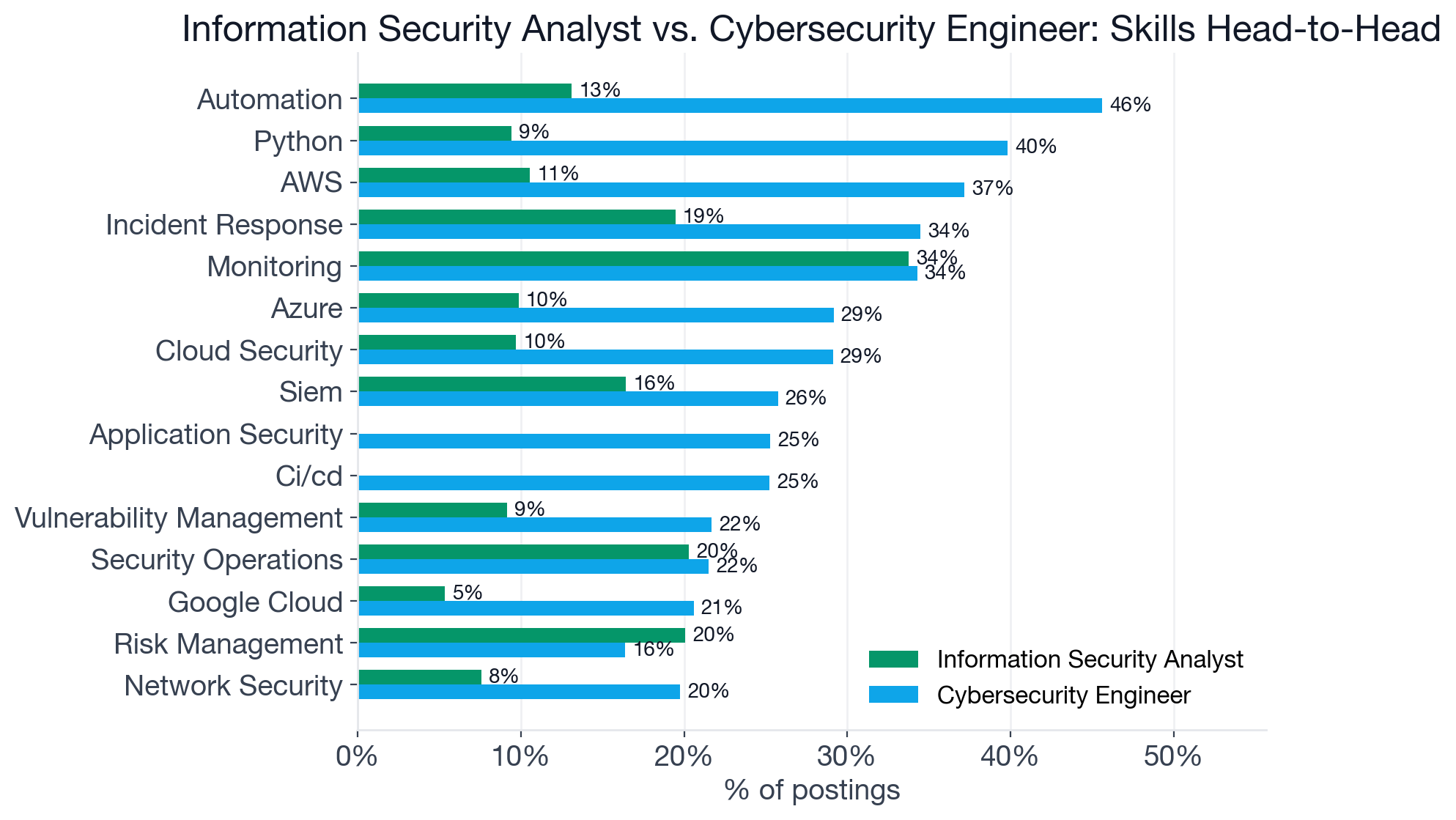
Automation, Python, and AWS are nominally shared skills, but the frequency gap inside them tells the real story below.
But shared does not mean equal. Monitoring sits close together (34% Analyst vs. 34% Engineer), while Automation, Python, and AWS diverge sharply: 13.1% vs. 45.6% for Automation, 9.4% vs. 39.8% for Python, 10.6% vs. 37.2% for AWS. Those three skills are the actual fault line inside the "shared" list: the Analyst role expects you to read output from tools written in Python running on AWS; the Engineer role expects you to write that code and configure that cloud.
Where Operating Ends and Building Begins
The skills that appear almost exclusively in Cybersecurity Engineer postings sketch a build-heavy job: Application Security (25.3%), CI/CD (25.2%), Security Architecture (18.7%), Threat Modeling (18.6%), Kubernetes (15.5%), DevSecOps (14.9%), Terraform (14.1%), OWASP (12.3%, the open-source project behind the standard web-vulnerability checklist), and SAST (11.9%, static application security testing, scanning source code before it ships). None of these clear a meaningful presence in Analyst postings. On the Analyst side, two skills clear the exclusivity bar: Threat Intelligence, at 9.2%, the closer read-and-interpret cousin of the Engineer's build-and-defend work, and Customer Service, at 13.9%. The second one is not a real analyst competency signal, it is a dataset role-matching artifact. The job board's classification pipeline sweeps some physical-security and facilities-security postings into the Information Security Analyst bucket, even though none of those postings are actually titled "Information Security Analyst": their real titles include "Security Guard B," "Security Attendant," and "Data Center Security Officer." That mismatch also shows up in the employer list: the dataset's top three employers by posting volume for this role, Allied Universal, Securitas, and Security Industry Specialists, are physical-security staffing firms rather than SOC or GRC employers, and their guard and attendant listings routinely require customer service, which pulls that skill into the aggregate. Read Threat Intelligence as the genuine analyst-exclusive skill; treat Customer Service as dataset noise, not a real-world title overlap between analysts and security guards.
That Automation gap deserves its own caveat. Job postings in this dataset do not tag "artificial intelligence" as a named skill for either role, so Automation is the closest structural proxy, and it is an imperfect one; in security postings it often means SOAR playbooks and scripting more than generative AI specifically. Read as scope rather than as an AI signal, the 3.5x gap (13.1% vs. 45.6%) still says something real: Engineer postings ask you to build and automate; Analyst postings ask you to operate what already runs. Layered on top of that, broader industry surveys show security teams moving toward real AI adoption regardless of what the job description says. ISC2 puts AI/ML as the top 2026 skill priority for 41% of security teams, and a Cloud Security Alliance survey found 28% of security professionals already using AI tools operationally, with another 41% actively testing or evaluating. Whichever title you hold, expect AI-assisted tooling in your daily workflow well before it shows up as a stated job requirement.
Which Role Pays More in 2026?
Cybersecurity Engineer, by a wide margin. The $165,000 median US base salary is $66,000 above the $99,000 Analyst median, a 40% gap relative to the engineer's number, or a 67% premium seen from the analyst's side. Part of that gap is a seniority effect, not a pure title effect: 40% of Engineer postings are senior or staff level versus 18.3% of Analyst postings, so a chunk of the premium reflects a more experienced pool, not just a different job title. A second effect pulls in the same direction: the physical-security contamination noted above also shows up in the salary data. Customer Service carries a median of just $47,800 (n=282) among Analyst postings, well below the $99,000 baseline, and 282 of the 1,456 US-salary sample is large enough to drag the overall Analyst median down. Between the seniority mix and this data-quality effect, treat the $66,000 headline gap as a reasonable upper bound on the true operate-versus-build pay difference rather than a precise one; the gap for analyst postings doing genuine SOC, GRC, or compliance work is likely smaller.
Among Information Security Analyst postings, specific skills push the median well above baseline: Zero Trust ($155,900, n=41), Security Architecture ($145,000, n=49), Threat Intelligence ($137,500, n=107), and SIEM ($135,000, n=167) all sit roughly $36,000 to $57,000 above the $99,000 analyst baseline. Among Cybersecurity Engineer postings, the standout is RAG ($209,000, n=37, retrieval-augmented generation, the technique behind most production LLM applications), a $44,000 premium that is the single clearest sign that AI-building work commands the biggest paycheck in security engineering, even at a small sample size. More broadly applicable, Threat Modeling ($185,000, n=353), Kubernetes ($180,000, n=247), and Application Security ($175,900, n=357) sit $11,000 to $20,000 above the engineer baseline on much larger samples, the safer bet for most engineers deciding what to learn next.
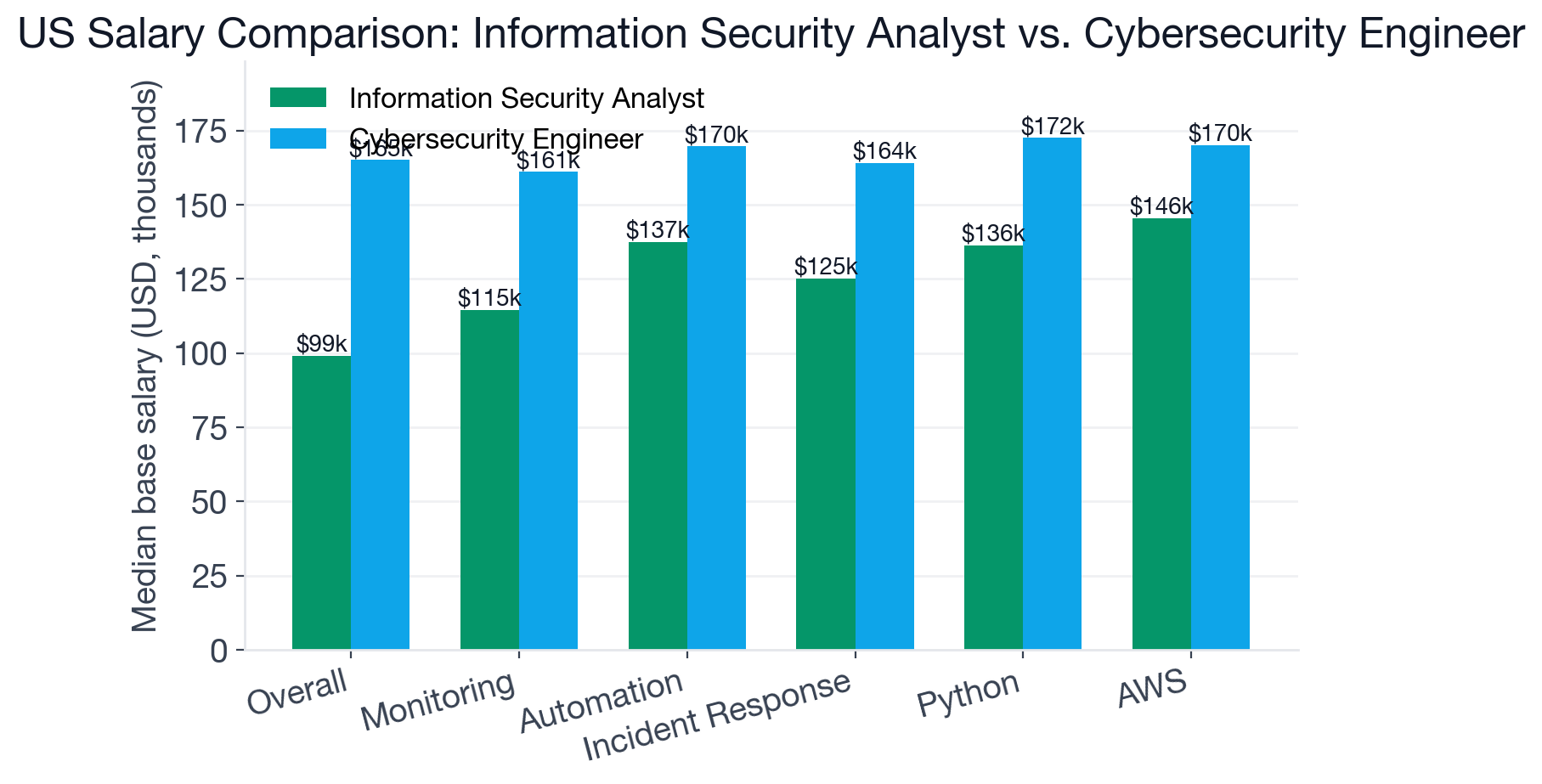
US base salary only; equity, bonus, and sign-on are not disclosed in posting data and are not reflected here.
Which Role Is Easier to Break Into?
Information Security Analyst, at the entry level. 3.6% of Analyst postings (202 of 5,649) are explicitly entry-level versus 1.5% for Cybersecurity Engineer (84 of 5,513), more than double the access rate. That gap compounds up the ladder: 78.2% of Analyst postings sit at mid-level versus 58.5% for Engineer, and Engineer postings pack far more into senior (27.3%) and staff (12.7%) than Analyst does (12.4% senior, 5.9% staff).
Work mode tells a related story about flexibility once you are in the door. Cybersecurity Engineer postings are remote 20.7% of the time and hybrid 34.3%, versus 8.4% remote and 20.4% hybrid for Analyst, whose postings run onsite 73.5% of the time. Geography is close to a wash: the US accounts for 49.8% of Analyst postings and 44.5% of Engineer postings, with India as the clear second market for each (8.0% Analyst, 11.3% Engineer).
Which Should You Choose?
Choose Information Security Analyst if you:
- Want the faster entry path: more than double the entry-level access rate, and a lower bar on hands-on coding
- Are drawn to judgment and interpretation work, alert triage, risk assessment, compliance documentation, over building the tooling
- Are comfortable with an onsite-heavy work reality: nearly three-quarters of postings are not remote or hybrid
Choose Cybersecurity Engineer if you:
- Already write code and want to build detection, automation, and cloud-security infrastructure rather than operate someone else's
- Want the higher pay ceiling and can clear a steeper seniority bar; entry-level access is scarce, and 40% of postings sit at senior or staff
- Want more remote flexibility, roughly 55% of postings are hybrid or remote, versus under three in ten for the analyst track
Put This to Work
If you already work security operations and want to test whether you're ready to move into the engineering track, drill the gap skills directly: practice threat modeling and application security questions in the question bank, and run a mock interview scoped to the Cybersecurity Engineer role to see where your automation and cloud fundamentals actually stand. If you're earlier in the field, InterviewStack's interactive courses cover the cloud and scripting foundations both tracks assume. Either way, browse live Information Security Analyst openings or Cybersecurity Engineer openings to see the current gap firsthand, and check the full Information Security Analyst skills breakdown or Cybersecurity Engineer skills breakdown for the per-role deep dive.
FAQ
Q. What is the salary difference between an Information Security Analyst and a Cybersecurity Engineer?
Cybersecurity Engineer postings carry a median US base salary of $165,000 (n=1,529), versus $99,000 for Information Security Analyst postings (n=1,456), a $66,000 gap. That is a 40% difference relative to the engineer's median, or a 67% premium seen from the analyst's side. Equity, bonus, and sign-on are not included; these are base salary figures only. Part of that gap is a more senior Engineer pool, and part is a data-quality effect: physical-security and facilities-security postings that share the Analyst title (Customer Service median $47,800, n=282) pull the Analyst aggregate lower, so treat $66,000 as an upper-bound estimate rather than a precise figure.
Q. Do Information Security Analyst and Cybersecurity Engineer roles share the same skills?
About half. The Jaccard overlap across each role's top 30 skills is 0.50, and 20 skills clear the shared-skill threshold in both, including Monitoring, Incident Response, SIEM, AWS, and Risk Management. But several of those shared skills appear at very different rates: Automation shows up in 13.1% of Analyst postings versus 45.6% of Engineer postings, a 3.5x gap that signals two different relationships to the same underlying tools.
Q. Is it easier to get an entry-level Cybersecurity Engineer or Information Security Analyst job?
Information Security Analyst is more accessible at entry, 3.6% of postings are explicitly entry-level (202 of 5,649), versus 1.5% for Cybersecurity Engineer (84 of 5,513). Cybersecurity Engineer postings also skew more senior overall: 40% are senior or staff level, compared with 18.3% for Analyst.
Q. Which role has more remote work options?
Cybersecurity Engineer. 20.7% of Cybersecurity Engineer postings are tagged remote versus 8.4% for Information Security Analyst, and onsite work drops from 73.5% of Analyst postings to 54.0% of Engineer postings.
Q. Can an Information Security Analyst move into a Cybersecurity Engineer role?
The 50% skill overlap makes it a realistic path, monitoring, SIEM, incident response, and cloud security fundamentals transfer directly. The gap to close is on the build side: CI/CD (25.2%) and application security testing (25.3%) each appear in about a quarter of Engineer postings, while Kubernetes (15.5%) and Terraform (14.1%) show up less often but still well ahead of the Analyst rate; none of the four are part of the typical Analyst skill set, and postings expect hands-on scripting rather than tool operation.
Q. Are there more Information Security Analyst or Cybersecurity Engineer jobs available?
The two markets are nearly identical in size. Information Security Analyst has 5,649 active postings versus 5,513 for Cybersecurity Engineer, a ratio of 1.02, within 2.5% of each other.
Q. Does either role explicitly require AI skills?
Neither role's postings tag artificial intelligence as a named skill in this dataset. The closest proxy, Automation, splits sharply (13.1% Analyst vs. 45.6% Engineer), reflecting build-versus-operate scope rather than AI specifically. Industry-wide, ISC2 reports 41% of security teams naming AI/ML their top 2026 skill priority, and a Cloud Security Alliance survey puts 28% of security professionals as already using AI tools operationally, so ambient AI exposure is rising for both titles even where job postings stay silent on it.
What the Title Doesn't Tell You
"Analyst" and "Engineer" sound like a promotion path, but the data says they are closer to parallel tracks that happen to share a toolset. The job market is the same size either way, so the choice is not about scarcity. It is about whether you want to interpret the alert or build the system that generates it, and whether you are ready to clear a steeper seniority bar for a meaningfully bigger paycheck.
Topics
Ready to practice?
Put what you've learned into practice with AI mock interviews and structured preparation guides.