
Your validation mAP looks great, the launch review goes well, and then the model stumbles on real user photos. In a mid-level Machine Learning Engineer computer vision interview, that gap often starts with one quiet choice: how you split the data. A well-prepared candidate is about to lose points they never see coming.
This walkthrough follows one illustrative 30-minute round, built from a real InterviewStack.io interview blueprint. The answers are dramatized composites ("a common answer here is..."), not a transcript of a real person, and the scenario is not any specific company's question.
Key Findings
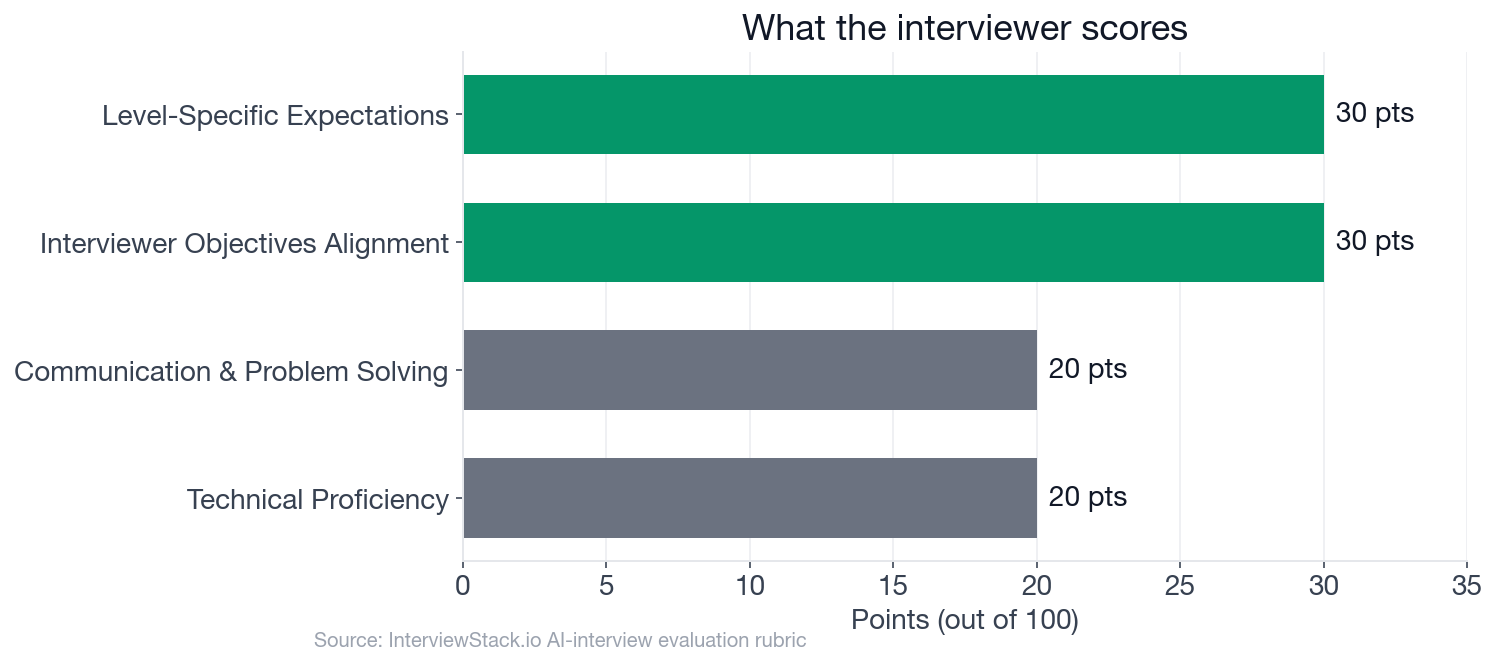
- The round is scored out of 100 points: 30 for objectives alignment, 30 for level-specific expectations, 20 for technical proficiency, 20 for communication.
- Judgment and trade-offs (objectives plus level) carry 60 of 100 points; technical proficiency carries only 20.
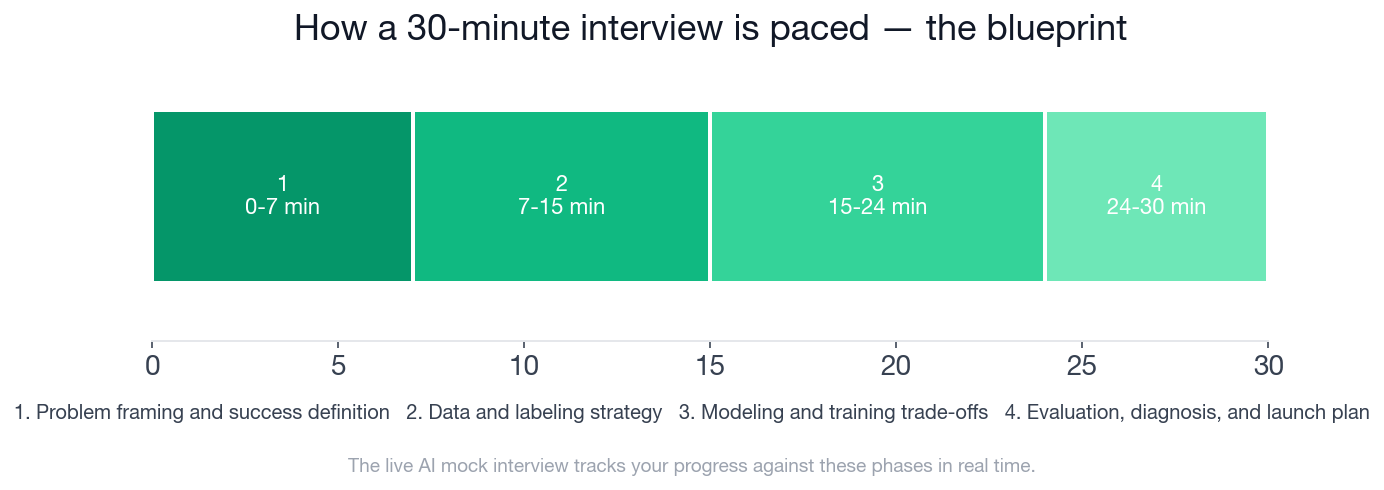
- The 30 minutes split into 4 phases: framing (0-7), data and labeling (7-15), modeling (15-24), and evaluation and launch plan (24-30).
- Modeling is the longest phase at 9 minutes, with 5 expected checklist items; the blueprint holds 18 items in total.
- The scenario starts with only a few hundred thousand historical images and limited box annotations, with one quarter to ship.
- Near-duplicate and burst photos are the leakage trap: 1 grouped split protects every metric you report afterward.
What Is a Machine Learning Engineer Computer Vision Interview Really Asking?
The interview question
You are joining a team that wants to improve photo understanding for a large consumer app. Users upload images taken in highly variable conditions from different phones and regions. A new feature needs to detect and localize products of interest in user-uploaded photos so downstream systems can index them and trigger product experiences. The current rule-based pipeline misses many small or partially occluded items and produces too many false positives on visually similar objects.
Assume you have access to a few hundred thousand historical images, limited box annotations today, and enough engineering support to train and iterate on one production-quality model over the next quarter.
How would you design the end-to-end computer vision approach for this feature, from data and labeling through model choice and evaluation, to a first production-ready version?
The interviewer is probing whether you can turn a vague product wish into a launchable detection pipeline: right task framing, a split that does not lie, a detector justified by trade-offs, and metrics tied to product cost. Nobody expects a novel architecture at mid-level; they expect a defensible baseline and clear priorities.
Where Prepared Candidates Lose Points
Turn 1: Tiny, Cluttered Products
Interviewer: "If many target products are tiny in cluttered images, what changes would you make to the data pipeline, architecture, or training setup?"
Turn 2: The Split That Lies
Interviewer: "What would a leakage-safe train, validation, and test split look like given historical user-uploaded images that may contain near-duplicates?"
Turn 3: Metrics With a Threshold
Interviewer: "How would you measure success offline and what metric thresholds would give you confidence to launch an initial version?"
Turn 4: Fails on Certain Phones
Interviewer: "If the model performs well overall but fails on certain phones or regions, how would you diagnose whether the issue is preprocessing, data quality, or domain shift?"
Why Is Reading This Not Enough?
Spotting these mistakes on the page took seconds. Avoiding them live is the real skill: the clock is running, the interviewer interrupts your detector comparison with a leakage question, and the structure you rehearsed in your head has to survive. Fluency under unscripted follow-ups only comes from reps.
The Blueprint a Strong Candidate Hits
This is the blueprint a strong candidate covers in 30 minutes, and it is exactly what the AI mock interview tracks you against in real time.
- ✓States that the task requires localization, not only classification
- ✓Clarifies target granularity such as product categories versus exact SKUs if ambiguity matters
- ✓Identifies likely constraints like latency, annotation budget, and long-tail data variation
- ✓Names at least one primary offline metric such as mAP and discusses precision-recall trade-off
- ✓Describes how to source positives and negatives from historical images
- ✓Recommends box annotation guidelines and some quality control approach such as consensus or audit sampling
- ✓Notes duplicate or burst-photo leakage risk and proposes grouping by user/session/image similarity for splits
- ✓Mentions augmentation relevant to image capture variation rather than only generic augmentation
- ✓Suggests a sensible way to expand labels under limited budget, such as uncertainty sampling or mining false positives
- ✓Chooses a plausible detector family and justifies it in terms of accuracy, speed, and implementation complexity
- ✓Mentions pretrained backbones or self-supervised pretraining as a practical starting point
- ✓Discusses mechanisms relevant to detection such as feature pyramids, anchor design versus anchor-free heads, or NMS
- ✓Provides at least one concrete strategy for small objects, such as higher input resolution, tiling, multiscale training, or FPN-based models
- ✓Addresses class imbalance or hard negatives with a concrete training tactic
- ✓Defines a validation and test evaluation plan using IoU-based metrics and slice-based analysis
- ✓Proposes error analysis by object size, occlusion, device type, region, or visual confounders
- ✓Distinguishes between data issues, preprocessing issues, and model capacity issues when diagnosing failures
- ✓Articulates a realistic first-version scope and one or two high-impact follow-up iterations
Run This Round Live
Start the AI mock interview for this exact scenario and get scored on the same four dimensions. Want more first? Drill the computer vision fundamentals question bank, browse Machine Learning Engineer roles, or use the preparation guides.
FAQ
What does a Machine Learning Engineer computer vision interview cover?
It tests whether you can turn an ambiguous visual recognition task into a detection pipeline: framing and metrics (0-7 minutes), data and labeling (7-15), modeling trade-offs (15-24), and evaluation plus launch plan (24-30). Detector internals, leakage-safe splits, and slice-based error analysis all show up.
How is a mid-level computer vision interview scored?
Out of 100 points: Interviewer Objectives Alignment 30, Level-Specific Expectations 30, Technical Proficiency 20, and Communication and Problem Solving 20. Judgment and trade-offs carry 60 points, so a well-reasoned plan beats a list of architecture names.
How do you split image data without leakage?
Group images before splitting. Near-duplicates and burst photos from the same user or session must land in one partition, so cluster by user, session, or image-embedding similarity and assign whole groups to train, validation, or test. A random per-image split lets near-copies sit on both sides and inflates your metrics.
How do you handle tiny objects in a detection model?
Raise effective resolution at the object scale: higher input resolution, tiling of large images, multiscale training, or a feature-pyramid backbone that keeps fine-grained feature maps. Then check results by object-size slice, not only overall mAP.
Which offline metrics matter for an object detector?
Use IoU-based average precision, reported per size, occlusion, and device slice, and tie the operating point to product cost. If false positives trigger user-visible experiences, pick a precision target first and read recall at that threshold.
How do you diagnose a model that fails on certain phones or regions?
Separate three causes: preprocessing (resizing, color handling, orientation metadata), data quality (labels and coverage per slice), and model capacity or domain shift. Compare slice error against raw-image statistics before collecting more labels.
Where Your Next Rep Goes
Pick the turn that stung most, probably the split, and rehearse it out loud until the grouping logic is automatic. Then run the full round and see which follow-up breaks your structure.
Topics
Ready to practice?
Put what you've learned into practice with AI mock interviews and structured preparation guides.