
The Machine Learning Engineer Innovation and Emerging Technology Interview Rewards the Boundary You Draw, Not the Model You Pick
In the first eight minutes of a mid-level Machine Learning Engineer interview on innovation and emerging technology, the interviewer hands you a genuinely exciting brief: design a copilot that reads experiment docs, model metadata, dashboards, and prior launch decisions, then helps reviewers and model owners catch missing risks before a launch ships. The tempting move is to let that copilot start deciding things: flag a launch as ready, block one that isn't. The rubric disagrees. This walkthrough runs on the real interview package InterviewStack.io's AI interviewer uses for a mid-level Machine Learning Engineer round on innovation and emerging technology, the same blueprint scored by the Machine Learning Engineer question bank if you want to drill the underlying concepts first.
Every one of this interview's three phases tests some version of the same instinct: can you tell a genuinely valuable, scoped assistant apart from an impressive-sounding autonomous system you'd never actually be allowed to ship. A candidate who reaches for the more dramatic answer, more autonomy, a bigger model, a broader platform, loses points in phase after phase, even when the underlying engineering is sound.
Key Findings
- This mid-level interview runs 30 minutes across 3 phases: problem framing (0-8 min), solution design (8-18 min), and evaluation and rollout (18-30 min).
- Interviewer Objectives Alignment and Level-Specific Expectations each carry 30 of the 100 rubric points, 60 combined, versus 20 each for Technical Proficiency and Communication and Problem Solving.
- Phase 2's checklist explicitly rewards keeping autonomous decisioning "out of scope or heavily gated," one of 5 solution-design checklist items.
- Phase 1 gives just 8 minutes to hit 4 framing checklist items, including naming a concrete reason the project might not be worth building.
- Phase 3 scores against 5 checklist items spanning offline and online metrics, business impact, safety metrics, pilot design, and escalation paths.
- The interviewer has 6 follow-up prompts available; this walkthrough dramatizes 4 of them.
- 4 skill areas are explicitly out of scope for this round: algorithm coding, unrelated distributed-systems internals, foundation-model research, and deep legal or compliance analysis.
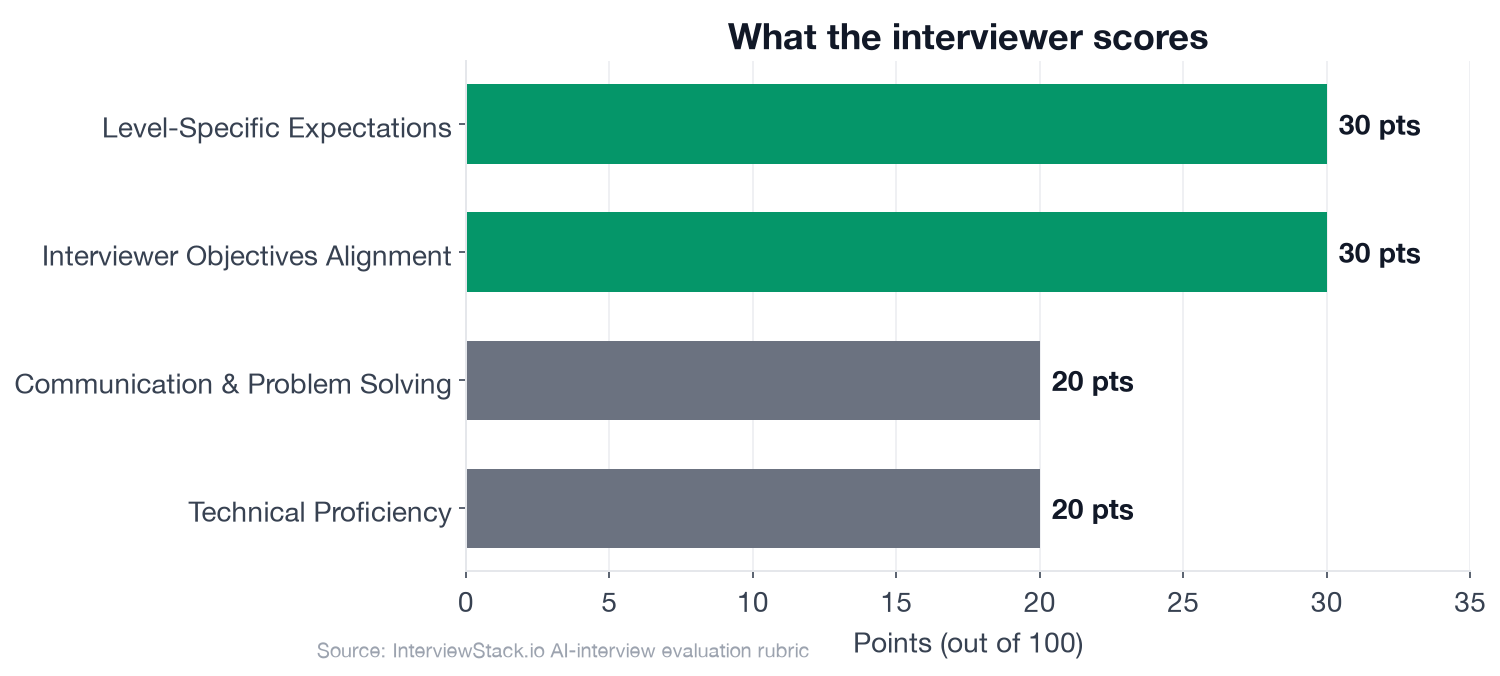
The two highest-weighted dimensions, worth 60 of the 100 points, score how you frame the opportunity and calibrate your scope to a mid-level engineer's actual authority, not how sophisticated your architecture sounds.
What Is the Interviewer Actually Testing With This Launch-Readiness Copilot?
Here's the scenario as it appears in the live blueprint:
The interview question
You are joining an internal ML platform team at a large consumer tech company. The team supports thousands of engineers and data scientists who build recommendation, ranking, moderation, and search models. Over the last 6 months, leadership has been pushing teams to explore new foundation-model capabilities to improve engineering productivity. One recurring pain point is that model launches are slowed down by fragmented experiment reviews, inconsistent model-card quality, and repeated back-and-forth on safety, offline metrics, and rollout readiness. Your team has been asked to evaluate whether an AI-assisted "launch readiness copilot" should be built. The idea is a tool that reads experiment docs, model metadata, dashboards, and prior launch decisions, then helps reviewers and model owners prepare higher-quality launch packages and catch missing risks earlier.
How would you evaluate and propose this launch readiness copilot so that the company can decide whether it is worth building and how to build it responsibly?
The interviewer is scoring whether you can separate durable value from hype in a real ML platform setting, reason about business impact and operational constraints rather than technology for its own sake, and propose an experimentation and rollout plan that a mid-level engineer could realistically own end to end, not a company-wide innovation strategy.
Four Follow-Ups, One Line the Rubric Won't Let You Cross
The candidate below, Theo, is dramatized to show where mid-level answers commonly lose points on this scenario, not a transcript of a real session. These four follow-ups, in the order a strong candidate would actually build toward them, move from testing whether the opportunity is even real, to choosing what data to trust, to cutting scope honestly, to handling the moment the tool gets it wrong in front of everyone.
Turn 1: Naming the Failure Condition
Interviewer: "What would make you conclude that this is not actually a good innovation opportunity, even if the technology seems impressive?"
Turn 2: Choosing Signals, Not Everything
Interviewer: "What signals or data sources would you rely on first, and which ones would you avoid using in an initial version?"
Turn 3: Cutting Scope, Not Corners
Interviewer: "If leadership wants a prototype in one quarter, what scope would you cut to make the project realistic while still learning something meaningful?"
Turn 4: When the Copilot Is Confidently Wrong
Interviewer: "Suppose the copilot gives confident but wrong readiness guidance for a high-visibility launch. How would you reduce that risk technically and operationally?"
Why Doesn't Spotting the Overreach on the Page Stop You From Doing It Live?
Every mistake above is easy to catch once it's sitting on the page with a fix written right underneath it. Live, there is no fix underneath the question. You get 30 minutes, an interviewer who follows up on whatever boundary you just drew, or didn't, and a checklist you cannot see. Recognizing "that's the autonomous-decisioning trap" while reading an article is a different skill than not reaching for it mid-sentence, under a clock, with two more follow-ups still coming. The only way to build that instinct is reps in the AI mock interview itself.
How Do the Interview's Three Phases Actually Score You?
The chart below maps how the interview's 14 checklist items are distributed across framing, design, and rollout.
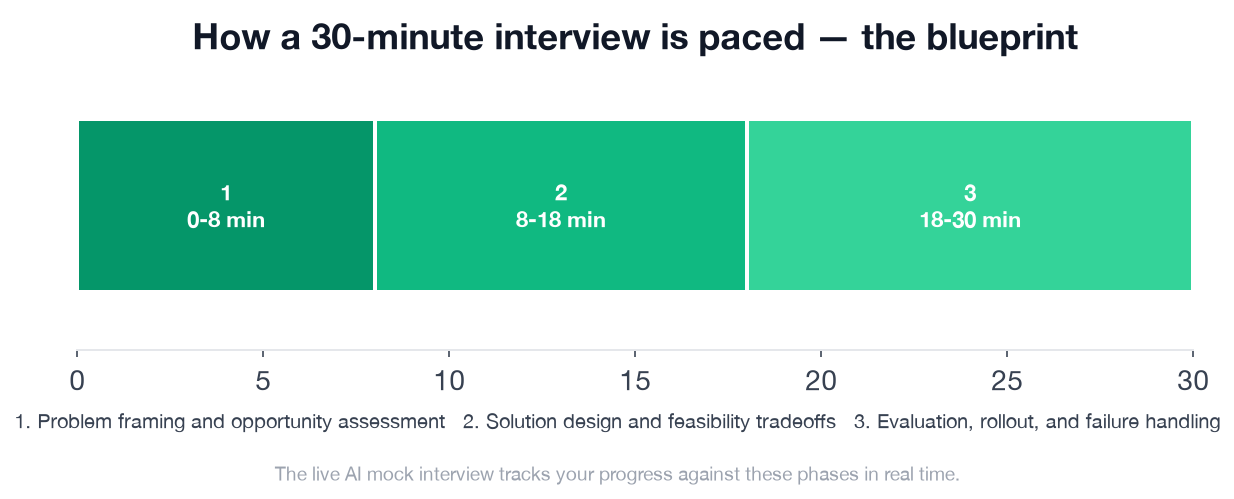
Solution design and feasibility tradeoffs, the middle 10 minutes, ties evaluation and rollout for the most checklist items of the three phases at 5 of 14 apiece, and it's here that the autonomous-decisioning boundary every dramatized turn above eventually runs into first appears.
This is the blueprint a strong candidate hits, phase by phase, and the exact structure the AI mock interview tracks you against while you're answering, not after:
- ✓Identifies primary users such as model owners, reviewers, or platform teams
- ✓States the current pain in operational terms like review delays, inconsistent documentation, or missed launch risks
- ✓Separates assistive use cases from decision-automation use cases
- ✓Names at least one reason the project may not be worth building if workflow friction is not actually caused by information synthesis
- ✓Proposes a concrete MVP, for example summarizing readiness evidence, extracting missing checklist items, or retrieving similar past launches
- ✓Discusses data sources with some realism, such as docs, model cards, experiment dashboards, incident history, prior review comments, or launch outcomes
- ✓Mentions at least two constraints among privacy, access control, hallucination risk, stale data, latency, cost, or reviewer trust
- ✓Chooses an implementation approach and justifies it, such as RAG over full fine-tuning, rules plus LLM, or human-in-the-loop workflow
- ✓Keeps autonomous decisioning out of scope or heavily gated
- ✓Defines offline and online metrics, not just qualitative excitement
- ✓Includes business/process metrics such as review turnaround time or reduced back-and-forth
- ✓Includes quality/safety metrics such as precision of risk flags, harmful suggestion rate, or override rate
- ✓Describes a pilot with a narrow user group and explicit stop/go criteria
- ✓Explains how user feedback, auditing, and escalation paths would work when the copilot is wrong
Take the Launch-Readiness Scenario Into a Real Interview
Reading Theo's four mistakes is the easy part. The AI mock interview for Machine Learning Engineer innovation and emerging technology asks this same launch-readiness scenario, follows up based on what you actually propose, and scores you across all four rubric dimensions the moment the 30 minutes end. That's the only way to find out whether you'd actually hold the assistive-versus-autonomous line live, not on a re-read of this post. For focused drilling first, the question bank for innovation and emerging technology covers opportunity framing, feasibility tradeoffs, and rollout design with worked answers, and the InterviewStack.io preparation guide maps how this topic fits into the broader Machine Learning Engineer prep path.
FAQ
Q. What does a mid-level Machine Learning Engineer innovation and emerging technology interview actually test?
The interview runs 30 minutes across 3 phases: problem framing and opportunity assessment (0-8 min), solution design and feasibility tradeoffs (8-18 min), and evaluation, rollout, and failure handling (18-30 min). The rubric weights Interviewer Objectives Alignment and Level-Specific Expectations at 30 points each, so framing and judgment account for 60 of 100 points, with Technical Proficiency and Communication and Problem Solving worth 20 points each.
Q. Why would an AI mock interview penalize a launch-readiness copilot that can approve launches on its own?
Because the blueprint treats autonomous decisioning as a design failure, not a feature. The Phase 2 checklist explicitly rewards keeping autonomous decisioning out of scope or heavily gated, and the interviewer's evaluation criteria call for a solution shape with clear boundaries, such as assistive drafting, checklist completion, or risk surfacing, instead of autonomous launch approval. A candidate who lets the tool decide is solving an easier problem than the one being asked.
Q. How should I define success for an internal AI tool like this beyond user engagement?
Pair business and process metrics, such as review turnaround time or reduction in back-and-forth between reviewers and model owners, with quality and safety metrics, such as precision of risk flags, harmful suggestion rate, or override rate. The Phase 3 checklist expects both categories together; engagement alone tells you people are clicking, not that the tool is making launches safer or faster.
Q. Should I build this with an external general-purpose model, an internally hosted model, or a rules-plus-ML approach?
The blueprint doesn't reward a single correct answer here, it rewards choosing one and justifying it against real constraints: data confidentiality, latency, cost, and how much the team can maintain. Level-specific expectations call for sensible tradeoffs between model sophistication and delivery speed, favoring a narrow high-value workflow over a broad platform build, whichever approach gets there fastest with an acceptable risk profile wins the argument.
Q. What's out of scope for this interview round?
Four things: LeetCode-style algorithm coding, low-level distributed systems internals unrelated to the use case, pure research on training new foundation models from scratch, and deep legal or compliance analysis beyond practical engineering safeguards. The round stays focused on product-minded ML engineering judgment, not infrastructure trivia or novel research.
Q. How is the interview scored?
Four dimensions totaling 100 points: Interviewer Objectives Alignment (30 points), Level-Specific Expectations (30 points), Technical Proficiency (20 points), and Communication and Problem Solving (20 points). The two highest-weighted dimensions reward how you scope and frame the opportunity, not just whether your architecture is technically sound.
Q. How should I prepare for a Machine Learning Engineer innovation and emerging technology interview?
Practice naming a concrete failure condition for the opportunity before you get excited about the technology, drawing a hard assistive-versus-autonomous boundary early, and defining both business and safety metrics for anything you propose. The InterviewStack.io AI mock interview for Machine Learning Engineer innovation and emerging technology tracks you against the live blueprint in real time.
Scope Is the Skill, Not the Model
Nothing in this scenario asks you to pick the most powerful model available. It asks you to notice, four separate times, that the more impressive answer is also the one that hands a tool authority it hasn't earned. That's a scoping instinct, not a modeling one, and it only gets sharp under the same time pressure and unscripted follow-ups a live interview actually applies.
Topics
Ready to practice?
Put what you've learned into practice with AI mock interviews and structured preparation guides.