
The Metric That Improved Wasn't the One That Mattered
Rhea is twenty-six minutes into a mid-level Machine Learning Engineer interview at a leading tech company when the interviewer asks the question the whole session was built around: a new model version scores better on average helpfulness, but its hallucination rate on policy questions ticked up. Ship it, hold it, or something in between?
That single follow-up is worth more of the rubric than any line of code Rhea writes in this session. This walkthrough runs on a real AI-interview blueprint, the same one InterviewStack.io's AI interviewer uses to score a live session on LLM evaluation and observability, generated for a mid-level Machine Learning Engineer. The Machine Learning Engineer question bank covers the same underlying concepts if you want to drill them before you hit the live scenario.
Every phase of this interview tests some version of the same instinct: can you resist collapsing an open-ended, non-deterministic system down to one blended number, whether that number is a quality score, a judge's verdict, a log line, or a rollout average. A candidate who reaches for the single number loses points in phase after phase, even when the underlying engineering instinct is sound.
Key Findings
- This mid-level interview runs 30 minutes across 4 phases: problem framing (0-7 min), evaluation design (7-18 min), observability and failure diagnosis (18-26 min), and the rollout decision (26-30 min).
- Interviewer Objectives Alignment and Level-Specific Expectations each carry 30 of the 100 rubric points, 60 combined, versus 20 each for Technical Proficiency and Communication and Problem Solving.
- The four phases carry 20 checklist items total: 5 in problem framing, 6 in evaluation design, 5 in observability, and 4 in the rollout decision.
- The rollout-decision phase gets just 4 minutes (26-30) to resolve a model that scores better on average but worse on a named high-risk slice.
- The scenario's retrieval-augmented assistant serves millions of requests a day across many tenants, per the live blueprint.
- 4 skill areas are explicitly out of scope for this round: training a foundation model from scratch, deep calibration theory, unrelated frontend UX, and low-level inference-serving internals.
- The interviewer has 6 follow-up prompts available; this walkthrough dramatizes 4 of them.
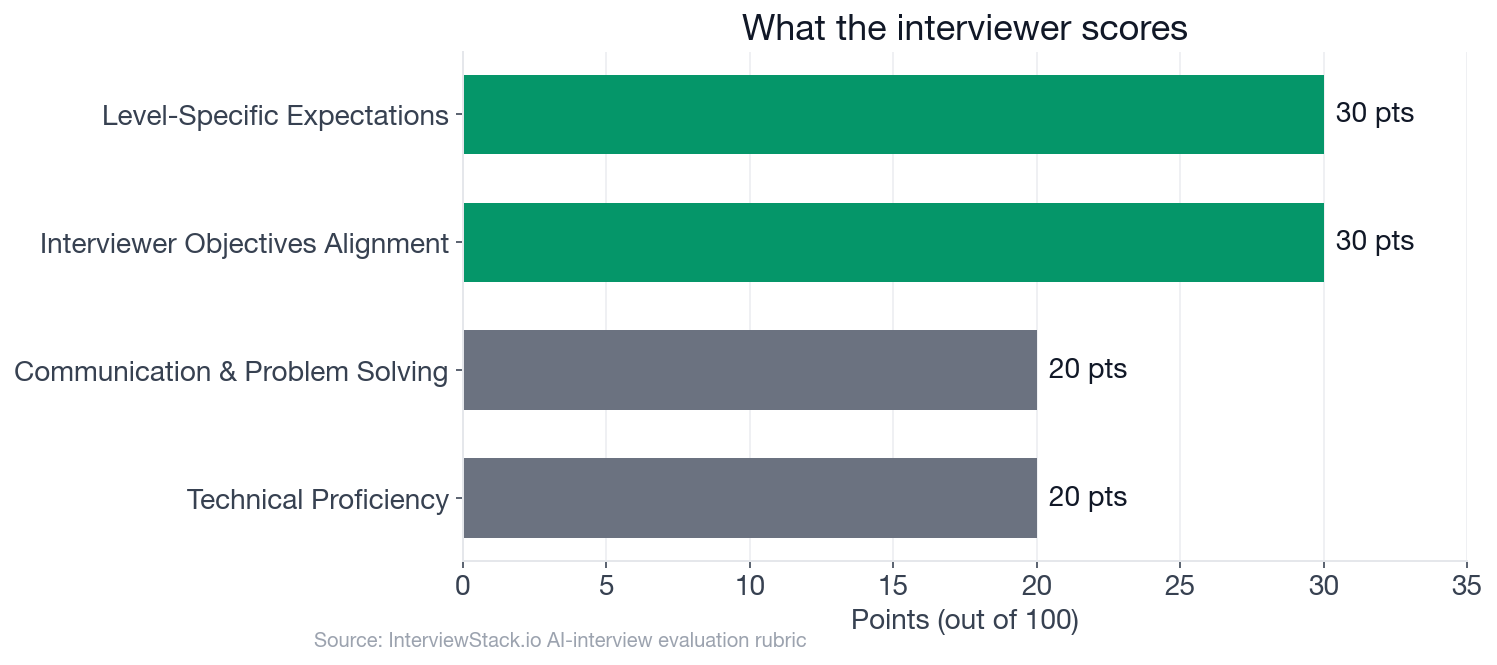
Interviewer Objectives Alignment and Level-Specific Expectations, worth 60 of the 100 points combined, score whether you can define measurable quality signals and reason about trade-offs like a mid-level engineer actually would, not whether your architecture diagram looks impressive.
What Is the Machine Learning Engineer LLM Evaluation and Observability Interview Actually Testing?
Here's the scenario as it appears in the live blueprint:
The interview question
You are supporting a customer-facing AI assistant used inside a large productivity platform. The assistant answers user questions using retrieval-augmented generation (RAG) over internal help-center documents, policy docs, and product guides, and it currently serves millions of requests per day across many tenants. Recent leadership feedback: some answers look fluent but are factually wrong or cite the wrong policy, the existing dashboard mainly shows latency and error rate but not answer quality, prompt changes and model upgrades sometimes improve one use case while hurting others, and support teams need a faster way to investigate bad outputs reported by users.
User query -> retriever -> ranked documents -> prompt assembly -> LLM response -> optional citation rendering
Multiple model versions may be active during rollouts, outputs are open-ended text and somewhat non-deterministic, human review bandwidth is limited, and the team wants something useful in the next quarter, not a long-term research project. How would you design an evaluation and observability framework for this assistant so the team can measure quality, catch regressions, and debug failures in production?
The interviewer isn't grading whether you can name eval frameworks. They're testing whether you can define measurable quality signals for open-ended output, choose defensible offline and online evaluation methods, reason about hallucination and safety risk, and propose tracing that helps someone else debug a non-deterministic system, all while making trade-offs a mid-level engineer could realistically own in one quarter.
Four Turns, One Instinct: Don't Trust a Single Number
The candidate below, Rhea, is dramatized to show where mid-level answers commonly lose points on this scenario, not a transcript of a real session. Each turn below tests the same instinct: whether you collapse something that should stay multi-dimensional into one number, one score, one judge, one log field, one average. Watch where that habit costs Rhea.
Turn 1: One Score Isn't a Strategy
Interviewer: "What quality metrics would you track first, and how would you define them so they are reliable for open-ended answers?"
Turn 2: Trusting the Judge Too Much
Interviewer: "If human labeling capacity is very limited, how would you use model-graded or automated evaluation without overtrusting it?"
Turn 3: Logging Everything, Explaining Nothing
Interviewer: "What would you log and trace for each request so that support engineers and ML engineers can investigate failures efficiently while respecting privacy constraints?"
Turn 4: The Rollout Call
Interviewer: "Suppose a new model has better average helpfulness but slightly worse hallucination rate on policy questions. How would you make the rollout decision?"
What Happens When the Interviewer Asks You to Prove Where the Answer Went Wrong?
Every mistake above is easy to catch once it's sitting on the page with the fix written right underneath it. Live, Rhea doesn't get that. After the rollout call, the natural next follow-up is harder: given one specific bad response, how do you tell whether it came from retrieval, from prompt assembly, or from the model itself? Recognizing "that's the one-number trap" while reading an article is a different skill from not reaching for it mid-sentence, under a clock, with more follow-ups already stacked up behind this one. The only way to build that instinct is reps in the AI mock interview itself.
Four Phases, Twenty Checklist Items, One Rollout Call
The chart below maps how the interview's 20 checklist items are distributed across the four phases.
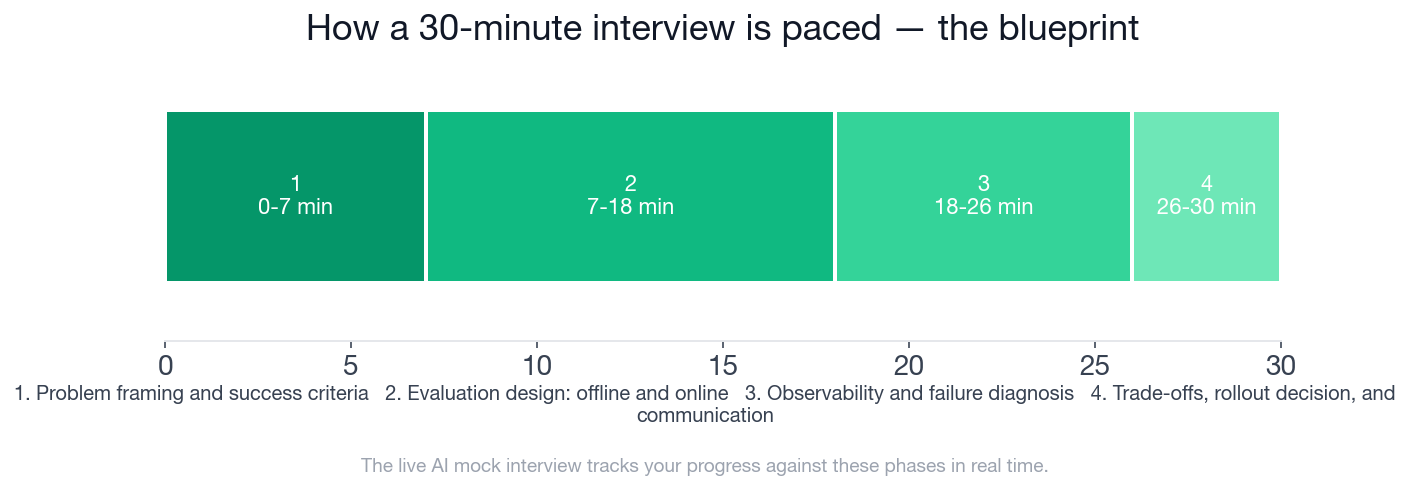
Evaluation design, the middle eleven minutes, carries the most checklist items of the four phases at 6 of 20, and it's the phase where model-graded evaluation gets calibrated, or overtrusted, before it ever reaches a rollout decision.
This is the blueprint a strong candidate hits, phase by phase, and the exact structure the AI mock interview tracks you against while you're answering, not after:
- ✓Clarifies the core user-facing failure modes such as hallucination, retrieval miss, wrong citation, unsafe or policy-violating output, and low helpfulness
- ✓Breaks quality into measurable dimensions instead of using a single vague score
- ✓Mentions both system metrics and user-centric metrics
- ✓Identifies constraints like limited human review, multiple model versions, and non-deterministic outputs
- ✓Prioritizes a practical initial scope rather than attempting to solve every evaluation problem at once
- ✓Proposes an offline eval set segmented by use case or risk tier, such as policy questions versus simple help-center lookups
- ✓Defines candidate metrics like answer correctness, faithfulness to retrieved docs, citation support, safety, refusal appropriateness, and task success
- ✓Explains how to obtain labels or judgments, including targeted human review on high-risk or ambiguous slices
- ✓Uses automated or model-graded evaluation with validation/calibration against human labels rather than treating it as ground truth
- ✓Describes online monitoring signals such as user feedback, escalation rate, answer abandonment, guardrail triggers, and slice-based drift or regression dashboards
- ✓Explains how offline eval informs release gates while online metrics catch real-world issues not covered by static benchmarks
- ✓Proposes request-level tracing across query, retrieval results, ranking scores, selected context, prompt template/version, model version, generation parameters, output, citations, latency, and evaluator outputs
- ✓Suggests metadata needed for slicing and debugging, such as tenant, language, use case, rollout bucket, and document/source identifiers
- ✓Explains how traces help localize whether failures come from retrieval, context assembly, model reasoning, or post-processing
- ✓Mentions privacy-conscious logging or redaction for sensitive user content
- ✓Includes mechanisms for surfacing bad cases, such as sampled trace review, user-reported examples, or high-risk queueing
- ✓Articulates how to make a rollout decision when one metric improves while another regresses, especially for high-risk slices
- ✓Suggests thresholding or weighted criteria by risk level rather than relying on a single aggregate average
- ✓Outlines a phased implementation plan for the next quarter
- ✓Communicates clearly and concisely, with explicit assumptions and fallback plans
Can You Make This Call Without a Rewrite Button?
Reading Rhea's four mistakes is the easy part. The AI mock interview for Machine Learning Engineer LLM Evaluation and Observability asks this same RAG-assistant scenario, follows up based on what you actually propose, and scores you across all four rubric dimensions the moment the 30 minutes end. That's the only way to find out whether you'd actually hold the risk-tiered line live, not on a re-read of this post. For focused drilling first, the question bank for LLM evaluation and observability covers metric definitions, offline and online design, and tracing with worked answers, and current Machine Learning Engineer openings on the InterviewStack.io job board show what teams are actually hiring this skill set for.
FAQ
Q. What does a mid-level Machine Learning Engineer LLM evaluation and observability interview actually cover?
The interview runs 30 minutes across 4 phases: problem framing and success criteria (0-7 min), offline and online evaluation design (7-18 min), observability and failure diagnosis (18-26 min), and the rollout trade-off decision (26-30 min). Interviewer Objectives Alignment and Level-Specific Expectations each carry 30 of the 100 rubric points, 60 combined, with Technical Proficiency and Communication and Problem Solving worth 20 points each.
Q. How do you separate retrieval, prompt, or model failures when an LLM response is wrong?
By tracing each request end to end: the retrieved documents and their ranking scores, the assembled prompt and its template version, the model version and generation parameters, and the final output with citations. Replaying the same query against each stage shows where the answer diverges from what strong retrieval and a well-formed prompt should have produced, instead of guessing which layer is at fault.
Q. Should you trust an LLM judge to grade every response instead of a human?
Not without calibration. Use limited human review capacity to label a sampled, risk-weighted slice, measure how often the automated or model-graded judge agrees with those human labels, and only extend the judge to the rest of production traffic once that agreement rate holds up, rechecking it whenever the prompt or model changes. Treating an uncalibrated judge as ground truth is one of the fastest ways to lose points on this interview's evaluation-design phase.
Q. What's the difference between offline evaluation and online monitoring for an LLM feature?
Offline evaluation runs a fixed, risk-segmented test set against a candidate model or prompt before release and gates whether it ships. Online monitoring watches live signals like user feedback, escalation rate, and guardrail triggers after release to catch regressions the offline set never anticipated. A candidate who proposes only one of the two misses half of this interview's evaluation-design phase, since offline eval informs the release gate while online monitoring catches what static benchmarks can't.
Q. What should you log for each LLM request without violating user privacy?
Trace the retrieval results and ranking scores, the prompt template and model version, generation parameters, the output and its citations, and latency, tagged with tenant, use case, and rollout bucket for slicing, while redacting or hashing sensitive user content and gating access to raw traces. Logging the full raw query and response indefinitely with no redaction plan costs points on the observability phase, since the checklist explicitly expects privacy-conscious logging or redaction for sensitive user content.
Q. Is training or fine-tuning a foundation model in scope for this interview?
No. The blueprint explicitly keeps training a foundation model from scratch, deep theoretical calibration proofs, frontend UX work unrelated to evaluation or observability, and low-level inference-serving infrastructure out of scope for this round. The interview stays focused on evaluating and operating an LLM-powered system that already exists, not building a new model.
Q. Can I practice this exact LLM evaluation and observability scenario?
Yes. The AI mock interview for Machine Learning Engineer LLM Evaluation and Observability runs this same RAG-assistant scenario, follows up based on what you actually propose, and scores you across all four rubric dimensions the moment the 30 minutes end.
The Slice Was the Point All Along
Nothing in this scenario asks Rhea to pick a fancier model or a cleverer prompt. It asks Rhea, four separate times, to resist collapsing a messy, non-deterministic system into one clean number, because the rubric is built to catch exactly that habit. That's a discipline, not a formula, and it only gets reliable under the same time pressure and unscripted follow-ups a live interview actually applies.
Topics
Ready to practice?
Put what you've learned into practice with AI mock interviews and structured preparation guides.