
The News Feed Looks Done Until the Phone Rotates
A mid-level Mobile Developer interview on Android development doesn't open by asking you to recite coroutine syntax. It hands you three small interfaces, a repository-shaped news screen, and watches whether your design survives the moment a user rotates the phone mid-load. This walkthrough runs on a real interview blueprint, generated by the same production prompt InterviewStack.io's AI interviewer uses for a mid-level Mobile Developer interview on Android development fundamentals in Kotlin and Java, scored across 4 rubric dimensions worth 100 points.
The scenario: an Android news screen that loads articles from a local cache and a network API, has to stay responsive while data loads, and has to behave correctly when the OS tears down and recreates the screen on a configuration change. Watch where a prepared candidate loses points anyway, then get the complete graded blueprint to practice against yourself.
Key Findings
- This is a 30-minute mid-level Mobile Developer interview on Android Development Fundamentals (Kotlin and Java), scored across 4 rubric dimensions worth 100 points total.
- Interviewer Objectives Alignment and Level-Specific Expectations each carry 30 points, 60 of the 100 total, before Technical Proficiency or Communication and Problem Solving (20 points each) even factor in.
- Problem framing and API shape gets just 7 minutes (0-7) before the interview moves into implementation.
- Core implementation and concurrency is the longest phase at 13 minutes (7-20) and carries 6 checklist items, more than either other phase.
- Edge cases, lifecycle, and testing closes the interview in the final 10 minutes (20-30) and still expects at least 2 named unit tests plus explicit cancellation-scope reasoning.
- 4 skill areas, including Jetpack Compose UI implementation and iOS or cross-platform frameworks, are explicitly out of scope for this interview.
- The real interview carries 6 follow-up questions; this walkthrough dramatizes 4 of them, all drawn from the interview's final two phases (core implementation and edge cases).
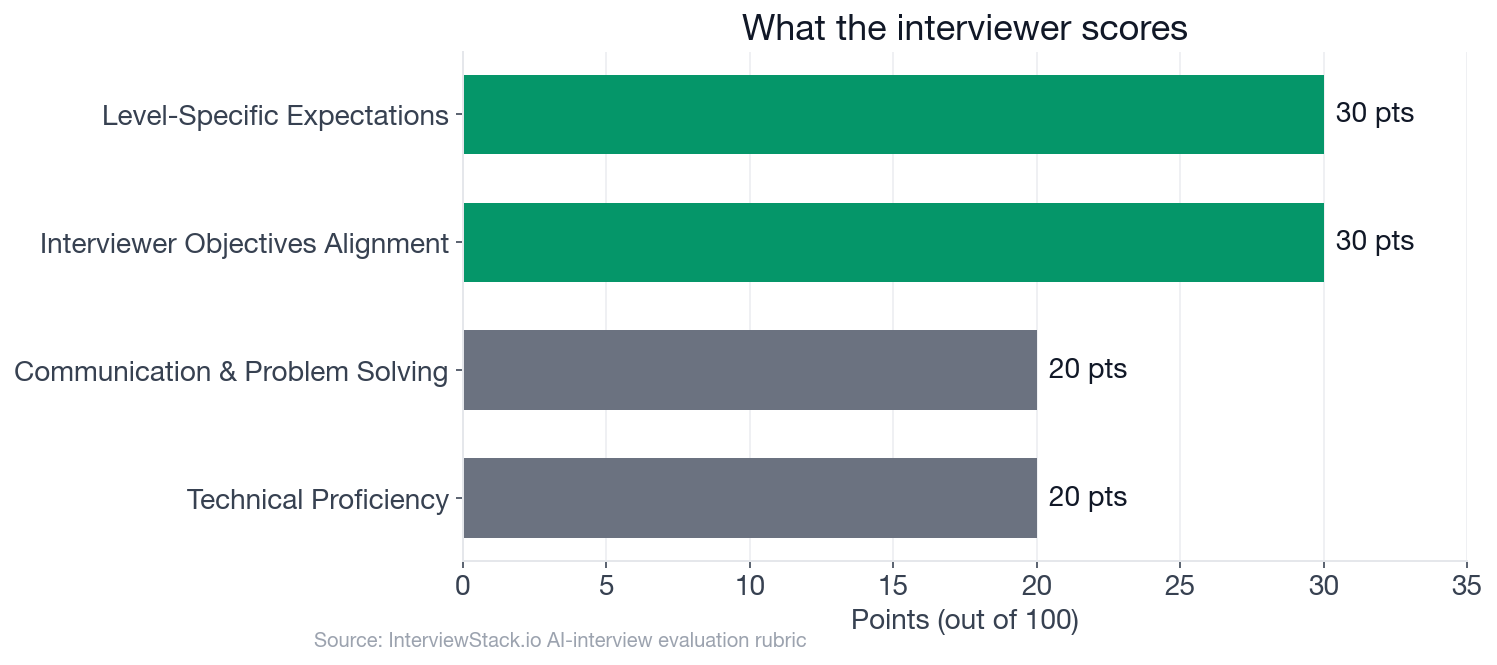 Interviewer Objectives Alignment and Level-Specific Expectations each hold 30 points, so most of the score rewards design judgment, not whether the Kotlin compiles.
What Does a Mobile Developer Android Kotlin Interview Really Test?
The interview question
You are handed this API surface for a news screen: a suspend function that fetches articles from the network, a DTO and a domain model that look identical today but are not guaranteed to stay that way, and a cache interface whose only freshness signal is a raw timestamp.
interface ArticleApi {
    suspend fun fetchArticles(): List<ArticleDto>
}

data class ArticleDto(
    val id: String,
    val title: String,
    val body: String,
    val updatedAtMillis: Long
)
data class Article(
    val id: String,
    val title: String,
    val body: String,
    val updatedAtMillis: Long
)
interface ArticleCache {
    fun readAll(): List<Article>
    fun writeAll(articles: List<Article>)
    fun lastUpdatedMillis(): Long?
}
Using the code above, design and implement an Android-side data layer for a news screen that loads articles from cache and network, keeps the UI responsive, and behaves well across configuration changes.
What the interviewer is actually probing here is not whether you can write correct Kotlin syntax. It is whether you can separate cache, network, and mapping into clean responsibilities, reason about coroutines and threading without blocking the main thread, and make deliberate calls about collections and trade-offs that a shipping Android app actually depends on.
Turn 1: Surviving the Rotation
Interviewer: "If the user opens the screen repeatedly or rotates the device during loading, how would your design avoid duplicate work or inconsistent UI state?"
Turn 2: Choosing the Right Container
Interviewer: "What collections or data structures would you use if the API sometimes returns duplicate articles or out-of-order updates, and why?"
Turn 3: Crossing the Java Boundary
Interviewer: "Suppose part of this module is still written in Java. What Kotlin-to-Java interoperability choices would you make in this API, and what pitfalls would you avoid?"
Turn 4: Letting Go of the Screen
Interviewer: "How would cancellation work if the user leaves the screen mid-request, and what Android or coroutine scope would own the work?"
What Happens When the Follow-Up Isn't on the Page Anymore?
Every mistake above is easy to catch once it is sitting in a red box with the fix right underneath. None of that is what makes a real interview hard. A real interviewer does not stop at "how would your design avoid duplicate work." They ask what happens next: what if the cache write fails mid-rotation, what if the second fetch already returned before the first one cancels. There is no red box on the page warning you which checklist item you are about to miss. That gap, between recognizing a mistake in writing and avoiding it live, unscripted, under a 30-minute clock, is exactly what a real mock interview tests and reading alone cannot.
How Does the Full Blueprint Score More Than the Rotation Fix?
The rotation fix, the LinkedHashMap, the Java-facing wrapper, and the viewModelScope cancellation are four facets of one 30-minute blueprint, not four separate topics. Here is how a strong candidate paces all three phases and every checklist item the AI interviewer tracks in real time.
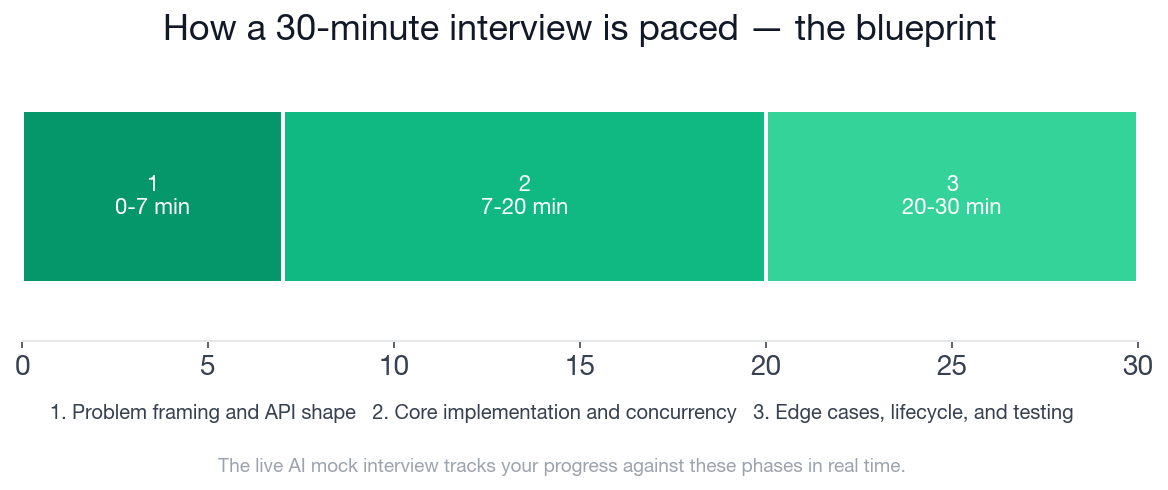 Problem framing gets 7 minutes, core implementation and concurrency gets 13, and edge cases, lifecycle, and testing close out the final 10.
- ✓Clarifies at least one key product behavior such as whether stale cache can be shown immediately
- ✓Proposes a repository or equivalent abstraction rather than putting all logic directly in UI code
- ✓Defines a UI-facing result/state shape such as loading/content/error or stream-based updates
- ✓Mentions configuration changes and identifies an Android owner for the work, typically a ViewModel
- ✓Implements or outlines a suspend or Flow-based repository method with a coherent control flow
- ✓Keeps network and cache work off the main thread and distinguishes IO work from UI observation
- ✓Handles at least cache-first or stale-while-revalidate behavior in a way that matches their stated requirements
- ✓Explains how concurrent calls are prevented, shared, or serialized to avoid duplicate fetches
- ✓Uses an appropriate collection approach for deduplication or stable ordering, such as LinkedHashMap keyed by id
- ✓Maps DTOs to domain models rather than leaking transport objects throughout the app
- ✓Explains what happens when the user leaves the screen and ties cancellation to the appropriate scope
- ✓Describes fallback behavior when network fails and cache is empty versus when stale cache exists
- ✓Mentions how state survives configuration changes, typically through ViewModel retention and observable state
- ✓Identifies at least 2 focused unit tests covering cache hit, network failure, freshness decision, or concurrent load behavior
- ✓Shows awareness of Java callers if relevant, such as nullability annotations, checked exceptions avoidance, or simple interop-friendly API surfaces
This is the exact blueprint the AI mock interview scores you against, phase by phase, checklist item by checklist item, while the clock runs.
Put This Design in Front of a Live Interviewer
Reading the fixes above is not the same as producing them out loud while a 13-minute concurrency phase ticks down. Start the same 30-minute Android Development (Kotlin and Java) mock interview and see how much of this blueprint you cover without a red box to warn you first. Want to drill the underlying concepts before you go live? Work through the Android Development Fundamentals (Kotlin and Java) question bank, or browse company-specific interview guides if you are prepping for a particular employer's process.
FAQ
Q. What does this Mobile Developer Android Kotlin interview actually test?
It tests whether you can design a repository-style Android data layer in Kotlin, with Java interoperability in mind, that orchestrates cache and network calls without blocking the main thread, survives configuration changes without duplicate work, and handles edge cases like empty cache, network failure, and duplicate or out-of-order data. Interviewer Objectives Alignment and Level-Specific Expectations each carry 30 of the interview's 100 points, with Technical Proficiency and Communication and Problem Solving worth 20 points apiece.
Q. How do you decide when cached articles are fresh enough to show, and how should loading, success, and error states reach the UI?
A workable answer treats the cache's last-updated timestamp as the freshness signal: show cached data immediately if it falls within an acceptable window, otherwise show a loading state while a background refresh runs, and expose the result as a single state type (loading, content, or error) the UI observes rather than three separate booleans it has to reconcile itself. This is part of the Phase 1 checklist item that expects a clear UI-facing result or state shape defined before implementation code gets written.
Q. How would you unit test this repository's cache, network, and concurrency behavior?
The blueprint's final phase expects at least 2 focused unit tests, for example one confirming a cache hit skips the network call, and one confirming a network failure with an empty cache surfaces an error state while a network failure with existing cached data falls back to showing the stale cache. Tests confirming that concurrent calls collapse into a single in-flight request are also explicitly rewarded.
Q. Is Jetpack Compose UI code part of this interview?
No. Jetpack Compose UI implementation details, iOS or cross-platform frameworks, backend system design beyond this Android module, and machine learning topics are all explicitly out of scope for this blueprint. The interview stays focused on the Android-side data layer: coroutines, collections, lifecycle, and Java interoperability.
Q. How long is the real AI mock interview, and how is it scored?
30 minutes, split into 3 timed phases (problem framing and API shape, core implementation and concurrency, and edge cases, lifecycle, and testing), scored live across the same 4 rubric dimensions worth 100 points this walkthrough uses.
Q. What level is this interview calibrated for?
Mid-level, roughly 2 to 5 years of experience. A strong answer reaches a workable end-to-end design with light prompting, uses common Android patterns like ViewModel-owned coroutines and repository separation without needing to invent a novel architecture, and makes reasonable trade-off calls rather than over-engineering the solution.
The Rotation Was Just the First Trap
A candidate who fixes the rotation bug and stops there still has three more traps to clear before they've proven they can ship this feature for real: a Java-facing boundary that doesn't leak nulls, a collection choice that survives messy network data, and a cancellation story that doesn't write stale results after the user has moved on. The fastest way to find out which of those you would actually catch live is to run the interview, not read about it.
Topics
Ready to practice?
Put what you've learned into practice with AI mock interviews and structured preparation guides.