
The Sync Phase Is Where the Mid-Level Bar Gets Set
Most candidates preparing for a mobile offline-first interview rehearse conflict resolution: last-write-wins, CRDTs, operational transformation. That is the wrong place to start. In a 30-minute mid-level Mobile Developer interview on offline-first architecture and data synchronization, 60 of 100 rubric points belong to Interviewer Objectives Alignment (30 pts) and Level-Specific Expectations (30 pts). Both reward architectural judgment and protocol correctness, not algorithm depth. The real scoring trap is Phase 2 (8-18 min), where five checklist items on sync protocol, idempotency, and incremental sync have to land in ten minutes, before the conflict question even arrives.
The Mobile Developer question bank on InterviewStack.io covers the full topic range for offline-first architecture and data synchronization if you want to drill individual concepts before the full simulation.
Key Findings
- 60 of 100 rubric points go to Interviewer Objectives Alignment (30 pts) and Level-Specific Expectations (30 pts); Technical Proficiency and Communication share the remaining 40 pts.
- Phase 2 (sync protocol and data lifecycle, 8-18 min) contains 5 required checklist items in 10 minutes, the densest phase in the interview.
- Phase 1 (problem framing, 0-8 min) has 4 checklist items; all four are architectural and none require implementation.
- Phase 3 (conflict handling, 18-26 min) carries 5 checklist items including a concrete detection mechanism and a product-justified resolution strategy.
- The Level-Specific Expectations explicitly state mid-level candidates need not derive CRDTs or operational transformation; sound sync protocol design comes first.
- The full interview runs 30 minutes across 4 phases with a 17-item checklist.
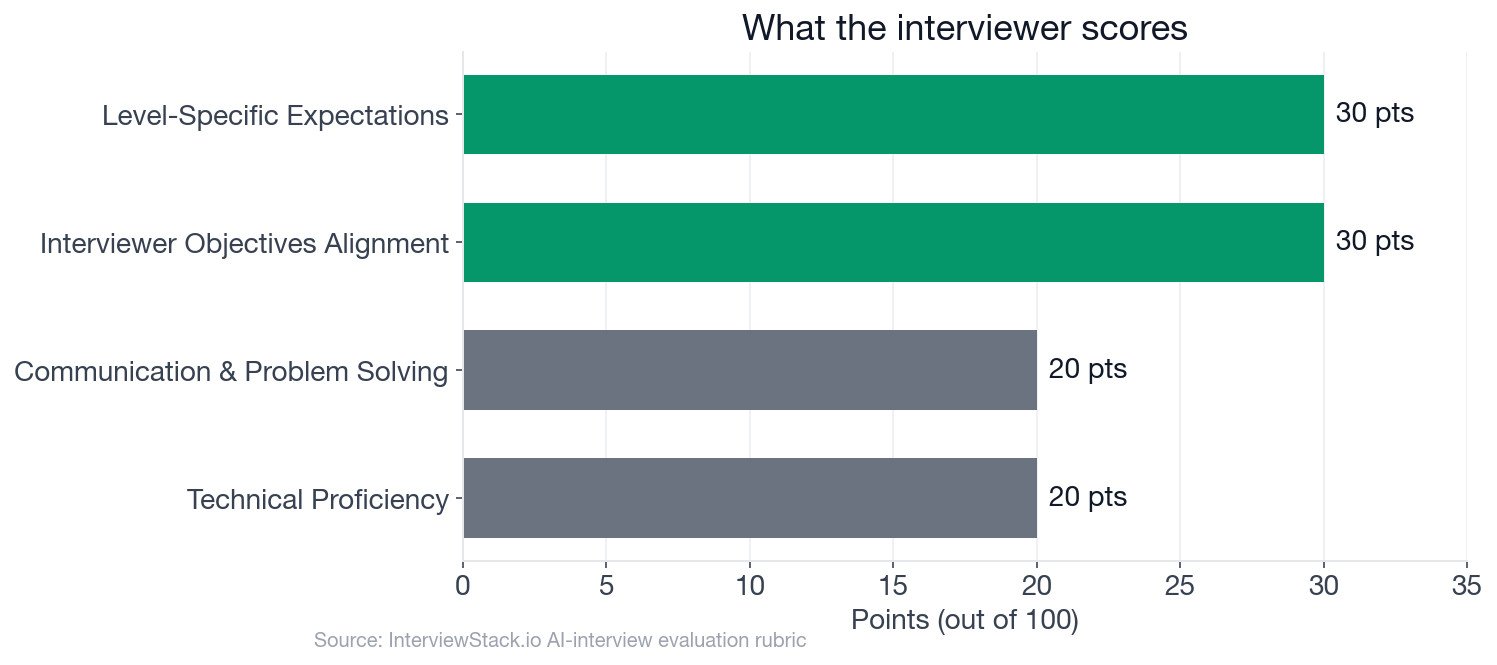
Framing and mid-level judgment (the top two dimensions) account for twice the points of technical correctness alone.
What Is the Mobile Developer Offline-First Architecture Interview Question?
The interviewer puts you in a shared-notes scenario with millions of users, unreliable connectivity, and multi-device editing. Here is the question as it appears in the live blueprint:
The interview question
You are working on a mobile app used by millions of users globally. A major user pain point is unreliable connectivity during travel, commuting, and international usage. The product team wants a redesign of the app's data layer so users can create, edit, and delete shared notes while offline, and see their changes reliably sync when connectivity returns. Notes can be edited from multiple devices, and users expect the app to feel fast and trustworthy even when the network is unstable.
Assume the mobile client owns a local database and talks to a backend sync service over HTTPS. How would you design the mobile client architecture and synchronization approach for this shared notes feature so that it works well offline and converges correctly when devices reconnect?
The interviewer is evaluating whether you can propose a coherent offline-first architecture, design a practical sync protocol, reason about conflict handling, and identify mobile-specific failure modes, all without needing to be guided through the problem structure.
How Do the Follow-Up Questions Move the Score?
Four follow-ups from the blueprint, covering Phases 2 and 3 in order.
Turn 1: Persisting Pending Writes
Interviewer: "What data would you persist locally, and how would you represent pending writes so the app can survive process death, device restart, or app upgrade?"
Turn 2: Safe Retries Without Duplicates
Interviewer: "How would you make the sync operations safe to retry under flaky networks without creating duplicates or corrupting state?"
Turn 3: Incremental Sync for Large Catalogs
Interviewer: "Suppose some users have thousands of notes and connect through poor networks frequently. How would you avoid full re-syncs and keep bandwidth, battery, and startup time under control?"
Turn 4: Conflict Detection and Resolution
Interviewer: "If two devices edit the same note offline and reconnect hours later, how would your system detect and resolve conflicts, and what trade-offs are you making?"
Watching the Mistakes Is the Easy Part
You followed every mistake above. The harder question is whether you would catch them yourself at minute 12, under a follow-up you did not anticipate, with just enough time to recover or push forward. That gap between recognizing a pattern on the page and avoiding it under real time pressure closes only through deliberate reps.
The InterviewStack.io AI mock interview for Mobile Developer offline-first architecture runs the live version of this blueprint, tracks your checklist in real time, and gives scored feedback across all four dimensions when the 30 minutes close.
The Complete 30-Minute Blueprint
The chart below maps the four phases against time so you can see where checklist density clusters:
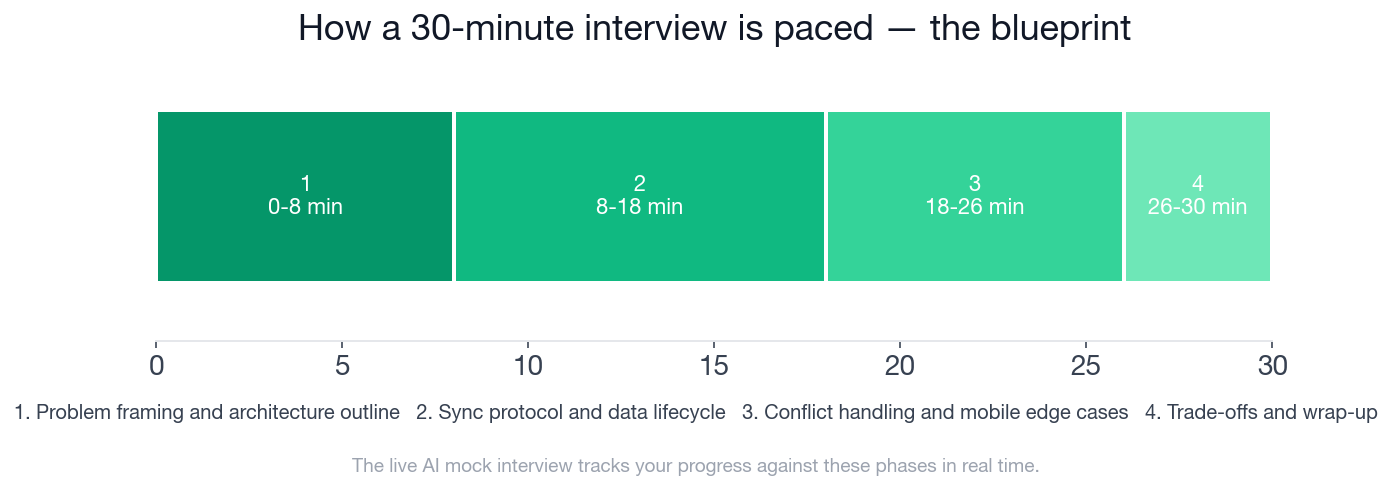
Phase 2 (8-18 min) is the widest band with the most items; hitting it well is the difference between a mid-level pass and a borderline score.
This is the blueprint a strong candidate covers, and the exact structure the AI mock interview tracks you against in real time:
- ✓Clarifies assumptions such as shared notes, multi-device edits, expected consistency, and whether attachments are in scope.
- ✓States that the local database is the source of truth for rendering UI while offline.
- ✓Separates concerns between local storage, sync engine, API layer, and UI observation/update flow.
- ✓Describes optimistic local writes with pending sync state rather than blocking user actions on network availability.
- ✓Defines note records and some representation of pending mutations or an operation queue persisted locally.
- ✓Explains how creates, updates, and deletes are queued and retried after connectivity returns.
- ✓Mentions idempotency keys, client-generated IDs, or equivalent duplicate-prevention strategy for safe retries.
- ✓Describes incremental pull/push sync using versions, timestamps, tokens, or change feeds instead of full refresh each time.
- ✓Acknowledges partial sync/resume behavior so large sync jobs can continue safely across interruptions.
- ✓Provides a concrete conflict detection mechanism such as revision numbers, per-note version, timestamps with caveats, or causal metadata.
- ✓Chooses a conflict resolution approach and justifies it in product terms, for example field-level merge, server-authoritative merge, or user-visible conflict copies.
- ✓Discusses handling process death, app restart, background limits, and network flapping without losing pending changes.
- ✓Mentions instrumentation such as sync success rate, retry counts, queue age, conflict rate, or divergence indicators.
- ✓Proposes meaningful tests such as offline edit sequences, duplicate request replay, out-of-order responses, and migration or upgrade scenarios.
- ✓Identifies where they would start with a simpler design versus where more advanced techniques would be justified later.
- ✓Explains trade-offs between correctness, implementation complexity, latency, battery, and bandwidth.
- ✓Can summarize the end-to-end flow clearly and acknowledge known limitations.
Practice the Blueprint Live
The AI mock interview for Mobile Developer offline-first architecture and data synchronization asks the opening question, follows up based on your answers, and scores you across all four dimensions when the 30 minutes close. That live feedback loop is what converts blueprint knowledge into interview performance.
For targeted drilling before the full simulation, the question bank for this topic covers synchronization, conflict resolution, and mobile edge cases with worked answers. And if you want to see how this topic fits into a broader Mobile Developer prep path, the InterviewStack.io preparation guide maps topic coverage by seniority level.
FAQ
Q. What does a mid-level Mobile Developer offline-first architecture interview test?
The interview tests four areas: offline-first architecture design (Phase 1, 0-8 min), sync protocol and data lifecycle (Phase 2, 8-18 min), conflict handling and mobile edge cases (Phase 3, 18-26 min), and trade-off reasoning (Phase 4, 26-30 min). The rubric weights Interviewer Objectives Alignment and Level-Specific Expectations at 30 points each, so framing and architectural judgment account for 60 of 100 points.
Q. How many phases are in a 30-minute offline-first mobile interview?
Four phases: problem framing and architecture outline (0-8 min, 4 checklist items), sync protocol and data lifecycle (8-18 min, 5 checklist items), conflict handling and mobile edge cases (18-26 min, 5 checklist items), and trade-offs and wrap-up (26-30 min, 3 checklist items).
Q. Do mid-level Mobile Developer candidates need to know CRDTs for offline-first interviews?
No. The Level-Specific Expectations explicitly state that mid-level candidates are not expected to derive advanced distributed systems algorithms in depth. Candidates should recognize when vector clocks, OT, or CRDTs might be relevant and discuss them at a high level, but must first demonstrate sound sync protocol design: idempotency keys, incremental sync, operation queues, and conflict detection before reaching for advanced algorithms.
Q. What is the most common mistake in offline-first mobile architecture interviews?
Jumping straight to conflict resolution strategies (CRDTs, operational transformation) without establishing the sync protocol foundation. Phase 2 (8-18 min) requires candidates to address five items including operation queuing, idempotency, incremental sync, and partial resume behavior. Candidates who skip to conflict handling miss these items and concede up to 30 points on Level-Specific Expectations before the conflict question is even asked.
Q. What are idempotency keys and why do they matter in mobile sync interviews?
Idempotency keys are client-generated IDs attached to each sync operation so the server can safely deduplicate retried requests. On mobile, where flaky networks can cause the client to retry a request that the server already processed, idempotency keys prevent duplicate creates and double-applied updates. They are an explicit expected checklist item in Phase 2 of this interview blueprint.
Q. How should I prepare for a Mobile Developer offline-first architecture interview?
Practice designing the sync protocol first, not the conflict resolution algorithm. Work through: local database as source of truth, operation queue persistence across process restarts, idempotency keys for safe retries, incremental sync with version tokens, and partial sync resume. Then layer on conflict detection and resolution. The InterviewStack.io AI mock interview for Mobile Developer offline-first architecture tracks you against the live blueprint in real time.
Q. What is the scoring rubric for a Mobile Developer offline-first architecture interview?
The rubric has four dimensions: Interviewer Objectives Alignment (30 points), Level-Specific Expectations (30 points), Technical Proficiency (20 points), and Communication and Problem Solving (20 points). Total is 100 points. The two highest-weighted dimensions reward systematic framing and mid-level judgment, not just technical correctness.
The Queue Is the Foundation
The conflict algorithm is what everyone studies. The operation queue, idempotency keys, and incremental sync cursor are what decide the mid-level score in Phase 2. Get those three right in the first 18 minutes, then bring the conflict discussion as the natural next layer. That ordering is exactly what the 17-item checklist rewards.
Topics
Ready to practice?
Put what you've learned into practice with AI mock interviews and structured preparation guides.