
Normal Utilization Doesn't Mean a Normal Network
Picture a mid-level Network Engineer interview built around a service running in 3 regions with 2 data centers each, mixing east-west service traffic with north-south client traffic. The SRE team has been chasing intermittent latency spikes and throughput drops for a month, and every time they check the dashboards, the interface utilization graphs look completely normal. That's the trap this interview is built to test: a candidate who reads "normal utilization" as "not a network problem" walks straight into it, and the cost shows up on the rubric before the interview is half over.
This walkthrough follows one real interview package from InterviewStack.io's production AI interviewer, the same scenario, rubric, and phase timing a live candidate would get, played out turn by turn so you can see exactly where a well-prepared answer starts leaking points.
Key Findings
- The rubric splits 100 points across four dimensions: 30 for Interviewer Objectives Alignment, 30 for Level-Specific Expectations, 20 for Technical Proficiency, and 20 for Communication and Problem Solving.
- The interview runs 30 minutes across three phases: monitoring design (minutes 0-10), diagnosis (minutes 10-22), and baselines, alerting, and capacity (minutes 22-30).
- The scenario spans 3 regions with 2 data centers each, 6 sites total, mixing east-west service traffic with north-south client traffic.
- Phase 2 alone, 12 of the 30 minutes, covers localizing an issue by region or path, reading multiple telemetry signals together instead of any single metric, telling apart look-alike causes, and using that data for faster in-incident isolation rather than just postmortem analysis.
- Across the three phases, the blueprint scores against 12 distinct checklist items; missing the one about combining normal utilization with elevated drops or queue pressure is a specifically named miss, not a vague deduction.
- This walkthrough dramatizes 4 of the 6 real follow-up prompts from the production interview package.
- 4 technical areas are explicitly out of scope for this interview: kernel or NIC driver work, machine learning model design, coding exercises, and cryptography or PKI depth.
What Does the Network Engineer Network Monitoring Interview Actually Ask?
Here's the prompt a candidate actually sees at minute zero:
The interview question
A company runs a global user-facing service across 3 regions with two data centers per region. The network serves a mix of east-west service traffic and north-south client traffic. Over the last month, the SRE team has reported intermittent latency spikes and occasional throughput drops during peak traffic, but the incidents are hard to localize quickly because visibility is inconsistent across devices and paths. You are joining the network engineering team responsible for improving observability and performance operations for this environment.
How would you design a monitoring and performance strategy for this network so the team can detect, triage, and investigate latency and throughput issues effectively in day-to-day operations?
The interviewer isn't grading for a specific vendor or tool. The objective is to see whether a candidate can design a practical, coherent monitoring and performance approach for a production environment: reasoning about telemetry coverage and signal quality, diagnosing degradation from observable data, defining baselines and alerting thresholds that hold up over time, and making sound trade-offs for a mid-level engineer supporting latency-sensitive services at scale.
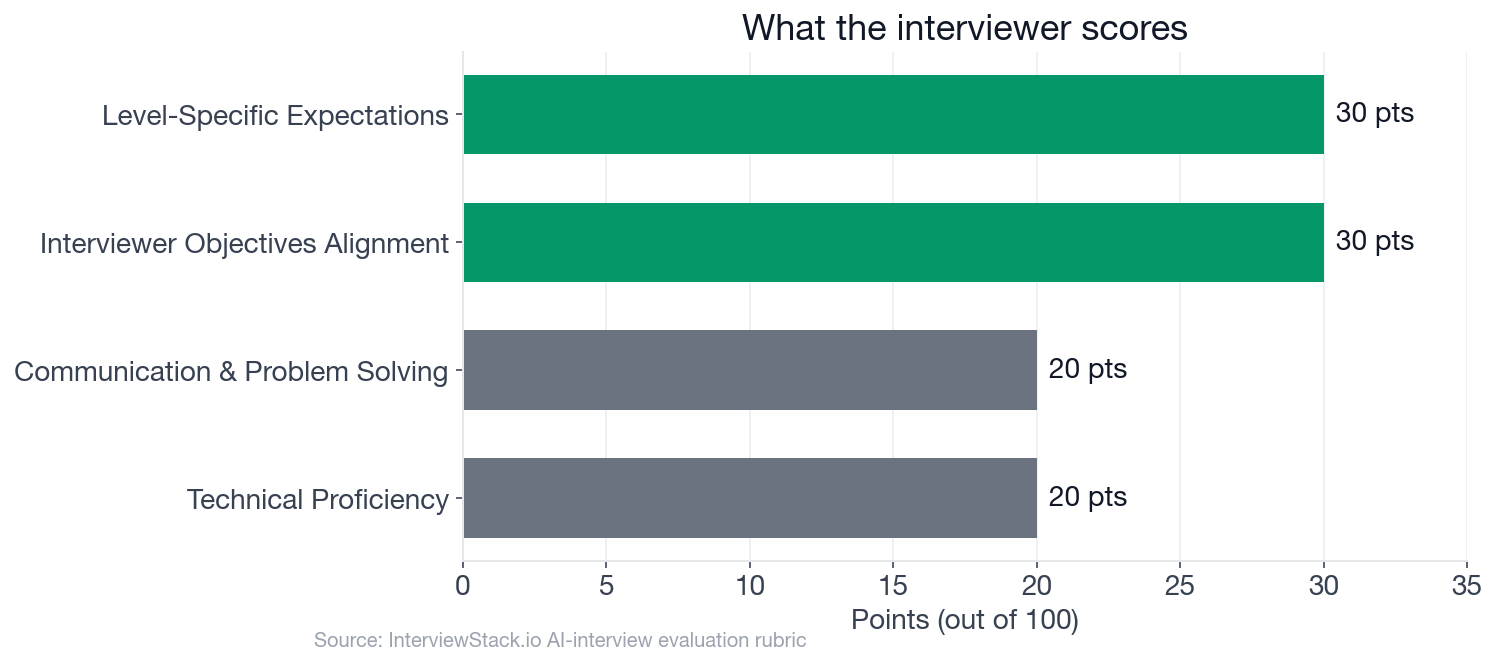
Two of those four dimensions, Interviewer Objectives Alignment and Level-Specific Expectations, account for 60 of the 100 points, which is exactly where the blind spot below costs the most.
One Blind Spot, Four Different Layers
Four of the six real follow-up prompts in this interview package trace the same blind spot through four different layers of the job: what you instrument, how you diagnose, how you baseline, and how you alert. Call the candidate Nolan. Here's where a well-prepared answer starts losing points anyway.
Turn 1: Picking the First Telemetry
Interviewer: "What telemetry would you collect first from network devices and adjacent systems, and how would you prioritize it if you could not instrument everything at once?"
Turn 2: The Graph Says Nothing's Wrong
Interviewer: "Suppose one region shows elevated application latency but interface utilization looks normal. How would you investigate whether the issue is network-related?"
Turn 3: One Threshold for Every Region
Interviewer: "How would you establish a performance baseline for this environment, and how would you keep that baseline useful as traffic patterns change over time?"
Turn 4: Alerting on the Same Blind Metric
Interviewer: "How would you design alerting so the on-call engineer gets actionable signals without being overwhelmed by noisy thresholds?"
What Happens When the Interviewer Also Asks About Backup Traffic?
Every mistake above is easy to spot with the transcript in front of you and no clock running. It gets harder the moment the interviewer changes the shape of the question, for example by asking how the approach differs for latency-sensitive service-to-service traffic versus bulk replication or backup traffic, a real follow-up in this same interview package that this walkthrough hasn't dramatized. A candidate who has only rehearsed the four turns above, instead of the underlying discipline of matching monitoring rigor to what's actually at risk, has no scaffolding left to fall back on.
That's the actual skill being tested: not memorizing four answers, but building the habit of asking what a metric can and can't tell you, on the spot, under a 30-minute clock, against follow-ups you haven't seen before. Reading about it gets you partway; running the same scenario as a live AI mock interview gets you the rest of the way.
What Does a Strong 30-Minute Answer Actually Cover?
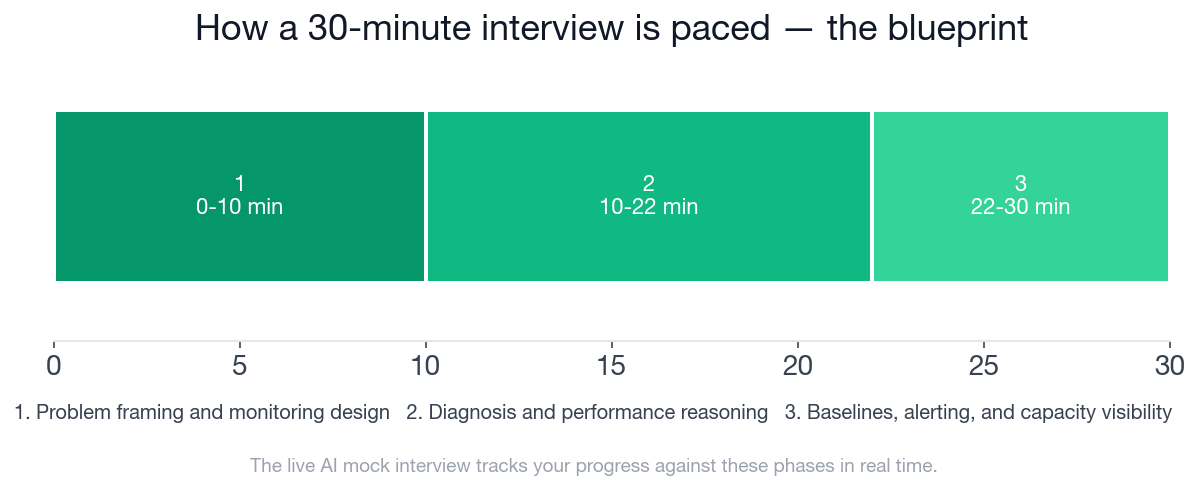
The three phases the AI interviewer times and scores against in real time: framing and monitoring design first, then diagnosis, then baselines, alerting, and capacity.
This is the complete blueprint a strong candidate hits, phase by phase, and it's the exact thing the AI mock interview tracks you against turn by turn. It follows the same phase-by-phase structure as our broader Network Engineer preparation guides.
- ✓Clarifies environment assumptions such as traffic types, critical paths, existing tooling gaps, and operational goals
- ✓Separates detection, triage, and deep-dive investigation needs instead of treating monitoring as one layer
- ✓Names specific telemetry categories such as SNMP/interface counters, streaming telemetry, flow logs, routing adjacencies, device health, and active probes
- ✓Prioritizes initial instrumentation in a way that would be feasible for a mid-sized production rollout
- ✓Explains how to localize by region, device role, path segment, traffic class, or time window
- ✓Uses multiple signals together, for example normal utilization with elevated drops, queue pressure, path changes, retransmits, or synthetic probe degradation
- ✓Differentiates possible causes such as congestion, microbursts, duplex or physical issues, routing instability, policy/QoS effects, host-side bottlenecks, or application symptoms misattributed to network
- ✓Describes how collected data would support faster isolation during an incident rather than only postmortem analysis
- ✓Defines baselines by traffic class, region, and time-of-day or day-of-week instead of one universal threshold
- ✓Suggests actionable alerts tied to symptoms or SLO impact, with suppression or aggregation to reduce noise
- ✓Identifies capacity indicators such as sustained utilization, peak headroom, discard trends, queue occupancy, and growth over time
- ✓Discusses retention, metric cardinality, dashboarding, and escalation trade-offs at a practical level
Practice This Scenario Before the Real Interview Does
Reading through Nolan's four mistakes is the easy part. The real test is catching the same blind spot live, when the interviewer changes the traffic mix or asks you to defend a threshold you just proposed. Start the same 30-minute Network Engineer network monitoring interview and get scored against this exact rubric, phase by phase, with feedback on where you lost points and why. If you want to drill the underlying concepts first, telemetry design, baselining, and alerting, the Network Monitoring and Performance question bank breaks them down by topic.
FAQ
Q. What experience level is this Network Engineer interview calibrated for?
This walkthrough follows a mid-level (2 to 5 years) Network Engineer interview on network monitoring and performance. The bar is a reasonably complete monitoring design for a known environment, not the staff-level depth of building a company-wide telemetry platform from scratch.
Q. How long does the interview run and what are its phases?
The full interview runs 30 minutes across three phases: problem framing and monitoring design (minutes 0 to 10), diagnosis and performance reasoning (minutes 10 to 22), and baselines, alerting, and capacity visibility (minutes 22 to 30). Each phase carries its own checklist the interviewer is scoring against.
Q. What's the recurring blind spot this network monitoring interview is built to test?
Treating normal interface utilization as proof the network is not the problem. Microbursts, queue pressure, retransmits, and routing changes can all degrade performance well below the point where average utilization looks abnormal, and missing that costs points on the interview's Level-Specific Expectations dimension, worth 30 of 100 points.
Q. How is the Network Engineer network monitoring interview scored?
The rubric splits 100 points across four dimensions: Interviewer Objectives Alignment (30 points), Level-Specific Expectations (30 points), Technical Proficiency (20 points), and Communication and Problem Solving (20 points).
Q. Does the interview expect a different approach for latency-sensitive traffic versus backup traffic?
Yes. A strong answer treats service-to-service traffic that is sensitive to latency and jitter differently from bulk replication or backup traffic, prioritizing tighter monitoring and alerting thresholds on the former and tolerating more variance on the latter, since the two traffic classes fail in different ways and at different costs.
Q. What is out of scope for this interview?
The interview stays in network engineering territory. Kernel or NIC driver development, machine learning model design, software feature coding exercises, and cryptography or PKI deep dives are all explicitly out of scope.
Q. Can I practice this exact interview scenario?
Yes. The AI mock interview runs the same scenario, rubric, and phase timing described here, and scores your answers turn by turn so you can see exactly where points are won or lost.
Instrumentation Decides What You're Allowed to See
Every layer of this interview, telemetry, diagnosis, baselines, alerting, comes back to the same idea: you can only catch what you built the capability to see. A network engineer who instruments for signal quality, not just coverage, walks into minute ten already ahead of one who is still reading a flat utilization graph and calling it good news.
Topics
Ready to practice?
Put what you've learned into practice with AI mock interviews and structured preparation guides.