
The Network Engineer Network Troubleshooting Interview Rewards Looking Close Before Looking Far
A production incident is already 20 minutes old when this interview opens. A subset of application servers can't reach a critical internal service, other clients in the region are fine, and there was an unconfirmed network change earlier today. The instinct most candidates reach for first, blame the change, blame the far side of the network, is exactly what this interview is built to test. Below is a live walkthrough of that interview, mirrored from InterviewStack.io's production AI-interview generator, turn by turn, including where a well-prepared mid-level candidate still gives away points.
Key Findings
- 100 rubric points split across four dimensions: 30 for Interviewer Objectives Alignment, 30 for Level-Specific Expectations, 20 for Technical Proficiency, 20 for Communication and Problem Solving.
- The simulated incident is already 20 minutes old when the interview opens, so the first answer has to triage a live clock, not a hypothetical.
- The 30-minute interview breaks into three phases: 7 minutes to triage, 13 minutes to isolate the fault, and 10 minutes to decide on mitigation and communicate it.
- Technical isolation (minutes 7-20) carries 6 checklist items in 13 minutes, more than either the triage phase (4 items) or the mitigation phase (5 items) on its own.
- Six follow-up prompts probe the incident; this walkthrough dramatizes four of them, spanning triage, isolation, and mitigation.
- Candidates are expected to independently drive the first-pass diagnosis, a mid-level bar (2-5 years), not design a company-wide remediation architecture.
Here's the prompt a real mid-level candidate walks into:
The interview question
You are the primary on-call Network Engineer for a production service in one region of a large tech company. Starting about 20 minutes ago, multiple application teams reported that requests from a subset of application servers to a critical internal service are timing out, while other clients in the same region appear healthy. There was a routine network change earlier today, but the details are not yet confirmed. You have access to standard network troubleshooting tools from affected hosts and network devices, and you can engage adjacent teams if needed.
How would you investigate and drive this incident to identify the network issue and restore service?
The interviewer is watching whether you troubleshoot methodically across DNS, routing, firewall policy, and Layer 3/4 connectivity, pick the right diagnostic tool for each hypothesis, and turn an ambiguous symptom into an actionable incident plan, at a level appropriate for someone with 2 to 5 years of experience working onsite at a large company.
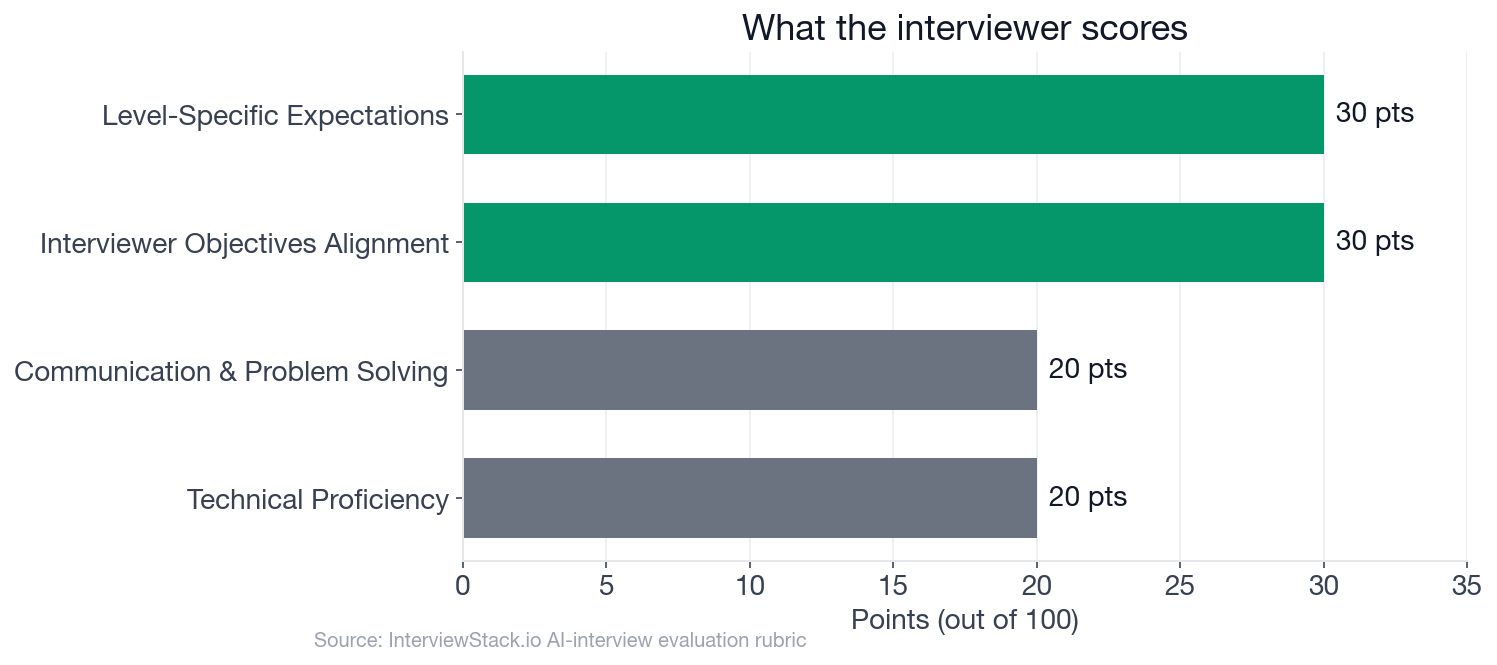 Sixty of the interview's 100 points reward how you frame and isolate the problem; the other forty reward execution and communication.
Where Does the Investigation Actually Fall Apart?
Below are four moments from this interview where a well-prepared mid-level candidate, call him Omar, gives an answer that sounds reasonable and still costs rubric points.
Turn 1: The First Move
Interviewer: "What would you check first to determine whether this is a DNS issue, a routing issue, or a firewall/connectivity issue?"
Turn 2: The Hop That Stops
Interviewer: "Suppose ping fails from affected hosts, but DNS resolution succeeds and traceroute stops after the first hop. How would you interpret that?"
Turn 3: The Bastion That Works
Interviewer: "Imagine the service is reachable from a bastion host but not from the application servers. What hypotheses would you prioritize next?"
Turn 4: The Confirmed Change
Interviewer: "If you found that a firewall policy was recently updated, how would you confirm it is the root cause and safely restore connectivity?"
Spotting the Mistake on the Page Is the Easy Part
Every mistake above is easy to catch once the wrong sentence is highlighted in red and the fix is in green. Live, you don't get that framing. You get an interviewer asking a plain question, a clock that doesn't pause while you decide whether to escalate or check one more thing locally, and follow-ups that don't announce which checklist item they're testing. The gap between reading this walkthrough and passing this interview is reps: running the scenario out loud, under real time pressure, until "compare affected versus unaffected first" becomes the automatic move instead of the thing you remember two minutes too late.
The Complete 30-Minute Blueprint
Here's how the phases break down against the clock:
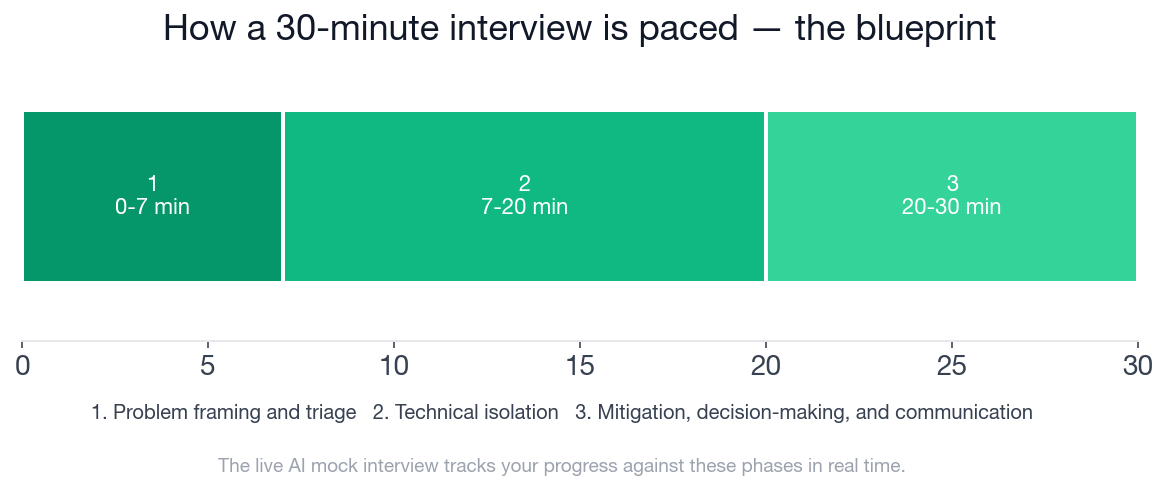 Triage gets 7 minutes, technical isolation gets the most time and the most checklist items at 13 minutes, and mitigation and communication close out the final 10.
- ✓Clarifies affected source hosts, destination service, timing, and whether failures are total or intermittent
- ✓Separates working vs non-working populations to identify blast radius
- ✓Mentions recent change correlation without assuming causation immediately
- ✓Proposes an order of operations such as DNS check, path check, route/policy validation, and packet-level verification
- ✓Explains how to verify name resolution separately from transport connectivity
- ✓Uses comparison from affected and unaffected hosts to isolate subnet, AZ, VLAN, route domain, or security policy differences
- ✓Checks local host route table/default gateway and upstream path visibility
- ✓Discusses validating firewall/ACL/security group rules in both directions if relevant
- ✓Mentions tcpdump or flow logs to determine whether SYN packets leave, whether replies return, or whether packets are dropped mid-path
- ✓Considers intermittent issues such as packet loss, congestion, asymmetric routing, or MTU problems when symptoms are not binary
- ✓States clear criteria for rollback versus continued investigation
- ✓Proposes a low-risk mitigation path such as reverting a policy/route change or shifting traffic if available
- ✓Describes how to confirm the fix from multiple vantage points after mitigation
- ✓Communicates what evidence would be shared with service owners or network control-plane teams
- ✓Mentions documenting timeline, cause, and preventive follow-up after restoration
This is the blueprint a strong candidate hits, phase by phase, checklist item by checklist item, and it's the exact structure the AI mock interview tracks you against in real time, not just at the end.
Ready to Run This Incident for Real?
Reading the mistakes above is the easy part. The hard part is doing this live, out loud, on a clock, with an interviewer who won't tell you which layer the next follow-up targets. Start the Network Engineer network troubleshooting mock interview and get scored against this exact rubric, with feedback on where you actually lost points. If you want to drill the underlying concepts first, work through the Network Engineer network troubleshooting question bank, build foundational judgment with the interactive courses, or browse open Network Engineer roles to see what teams are actually asking for.
FAQ
Q. What does a Network Engineer interview on network troubleshooting methodologies actually test?
It tests whether you can drive a live incident through a structured order of operations, DNS, then path, then routing and firewall policy, then packet-level verification, rather than guessing at a cause. Two of the four rubric dimensions, worth 60 of the interview's 100 points combined, reward that structure and the seniority-appropriate judgment behind it.
Q. If DNS resolves and ping fails with a traceroute that stops at the first hop, what does that actually mean?
A response at hop one already confirms the affected host's own route table, ARP, and default gateway are working, since something local answered the probe. The break more likely sits just past that hop, the gateway's own routing or a policy immediately beyond it, not deep in the backbone. The interview's technical isolation phase explicitly rewards checking upstream path visibility just beyond that first hop before escalating to another team.
Q. If a service is reachable from a bastion host but not from application servers, where should you look first?
Compare the network context of the two host populations, subnet, security group or ACL membership, and route table, before diving into host-level configuration. Reachable from one host type and not another is a textbook signal of a routing-domain or security-policy difference between the two populations, not a general outage.
Q. How long is this interview and how is it paced?
Thirty minutes across three phases: 7 minutes to triage and scope the incident, 13 minutes to isolate the fault technically, and 10 minutes to decide on mitigation, confirm the fix, and communicate it.
Q. What's the biggest mistake mid-level candidates make in this interview?
Treating a recent network change or an ambiguous symptom as proof of the root cause before comparing affected and unaffected host populations. That skips the triage phase's checklist item on separating working from non-working hosts to establish blast radius, and it costs points before the deeper technical questions even arrive.
Q. Should you always roll back a recent network change if the timing lines up with an incident?
No. The interview's mitigation phase specifically rewards stating clear criteria for rollback versus continued investigation, and confirming what the change actually altered and whether it touches the failing hosts, before reverting it. A change that lines up in time is a hypothesis to test, not an automatic verdict.
Q. Can I practice this exact interview?
Yes. The AI mock interview runs this same Network Engineer network troubleshooting scenario live, asks unscripted follow-up questions, and scores your answers against the same rubric described here.
Local Before You Escalate
Nothing in this scenario requires exotic tooling. Every trap above is solved by the same discipline: compare what's failing to what isn't, check what's near before you blame what's far, and only escalate once the evidence, not the timing, points you there. That discipline is easy to nod along with reading a blog post and genuinely hard to hold onto live, under a clock, which is exactly what the mock interview is built to pressure-test.
Topics
Ready to practice?
Put what you've learned into practice with AI mock interviews and structured preparation guides.