
The Framing Trap Starts With "DNS Works"
You're on call. A new internal web app is failing at one branch: users can resolve the hostname, but the connection intermittently hangs or drops. Other offices are slow but reachable. The interviewer hands you this scenario and asks you to walk through it using the OSI model and TCP/IP stack.
This is a 30-minute mid-level Network Engineer interview, and 60 of 100 rubric points score how you structure and drive the investigation, not how many layers you can name. The OSI Model and TCP/IP Stack question bank surfaces this pattern repeatedly: candidates who recite all seven layers fluently still concede the framing points by treating the model as a fact list instead of a diagnostic tool.
Key Findings
- 60 of 100 rubric points go to Interviewer Objectives Alignment (30 pts) and Level-Specific Expectations (30 pts): framing and investigation structure, not protocol recall.
- The interview spans 30 minutes across four phases: fault-domain hypothesis (0-7 min), layer-by-layer walkthrough (7-20 min), deeper probing and tradeoffs (20-27 min), and summary (27-30 min).
- Phase 1 has four explicit checklist items; failing to "outline a stepwise plan instead of listing isolated commands or facts" costs points in the single highest-weighted dimension.
- Mid-level candidates are expected to independently drive a standard network incident investigation without heavy prompting; waiting for direction at each step drops the Level-Specific Expectations dimension (30 pts).
- Successful DNS resolution confirms Layer 3 connectivity for that specific traffic path only; the investigation should narrow to Layers 1-4 for the application path, not conclude the problem is above Layer 3.
- A missing SYN-ACK is a Layer 4 symptom with plausible causes at Layers 2, 3, and 4 simultaneously; presenting one hypothesis without mapping alternatives costs Interviewer Objectives Alignment points.
- TLS encrypts the application payload, but the TCP handshake, SNI field, certificate exchange, and connection timing remain observable; concluding that TLS makes troubleshooting impossible costs Technical Proficiency points (20 pts).
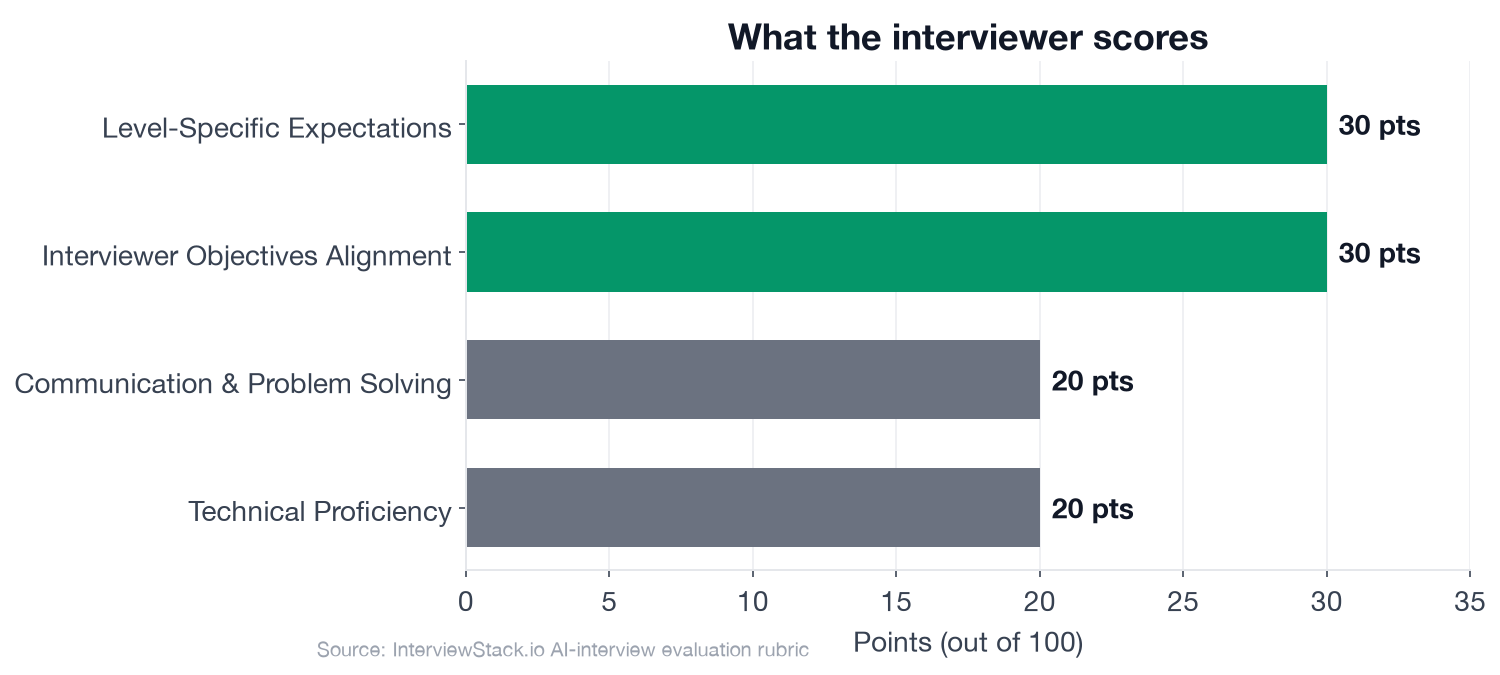
The four rubric dimensions and their point weights. Framing and level-appropriate judgment carry twice the weight of protocol recall or communication.
How Does a Network Engineer OSI Model and TCP/IP Stack Interview Run?
The interview question
A new internal web application was rolled out across several office locations. Users in one branch report that they can resolve the application's DNS name, but when they try to load the site, the connection intermittently fails or hangs. Other branches can usually reach it, although some users report slowness. You are the on-call network engineer during a daytime incident and need to lead the technical investigation with limited time and incomplete information.
Walk me through how you would troubleshoot this incident using the OSI model and TCP/IP stack, including how you would narrow the fault domain and what you would expect to validate at each stage.
The interviewer is testing whether you convert the symptom evidence immediately into a layered troubleshooting plan and whether you can own that plan without being redirected at every step. DNS success, branch localization, and intermittency are not background detail: they are the fault-domain filters Phase 1 expects you to apply in the first two minutes. Browse Network Engineer preparation guides to see what the full role scope looks like before the session.
Turn 1: DNS Success and Layer Scope
Interviewer: "If users can successfully resolve the hostname but cannot reliably load the application, which layers become more or less likely, and why?"
Turn 2: The Missing SYN-ACK
Interviewer: "Suppose packet captures show TCP SYNs leaving the client and no SYN-ACK returning from the server side. What possibilities would you investigate next across different layers and devices?"
Turn 3: Isolating the Affected Branch
Interviewer: "If one branch is impacted much more than others, what branch-specific Layer 1 through Layer 3 causes would you want to rule out first?"
Turn 4: TLS and Visibility Limits
Interviewer: "Where would TLS encryption fit into your explanation, and how can encryption affect what you can and cannot validate during troubleshooting?"
Watching the Mistakes Is Easier Than Avoiding Them Live
Reading these turns, the right call seems clear. Under a 30-minute clock with an interviewer introducing new evidence at each step, the pressure looks different. The four turns above represent roughly 23 minutes of live conversation, each building on the last.
Knowing the OSI layers closes the recall gap. Driving a structured investigation under time pressure closes the framing gap. That second gap is a reps problem. The Network Engineer OSI Model and TCP/IP Stack AI mock interview runs the same 30-minute session, tracks you against the four-phase blueprint in real time, and returns scored feedback on every rubric dimension after the session. If you want to drill specific turns first, the OSI Model and TCP/IP Stack question bank has targeted practice on each phase's checklist items.
The Blueprint a Strong Candidate Hits
Below is the exact phase structure the AI interviewer tracks you against in a live session. Phase 1 (0-7 min) is where most rubric points are secured or conceded.
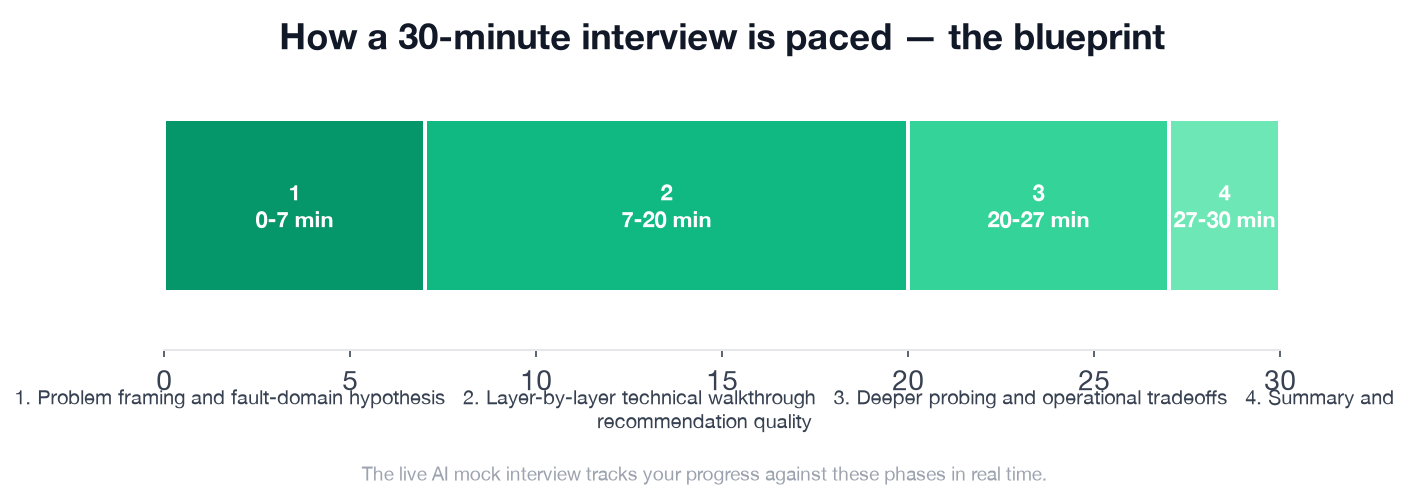
The 30-minute interview paced by phase. Phase 2 carries the bulk of the technical evaluation at 13 minutes.
- ✓Clarifies scope of impact such as one branch versus global issue
- ✓Recognizes that successful DNS resolution suggests some application-layer functionality is working
- ✓Narrows likely investigation toward layers 1-4 and application availability rather than treating DNS as the primary fault
- ✓Outlines a stepwise plan instead of listing isolated commands or facts
- ✓Explains physical checks such as interface state, errors, speed and duplex, optics or cabling where relevant
- ✓Covers data link validation such as VLAN membership, MAC learning, switching loops, ARP behavior, and frame delivery within the branch
- ✓Covers network-layer checks such as IP addressing, subnet mask, default gateway, routing path, ACLs, MTU concerns, and asymmetric routing possibilities
- ✓Covers transport-layer checks such as TCP handshake, retransmissions, resets, timeouts, and distinction from UDP behavior
- ✓Connects application behavior to protocols like HTTP, HTTPS, and DNS without over-attributing all symptoms to layer 7
- ✓Correctly uses terms like bits, frames, packets, and segments or datagrams in context
- ✓Interprets missing SYN-ACK evidence as a transport symptom that may originate from routing, filtering, server reachability, or return-path problems
- ✓Explains how branch-specific symptoms could point to access-layer, WAN, local routing, or policy differences
- ✓Describes the impact of TLS on visibility while still identifying what remains observable such as TCP handshake, SNI in some environments, certificate exchange, or timing behavior
- ✓Chooses sensible validation tools such as ping, traceroute, arp, interface counters, route tables, logs, and packet captures with clear purpose
- ✓Summarizes the most likely fault domains in priority order
- ✓Proposes immediate next validation steps and escalation points
- ✓Communicates tradeoffs between fast restoration and deeper root-cause isolation
Practice This Live
The four turns above cover the highest-signal follow-ups in the blueprint. The remaining scenarios and the per-phase scoring breakdown only surface in the live session.
Start the Network Engineer OSI Model and TCP/IP Stack AI mock interview to run the full 30-minute simulation with real-time blueprint tracking and scored feedback on all four rubric dimensions. If you want additional question-bank practice on this topic before going live, the Network Engineer question bank has targeted drills organized by phase.
FAQ
Q. What do interviewers evaluate in a Network Engineer OSI model and TCP/IP stack interview?
Interviewers score across four rubric dimensions: Interviewer Objectives Alignment (30 pts), Level-Specific Expectations (30 pts), Technical Proficiency (20 pts), and Communication and Problem Solving (20 pts). The highest-weighted criteria reward a structured, layered troubleshooting approach and the ability to drive an investigation independently without heavy prompting.
Q. Why does DNS working narrow the suspect list to Layers 1-4?
Successful DNS resolution confirms that the client can reach a resolver and receive a UDP response, proving Layer 3 connectivity for that specific traffic path. It says nothing about TCP connectivity to the application server, which may traverse a different routing path, firewall rule, or VLAN. The correct framing narrows the primary investigation toward Layers 1-4 transport-path issues rather than treating this as a Layer 7 application problem.
Q. What does a missing SYN-ACK in a packet capture mean for OSI model troubleshooting?
A missing SYN-ACK means the TCP handshake never completed, which is a Layer 4 symptom with potential causes at multiple layers: the SYN may not be reaching the server (Layer 3 routing or ACL), the server may not be listening on that port (Layer 4 or application), return-path asymmetry may be dropping the SYN-ACK, or a firewall is silently blocking it. A strong answer maps each hypothesis to a specific layer and names a validation tool for each.
Q. How does TLS affect troubleshooting visibility in a Network Engineer interview scenario?
TLS encrypts the application payload at the session and presentation layer range (OSI Layers 5-6), but several signals remain observable: the TCP three-way handshake at Layer 4 is visible in packet captures, the TLS ClientHello contains the SNI field and is readable before encryption, and certificate exchange timing can reveal negotiation failures. What becomes opaque is the HTTP payload and application-level errors inside TLS records.
Q. What is the difference between the OSI model and the TCP/IP model in a troubleshooting context?
The OSI model has seven layers; the TCP/IP model has four, collapsing OSI Layers 5-7 into a single Application layer and combining Layers 1-2 into a Network Access layer. In practice, OSI granularity is useful for pinpointing where a fault likely originates, while TCP/IP terminology maps more directly to protocol implementations. A strong candidate uses OSI for diagnostic precision and TCP/IP for protocol-level discussion rather than treating them as alternatives.
Q. How should a mid-level Network Engineer drive a troubleshooting interview differently from a junior?
At mid-level, the expectation is independent investigation leadership without heavy prompting from the interviewer. This means proposing a structured, layered plan in the first response, prioritizing likely causes over exhaustive theory coverage, making reasonable assumptions with stated rationale, and adapting the investigation as new evidence appears. A candidate who waits for the interviewer to direct each step is missing the Level-Specific Expectations dimension, which carries 30 of 100 rubric points.
Q. Which validation tools are expected in a Network Engineer OSI model interview?
Strong candidates cite purpose-driven tool selection aligned to specific layers: ping and traceroute for Layer 3 path verification, arp for Layer 2 MAC reachability, interface counters and link state checks for Layer 1-2 physical validation, route table inspection for Layer 3 routing logic, firewall and ACL logs for policy-level filtering, and packet capture for Layer 4 handshake verification. The key is explaining why each tool applies at a specific layer rather than listing commands without context.
The Score Lives in the Structure, Not the Layers
This walkthrough is illustrative of how a strong mid-level network engineering interview runs: the protocol vocabulary matters, but the rubric rewards candidates who own the investigation from ambiguous symptom to ranked hypotheses to validated next steps. The Network Engineer job board shows what employers are actively requiring; the AI mock interview shows whether you can perform it live under pressure.
Topics
Ready to practice?
Put what you've learned into practice with AI mock interviews and structured preparation guides.