
The Cloud Skill Premium Doesn't Belong to the Cloud Role
Ask which role pays more for cloud skills, Network Engineer or Cloud Engineer, and the obvious answer is wrong. Google Cloud adds $28,500 to a Network Engineer's median US base salary (base pay only; postings don't disclose equity or bonus). The same skill adds just $11,000 inside Cloud Engineer's own postings. CI/CD does something even stranger: a $29,200 premium on the Network Engineer side and a $1,500 pay cut on the Cloud Engineer side, where it's simply expected.
We compared every active Network Engineer and Cloud Engineer posting on the InterviewStack.io job board as of July 2026, 4,135 and 3,765 listings, the same filtered set visible on the job board itself. Network Engineer is the older, protocol-and-hardware discipline: BGP, OSPF, firewalls. Cloud Engineer is the newer, provisioning-and-automation discipline: Terraform, Kubernetes, CI/CD. The two overlap by 28% (Jaccard similarity, the fraction of skills the two roles' top-30 lists have in common), and the pattern above is what happens once you look past that overlap: the skills that define one job pay more when they show up, unexpectedly, in the other.
A scope note on the data: role classification on a live job board is not hand-curated. A slice of the Cloud Engineer sample is generic "IT Infrastructure" specialist or expert titles with no explicit cloud focus, plus a few postings where "Cloud" appears only in the hiring team's name rather than the job itself (a hardware chip-design role and a data-center controls-engineering role at major cloud providers both showed up in the sample). Network Engineer's sample is cleaner, with just a small slice of Technician-tier and telecom-core roles mixed in. Both roles' skill and salary figures below are computed across the full posting set either way, so this dilutes the role-specific signal rather than inflating it.
| Network Engineer | Cloud Engineer | |
|---|---|---|
| Median US base salary | $127,500 | $145,000 |
| Active postings | 4,135 | 3,765 |
| Top skill | Monitoring (44.2%) | Azure (46.5%) |
| Hybrid + remote share | 37.3% | 55.0% |
| Entry-level share | 2.7% | 3.6% |
| Skill overlap (Jaccard) | 28% shared (pairwise) | 28% shared (pairwise) |
Key Findings
- Cloud Engineer's median US base salary is $145,000 versus $127,500 for Network Engineer, a $17,500 gap (12%).
- Skill overlap is 28% (Jaccard on each role's top 30 skills); even shared skills split hard, AWS runs 2.4x more common in Cloud Engineer postings, Azure 2.8x, Terraform 4.9x.
- Google Cloud adds a $28,500 premium in Network Engineer postings (n=88) versus $11,000 in Cloud Engineer's own postings (n=216).
- CI/CD adds $29,200 to Network Engineer pay (n=81) but sits $1,500 below Cloud Engineer's own baseline (n=266).
- Network Engineer carries 1.10x the posting volume (4,135 vs. 3,765), a near-even split.
- Entry-level share is thin on both sides: 2.7% for Network Engineer, 3.6% for Cloud Engineer.
- Cloud Engineer is far more flexible: 55.0% of postings are hybrid or remote versus 37.3% for Network Engineer.
What Skills Do Both Roles Actually Share?
Both roles lean on Monitoring, Automation, AWS, Azure, and Python in a majority or near-majority of postings, but "shared" hides how unevenly those skills are actually split.
| Skill | Network Engineer | Cloud Engineer | Skews toward |
|---|---|---|---|
| Monitoring | 44.2% | 39.0% | Network Engineer, 1.1x |
| DNS | 20.2% | 10.5% | Network Engineer, 1.9x |
| Automation | 32.7% | 45.7% | Cloud Engineer, 1.4x |
| AWS | 19.5% | 46.5% | Cloud Engineer, 2.4x |
| Azure | 16.3% | 46.5% | Cloud Engineer, 2.8x |
| Python | 21.9% | 34.7% | Cloud Engineer, 1.6x |
| Terraform | 7.9% | 38.7% | Cloud Engineer, 4.9x |
Two shared skills lean toward Network Engineer: DNS most strongly, showing up in 20.2% of Network Engineer postings against 10.5% of Cloud Engineer postings, nearly double, and Monitoring only slightly (1.1x). A third, High Availability, is close enough to call a tie (11.1% versus 10.0%) and isn't broken out in the table above. Every other skill in the 13-skill shared list, including the rest shown here, tilts toward Cloud Engineer, and Terraform is barely shared at all: it clears the 5% floor on the Network Engineer side, but just barely, showing up in roughly 1 in 12 Network Engineer postings against nearly 2 in 5 Cloud Engineer postings.
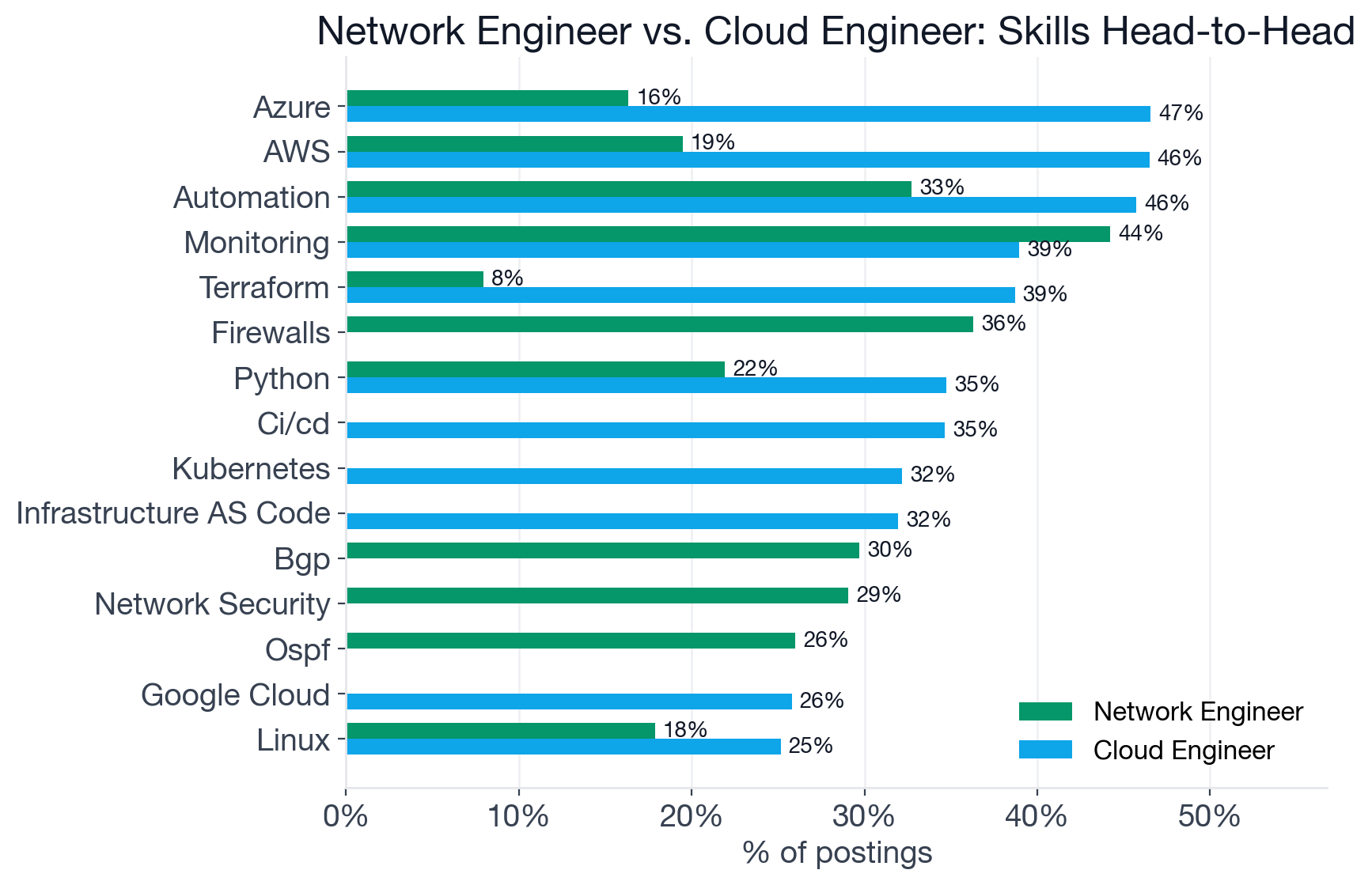
Top skills from the combined top-30 lists of both roles, by share of postings.
Past the shared list, the two roles pull from almost entirely different vocabularies. Network Engineer's exclusive skills are protocol-and-perimeter work: Firewalls (36.3%), BGP (29.7%), Network Security (29.1%), OSPF (26.0%), and VPN (21.5%). One outlier stands out: TypeScript clears the exclusivity threshold at 11.7%, likely the automation-tooling slice of the role. Titles like "Network Automation Engineer" and "Infrastructure Automation Engineer" show up in the sample, and Meta and Google both appear among the role's top employers alongside a heavier concentration of defense and government contractors (CACI International, Leidos, General Dynamics Information Technology, Peraton, Northrop Grumman).
Cloud Engineer's exclusive skills are provisioning-and-delivery: CI/CD (34.6%), Kubernetes (32.2%), Infrastructure as Code (31.9%), Google Cloud (25.8%), and Docker (18.7%). Nothing in that list would be unfamiliar to a DevOps engineer; the role sits at the intersection of infrastructure and software delivery in a way Network Engineer, still centered on the network layer itself, does not.
Which Role Pays More?
Cloud Engineer pays more, by a real margin. Among US postings (the only comparable slice, since wage-transparency laws produce consistent disclosure there), the median base salary is $145,000 for Cloud Engineer versus $127,500 for Network Engineer, a $17,500 gap (12%). These are base salary figures only; equity, bonus, and sign-on aren't disclosed in postings, so total compensation runs higher than either number alone, especially at senior levels.
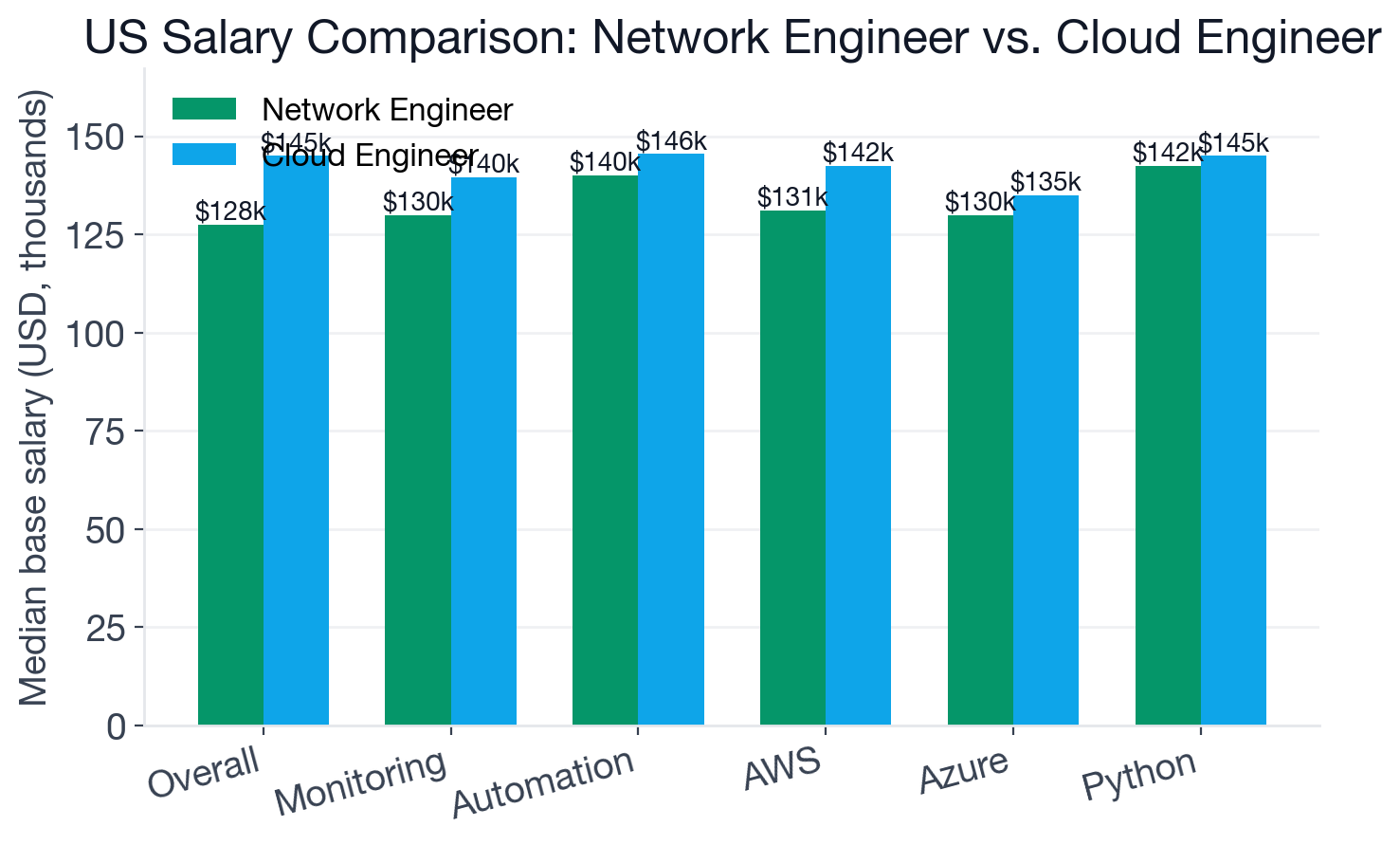
Median US base salary, overall and by shared skill, for each role.
Network Engineer's own defining skills barely move that $127,500 baseline. Firewalls (n=456) pays $2,700 below it. BGP (+$5,500), Network Security (+$5,000), and OSPF (+$6,700) clear it, but modestly. The real premiums sit outside the role's core skill list entirely: CI/CD (+$29,200, n=81), Google Cloud (+$28,500, n=88), Observability (+$23,200, n=96), Kubernetes (+$17,100, n=56), and Python (+$15,000, n=300, despite already being a top-30 skill for the role at 22%). None of these are Network Engineer table stakes, and all of them pay more than protocol depth does.
Cloud Engineer shows the mirror pattern, for a different reason. Its own headline provisioning skills sit at or below its $145,000 baseline: AWS (-$2,600), Azure (-$10,000), Terraform (-$2,500), CI/CD (-$1,500), Docker (-$2,600). They're so close to universal within the role that they no longer differentiate anyone. The real Cloud Engineer premiums sit one layer up, in operations maturity: Debugging (+$19,800, n=63), Distributed Systems (+$17,100, n=50), Incident Management (+$15,000, n=26), Google Cloud (+$11,000, n=216), and Site Reliability Engineering (+$9,600, n=30).
The same table-stakes-versus-premium split shows up in AI skills, and neither role's top-30 list contains one. Machine Learning is a thin but well-paid signal for Network Engineer (n=62, +$35,500, larger than any of the differentiator premiums covered above for the role: CI/CD, Google Cloud, Observability, Kubernetes, or Python). Cloud Engineer's only AI trace is Generative AI, an even thinner slice (n=35) worth $5,000. That silence doesn't mean AI is absent day to day: 84% of developers now use or plan to use AI tools (Stack Overflow 2025 Developer Survey), a floor that maps far more onto Cloud Engineer's Terraform and CI/CD scripting than onto Network Engineer's CLI- and vendor-platform-centric workflow, where the Network Automation Forum's 2025 survey found most teams still under 30% automated.
Who Has the Easier Path In?
Volume is close to even: Network Engineer carries 1.10x the posting count (4,135 vs. 3,765), barely more market to apply into. Entry-level share is thin on both sides and doesn't flip that picture: 2.7% for Network Engineer (113 of 4,135) versus 3.6% for Cloud Engineer (136 of 3,765). Neither role is a realistic first job without prior IT or software experience.
Seniority mix leans mid-level for both, 65.5% Network Engineer and 61.3% Cloud Engineer (postings with no explicit seniority signal default there). Cloud Engineer has a slightly heavier senior-and-staff tail, 35.1% combined versus Network Engineer's 31.8%, which tracks with its higher pay ceiling.
Which Role Offers More Remote Work, Network Engineer or Cloud Engineer?
Cloud Engineer isn't just better paid, it's also far more flexible. 55.0% of Cloud Engineer postings are hybrid or remote versus 37.3% for Network Engineer, which is 65.6% onsite. Geography likely explains part of the gap: Network Engineer postings in this dataset are 53.6% US-based and lean on a heavier defense and government-contractor presence (CACI International, Leidos, General Dynamics Information Technology, Peraton, Northrop Grumman, Booz Allen Hamilton), a segment where clearance and onsite requirements are the norm. Cloud Engineer is more globally distributed (33.0% US, 12.3% India) and pulls more from consulting, financial services, and product companies, where remote and hybrid arrangements are common.
Pick the Job, Not Just the Skill Stack
Choose Network Engineer if you:
- Want to work close to the physical and logical network layer, routing, firewalls, VPNs, rather than provisioning cloud infrastructure.
- Are comfortable in an onsite-heavy, often government or defense-adjacent environment; clearance-eligible candidates have a real edge in this dataset.
- Plan to add cloud and automation skills deliberately. The data shows they pay a real premium precisely because they're uncommon on this side.
Choose Cloud Engineer if you:
- Want the modern provisioning-and-delivery stack, Terraform, Kubernetes, CI/CD, as your daily work, not an add-on.
- Value flexibility: over half of postings are hybrid or remote.
- Are aiming for the higher pay ceiling and are willing to specialize further into operations maturity (debugging, incident response, SRE) once the core stack stops differentiating you.
Either direction, practice the specific skill gap with AI mock interviews or drill networking and cloud-infrastructure topics one at a time in the question bank before you apply.
FAQ
Q. Which pays more, Network Engineer or Cloud Engineer?
Cloud Engineer pays more. The median US base salary is $145,000 for Cloud Engineer versus $127,500 for Network Engineer, a $17,500 gap (12%). Both figures are base salary only; postings don't disclose equity or bonus.
Q. How much skill overlap is there between Network Engineer and Cloud Engineer?
28% (Jaccard similarity across each role's top 30 skills). Even the skills both roles share aren't shared evenly: AWS is about 2.4 times more common in Cloud Engineer postings, Azure about 2.8 times, and Terraform nearly 4.9 times. Monitoring is the most common skill that stays close to balanced, appearing in 44.2% of Network Engineer postings and 39.0% of Cloud Engineer postings; High Availability splits even more evenly (11.1% versus 10.0%) but at far lower overall prevalence.
Q. Do cloud skills pay more for Network Engineers or Cloud Engineers?
For Network Engineers. Google Cloud adds a $28,500 premium over the Network Engineer baseline (n=88) versus $11,000 inside Cloud Engineer's own postings (n=216). CI/CD is the sharpest example: +$29,200 in Network Engineer postings (n=81) but a $1,500 discount inside Cloud Engineer's own postings (n=266). The same skill set is a differentiator on one side of this comparison and table stakes on the other, and table stakes don't get paid extra.
Q. Is Network Engineer or Cloud Engineer easier to break into?
Neither is easy, but Cloud Engineer has a slightly wider door. Entry-level share is 3.6% for Cloud Engineer versus 2.7% for Network Engineer. Network Engineer has more total postings (4,135 vs. 3,765, a 1.10x edge), so raw opportunity volume is close, but the entry-level slice is thin on both sides.
Q. Which role offers more remote or hybrid work?
Cloud Engineer, by a wide margin. 55.0% of Cloud Engineer postings are hybrid or remote versus 37.3% for Network Engineer, which is 65.6% onsite. Network Engineer's heavier defense and government-contractor presence in this dataset likely explains part of the gap: onsite and clearance requirements are common in that segment.
Q. Do Network Engineer or Cloud Engineer postings require AI skills?
Almost never explicitly. Neither role's top-30 skill list contains an AI or ML skill. Generative AI appears only in a thin slice of Cloud Engineer's salary data (n=35, a $5,000 premium), and Machine Learning is a rare but well-paid signal in Network Engineer postings (n=62, a $35,500 premium). That explicit silence doesn't mean AI is absent day to day: 84% of developers now use or plan to use AI tools (Stack Overflow 2025 Developer Survey), a floor that maps onto Cloud Engineer's Terraform and CI/CD scripting workflow far more directly than onto Network Engineer's CLI- and vendor-platform-centric one, where most teams remain under 30% automated according to the Network Automation Forum's 2025 survey.
The Skill Pays More Than the Title Does
Neither role is short on demand, and the $17,500 gap between them is real but not decisive on its own. The sharper lesson is in the skill-by-skill data: the same cloud and automation skills that are simply expected inside a Cloud Engineer posting are worth $15K to $29K extra when they show up on a Network Engineer's resume instead. If you're already in networking, the fastest way to raise your ceiling isn't necessarily switching titles, it's adding the skills the other title already assumes. For the full per-role breakdown, see our Network Engineer skills analysis and Cloud Engineer skills analysis, or browse current Network Engineer and Cloud Engineer openings on the InterviewStack.io job board.
Topics
Ready to practice?
Put what you've learned into practice with AI mock interviews and structured preparation guides.