
You have prepared for this one. You know the OWASP API Security Top 10, you can decode a JWT by hand, and you have found a BOLA or two. Then a mid-level penetration tester interview opens with a broad design-review question, and 30 minutes later the feedback says you under-delivered. This walkthrough replays that interview turn by turn, so you can see where prepared candidates lose points they never noticed losing. The answers are dramatized and illustrative, not a transcript of a real person or a real company's interview.
Key Findings
- The interview is scored out of 100 points, and 60 of them (30 + 30) reward objectives alignment and level-appropriate depth, not tool trivia.
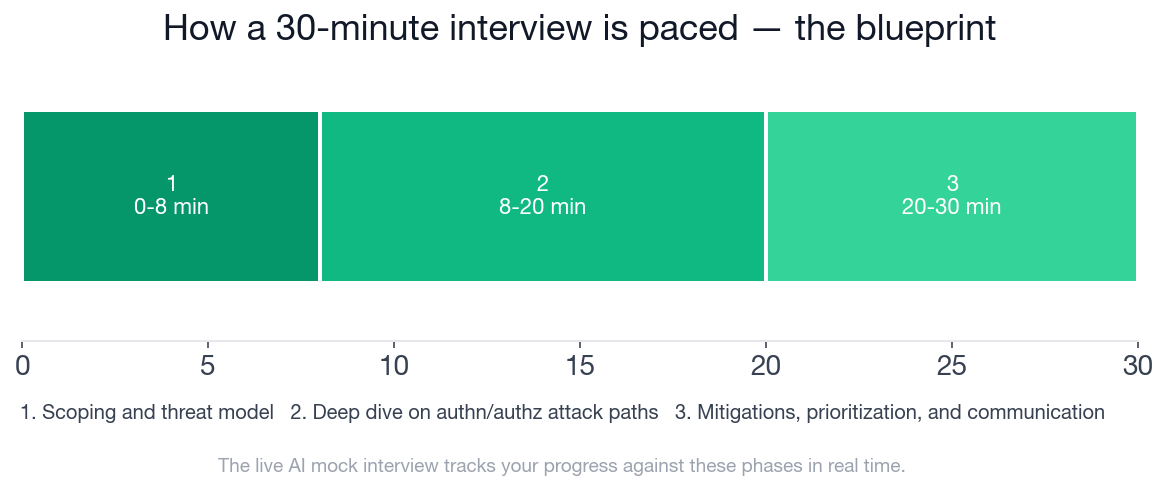
- The session runs 30 minutes in 3 phases: scoping (minutes 0-8), attack-path deep dive (8-20), and mitigations and communication (20-30).
- Technical Proficiency is only 20 points; Communication and Problem Solving is the other 20.
- The deep-dive phase carries 5 checklist items, the most of any phase, out of 13 across the interview.
- The scenario mixes 3 auth models on one API: session cookies, bearer JWTs, and OAuth 2.0 client credentials.
- The walkthrough below covers 4 follow-ups, each with one common mistake and the move that fixes it.
What Does a Penetration Tester API Security Interview Actually Ask?
It opens with a design-review scenario, not a trivia quiz. Read it like a scoping email from engineering:
The interview question
A consumer-facing platform at a large tech company is preparing to let third-party partners and internal mobile clients call the same versioned REST API. The API handles user profile data, document metadata, sharing permissions, and organization-scoped admin actions. Some endpoints use session cookies for web traffic, some use bearer JWTs issued by an internal identity service, and a new partner integration plans to use OAuth 2.0 client credentials. Engineering leadership is worried about account takeover, cross-tenant access, data scraping, and authorization gaps between object ownership and role-based permissions. You are the penetration tester assigned to this review.
How would you approach this assessment, and what would you want to validate or challenge before approving the API design for launch?
The interviewer is probing whether you can build a structured assessment (architecture, trust boundaries, authentication and authorization flows, token handling, object access, abuse cases) and balance offensive thinking with mitigations an engineering team can act on. Jumping straight to a tool name is the fastest way to look junior.
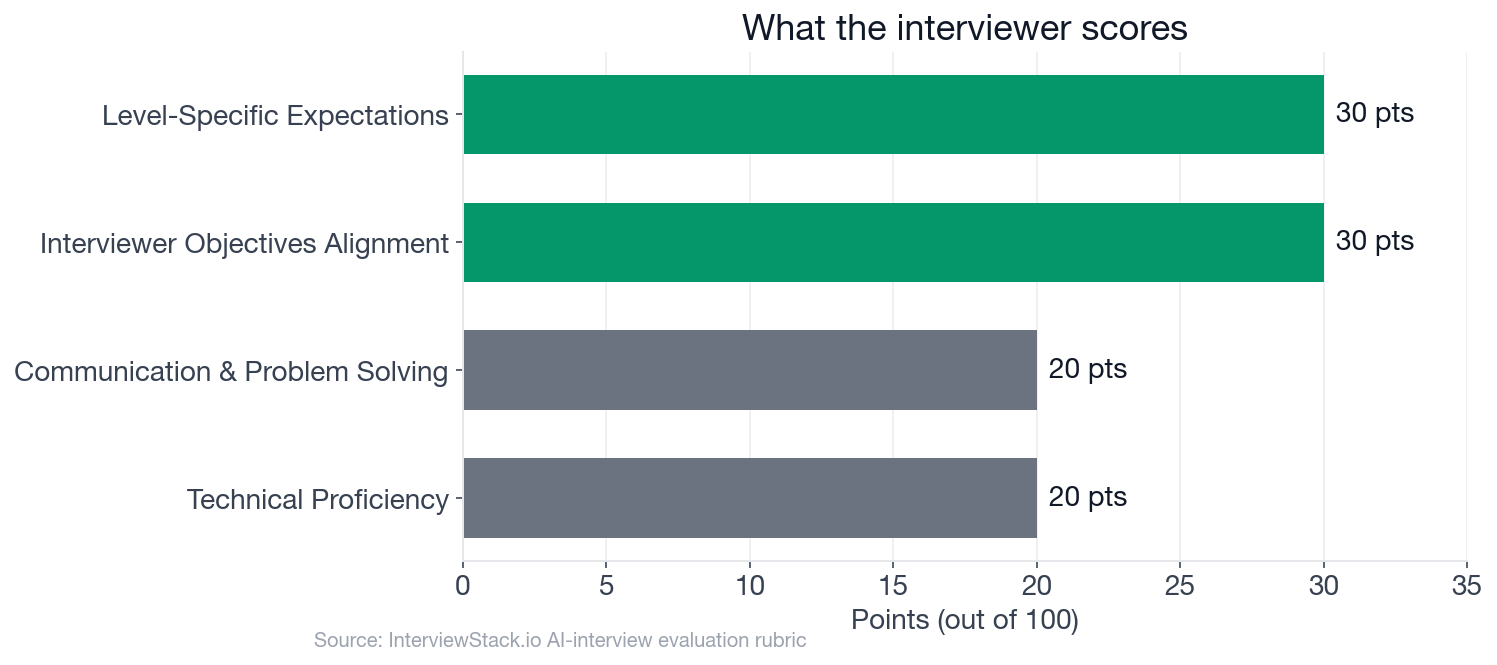
The chart shows where the 100 points sit. Notice how little of it is raw technique.
The Walkthrough: Four Turns Where Points Leak
Meet Dev, a capable mid-level candidate. Each turn below shows a common answer and the cost on the rubric.
Turn 1: Beyond the Signature
Interviewer: "If the team says they validate JWT signatures but not much else, what additional token checks would you expect and why?"
Turn 2: Testing Object Access
Interviewer: "How would you test for object-level authorization flaws in this API if users can access documents directly by ID and some resources are shared across organizations?"
Turn 3: The Long-Lived Token Ask
Interviewer: "The partner team wants long-lived access tokens because rotating them is operationally painful. How would you evaluate that trade-off and what alternatives would you suggest?"
Turn 4: Two Findings, One Report
Interviewer: "How would you prioritize and communicate findings if you discovered both an exploitable BOLA issue and a weak secret-handling practice in CI logs?"
Why Isn't Reading This Enough?
Every mistake above is easy to spot on the page. Live, you are 14 minutes in, the interviewer interrupts a half-built answer, and you still have to name audience checks, a tenant matrix, and a launch-blocker call without a script. Knowing the answer and producing it under a clock are different skills, and the second one only improves with repetitions. An AI mock interview gives you the unscripted follow-ups and the scoring against the same rubric.
The Complete Blueprint a Strong Candidate Hits
Here is the 30-minute pacing, then the full phase-by-phase checklist. This is the blueprint the AI mock interview tracks you against in real time.
- ✓Asks or states assumptions about client types, identity provider, token issuers, tenant model, and sensitive resources
- ✓Separates authentication concerns from authorization concerns
- ✓Calls out mixed auth models on the same API surface as a source of inconsistency risk
- ✓Outlines a phased assessment approach such as design review, endpoint mapping, auth flow validation, and exploit testing
- ✓Mentions validating JWT claims beyond signature, such as issuer, audience, expiry, not-before, algorithm handling, key rotation behavior, and scope/role mapping
- ✓Describes BOLA testing with user-to-user, role-to-role, and tenant-to-tenant access attempts using resource identifiers
- ✓Discusses function-level authorization risks for admin endpoints and differences between scopes, roles, and object ownership
- ✓Includes abuse cases such as enumeration, scraping, rate-limit bypass via distributed clients or partner credentials, and excessive data exposure
- ✓Notes common API risks like mass assignment, insecure deserialization or input handling where relevant to request bodies
- ✓Proposes practical mitigations such as short-lived tokens, refresh-token controls where applicable, server-side authorization checks, object ownership validation, least-privilege scopes, secret rotation, and stronger logging/monitoring
- ✓Distinguishes high-severity launch blockers like exploitable cross-tenant BOLA from hygiene issues that can be sequenced
- ✓Communicates findings in terms of exploitability, affected actors, and impact on users or partners
- ✓Shows awareness of test evidence needed to make a convincing report, such as reproducible requests and authorization matrix gaps
Run This Interview Live
Take this exact scenario in the AI mock interview for Penetration Tester API Security and see which of these four turns you actually fumble. Want more material first? Work through the API security question bank or browse penetration tester roles on the job board to see what employers ask for.
FAQ
What does a penetration tester API security interview cover?
At mid-level it centers on authentication versus authorization, JWT validation, OAuth 2.0 client credentials, broken object-level authorization (BOLA), abuse cases like scraping, and how you prioritize and report findings. The sample interview here runs 30 minutes in 3 phases.
How is a mid-level API security interview scored?
The rubric totals 100 points: 30 for interviewer objectives alignment, 30 for level-specific expectations, 20 for technical proficiency, and 20 for communication and problem solving.
What JWT checks go beyond verifying the signature?
Issuer, audience, expiry, not-before, algorithm handling, key rotation behavior, and how scopes or roles map to what the endpoint allows. A valid signature only proves who minted the token, not that this API should accept it.
How do you test for BOLA in an interview answer?
Describe concrete negative tests with resource identifiers: one user requesting another user's object, one role requesting another role's object, and one tenant requesting another tenant's object. Name the evidence you would capture, such as reproducible requests.
Is a long-lived partner access token ever acceptable?
Interviewers want you to weigh the operational pain against the blast radius of a leaked token, then offer alternatives such as short-lived tokens with controlled refresh or narrowly scoped client credentials. A flat yes or no scores worse than a reasoned trade-off.
How should you rank findings in a launch review?
Exploitable cross-tenant BOLA is a launch blocker. Weak secret handling in CI logs is serious hygiene work that can be sequenced. State exploitability, affected actors, and impact on users or partners for each.
Where Your Next Rep Goes
Pick the turn that stung most, probably the JWT claims or the tenant matrix, and say your answer out loud against a clock. Then take it into a live mock interview and let an unscripted follow-up find the next gap.
Topics
Ready to practice?
Put what you've learned into practice with AI mock interviews and structured preparation guides.