
Six of the Week's 168 Hours Decide This Interview
A mid-level Penetration Tester walks into this scenario with a full week on the calendar: a business-critical product launch, a public web app, a public API, an external IP range, and internal-subnet access that only opens on day 3. It reads like a lot of runway. It isn't. Buried in the constraints is a 6-hour cap on active exploitation, a hard number, not a soft guideline, and a candidate who treats the whole week as one undifferentiated block of hacking time spends that scarce budget on the wrong targets before the clock forces a decision they never actually made on purpose.
This walkthrough is built from a real AI-interview blueprint, the same phases, checklist items, and rubric weights the InterviewStack.io AI mock interviewer scores a candidate against live, for a mid-level Penetration Tester running a one-week engagement against a large tech company's pre-launch environment. The scenario hands over three test account roles (basic user, support user, admin-lite user), a heavily API-driven web application, and a hard rule: no phishing, no physical attacks, no destructive exploitation, findings due to engineering leadership within 24 hours of test completion. A candidate who plans against those constraints from minute one outperforms one who just starts scanning.
Key Findings
- The interview runs 30 minutes across three phases: engagement framing (0-8 minutes), reconnaissance and enumeration (8-20 minutes), and validation and reporting (20-30 minutes).
- Candidates work with a strict 6-hour active-exploitation budget inside a full one-week engagement, with internal-subnet access opening only during a controlled VPN window on day 3.
- Findings must reach engineering leadership within 24 hours of test completion, whether or not the written report is finished.
- Scope spans a public web app, a public API, a 16-address external IP range, and a 256-address internal subnet reachable only after day 3.
- Three test account roles, basic user, support user, and admin-lite user, let candidates exercise authorization boundaries without building access from scratch.
- Interviewer Objectives Alignment and Level-Specific Expectations each carry 30 of the 100 rubric points, 60 combined, while Technical Proficiency caps out at 20.
- Phase 2 (reconnaissance and tool-driven execution) carries the heaviest checklist load: 6 of the interview's 16 total expected-behavior items.
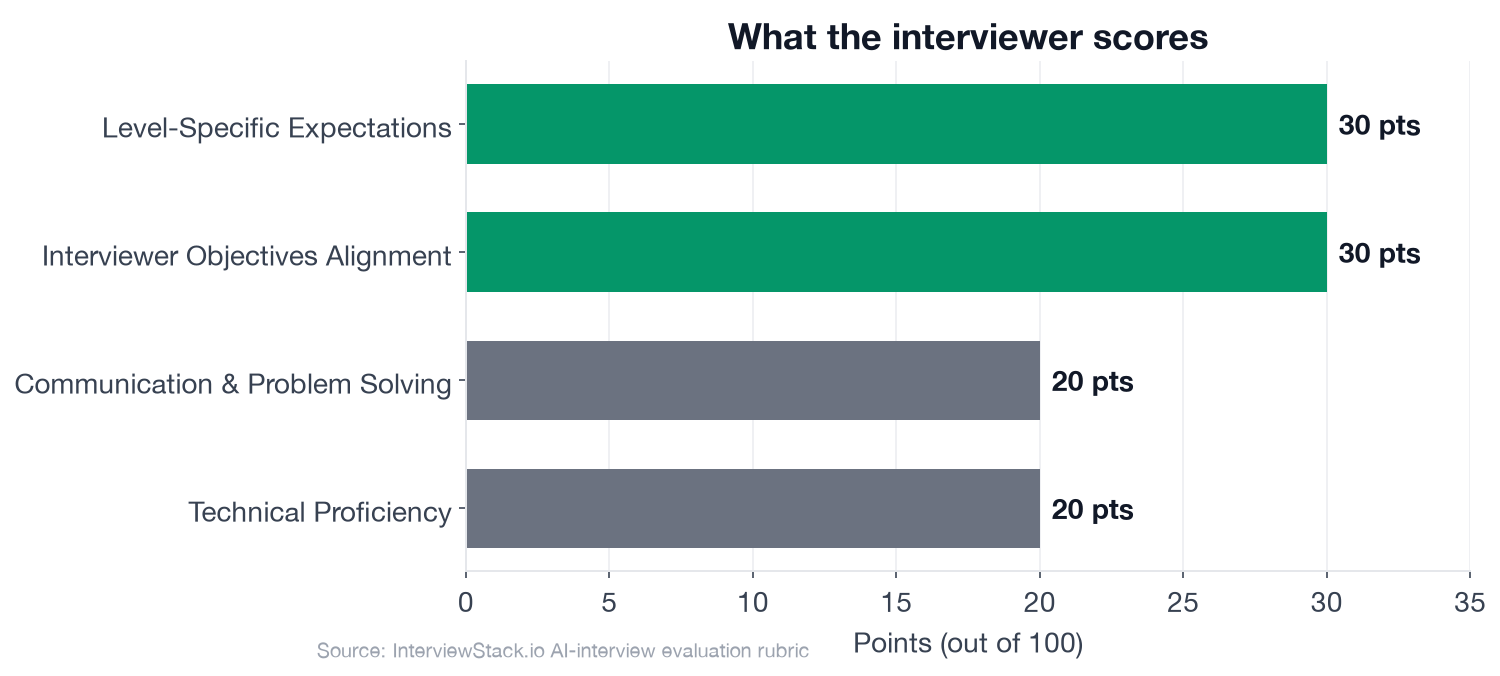 Framing and level-appropriate judgment together outweigh raw technical proficiency, which is exactly why a candidate who exploits well but budgets poorly still underperforms.
The Penetration Tester Penetration Testing Methodology and Execution Interview Opens on a Scope Document
This is the scenario a mid-level Penetration Tester candidate is handed, word for word from the blueprint:
The interview question
You are joining an onsite-style discussion for a mid-level penetration tester role. Assume you have been assigned a one-week authorized penetration test for a business-critical product launch at a large tech company.
Scope: - Public-facing web application: app.target-example.com - Public API: api.target-example.com - External IP range: 198.51.100.0/28 - One internal subnet available through a controlled VPN window on day 3: 10.20.40.0/24 - Corporate has provided test accounts for three roles: basic user, support user, and admin-lite userConstraints:
- No phishing or physical attacks
- No denial-of-service or destructive exploitation
- Limited maintenance window for active exploitation: 6 hours total
- Findings must be reported to engineering leadership within 24 hours of test completion
- You may use standard tools typically available to a penetration tester
Goal:
- Identify realistic security weaknesses and provide actionable findings without disrupting the launch
Walk me through how you would execute this penetration test from kickoff through final reporting.
The interviewer's objective, per the blueprint, isn't a maximal exploit count. It's whether the candidate can balance thoroughness, safety, and business constraints, scoping, reconnaissance and enumeration strategy, tool selection and sequencing, evidence collection, risk prioritization, and a concise report, at a scope appropriate for a mid-level tester working inside a top-tier tech company's launch window. Malware development, phishing, physical security testing, and large-scale denial-of-service strategies sit outside this scenario entirely.
Where Does the Six-Hour Exploitation Budget Actually Go?
A prepared candidate, call them Wren, walks in with solid instincts: a real recon-to-report mental model and hands-on tool experience. Here's where four of those instincts still cost points against the clock, and what a stronger version of each answer sounds like.
Turn 1: The VPN Window Trade-Off
Interviewer: "How would you decide what to do before the internal VPN window opens versus what you would defer until day 3?"
Turn 2: Reading a Quiet Nmap Scan
Interviewer: "If your Nmap scan shows a small number of exposed services on the external range but the web application appears complex and heavily API-driven, how would that change your testing priorities?"
Turn 3: Burp First, Metasploit Sparingly
Interviewer: "How would you use tools like Burp Suite and Metasploit in this engagement, and where would you deliberately avoid relying on them?"
Turn 4: Validating Without Crossing the Line
Interviewer: "Suppose you find a likely authentication or authorization weakness using the support account, but exploiting it further could affect production data. How would you handle validation and evidence collection?"
What Does an Unscripted Follow-Up Do to a Rehearsed Answer?
Every one of Wren's four mistakes looks obvious once it's laid out with a red box underneath it: work day one on the wrong target, keep pushing on a live production system, default to the loudest tool in the kit. But an interviewer who asks why, changes a constraint mid-answer, and gives you 30 minutes on a running clock is a different environment than reading a blog post at your own pace. Deciding, out loud, where a scarce 6-hour budget goes, and when to escalate an ambiguous finding instead of resolving it alone, is the actual skill this interview measures, and it only gets built through live reps against a real mock interview, not recognition.
What Does the Blueprint Actually Reward Across the Three Phases?
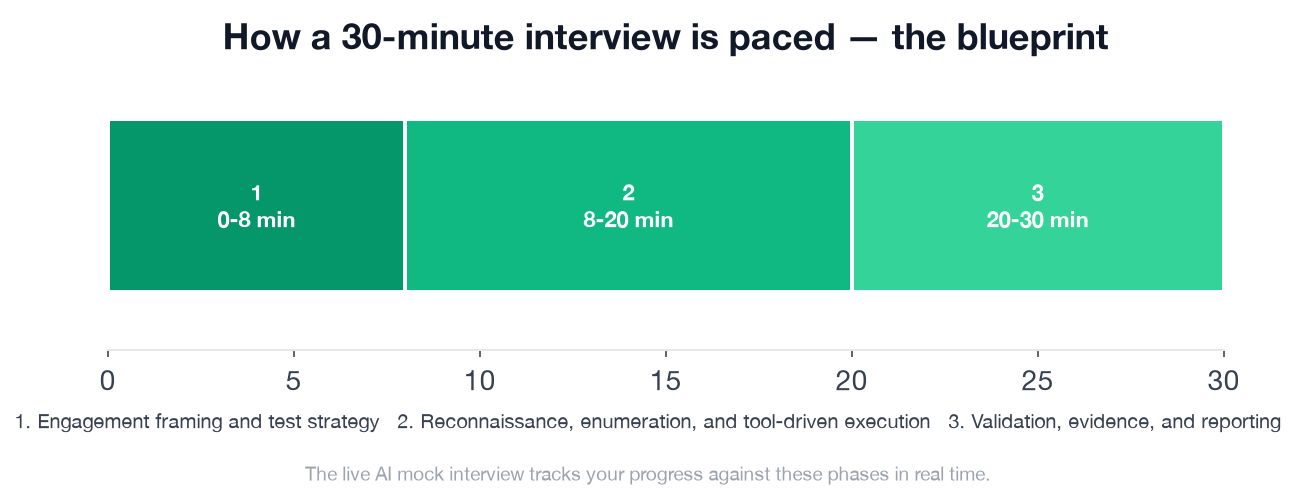 The same 30 minutes broken into the three phases the AI interviewer paces against in real time.
This is the complete blueprint: every phase, every checklist item, the exact thing the AI mock interviewer tracks while you talk.
- ✓Clarifies authorized scope and explicitly acknowledges production-safety constraints
- ✓Breaks the week into phases rather than describing an unstructured tool run
- ✓Prioritizes high-value targets such as authenticated web and API surfaces early
- ✓Plans around the day-3 VPN window and 6-hour active exploitation limit
- ✓Mentions kickoff alignment on contacts, escalation path, and reporting expectations
- ✓Describes passive and low-impact recon before active probing
- ✓Uses Nmap thoughtfully for host discovery, port/service detection, and targeted follow-up rather than blanket noisy scans
- ✓Explains how to enumerate web routes, API endpoints, authentication flows, and role differences using provided accounts
- ✓Uses Burp Suite for interception, repeater/intruder-style validation, mapping, and authenticated workflow analysis
- ✓Frames Metasploit as selective for validation or known service weaknesses, not as the sole methodology
- ✓Differentiates external testing from internal subnet enumeration once VPN access becomes available
- ✓Explains how to confirm findings without causing disruption or unauthorized data modification
- ✓Collects reproducible evidence such as requests, responses, screenshots, scan outputs, timestamps, and account context
- ✓Prioritizes findings by realistic impact and exploitability in the given environment
- ✓Describes a report structure with executive summary, methodology, findings, risk, reproduction steps, and remediation guidance
- ✓Can give a concise interim or final readout that distinguishes confirmed issues from suspected issues
A strong candidate doesn't necessarily say all 16 of these lines out loud, verbatim, but their answer touches nearly every one of them, and never spends the 6-hour budget confirming something that was never in question.
Turn This Walkthrough Into Practice Reps
Start a live AI mock interview on Penetration Testing Methodology and Execution at the mid-level bar: same three phases, same rubric, real follow-up questions that adapt to what you actually say and push back on your reasoning the way Wren's interviewer did. If tool sequencing, deciding when Nmap, Burp Suite, and Metasploit each earn their place, or report structure is the shakier part of your prep, the penetration testing methodology and execution question bank breaks the topic into individual practice questions with sample answers. Pair either with our preparation guides if you're prepping for a specific company's process.
FAQ
Q. What does a Penetration Tester penetration testing methodology interview actually test?
Whether you can run a full engagement end to end under real constraints: scoping and rules-of-engagement interpretation, methodical reconnaissance and enumeration, justified tool selection, safe validation, and a report leadership can act on, not how many vulnerabilities you can name. The 100-point rubric splits 30 points to Interviewer Objectives Alignment, 30 to Level-Specific Expectations, 20 to Technical Proficiency, and 20 to Communication and Problem Solving.
Q. How long is the interview and how is it paced?
30 minutes across three phases: engagement framing and test strategy (0-8 minutes, 5 checklist items), reconnaissance, enumeration, and tool-driven execution (8-20 minutes, the longest phase with 6 checklist items), and validation, evidence, and reporting (20-30 minutes, 5 checklist items).
Q. What artifacts should I collect during a penetration test to write a credible report?
Reproducible evidence for every finding: the requests and responses that demonstrate it, scan outputs, screenshots, timestamps, and which test account (basic, support, or admin-lite) was used. The blueprint expects that evidence trail to support a report structured around an executive summary, methodology, findings, risk, reproduction steps, and remediation guidance, not a narrative written from memory afterward.
Q. How should I give a verbal readout before my written report is finished?
Separate confirmed issues from suspected ones and lead with the confirmed, high-impact findings first. A strong readout communicates residual uncertainty honestly, what has been validated versus what still needs confirmation, rather than presenting every lead as equally certain just because the deadline is close.
Q. What's the most common mistake mid-level candidates make in this interview?
Treating the full week as one undifferentiated block of hacking time instead of budgeting the scarce 6-hour active-exploitation window and the day-3 VPN window against a phased plan, then defaulting to broad tool sweeps, especially Metasploit, instead of targeted, justified validation.
Q. Do I need to actually exploit every vulnerability I find to score well?
No. The blueprint explicitly rewards safe, minimal validation, confirming impact with the smallest request necessary, over aggressive exploitation, and it penalizes any action that risks disrupting the business-critical launch or modifying production data. Judgment about when to stop matters more than proving maximum impact.
Q. How can I practice a Penetration Tester interview like this one before the real thing?
Run a live AI mock interview that follows the same phases, checklist items, and rubric weights described here, so you get timed practice budgeting a limited exploitation window and defending your validation choices under follow-up questions instead of just reading about them.
Time Management Is the Technical Skill Here
Wren's four mistakes share one root cause: spending a scarce, fixed resource, the 6-hour exploitation window, on the wrong thing at the wrong time. At a mid-level bar, a penetration test is judged on scoping discipline, tool selection that matches the actual surface, safe validation under real constraints, and a report leadership can act on, not on how much gets exploited. Know where the budget goes before the clock starts.
Topics
Ready to practice?
Put what you've learned into practice with AI mock interviews and structured preparation guides.