
The Attack Surface Map Gets Built by Subtraction, Not Addition
A rapidly growing SaaS company just closed two acquisitions, and a mid-level Penetration Tester is asked for a useful attack surface map by end of day, covering the parent brand and both acquired ones. Certificate transparency logs and DNS enumeration will surface dozens of subdomains before lunch. The interview isn't testing whether you can find them all. It's testing whether you know which ones to throw out.
This walkthrough runs the real 30-minute blueprint the InterviewStack.io AI mock interview uses for Penetration Tester reconnaissance and information gathering: the same opening scenario, the same follow-up prompts, and the same 100-point rubric. You'll watch a dramatized candidate answer, see exactly which checklist item it costs her, and see the stronger version. Browse the Penetration Tester question bank on reconnaissance and information gathering if you want to drill individual concepts before running the full simulation.
Key Findings
- The rubric totals 100 points across four dimensions: Interviewer Objectives Alignment (30), Level-Specific Expectations (30), Technical Proficiency (20), and Communication & Problem Solving (20).
- The interview runs 30 minutes across 3 phases with 14 checklist items total: 4 in scoping (0-7 min), 5 in discovery and tool selection (7-18 min), and 5 in prioritization, validation, and handoff (18-30 min).
- The scenario spans 1 parent brand and 2 acquired brands, and one checklist item exists solely to test whether findings get correlated and de-duplicated across all three.
- Candidates face 6 scripted interviewer follow-ups covering passive/active sequencing, subdomain triage, CDN and third-party ambiguity, scan tuning, and false-positive filtering; this walkthrough dramatizes 4 of them.
- Phase 3 (18-30 min, 12 minutes) ties Phase 2 for the most checklist items of any phase, 5, and is where prioritization and false-positive filtering actually get scored.
- 4 categories of activity are explicitly out of scope for this interview: malware or persistence development, binary reverse engineering, exploit development beyond light validation, and physical or social-engineering execution.
- None of Phase 1's 4 checklist items require naming a specific tool; all 4 are pure scoping and framing judgment, decided in the first 7 minutes.
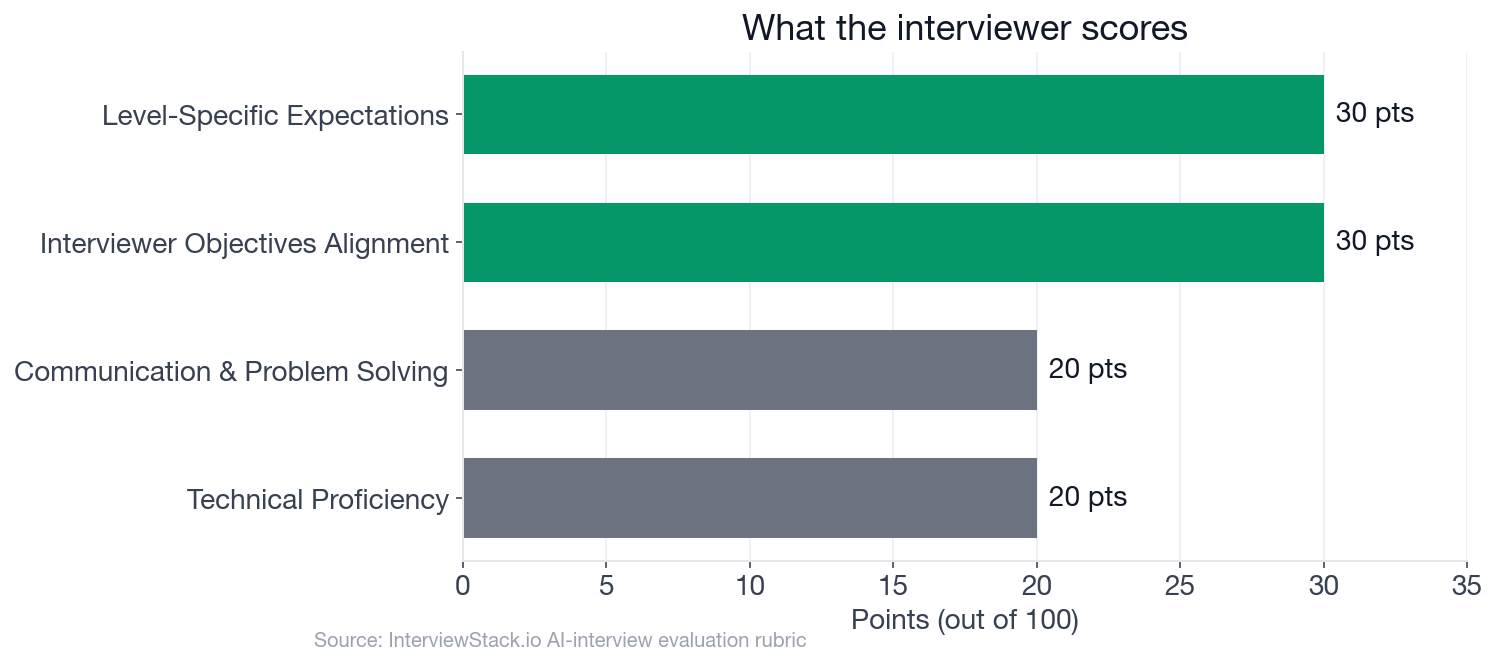
Interviewer Objectives Alignment and Level-Specific Expectations together hold 60 of 100 points, so a defensible, prioritized workflow outweighs raw tool knowledge.
What Does the Penetration Tester Reconnaissance and Information Gathering Interview Ask?
Here is the scenario as it appears in the live blueprint:
The interview question
You are supporting a scoped internal penetration test for a rapidly growing SaaS company that recently completed two acquisitions. The client has provided authorization for reconnaissance against internet-facing assets belonging to the parent company and the acquired brands. They want a useful attack surface map by the end of the day that can guide follow-on web, cloud, and credential testing. They are sensitive to production instability and do not want noisy or risky activity without clear justification.
Known starting points:
- Primary brand: acme-example.com
- Acquired brands: northstar-example.com, orbit-example.io
- Suspected external footprint includes marketing sites, customer applications, APIs, VPN/SSO portals, and cloud-hosted admin interfaces
- You may assume normal commercial tooling is available and that you can contact the client if a potentially dangerous validation step needs approval
How would you approach reconnaissance and information gathering for this engagement, from initial scoping through producing a prioritized attack surface map for the next testing phase?
The interviewer isn't grading tool-name recall. They're checking whether you can build an attack surface map from both passive and active sources, tune your approach to speed, coverage, stealth, and safety, validate findings to cut false positives, and prioritize entry points by business value rather than by how many hostnames you collected.
Where Does This Recon Interview Actually Cost Points?
Four follow-ups from the blueprint, picked to run from first move to final handoff: the passive-versus-active call, subdomain triage, the parked-domain trap, and the documentation the exploitation team actually needs.
Turn 1: Active First, Sort Later
Interviewer: "How would you decide what to do passively first versus what to validate actively, given the client's concern about production impact?"
Turn 2: The Subdomain Pile-Up
Interviewer: "Suppose certificate transparency logs and DNS data reveal dozens of subdomains across the parent company and both acquisitions. How would you triage which assets are most worth validating first?"
Turn 3: The Parked Domain Trap
Interviewer: "How would you distinguish a likely real entry point from a misleading or low-value finding such as a parked domain, stale DNS record, or inherited acquisition artifact?"
Turn 4: The Handoff Nobody Reads
Interviewer: "At the end of the 30 minutes, what would you want documented for the team that is picking up exploitation next, and what evidence would you retain?"
Reading the Mistakes Isn't the Same as Avoiding Them Live
Every mistake above is obvious once it's labeled red. Spotting it while you're reading is not the same as catching yourself mid-sentence at minute 12, in a live engagement, on a follow-up you didn't rehearse. That gap between recognizing a pattern on the page and avoiding it under real time pressure only closes with reps.
The Full 30-Minute Blueprint, Phase by Phase
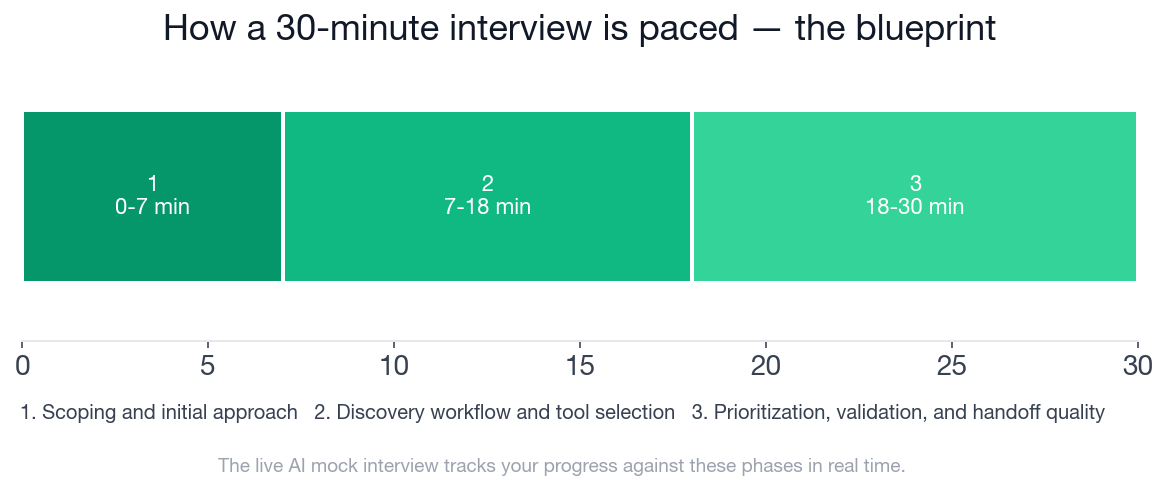
Phase 1 is short but decisive: 7 minutes to lock scope and framing before a single tool gets named, and it's the phase most candidates blow through on autopilot.
This is the blueprint a strong candidate covers end to end, and it's the exact structure the AI mock interview tracks you against in real time:
- ✓Clarifies authorized targets include parent and acquired brands and notes need to normalize domains, subsidiaries, and ownership
- ✓States the intended output is an attack surface map to support later testing, not just a list of raw findings
- ✓Separates passive discovery from active validation and acknowledges production-safety constraints early
- ✓Mentions identifying likely asset classes such as web apps, APIs, auth portals, remote access, cloud/admin interfaces, and supporting infrastructure
- ✓Describes passive collection methods such as CT logs, DNS records, registrar/WHOIS history, ASN/IP range ownership, code/repo exposure, public docs, social/job posting clues, and archived URLs
- ✓Explains how to correlate findings across the three brands and de-duplicate assets
- ✓Describes selective active validation such as DNS resolution checks, low-impact host discovery, conservative port/service enumeration, HTTP header/title/banner review, TLS inspection, and web/API fingerprinting
- ✓Mentions tuning scans with safer defaults such as reduced concurrency, timeouts, targeted ports, or staged validation rather than broad aggressive scanning
- ✓Calls out handling of CDN/WAF/fronted services and the need to distinguish origin infrastructure from edge services
- ✓Prioritizes assets by business criticality and attack utility, for example SSO/VPN, externally reachable admin panels, customer-facing apps, APIs, file transfer endpoints, and exposed services tied to acquisitions
- ✓Explains how to validate suspicious findings safely, such as confirming liveness, ownership, technology stack, auth surface, and exposure without jumping immediately into intrusive testing
- ✓Identifies and filters low-value artifacts such as stale subdomains, parked domains, third-party hosted pages, sinkholes, or expired acquisition remnants
- ✓Describes documenting each asset with hostname, IP or provider, service/tech fingerprint, confidence level, source of discovery, and recommended next action
- ✓Mentions retaining evidence, timestamps, commands/tools used, and any approval checkpoints for higher-risk activity
Run the Live Version of This Engagement
The InterviewStack.io AI mock interview for Penetration Tester reconnaissance and information gathering runs the live version of this exact engagement, follows up based on what you actually say, and scores you across all four rubric dimensions when the 30 minutes close. That's the only way to test whether your triage judgment holds up when the follow-up isn't one you rehearsed.
For targeted drilling before the full simulation, the Penetration Tester question bank on reconnaissance and information gathering breaks the same material into individual questions with worked answers. If you want to see how this topic sits inside a broader prep path, the InterviewStack.io preparation guide maps coverage by seniority level.
FAQ
Q. What does a mid-level Penetration Tester interview on reconnaissance and information gathering actually test?
It tests whether you can turn passive and active information gathering into a prioritized, defensible attack surface map for a multi-brand engagement, not whether you can name scanning tools. The 100-point rubric splits 30 points to Interviewer Objectives Alignment, 30 to Level-Specific Expectations, 20 to Technical Proficiency, and 20 to Communication & Problem Solving, across three phases: scoping (0-7 min), discovery and tool selection (7-18 min), and prioritization, validation, and handoff (18-30 min).
Q. Should a penetration tester start reconnaissance with active scanning or passive collection?
Passive first. Phase 1's checklist explicitly rewards separating passive discovery, certificate transparency logs, DNS records, WHOIS history, ASN ownership, from active validation, and acknowledging the client's production-safety concerns before naming a single scanning tool.
Q. What's the biggest mistake candidates make when certificate transparency and DNS enumeration turn up dozens of subdomains?
Treating every resolving subdomain as equally worth validating instead of grouping findings by brand and business criticality first. Phase 3's checklist specifically rewards identifying and filtering low-value artifacts, parked domains, stale DNS records, third-party hosted pages, and expired acquisition remnants, before deeper validation begins.
Q. How do you tell a real entry point from a parked domain or stale DNS record in an acquisition-heavy environment?
Check liveness and ownership before priority: an HTTP response with real content, a TLS certificate issued to the target rather than a third-party host or CDN, and a hosting provider that matches infrastructure the target actually owns. A subdomain that merely resolves is not the same as an asset worth testing, and conflating the two costs Level-Specific Expectations points tied to recognizing acquisition-related risk.
Q. What should a reconnaissance handoff document include at the end of a 30-minute engagement?
Per asset: hostname, IP or hosting provider, service or technology fingerprint, a confidence level, the source of discovery, and a recommended next action, plus retained evidence, timestamps, and any approval checkpoints for higher-risk validation. This is an explicit Phase 3 checklist item scored under Communication & Problem Solving.
Q. Does this interview cover exploitation or social engineering?
No. The blueprint explicitly places malware or persistence development, binary reverse engineering, exploit development beyond light validation discussion, and physical or social-engineering execution outside the scope of this reconnaissance-focused interview.
Q. How can I practice this Penetration Tester reconnaissance interview before the real thing?
Run the InterviewStack.io AI mock interview for Penetration Tester reconnaissance and information gathering, which uses this same phase-by-phase blueprint, follows up based on what you actually say, and scores you across all four rubric dimensions in real time.
The Deliverable Is What You Ruled Out
Every domain in this scenario is easy to find. Certificate transparency logs and DNS enumeration do that work for free within minutes. What a mid-level penetration tester actually gets paid for is the part that never shows up in a scan output: deciding which of those hits are worth a client's time and which are parked pages, stale records, and acquisition debris. That judgment call, repeated dozens of times under a same-day deadline, is exactly what the rubric is built to catch.
Topics
Ready to practice?
Put what you've learned into practice with AI mock interviews and structured preparation guides.