
Python Gets You in the Door. TypeScript Gets You Paid.
The skill that earns the highest salary premium in Penetration Tester hiring is TypeScript, a statically-typed language for enterprise web applications and APIs. Not Python, the language of most exploit frameworks. Not AWS, the cloud platform appearing in 1 in 5 postings. TypeScript, at a $33,100 premium over the $142,400 US base salary median. That tells you something important about where the role is headed.
We analyzed every active Penetration Tester posting on the InterviewStack.io job board as of June 2026, 577 listings with skills extracted and normalized from descriptions. The dataset spans the full offensive security spectrum: core pen tester titles sit alongside adjacent roles such as security researchers, vulnerability analysts, and offensive security consultants, which is typical for this role category. Python leads demand at 41.6% of postings. But Python earns exactly the role median, zero premium. The explicit "Penetration Testing" credential earns $2,000 below the baseline. The salary signal and the demand signal are pointing in different directions, which is what makes this role's data worth examining closely.
The underlying reason is that penetration testing is not one job. It splits by target surface: web applications, cloud environments, mobile apps, internal infrastructure, and increasingly AI systems. Each track has a different skill cluster, and the one paying the most right now is the web application track, where TypeScript fluency signals a tester who can work inside the code of the systems they are breaking.
Key Findings
- 577 active Penetration Tester postings analyzed on the InterviewStack.io job board as of June 2026.
- Median US base salary: $142,400 (n=105 postings with US salary data disclosed). Equity and bonus are not captured in posting data.
- No skill reaches 50% demand in this role, making it the most fragmented offensive security role on the board by specialization.
- TypeScript earns the highest salary premium: $175,500 median (+$33,100 over baseline, n=31), followed by Linux at $163,400 (+$21,000) and Automation at $159,200 (+$16,800).
- Python leads demand at 41.6% but earns exactly the role median. Penetration Testing as an explicit skill earns $140,400, slightly below baseline.
- Multi-cloud pairing is heavily rewarded: Azure plus Google Cloud has a co-occurrence lift of 4.71; AWS plus Google Cloud is 4.52; AWS plus Azure is 3.95.
- Only 2.8% of postings are entry-level (16 of 577). Mid-level dominates at 67.8%.
- 57.5% of postings are onsite, with only 21.3% fully remote.
What Does the Salary Data Reveal for Penetration Testers?
The salary picture below is US-only. Among US postings where wage-transparency laws produce structured salary data, the median Penetration Tester base salary is $142,400 (n=105). These figures cover base pay only: equity, RSUs, bonuses, and sign-on are not captured in posting data, so total compensation at top employers, particularly in defense, financial services, and tech, runs meaningfully higher.
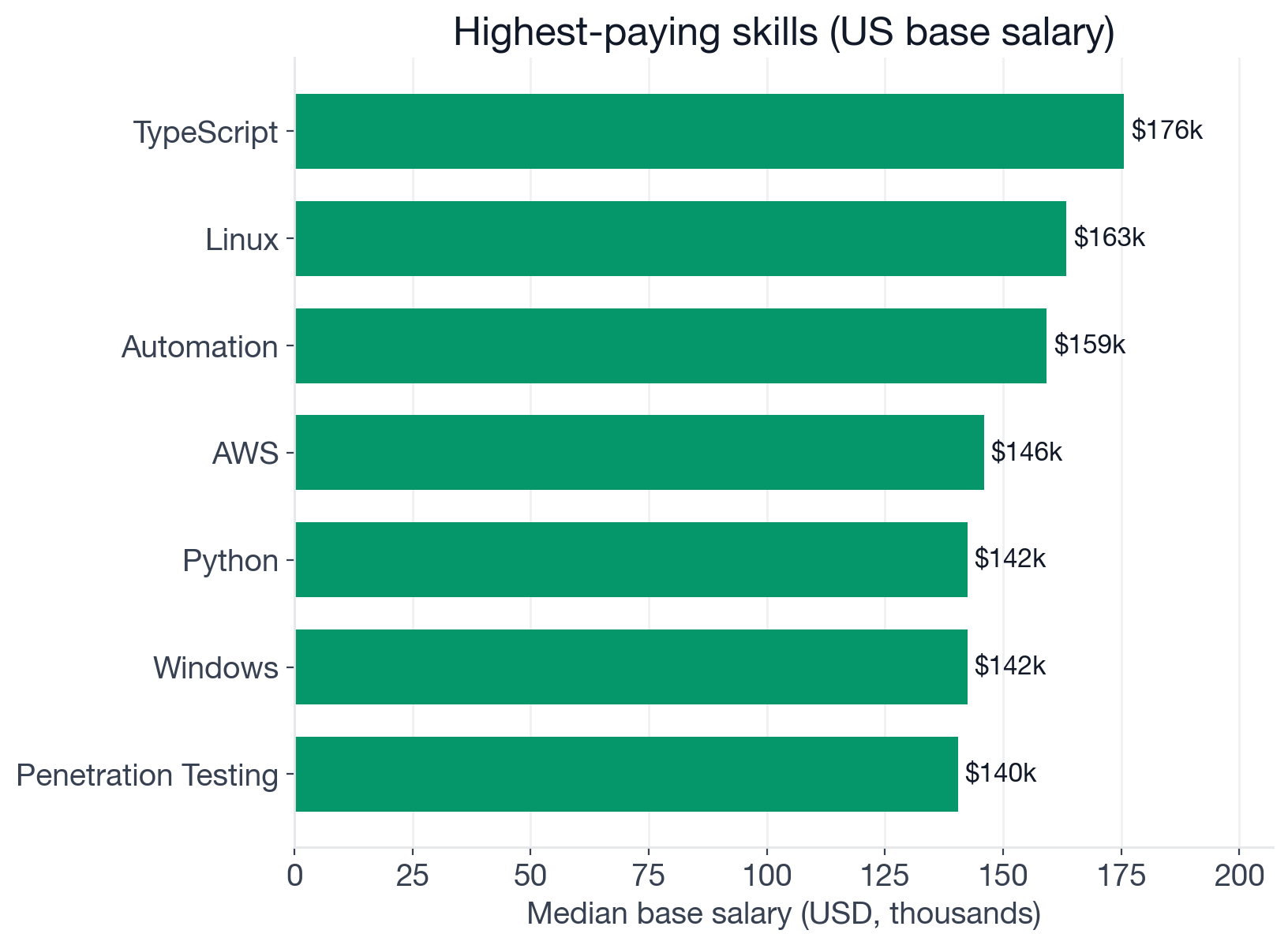
Median US base salary (base pay only, equity excluded) for Penetration Tester postings that mention each skill, among US postings with structured salary data (n=105).
| Skill | US Median | Premium over $142,400 | Sample |
|---|---|---|---|
| TypeScript | $175,500 | +$33,100 | n=31 |
| Linux | $163,400 | +$21,000 | n=28 |
| Automation | $159,200 | +$16,800 | n=29 |
| AWS | $145,900 | +$3,500 | n=28 |
| Python | $142,400 | baseline | n=50 |
| Windows | $142,400 | baseline | n=25 |
| Penetration Testing | $140,400 | -$2,000 | n=49 |
Three things stand out in this table.
First, TypeScript's $33,100 premium is the strongest directional signal in this table, backed by the third-largest sample (n=31). Part of the premium likely reflects employer composition (TypeScript-heavy postings cluster at tech companies and mature fintech firms that pay above the role median across all skills), but the specialization signal is directionally consistent: web application pen testers who can read TypeScript source, trace API endpoints, and identify injection or authentication flaws in a Next.js codebase command a real premium over generalists running automated scanners. TypeScript has become the dominant language for enterprise web applications, APIs, and React-based front ends, and employers are paying for testers who can work inside that code.
Second, Linux earns a $21,000 premium by signaling deep offensive tooling fluency. Red team and infrastructure attack work requires Linux command-line proficiency at a level most security generalists do not have. The premium reflects scarcity, not just frequency.
Third, the "Penetration Testing" skill sitting $2,000 below the role median is the clearest possible signal that a generalist penetration testing credential is a floor, not a ceiling. The premium comes from what kind of penetration testing you do, not from having done it at all. Browse Penetration Tester openings that require TypeScript or those requiring Linux to see what this specialization gap looks like on real job descriptions.
What Skill Families Define This Role?
Group individual skills into their parent family and count how many postings ask for at least one skill from each group. For most tech roles, two or three families dominate. For penetration testing, the picture is deliberately spread across multiple competency areas.
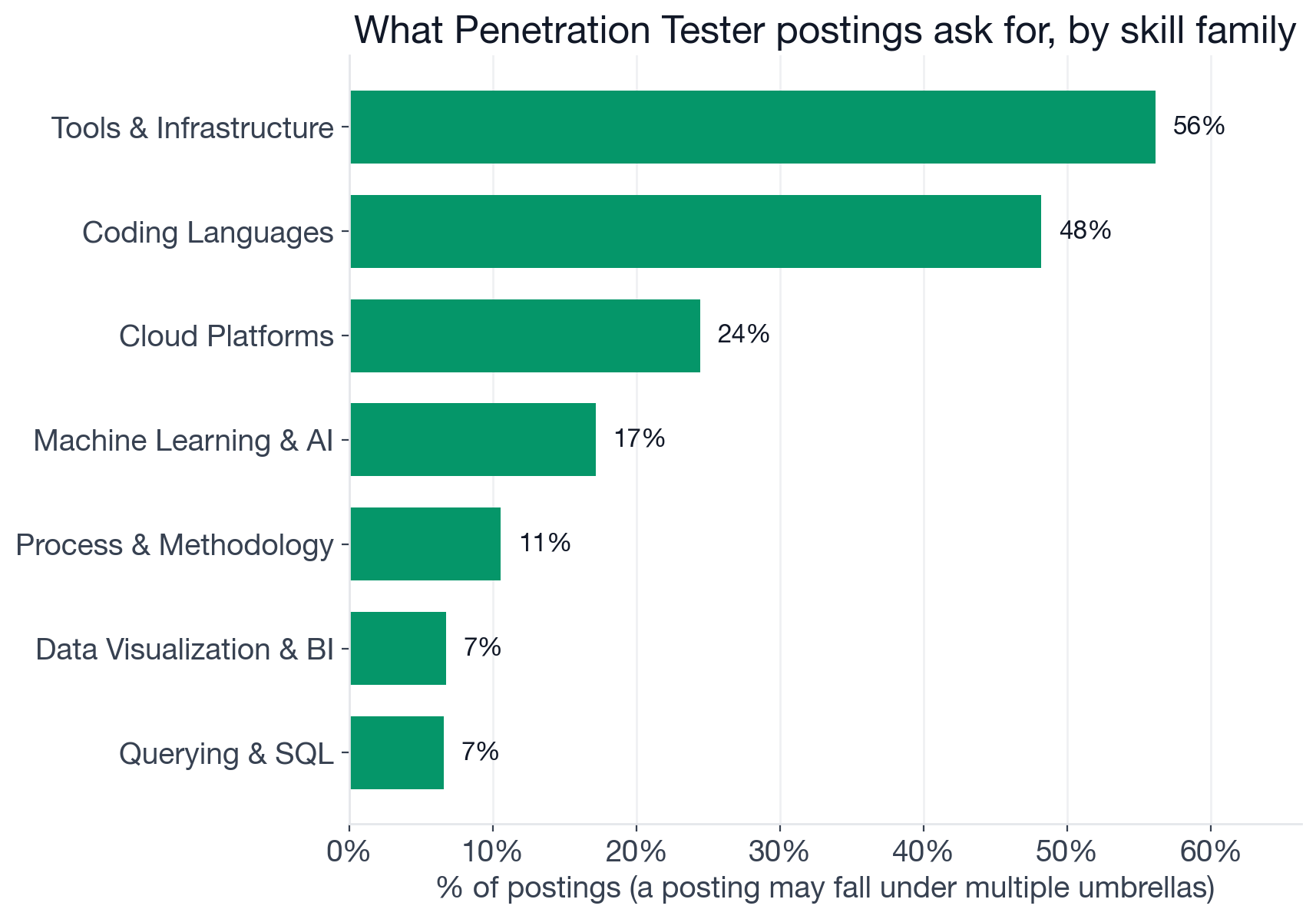
Share of Penetration Tester postings asking for at least one skill in each family. A posting that mentions both AWS and Azure counts once under Cloud Platforms.
The "Other" umbrella at 95% captures everything the keyword packs flag as cybersecurity-specific: vulnerability management, OWASP, application security, threat intelligence, incident response, cloud security, active directory, and the explicit penetration testing credential. The label is a catch-all, but the substance is the role's core domain knowledge.
Below that:
- Tools and Infrastructure (56%): Automation, monitoring, Linux, and Kubernetes. The scripting and toolchain layer most pen testers work from daily.
- Coding Languages (48%): Python, then Java, TypeScript, Bash, JavaScript, and C++ in descending order. Nearly half of all postings expect a pen tester to read or write code, not just run tools.
- Cloud Platforms (24%): AWS, Azure, and Google Cloud. A quarter of postings want cloud-environment attack coverage, which almost always means multi-cloud.
- Machine Learning and AI (17%): Machine Learning at 10.9% and LLMs at 4.7%. The explicit requirement is mostly for roles testing AI systems or building ML-assisted offensive tooling. But this number understates how widely AI tools are used in the role.
On the AI usage question: these percentages measure postings that explicitly require ML or AI skills, meaning employers who want someone to audit AI systems, red-team language models, or build ML-assisted attack pipelines. (The analytics title sample includes "Senior AI Penetration Tester," "AI Red Team Specialist," and "Associate AI Security Researcher" as real postings.) The ambient layer is a different story: industry survey data consistently shows the majority of ethical hackers now report using AI tools in their workflow. AI tools for recon automation, exploit script drafting, and vulnerability report writing are now baseline productivity expectations across offensive security, regardless of what postings say. The 17% is the floor for explicit AI-system testing requirements; actual AI tool usage among working pen testers runs far higher.
The Three Tiers of Penetration Tester Skills
The standard skill-tier framework divides skills into table stakes (50%+), common (20-50%), and differentiators (5-20%).
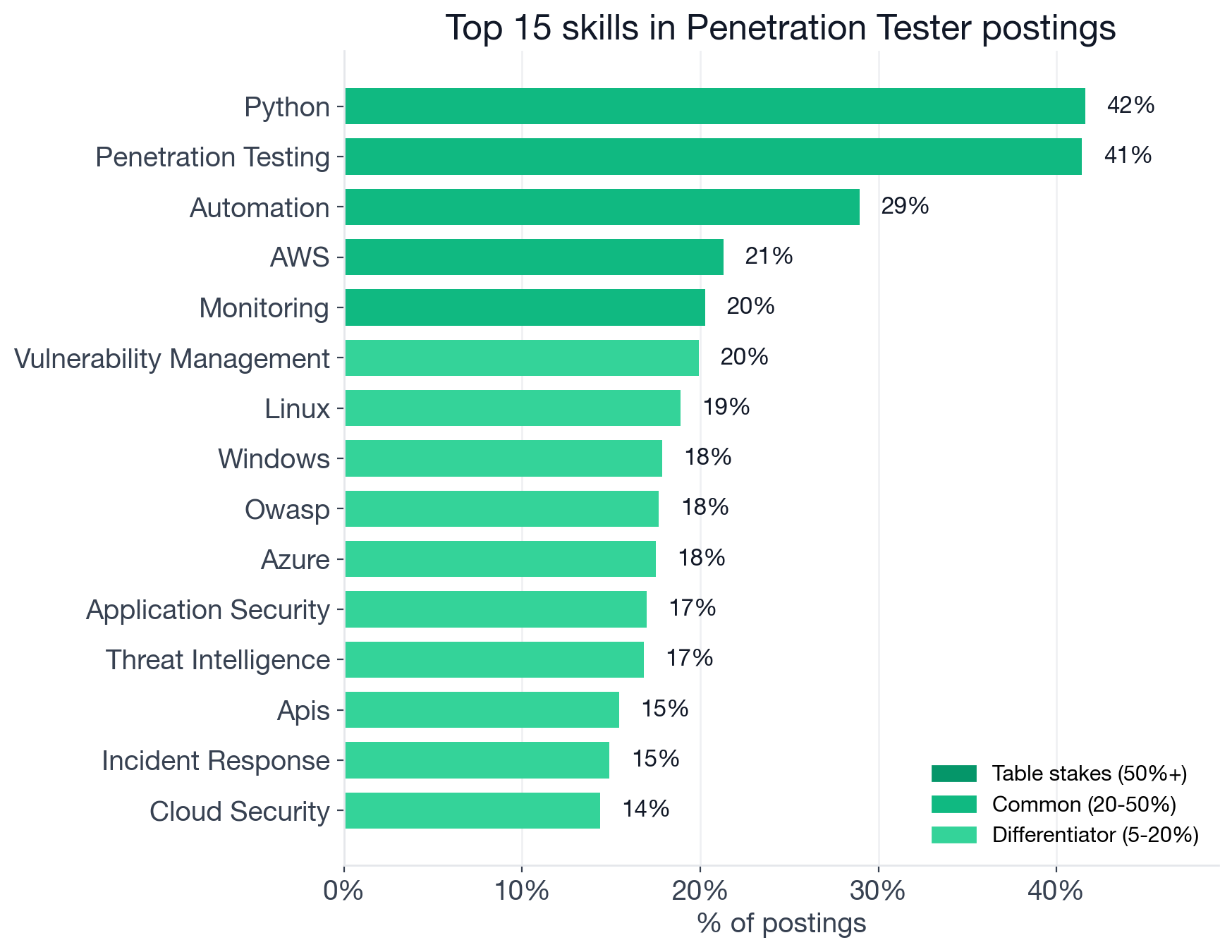
Top individual Penetration Tester skills by share of active postings. No skill exceeds the 50% table-stakes threshold.
No Table Stakes
This is the only meaningful pattern in the tier data: nothing exceeds 50%. Python and the explicit Penetration Testing credential are neck-and-neck at 41.6% and 41.4%, but neither clears the threshold most tech roles hit easily.
What this signals is real fragmentation, not a data anomaly. A web AppSec pen tester, a red team infrastructure specialist, a mobile security researcher, and a cloud environment attacker are genuinely different jobs. No single skill is required across all of them, so the data reflects that. Browse the full Penetration Tester opening list and the specialization split is visible in the titles alone.
Common Expectations (20-50% of Postings)
Five skills sit in the common tier:
- Python (41.6%): The language of exploitation frameworks, recon scripts, and custom tooling. Present in 4 of 10 postings but, as the salary data shows, unremarkable on its own. (Penetration Tester + Python openings)
- Penetration Testing (41.4%): Explicitly named as a required skill or credential in the posting.
- Automation (28.9%): Appears heavily in roles that want pipeline-style testing or continuous security validation, not just point-in-time engagements.
- AWS (21.3%): The most-named cloud, in a role where cloud attack surface coverage is increasingly required.
- Monitoring (20.3%): Detection evasion and monitoring-aware offensive work are showing up as explicit requirements.
Differentiators (5-20% of Postings)
The differentiator tier is unusually deep for this role, spanning over 40 skills from Linux (18.9%) down to Firewalls (5%). The most strategically interesting entries:
- Linux (18.9%), Windows (17.9%), PowerShell (12.1%): The OS and shell layer. Linux+Windows co-occurrence is actually strongly paired (lift 3.80), meaning the best-paid roles want dual-environment fluency.
- OWASP (17.7%): Web application security standard. Signals the AppSec track directly.
- Application Security (17.0%), APIs (15.4%): Employers targeting web API attack surface.
- Threat Intelligence (16.8%): Suggests roles that combine offensive work with adversary tracking.
- iOS (10.9%), Android (10.2%), Swift (6.4%), Kotlin (5.4%): The mobile security track. All four appear because mobile pen testing requires reading native app code, not just running web scanners.
- Cloud Security (14.4%), Active Directory (10.2%): Infrastructure attack paths.
- CI/CD (9.9%): DevSecOps integration, where pen testing happens inside the pipeline rather than after it.
When Two Clouds Are Better Than One
The highest-lift pairs in the co-occurrence data are not skill combinations most pen testers think about strategically.
| Skill pair | Co-occurrence lift | What it signals |
|---|---|---|
| Azure + Google Cloud | 4.71 | Employers who want cloud coverage want all three platforms |
| AWS + Google Cloud | 4.52 | Same pattern: multi-cloud coverage, not single-cloud depth |
| AWS + Azure | 3.95 | The three major clouds cluster together in postings |
| Linux + Windows | 3.80 | Dual OS offensive fluency in red team and infrastructure roles |
| OWASP + Penetration Testing | 1.99 | The AppSec pen testing track |
| JavaScript + Python | 2.29 | Web application attack surface: front-end code reading plus scripting |
| Bash + Python | 2.22 | Shell scripting plus Python tooling: the infrastructure attack toolkit |
| C++ + Python | 2.18 | Binary exploitation and reverse engineering alongside automation |
| PowerShell + Python | 2.16 | Windows environment attack plus cross-platform scripting |
The cloud data deserves specific attention. AWS appears in 21.3% of postings, Azure in 17.5%, and Google Cloud in 13.9% individually. But when any cloud appears, the others appear more often than chance would predict, at lifts of 3.9 to 4.7. That is not a coincidence. Enterprise environments in 2026 are multi-cloud by default, and pen testers hired to attack those environments need to understand attack paths across all three platforms. Cloud agnosticism is not a resume checkbox here; it is a real requirement for the segment of the market where cloud coverage is relevant.
Who Is Actually Getting Hired?
Seniority data reveals how hard it is to enter a role compared to how the rest of its career ladder is distributed.
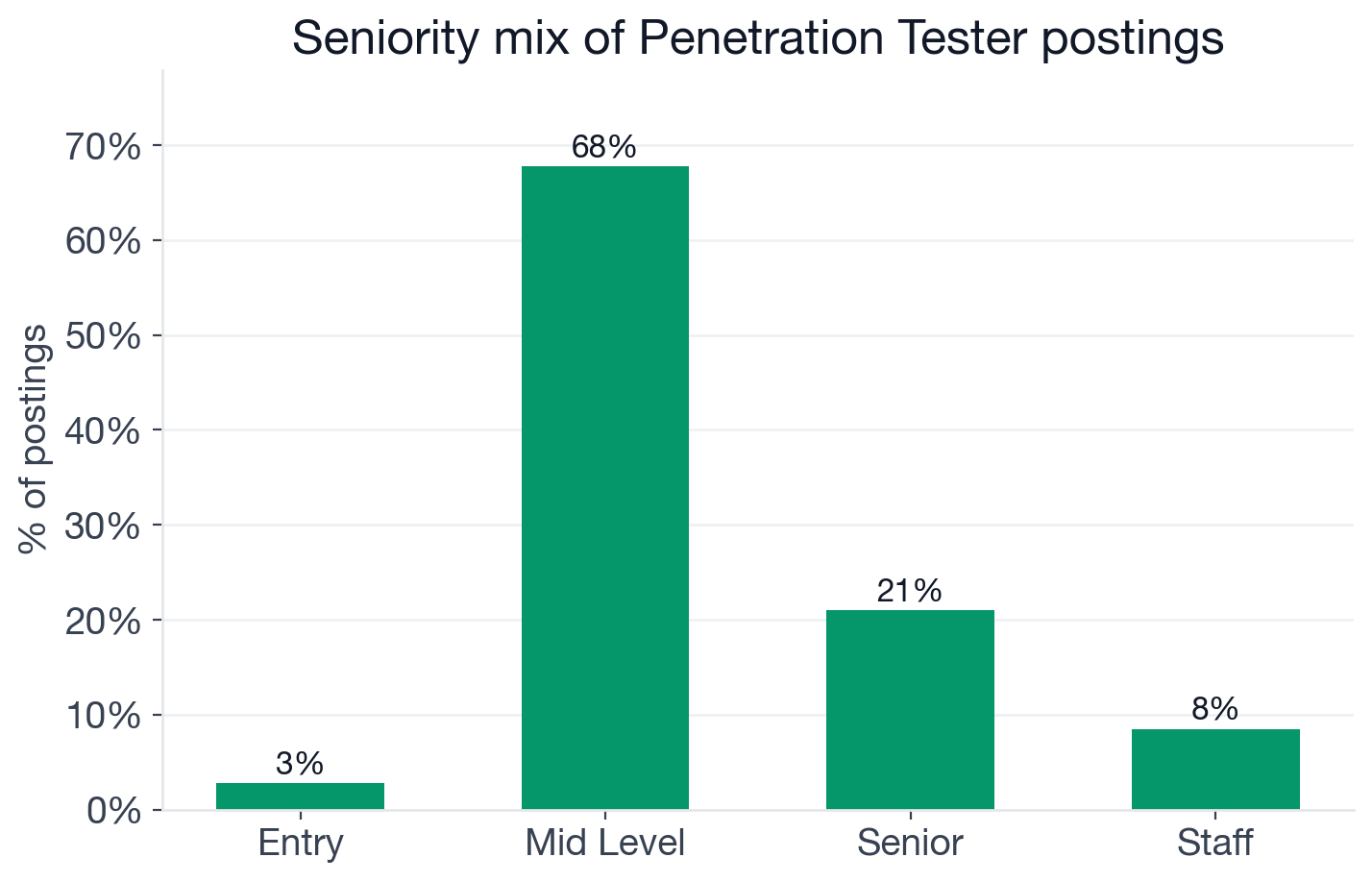
Seniority distribution of Penetration Tester postings, inferred from title keywords.
- Mid-level: 67.8% (391 postings)
- Senior: 21.0% (121 postings)
- Staff: 8.5% (49 postings)
- Entry: 2.8% (16 postings)
Fewer than 1 in 36 postings is explicitly entry-level. Companies hiring penetration testers almost universally expect prior hands-on security experience. The standard entry path is through adjacent roles: SOC analyst, vulnerability analyst, or application security engineer, which build the underlying knowledge and tooling familiarity the role demands. CTF competition wins and bug bounty participation are credible supplementary signals, but they do not replace the experience threshold most hiring managers are looking for at mid-level. Use the question bank to drill the security fundamentals that surface consistently in technical screens.
Where Are Penetration Tester Jobs, and How Remote-Friendly Are They?
Geography for this role has a notable cybersecurity cluster effect.
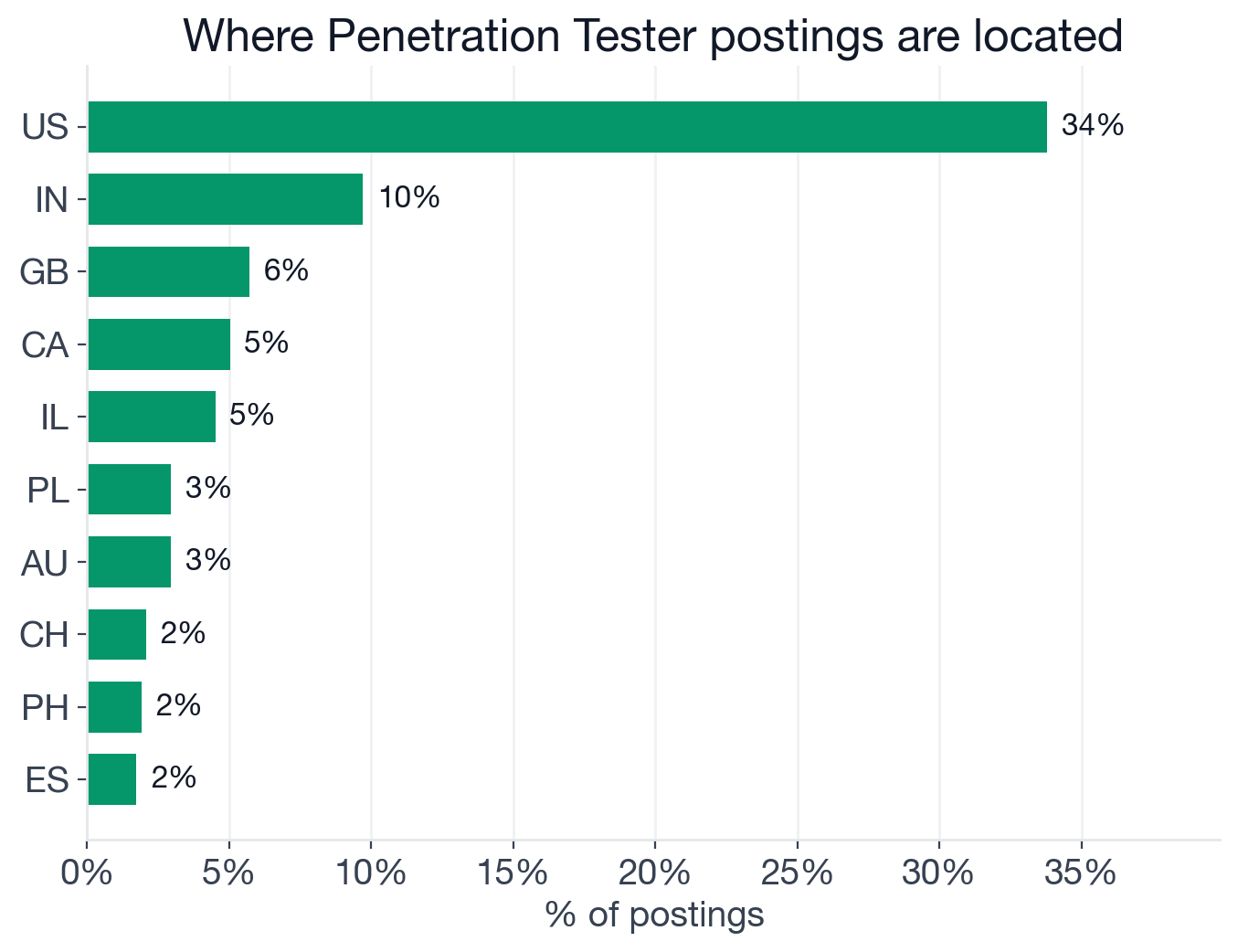
Top countries by share of Penetration Tester postings.
The US is the largest market at 33.8%. Israel at 4.5% is disproportionately large relative to its total tech labor market, reflecting the country's concentration of cybersecurity firms (Cellebrite, Check Point, and similar companies show up consistently in cybersecurity hiring data). The UK (5.7%) and Canada (5%) round out the English-speaking markets. Browse US-only Penetration Tester openings.
Work mode for this role skews clearly toward in-person.
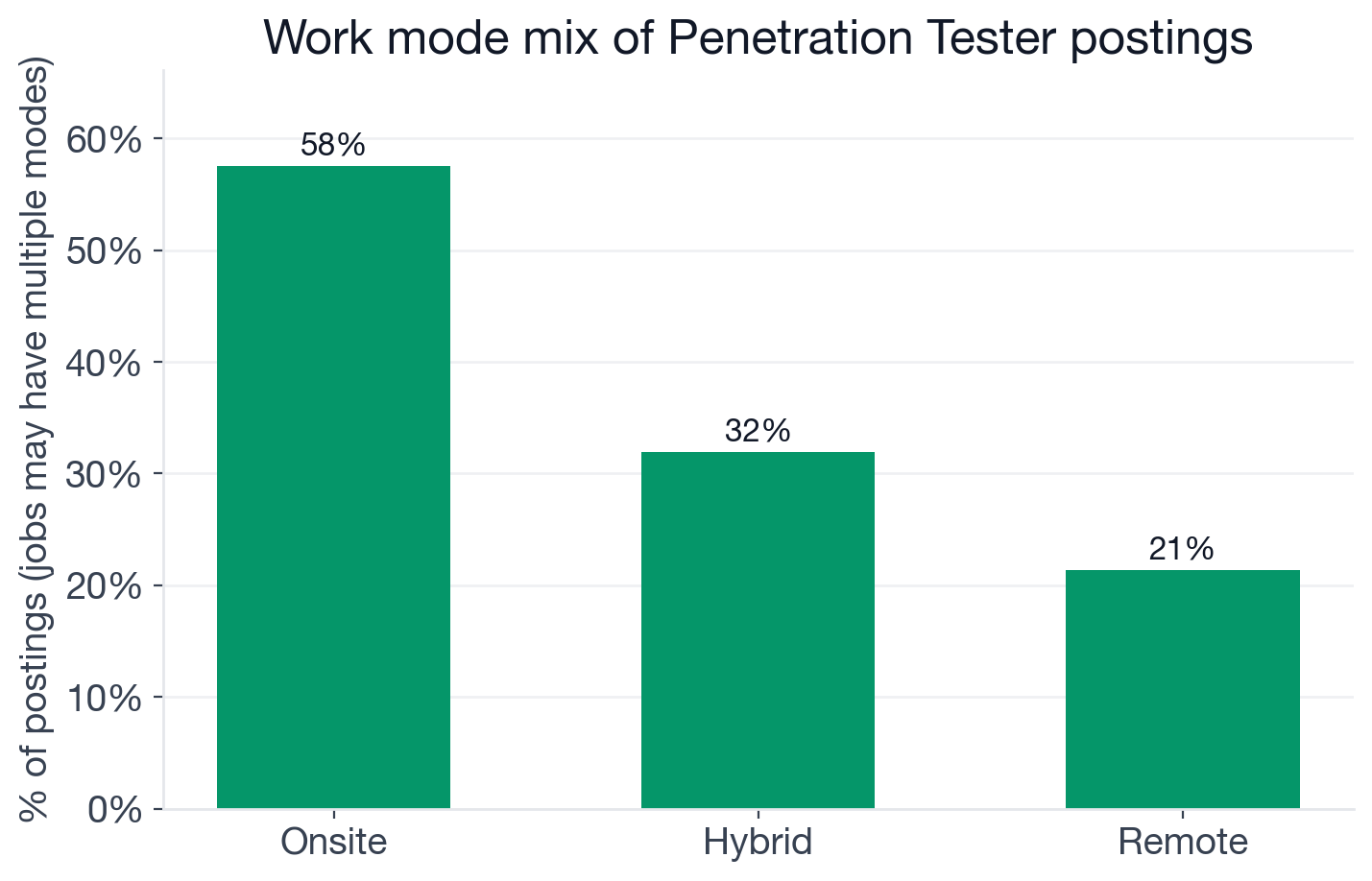
Work mode distribution of Penetration Tester postings. Percentages can exceed 100% when postings carry multiple tags (e.g., hybrid or remote).
- Onsite: 57.5% (332 postings)
- Hybrid: 31.9% (184 postings)
- Remote: 21.3% (123 postings)
The onsite skew is meaningful. Much of the work that goes into security engagements, physical access testing, secure facility requirements, government clearance-adjacent work, and the hands-on nature of red team operations, does not lend itself to full remote. Remote Penetration Tester openings represent a real segment of the market, concentrated in AppSec consulting and cloud security firms.
Who Is Hiring Penetration Testers in 2026?
The employer roster reflects the role's spread across financial services, defense, and specialized cybersecurity firms. The top employers below exclude MWDN and Mercor, which are staff augmentation and AI talent marketplace firms rather than direct employers, and CommIT and PD Inc International, which operate primarily as staffing providers.
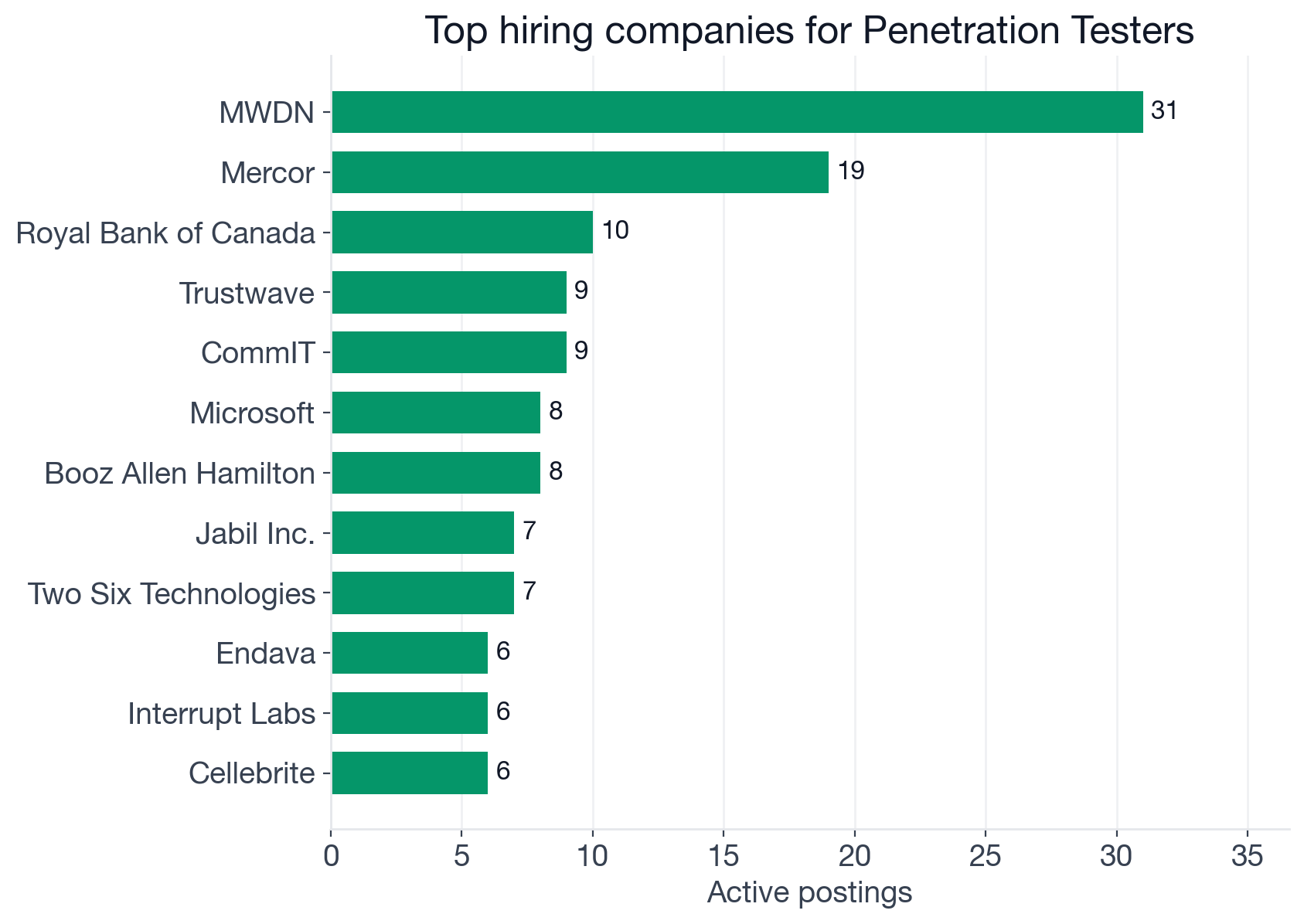
Top real employers by active Penetration Tester postings. Staffing firms and talent marketplaces are excluded.
| Company | Active postings | Segment |
|---|---|---|
| Royal Bank of Canada | 10 | Financial services |
| Trustwave | 9 | Managed security services |
| Microsoft | 8 | Enterprise tech |
| Booz Allen Hamilton | 8 | Defense and government consulting |
| Jabil | 7 | Manufacturing and supply chain tech |
| Two Six Technologies | 7 | Defense research |
| Cellebrite | 6 | Digital intelligence, Israel-based |
| Interrupt Labs | 6 | Cybersecurity research |
| Sun Life Financial | 6 | Financial services |
| SixGen | 5 | Cybersecurity services |
| Software Engineering Institute (CMU) | 5 | Federally funded research |
| Thales | 5 | Defense and aerospace |
| NTT Limited | 5 | Global telecom and managed services |
The pattern across these employers is clear. Financial services (RBC, Sun Life) need penetration testers for regulatory compliance and internal red team programs. Defense and government contractors (Booz Allen, Two Six Technologies, SEI, Thales) need cleared or clearance-eligible offensive security talent. Specialized cybersecurity firms (Trustwave, Cellebrite, Interrupt Labs, SixGen) run engagements across client environments and hire for breadth of attack surface coverage. Enterprise tech and manufacturing (Microsoft, Jabil, NTT) run internal red team or security engineering programs. The employer mix matters for how you position: a financial services pen tester and a defense contractor pen tester face different interview processes and often different clearance requirements.
How to Use This in Your Job Search
Decide which track you are on. The data is clear: Penetration Testing as a role title covers at least four distinct tracks (web AppSec, cloud, infrastructure/red team, mobile), each with a separate skill cluster and different salary ceiling. TypeScript and OWASP signal AppSec. Linux, Active Directory, and PowerShell signal red team and infrastructure. iOS, Android, Swift, and Kotlin signal mobile. AWS plus multi-cloud coverage signals cloud attack surface work. Pick the track where your background is strongest and skill up from there rather than trying to cover every surface.
On the AppSec track, treat TypeScript as a real investment. The $33,100 salary premium is not symbolic. Being able to read TypeScript source code, trace API call flows, and identify authentication or injection flaws in a React or Next.js application is a testable, demonstrable skill employers are willing to pay for. The question bank covers application security topics including OWASP Top 10 and API security that surface in technical screens.
Build multi-cloud coverage if cloud is your track. The lift data shows that employers who care about cloud attack surfaces care about all three major clouds. If you have AWS depth, adding at least working Azure knowledge (particularly Active Directory and Entra ID attack paths) puts you in range for a much larger share of cloud-adjacent openings. Browse Penetration Tester openings by cloud skill.
Prepare for both technical screens and hands-on assessment. Most penetration testing interviews include a technical component beyond standard behavior questions: CTF-style challenges, code review scenarios, or live tool demonstrations. AI mock interviews let you practice the verbal reasoning portion, explaining attack methodologies and remediation logic under interview conditions, which is often where candidates lose ground even when their hands-on skills are strong.
Use skill-filtered job board search to find your track. The role title alone is too broad to search on. Filter to your specific stack: Penetration Tester + OWASP + Application Security for AppSec roles, or Penetration Tester + Linux + AWS for cloud and infrastructure roles. The board updates daily. Also review our preparation guides if you are targeting specific company interview processes.
FAQ
Q. What skills do Penetration Testers need in 2026?
No skill reaches the table-stakes threshold of 50% in Penetration Tester postings, reflecting how much the role splits by target surface. Common-tier skills (appearing in 20-50% of postings) are Python (41.6%), Penetration Testing as an explicit credential (41.4%), Automation (28.9%), AWS (21.3%), and Monitoring (20.3%). Linux, OWASP, Windows, Azure, Application Security, and Threat Intelligence round out the upper differentiator tier at 14-19% of postings.
Q. What is the median Penetration Tester salary in 2026?
The median US base salary for Penetration Tester postings is $142,400, based on 105 postings with structured US salary data. That figure covers base pay only; equity, bonuses, and sign-on are not disclosed in posting data, so total compensation at top employers is higher.
Q. Which Penetration Tester skills carry the biggest salary premium in 2026?
Among US postings with salary data, TypeScript earns the largest premium at $175,500 median (+$33,100 over the $142,400 baseline), followed by Linux at $163,400 (+$21,000) and Automation at $159,200 (+$16,800). Python and Windows both sit exactly at the $142,400 role median. Penetration Testing itself earns $140,400, slightly below the baseline.
Q. Is Penetration Testing hard to break into without experience?
Yes. Only 2.8% of Penetration Tester postings are explicitly entry-level, which is 16 of 577 analyzed. Mid-level roles account for 67.8% of postings, and senior plus staff together make up nearly 30%. The most common path in is through adjacent security roles such as SOC analyst, vulnerability analyst, or application security engineer.
Q. How remote-friendly are Penetration Tester jobs?
Penetration Testing skews heavily toward onsite: 57.5% of postings are onsite, 31.9% are hybrid, and only 21.3% are remote (percentages can sum above 100% because some postings carry more than one work-mode tag). The US is the largest single market at 33.8% of postings, with Israel (4.5%) notable as a cybersecurity cluster alongside the UK (5.7%) and Canada (5%).
Q. Which companies are hiring Penetration Testers in 2026?
The top real employers (excluding staffing firms) include Royal Bank of Canada (10 openings), Trustwave (9), Microsoft (8), Booz Allen Hamilton (8), Jabil (7), Two Six Technologies (7), Cellebrite (6), and Interrupt Labs (6). The hiring mix spans financial services, defense and government contractors, and specialized cybersecurity firms.
Q. What is the dominant skill stack for Penetration Testers in 2026?
The strongest co-occurrence patterns involve multi-cloud coverage: Azure plus Google Cloud (lift 4.71), AWS plus Google Cloud (lift 4.52), and AWS plus Azure (lift 3.95) all appear together far more often than individual frequencies would predict. Python pairs with several secondary languages at lifts of 2.1 to 2.3 (JavaScript at 2.29, Bash at 2.22, C++ at 2.18, PowerShell at 2.16). On the application security track, OWASP plus Penetration Testing has a lift of 1.99, the most cited AppSec combination.
The AppSec Bet Worth Making in 2026
The penetration testing market is rewarding depth in two specific directions: application security (TypeScript, OWASP, APIs) and cloud attack surface (multi-cloud coverage with high co-occurrence lifts). A generalist pen testing background earns the role median. A specialist with TypeScript-fluent AppSec skills or demonstrable multi-cloud attack knowledge earns $21K to $33K above it. The role's lack of table stakes is not a flaw in the data; it is the data telling you that the right specialization matters more than covering every surface at average depth.
Topics
Ready to practice?
Put what you've learned into practice with AI mock interviews and structured preparation guides.