
The Fork Request Is Where Tradeoff Reasoning Gets Tested
Eight to twenty minutes into a mid-level Product Designer interview on design systems, a product team asks to fork the shared button and form components for a launch that cannot wait. How a candidate answers that one moment is one of the clearest tests of the tradeoff reasoning this interview rewards throughout.
This walkthrough follows one real interview blueprint, the same package structure InterviewStack.io's AI interviewer generates and scores live, covering the phases, rubric, and follow-up questions a mid-level Product Designer candidate actually faces on design systems and component architecture. Here is what that blueprint rewards, and where a well-prepared candidate still gives away the points that decide the score.
Key Findings
- The rubric weighs 100 points across 4 dimensions; Interviewer Objectives Alignment and Level-Specific Expectations each carry 30 points, together 60% of the score.
- The 30-minute interview spends its longest stretch, 12 minutes (minute 8 to minute 20), on component model, evolution, and governance, not on opening framing.
- That middle phase alone carries 5 checklist items, one more than either of the other two phases.
- The scenario names 3 product surfaces, the core consumer app, the growth team, and the creator tools team, each shipping its own UI patterns before this push.
- Technical Proficiency and Communication & Problem Solving each carry 20 points, 40 combined, two-thirds the combined weight of the two framing dimensions.
- The middle phase's checklist explicitly credits handling team-specific requests, platform differences, and urgent launch needs, exactly the fork scenario this walkthrough dramatizes.
The interview question
Imagine you have joined a company with multiple product surfaces across web and mobile. The core consumer app, growth team, and creator tools team have each been shipping their own UI patterns, and leadership now wants to reduce inconsistency and speed up delivery without freezing product innovation. The company already has a partial component library used unevenly by teams, and several upcoming launches depend on it.
How would you approach improving and scaling this design system so teams can adopt it confidently while the system continues to evolve?
The interviewer is not grading for a polished visual system. The objectives behind this question are explicit: design and evolve a system that balances consistency with product-team flexibility, define a workable component and token strategy (tokens being the shared values, like spacing, color, and type scale, that keep every component visually consistent), reason about versioning and migration risk, set up practical governance, and drive real adoption, with enough specificity that a cross-functional team at a large company could actually implement it.
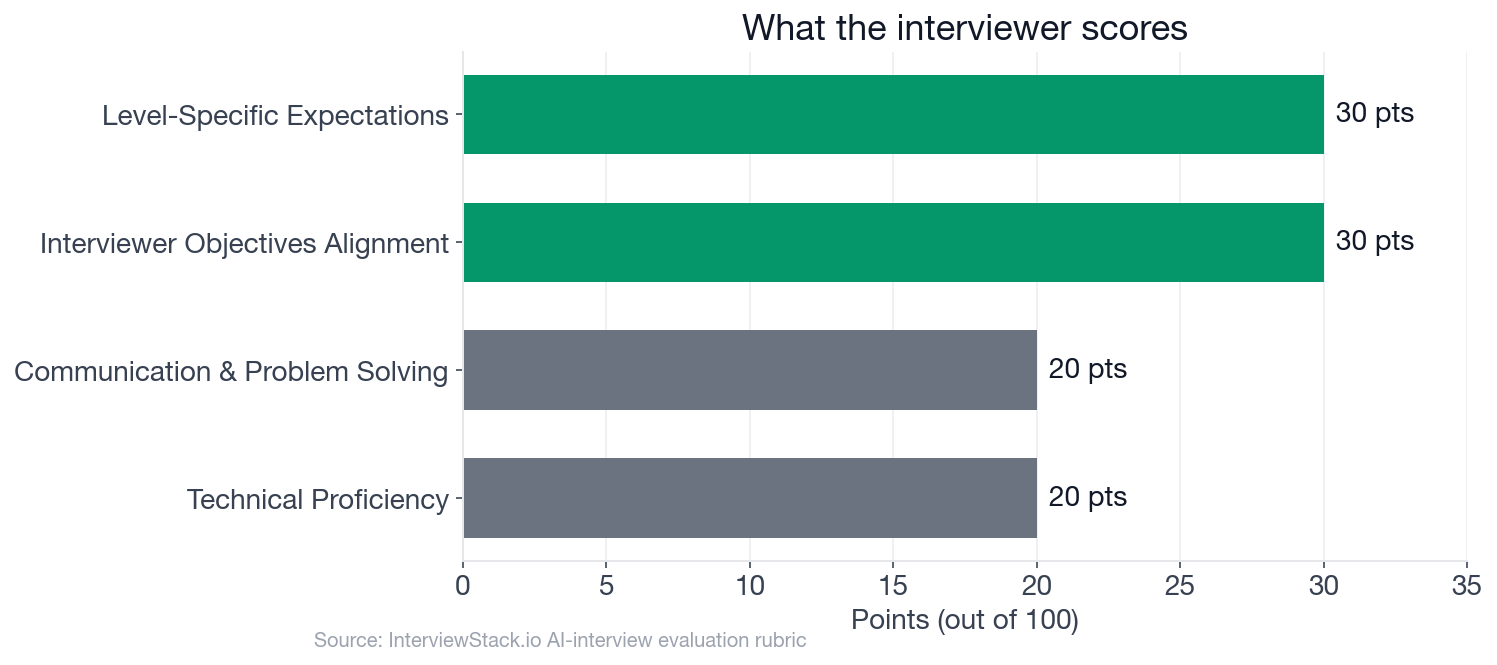 Interviewer Objectives Alignment and Level-Specific Expectations each carry 30 of the interview's 100 points; Technical Proficiency and Communication & Problem Solving carry 20 each.
What Is a Product Designer Design Systems Interview Really Judging?
A design systems interview at this level is not testing whether a candidate knows what a design token is. It is testing whether they can hold a system together while real teams pull against it, in real time, across 30 minutes. Four moments in this blueprint separate a candidate who describes a system from one who can actually run one. A consistent candidate, Farah, walks through all four below, mistakes included.
Turn 1: The Fork Request
Interviewer: "A product team says the existing button and form components don't meet a new launch need and wants to fork them. How would you handle that situation?"
Turn 2: What Belongs in the System
Interviewer: "How would you decide what belongs in the system as a reusable component versus what should stay local to a product team?"
Turn 3: Evolving Without Breaking Things
Interviewer: "How would you evolve tokens or core components without breaking existing product experiences that depend on them?"
Turn 4: Winning Back Adoption
Interviewer: "If adoption is low because engineers think the system slows them down, what signals would you look for and what would you change?"
Would You Still Say No Under Real Time Pressure?
Every mistake above is easy to spot once it is printed on a page with the fix sitting right underneath it. It is much harder live: the interviewer does not pause the clock while a candidate works out whether a fork request is a one-off exception or the first crack in the system, and a follow-up rarely offers a do-over. A prepared candidate can still freeze on the fork question, over-explain the easy parts, and burn the minutes that phase 2 needed for versioning and governance too. That gap, between recognizing the right move on the page and producing it live while an interviewer probes the answer, is exactly what practice closes.
What Does the Blueprint Track Once the Fork Question Passes?
The fork question is one moment inside a longer blueprint. Here is the full 30 minutes, phase by phase, the same structure InterviewStack.io's AI interviewer tracks against in real time during a live Product Designer design systems mock interview.
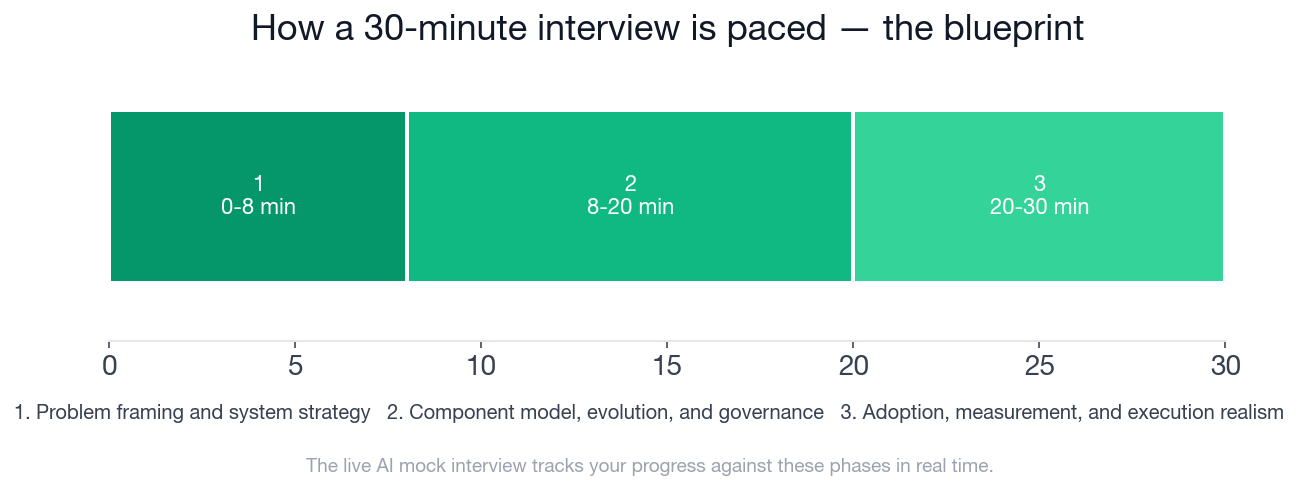 The 30-minute interview in three phases: problem framing and system strategy (0-8 min), component model, evolution, and governance (8-20 min), and adoption, measurement, and execution realism (20-30 min).
- ✓Clarifies who the users of the system are, such as product designers and engineers, not just end users
- ✓Identifies current pain points like inconsistency, duplicated work, slow delivery, fragmented patterns, or unclear ownership
- ✓Defines a goal state that balances standardization with room for product-specific needs
- ✓Outlines an initial strategy with foundations, component inventory or audit, and adoption plan
- ✓Explains criteria for promoting patterns into shared components versus leaving them local
- ✓Describes how tokens or component variants create consistency while supporting multiple use cases
- ✓Addresses change management through versioning, deprecation, migration guidance, or backward compatibility
- ✓Proposes a lightweight governance model such as review rituals, contribution guidelines, or ownership boundaries
- ✓Responds thoughtfully to edge cases like team-specific requests, platform differences, or urgent launch needs
- ✓Suggests realistic adoption levers such as documentation, office hours, embedded support, templates, or pilot teams
- ✓Defines a few concrete success metrics like component usage, reduced duplication, implementation quality, or faster design and build cycles
- ✓Acknowledges organizational friction and explains how to build trust with skeptical product teams
- ✓Prioritizes an MVP or phased rollout instead of attempting to standardize everything at once
This is the exact checklist the AI interviewer is scoring against while a candidate talks, not a rubric handed over afterward. Answer the fork question the way Turn 1 teaches, and the rest of the blueprint gets a lot easier to hit.
Make the Fork Call for Real
Reading Farah's mistakes is the easy version of this interview. The real version puts a candidate in the seat: a live AI interviewer asks the fork question, listens to how the tradeoff gets framed, and follows up based on what is actually said, not a script. Start a Product Designer design systems mock interview and find out whether an answer holds up in the room, not just on the page. To build up the individual pieces first, work through the design systems and component architecture question bank before going live, or browse InterviewStack.io's preparation guides if the goal is a specific company's process.
FAQ
Q. What level is this Product Designer design systems interview calibrated to?
This walkthrough is calibrated to a mid-level Product Designer (2 to 5 years of experience). At this level, the interview expects a candidate to structure a clear system strategy and make reasonable tradeoffs even without having owned a company-wide design system end to end, and to recognize migration and adoption risk rather than assuming perfect top-down compliance.
Q. How is the 30-minute design systems interview structured?
The interview runs three phases: problem framing and system strategy from minute 0 to 8, component model, evolution, and governance from minute 8 to 20 (the longest phase, at 12 minutes), and adoption, measurement, and execution realism from minute 20 to 30.
Q. What rubric dimension does the fork-request question test in this interview?
Treating an exception, like a team's request to fork a shared component, as a binary yes-or-no decision skips the tradeoff reasoning between centralization and flexibility that Interviewer Objectives Alignment, tied for the interview's largest rubric dimension at 30 of 100 points, is built to score throughout the interview.
Q. How should you handle a product team that wants to fork a shared component for a launch?
Treat it as a scoped, time-boxed exception rather than a permanent decision. Identify exactly which requirement the shared component cannot meet, ship a documented variant or override with a named owner, and set a date to reconcile it back into the system, either by fixing the gap in the shared component or formally promoting the new pattern if other teams need it too.
Q. How do you decide what belongs in a shared design system versus staying local to one product team?
Promote a pattern once there is real evidence of repeat need, typically the same interaction or component solving the same problem across at least two teams, not just one team's convenience. A pattern that stays local should still be documented and discoverable, so it can graduate later instead of quietly duplicating work elsewhere.
Q. How do you keep design tokens and components consistent across web and mobile with different technical constraints?
Separate the shared decision from the platform-specific implementation. Define the interaction pattern and the design tokens, spacing, color, type scale, once at a platform-agnostic layer, then let each platform's component library implement that pattern within its own technical constraints; consistency lives in the intent and the token values, not in forcing identical code across platforms.
Q. What governance model keeps a design system from becoming a bottleneck?
Lightweight review rituals beat centralized approval gates: published contribution criteria, a regular review cadence for new components, and clear ownership boundaries so most day-to-day decisions do not need the systems team's sign-off. The goal is a system where review capacity scales with adoption, instead of one where every change waits on a single team.
The System Is Judged by Its Exceptions
A design system that has never been tested by a team in a hurry has not really been finished; it just has not met its first hard case yet. This interview compresses that test into one scenario and 30 minutes, but the underlying judgment, treating exceptions as data instead of threats, is the same judgment the job asks for every quarter. That is worth rehearsing before the real interview asks for it.
Topics
Ready to practice?
Put what you've learned into practice with AI mock interviews and structured preparation guides.