
The Group Is Not One User
Nia has done this before. She has shipped features on mobile, led design sprints, and can talk through a design process comfortably for 30 minutes. When the interviewer describes a group dinner coordination problem on a maps platform, she feels the familiar shape of the work and begins.
Three turns in, the interviewer is pushing back on things she thought she had handled. Not the flows. Not the wireframes. The problem definition she finished in the first two minutes.
Sixty of 100 rubric points in a Product Designer end-to-end design process interview belong to the two framing dimensions: Interviewer Objectives Alignment (30 pts) and Level-Specific Expectations (30 pts). Both are scored before the first wireframe appears.
Key Findings
- 60 of 100 rubric points go to the two framing dimensions: Interviewer Objectives Alignment (30 pts) and Level-Specific Expectations (30 pts), both determined in the first 8 minutes.
- Phase 1 (0-8 min) contains 5 distinct checklist items: target outcome, at least two user roles with one meaningful distinction, key assumptions, constraint-bounded MVP scope, and at least one named design challenge.
- The Level-Specific Expectations rubric explicitly scores whether the candidate recognizes major constraints and works within them, rather than assuming unlimited engineering or research resources.
- Phase 2 (8-18 min) requires at minimum 2 genuinely distinct solution directions with tradeoffs compared across coordination burden, speed to ship, and technical complexity.
- Phase 3 (18-30 min) scores on whether post-launch metrics span both behavior (group flow completion, share-to-decision conversion) and quality (qualitative satisfaction, per-step drop-off).
- Forbidden territory includes visual polish critique, detailed A/B experimentation design, backend architecture deep dives, and generic behavioral storytelling unrelated to the design process.
What Does a Product Designer End-to-End Design Interview Actually Test?
The scenario is built around a common PM-to-design handoff: a hypothesis about user drop-off, a quarter to ship, and a platform constraint that rules out a standalone app or a major backend rebuild. The opening question is deliberately open-ended.
The interview question
You are joining a product team at a large maps and local discovery platform. The team wants to improve the experience of planning a group dinner.
Today, a user can search for restaurants, view details, and share individual places with friends, but there is no dedicated end-to-end flow for coordinating a decision across multiple people. PM believes this is causing drop-off between discovery and reservation or arrival.
Your team has one quarter to ship an MVP that works well on mobile first. Engineering can support a new lightweight feature set inside the existing app, but not a standalone app or a major backend rebuild. Assume reservations are handled through a mix of first-party flows and third-party integrations depending on the restaurant.
How would you approach this design problem from initial brief through launch and iteration?
The interviewer's objectives go well beyond "can this candidate design a feature." They want to see how the candidate frames the problem, names assumptions, distinguishes user roles, generates multiple solution directions, handles constraints, plans validation, and defines success after launch. The design work is the middle third of a 30-minute evaluation.
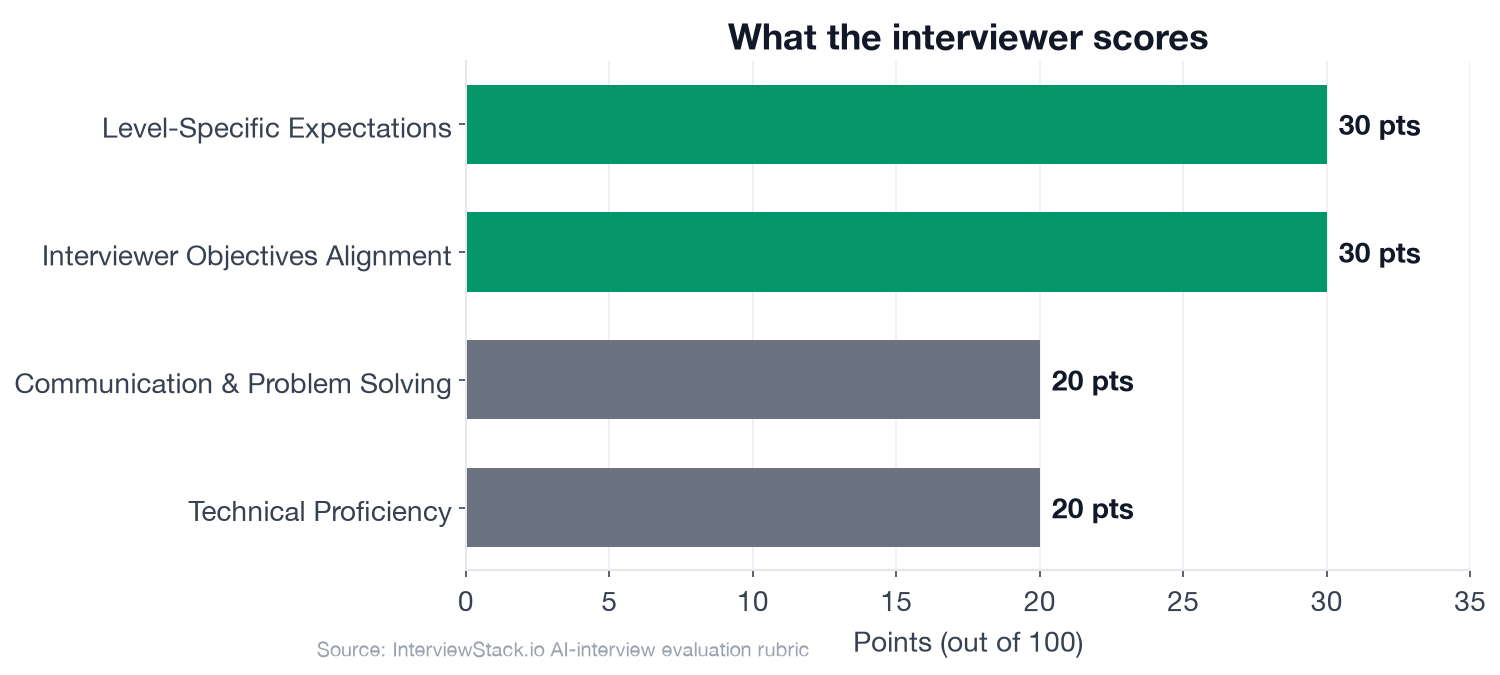
The scoring weight chart above shows why Phase 1 decisions matter so much: two of the four dimensions are scored entirely on judgment and framing, not on visual output.
The Walkthrough: Where the Points Actually Move
Turn 1: Who Is the Primary User?
Interviewer: "Who do you see as the primary user in this flow, and how would you handle cases where the organizer and attendees have different needs?"
Turn 2: Two Distinct Solution Directions
Interviewer: "Walk me through two different solution directions you would consider before choosing one."
Turn 3: Handling the Engineering Constraint
Interviewer: "If engineering tells you real-time collaboration is too expensive for the MVP, how would that change your design approach?"
Turn 4: Handoff and Launch Metrics
Interviewer: "What would you hand off to product and engineering before launch, and what metrics would you look at in the first few weeks after release?"
Spotting the Mistakes Is Not the Same as Avoiding Them
Reading these turns on the page, the pattern is clear: treat the brief as a starting point, name two user roles, keep distinct solution directions genuinely distinct, and tie your metrics to the hypothesis. Clean framing, in theory.
The difficulty is doing all of that live, under time pressure, while the interviewer is waiting for your next sentence and has already heard thirty versions of "I'd start by talking to users." That gap between knowing and performing is the one that shows up in your score, and it only closes through reps.
The Product Designer question bank for end-to-end design process is a solid place to drill individual turns. For the full 30-minute session with unscripted follow-ups and real-time scoring, the AI mock interview runs you through all three phases and shows you exactly which checklist items you hit and which you left open.
The Complete Interview Blueprint
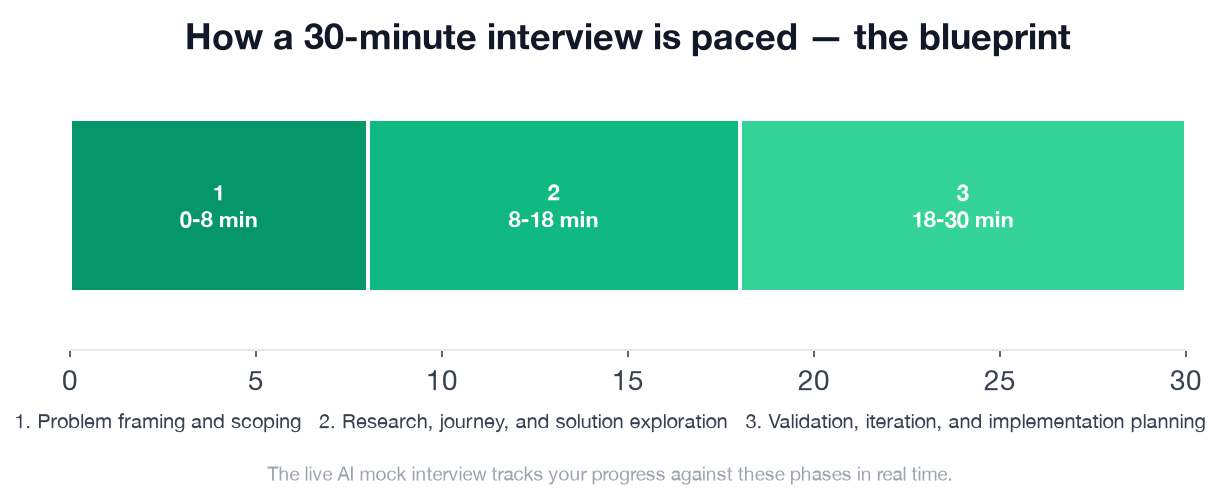
This is what a strong 30-minute end-to-end design process interview looks like, phase by phase. It is also what the AI mock interview tracks you against in real time.
- ✓Clarifies the target outcome beyond 'build a feature,' such as reducing coordination friction or increasing progression from discovery to decision
- ✓Identifies likely user roles such as organizer and invitees, with at least one meaningful distinction in needs or behaviors
- ✓Calls out important unknowns or assumptions to validate instead of treating the brief as complete
- ✓Acknowledges mobile-first and engineering constraints and uses them to bound MVP scope
- ✓Frames at least one clear design challenge in the current journey, such as sharing, preference aggregation, decision-making, or reservation handoff
- ✓Proposes a lightweight but realistic research plan, such as leveraging existing data, quick interviews, support tickets, or usability review of current sharing behavior
- ✓Describes what artifacts they would create from research, such as a journey map, pain-point list, or key scenarios
- ✓Explores at least two distinct solution directions rather than jumping immediately to a single UI
- ✓Compares solution directions using concrete tradeoffs like speed to ship, coordination burden, user clarity, and technical complexity
- ✓Begins to outline a sensible flow or IA for the chosen direction, including entry point, group coordination step, decision point, and booking or navigation handoff
- ✓Chooses an appropriate prototype fidelity for the stage and explains what they would test with it
- ✓Names specific usability risks or edge cases to validate, such as invitees without the app, conflicting preferences, no reservation availability, or partial group response
- ✓Explains at least one likely iteration based on feedback or engineering constraints, not just a one-pass design
- ✓Describes handoff outputs concretely, such as annotated flows, states, empty/error cases, reservation handoff behavior, and accessibility considerations
- ✓Defines a small set of meaningful launch metrics spanning behavior and quality, such as group flow completion, share-to-decision conversion, reservation click-through, drop-off points, or qualitative satisfaction
Practice the Interview, Not Just the Blueprint
The AI mock interview for Product Designer end-to-end design process runs this exact 30-minute session with live follow-ups, scores each answer against the four rubric dimensions in real time, and tells you which checklist items you satisfied and which you left open. For additional drilling on specific turns, the end-to-end design process question bank covers the most common question variants by phase. You can also find Product Designer roles open now on the InterviewStack.io job board if you want to match your prep to real postings.
FAQ
Q. How long is a product designer end-to-end design process interview?
The standard format is 30 minutes, structured across three phases: problem framing and scoping (0-8 min), research, journey mapping, and solution exploration (8-18 min), and validation, iteration, and implementation planning (18-30 min).
Q. What are the most common mistakes in a product designer end-to-end design interview?
The most common mistake is treating the brief as a complete specification and jumping straight to wireframes or solution directions. Failing to distinguish organizer vs. invitee needs, ignoring stated constraints, and skipping assumption identification each cost points across the Interviewer Objectives Alignment (30 pts) and Level-Specific Expectations (30 pts) dimensions.
Q. How should a product designer handle an engineering constraint mid-interview?
Acknowledge the constraint explicitly, then show how it reshapes the design rather than blocking it. For a group dinner flow, removing real-time sync shifts the solution toward an async model: share a shortlist, collect votes or comments asynchronously, and resolve the decision after polling. Demonstrating this pivot satisfies the Level-Specific Expectations rubric item on recognizing constraints and escalating appropriately.
Q. What metrics should a product designer define after launching a group feature?
Strong candidates name a tight set spanning behavior and quality: group flow completion rate, share-to-decision conversion, reservation click-through rate, per-step drop-off, and qualitative satisfaction measured by a brief post-session prompt. Defining metrics without a funnel connection (e.g., citing DAU alone) misses the Validation and Implementation phase checklist item.
Q. What is the rubric for a product designer end-to-end design interview?
The rubric assigns 30 points each to Interviewer Objectives Alignment (addressing the core problem and objectives) and Level-Specific Expectations (appropriate depth and seniority for a mid-level role), plus 20 points each to Technical Proficiency (prototyping, interaction design, tradeoff reasoning) and Communication & Problem Solving (clarity, handling ambiguity, asking useful clarifying questions).
Q. How many solution directions should a product designer present in an end-to-end design interview?
At least two genuinely distinct directions, compared using concrete tradeoffs: coordination burden on users, speed to ship, technical complexity, and how each handles edge cases like partial group response or conflicting preferences. Visual variations of the same interaction model do not count as distinct directions and miss the Phase 2 expectedChecklist item on breadth of ideation.
The Distinction Is in the Framing, Not the Flows
Most designers who struggle with end-to-end design process interviews do not struggle because their design work is weak. They struggle because they spend the first eight minutes confirming what the brief already tells them, instead of discovering what it does not. The brief describes a problem area. The designer's job is to frame the actual design problem. Those are not the same thing, and the rubric scores them separately. Prep guides and question drilling get you familiar with the territory; live practice under time pressure is what builds the instinct.
Topics
Ready to practice?
Put what you've learned into practice with AI mock interviews and structured preparation guides.