
The interviewer opens by telling you that younger users now start their dinner decisions on TikTok, Instagram, and Yelp instead of your maps app. A prepared mid-level Product Manager opens with a feature grid and a plan to launch short-form video. That answer feels decisive, and it quietly loses points on the exact thing this interview is built to test.
Why Does Copying TikTok Fail This Interview?
This walkthrough follows one simulated 30-minute mock interview for a mid-level Product Manager on competitive analysis and positioning. It is built from a real interview blueprint, and the candidate answers below are dramatized for illustration, not a transcript of any person or company. To see how often strategy skills appear in live postings, browse current Product Manager openings.
Key Findings
- The interview is scored out of 100 points across 4 dimensions, and 60 of those points reward objectives alignment (30) and level-specific expectations (30).
- Technical Proficiency is only 20 of 100 points, so a PM who wins on framework vocabulary but not on judgment leaves most of the score behind.
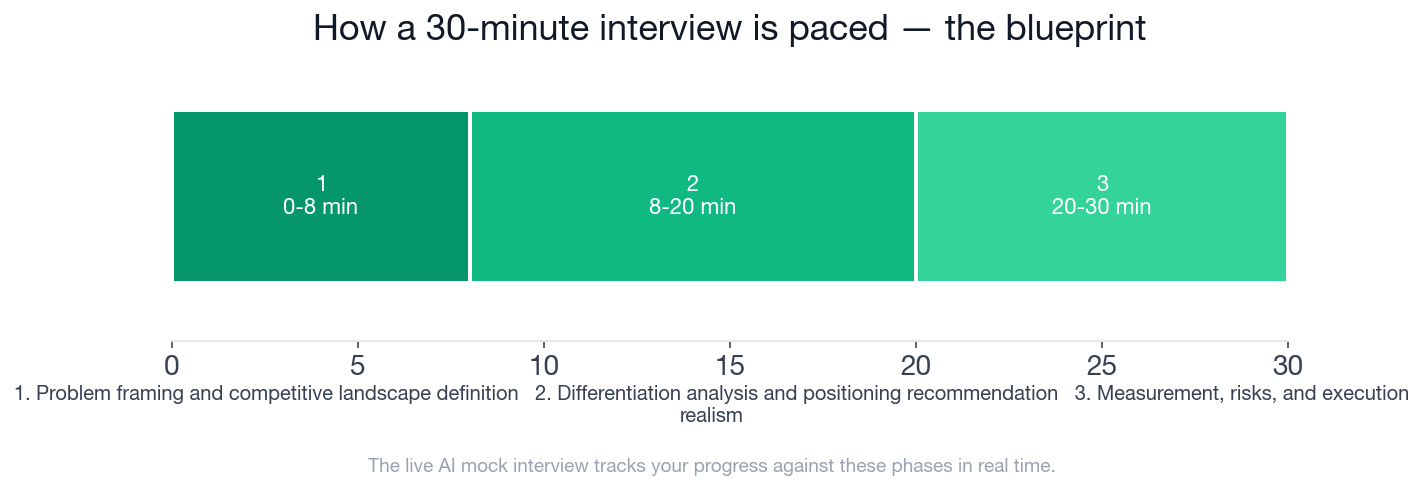
- The 30 minutes run in 3 phases: 8 minutes of framing, 12 of differentiation and positioning, 10 of measurement and risk.
- The longest phase, 12 minutes, is where the positioning recommendation must land.
- The blueprint tracks 16 expected checklist items: 5 in phase one, 6 in phase two, and 5 in phase three.
- Mid-level candidates are held to 5 level-specific expectations, including scoping to a 12-month horizon and prioritizing 1 or 2 user segments.
- 4 topics are deliberately out of scope (SQL, ranking-model design, pixel-level UI critique, valuation or M&A), so none of them earn a single point.
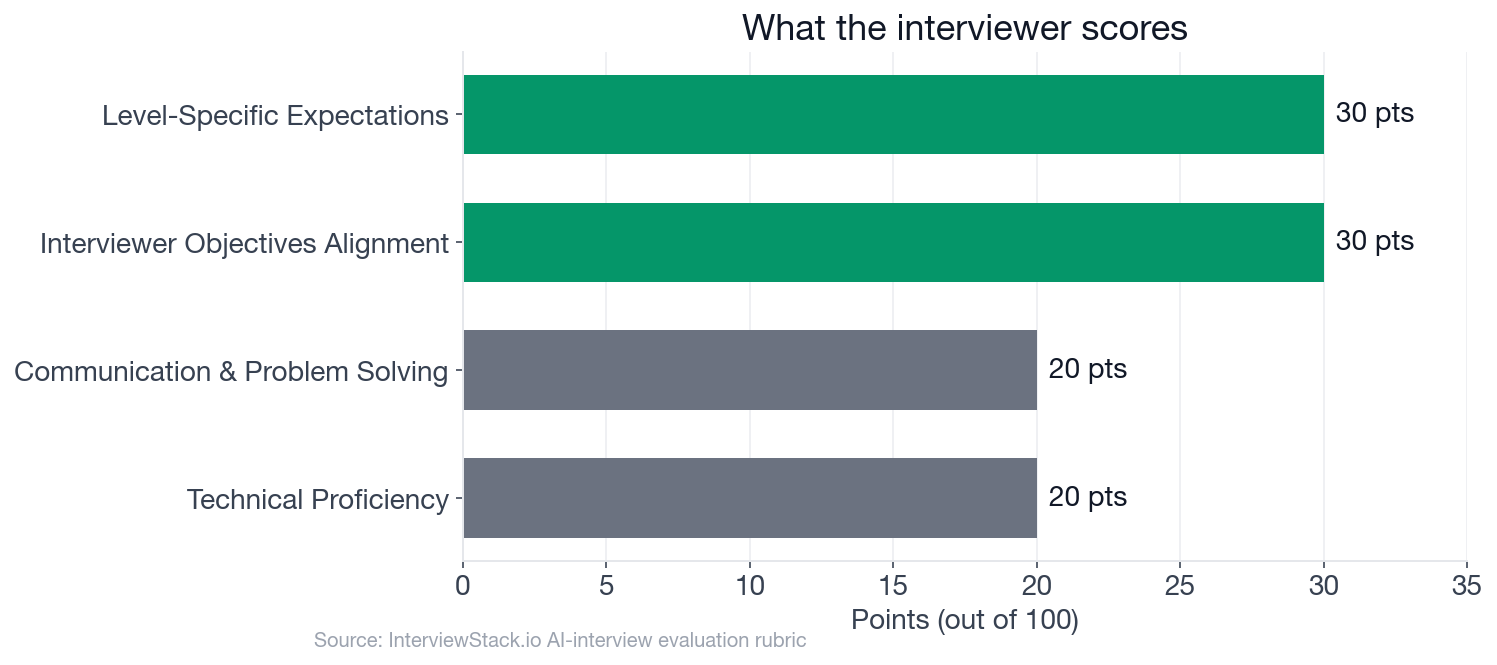
The chart shows where the points live: strategy judgment and level-appropriate scoping carry 60 of 100, which is why a clever feature list is the wrong thing to optimize.
What Is the Interviewer Actually Asking You to Decide?
Here is the question the AI interviewer opens with.
The interview question
You are a Product Manager at a large consumer tech company working on a maps and local discovery product. Leadership is concerned that younger users increasingly start local discovery journeys on TikTok, Instagram, and Yelp instead of using your product to decide where to eat, what to do, or which places are worth visiting.
Your team has been asked to recommend how the product should position itself competitively over the next 12 months. How would you evaluate the competitive landscape and recommend a positioning strategy for our maps and local discovery product?
The prompt is deliberately ambiguous. The interviewer is probing whether you can frame the user job, choose comparison dimensions that matter, commit to one defensible position tied to a segment, and then measure it. Nothing here asks you to out-feature a rival.
Which Follow-Ups Separate Strong Answers From Safe Ones?
Four of the six follow-up prompts in the blueprint make good case studies. In each, Priya, our illustrative candidate, gives a common answer that sounds reasonable and costs points.
Turn 1: Competitors Versus Substitutes
Interviewer: "Who do you consider the primary competitors here, and how would you decide which ones matter most versus substitutes or adjacent products?"
Turn 2: Moats Without Creator Culture
Interviewer: "If we cannot win on short-form content or creator culture directly, what product strengths or moats would you lean into?"
Turn 3: Parity Or Differentiation
Interviewer: "How would you decide between building feature parity with competitors and doubling down on differentiated strengths?"
Turn 4: Proving It Worked
Interviewer: "What metrics would you use to determine whether the new positioning is working over the next two quarters?"
Why Isn't Reading This Enough?
Spotting these four mistakes on a page is easy. Avoiding them live is the real skill, because the interviewer interrupts, pushes on your weakest assumption, and gives you no time to reorder your notes. Candidates who have only read answers tend to recite a framework. Candidates who have practiced out loud learn to pivot when challenged, which the final checklist item rewards directly.
What Does the Full Blueprint Look Like?
This is the blueprint a strong candidate hits across the 30 minutes. It is also what the AI mock interview tracks you against in real time, phase by phase, so you see exactly which checklist items you covered.
- ✓Clarifies the product scope as maps plus local discovery rather than generic maps only
- ✓Identifies direct and indirect competitors such as TikTok, Instagram, Yelp, and possibly search or review platforms
- ✓Distinguishes between use cases like inspiration, evaluation, planning, and navigation
- ✓States an initial hypothesis about where the company is gaining or losing user value
- ✓Prioritizes a manageable set of competitors and explains why
- ✓Chooses relevant comparison dimensions rather than listing features superficially
- ✓Explains where competitors are stronger, such as inspiration or social proof, and where the company may be stronger, such as intent capture, reliability, breadth, or navigation
- ✓Recommends a focused positioning statement linked to a user segment or use case
- ✓Outlines 2-3 concrete product implications of that positioning, such as trusted decision support, planning-to-navigation continuity, or high-confidence local recommendations
- ✓Addresses whether to pursue selective parity features, and justifies that decision with cost and strategic fit
- ✓Mentions defensibility through data quality, ecosystem integration, scale, merchant coverage, or user trust
- ✓Defines a small set of leading and lagging metrics tied to discovery and decision quality
- ✓Suggests how to test positioning through product changes, messaging, or experiments
- ✓Identifies key risks such as weak credibility with younger users, low content freshness, or confusing product identity
- ✓Proposes a sequenced 12-month approach rather than an overly broad transformation
- ✓Communicates recommendations concisely and revises them when challenged
Start the Live Mock Interview
Run this exact scenario against the AI interviewer. You will face unscripted follow-ups, a running clock, and feedback scored on the same four dimensions. Start the AI mock interview now, then review your misses and repeat.
If you want more reps first, work through the Product Manager competitive analysis question bank or the Product Manager preparation guides.
FAQ
What does a mid-level Product Manager competitive analysis interview test?
It tests whether you can structure an ambiguous strategy question, pick the competitors that matter, and commit to one positioning you can defend. In the 30-minute AI mock interview scored out of 100, 60 points go to objectives alignment and level-specific expectations, so judgment and prioritization outweigh framework recitation.
How do I choose which competitors matter in a positioning question?
Start from the user job, not the logo list. Separate inspiration, evaluation, planning, and navigation, then rank rivals by which job they win and how much of your usage they threaten. Name a short list, say why each made it, and park the rest as substitutes or adjacent products.
Should a product match competitors' features or double down on its strengths?
Usually both, in different proportions. Pursue selective parity only where the missing feature blocks users from reaching your core strength, and justify it with cost and strategic fit. Put the bulk of effort behind the advantage rivals cannot copy quickly, such as data quality, intent capture, or ecosystem integration.
What metrics show that a new positioning is working?
Pick a small set of leading and lagging measures tied to discovery and decision quality: discovery starts, place-detail engagement, saves, route starts, and local intent conversion. Say which ones you would watch within two quarters and how a test or messaging experiment would isolate the effect.
How much of the answer should be about the 12-month plan?
A mid-level answer should be scoped to roughly 12 months and sequenced, not a multi-year transformation. Show what ships first, what you test, and what you deliberately postpone. Executive-level portfolio or M&A reasoning is not expected at this level.
How long is the practice interview, and what is out of scope?
The AI mock interview runs 30 minutes in three phases (minutes 0 to 8, 8 to 20, and 20 to 30). SQL, ranking-algorithm design, pixel-level UI critique, and valuation or M&A analysis are deliberately out of scope, so spend your prep time on strategy and measurement.
Where to Start Tonight
Pick one product you use daily, name the user job it wins, name the rival that wins a different job, and say your positioning out loud in two sentences. Do that three times and the live interview stops feeling ambiguous.
Topics
Ready to practice?
Put what you've learned into practice with AI mock interviews and structured preparation guides.