
The Gap Isn't Framework Knowledge. It's the Call.
Most mid-level PMs walk into a prioritization interview prepared. They know RICE. They can sketch impact-vs-effort on a whiteboard. What the interview is actually testing is different: can you apply that framework, make a recommendation, and hold it when marketing has executive visibility on a competing proposal and engineering is convinced something else is the real problem?
That gap between knowing a prioritization structure and committing to one under live pressure is where the largest rubric dimension gets decided. The scenario below is the kind of question a leading tech company uses in a 30-minute product manager prioritization interview. Walk through it turn by turn to see exactly where the points go.
Key Findings
- The interview runs 30 minutes across 3 phases: problem framing (0-8 min), trade-offs and stakeholder alignment (8-20 min), and execution and measurement (20-30 min).
- Scoring spans 100 points: Interviewer Objectives Alignment (30 pts), Level-Specific Expectations (30 pts), Technical Proficiency (20 pts), and Communication and Problem Solving (20 pts).
- The stakeholder alignment phase (8-20 min) carries 5 distinct rubric checklist items, more than either other phase.
- Making a call with incomplete data and stating assumptions clearly is an explicit Level-Specific Expectation for mid-level candidates.
- Deprioritization communication is 1 of 4 required checklist items in the final phase; skipping it leaves points in the last 10 minutes.
- Mid-level candidates must structure the decision for 1 product area independently without needing portfolio-level optimization.
- Success metrics must tie to the specific funnel stage of the selected initiative, not generic team-level growth numbers.
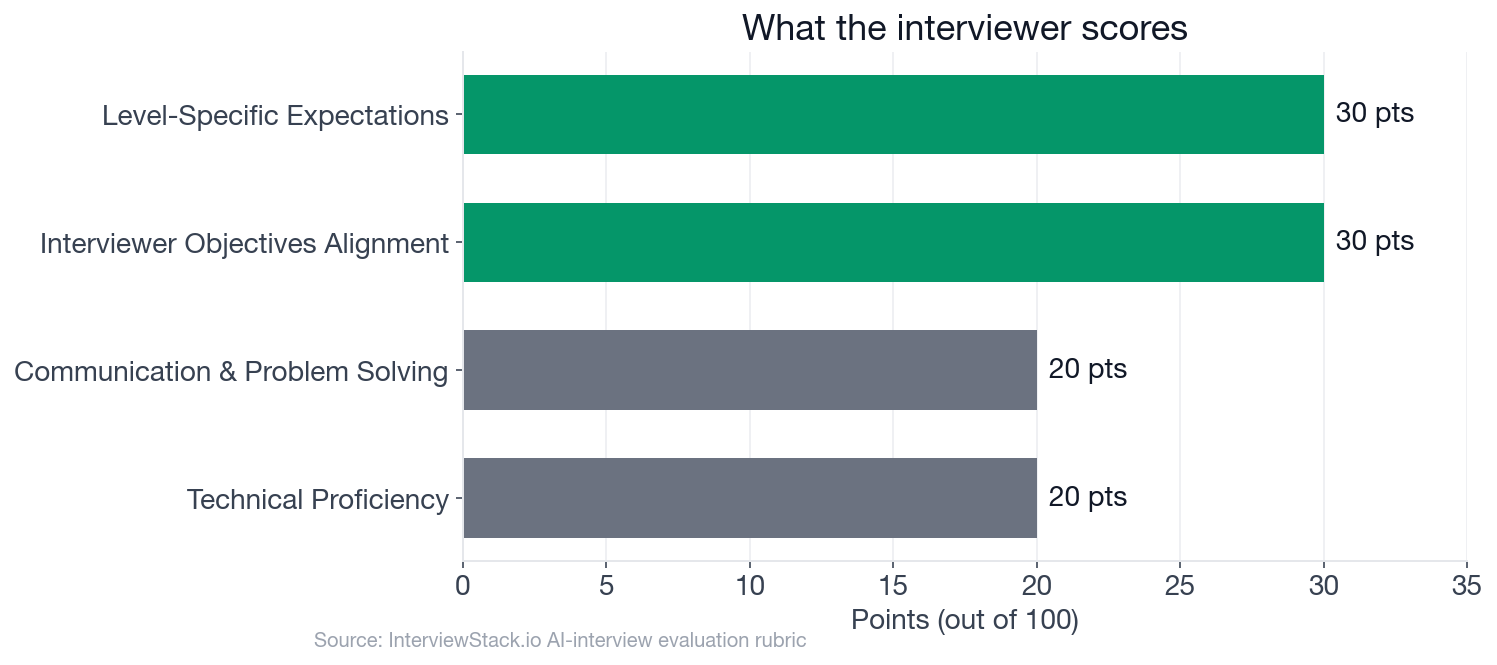
The two heaviest dimensions (30 pts each) both test judgment under real constraints, not framework recall.
Three Proposals, One Slot
The interview question
You are the PM for the consumer growth area of a large ride-sharing app. Your team owns rider activation and repeat usage in the first 30 days after signup.
It is quarterly planning time, and your team has capacity for only one major initiative this quarter. Three proposals are on the table: (1) A referral relaunch requested by marketing, which they believe can drive new user growth before a major seasonal campaign. (2) A first-ride reliability improvement requested by operations and engineering after an increase in failed pickups for new riders in several cities. (3) A post-signup onboarding redesign requested by design and research after findings that many new users do not complete their first booking.
Stakeholders are aligned that growth matters this quarter, but they disagree on which problem is most urgent and who should get resources first. How would you decide what to prioritize this quarter and get the relevant stakeholders aligned behind that plan?
Before the follow-ups arrive, note what the interviewer is tracking: Do you establish a comparison framework before answering? Do you segment the proposals by where they sit in the funnel (acquisition vs. first successful ride vs. onboarding completion)? All 4 Phase 1 checklist items fire in the first 8 minutes.
How Does a Product Manager Prioritization and Stakeholder Alignment Interview Actually Flow?
The opening question is the setup. The follow-ups are where the score is made.
Turn 1: Deciding Without Clean Data
Interviewer: "What information would you want first to compare these three options, and how would you make a decision if the data is incomplete or conflicting?"
Turn 2: Executive Pressure vs. Engineering Judgment
Interviewer: "Suppose marketing has executive visibility on the referral relaunch, while engineering believes reliability issues are causing the biggest user drop-off. How would you handle that conflict?"
Turn 3: Communicating Deprioritization
Interviewer: "Once you make a decision, how would you communicate deprioritization to the teams that did not get their proposal selected?"
Turn 4: Defining Success Metrics
Interviewer: "What metrics would you use during and after the quarter to determine whether your prioritization decision was successful?"
Spotting the Gap on the Page Is the Easy Part
Reading through these corrections, the mistakes look obvious. In a live interview they are not. The exec visibility detail lands while you are still framing your framework. The engineering-vs-marketing conflict arrives mid-answer. You have about 90 seconds to decide whether to hedge or commit. That is the skill the interview is actually measuring, and it only develops through reps under real pressure.
The AI mock interview for Product Manager: Prioritization and Stakeholder Alignment runs the full 30-minute scenario with timed follow-ups and scores your answers against the same rubric above. One session shows you where your answer holds and where it drifts.
What Does a Strong 30-Minute Answer Cover?
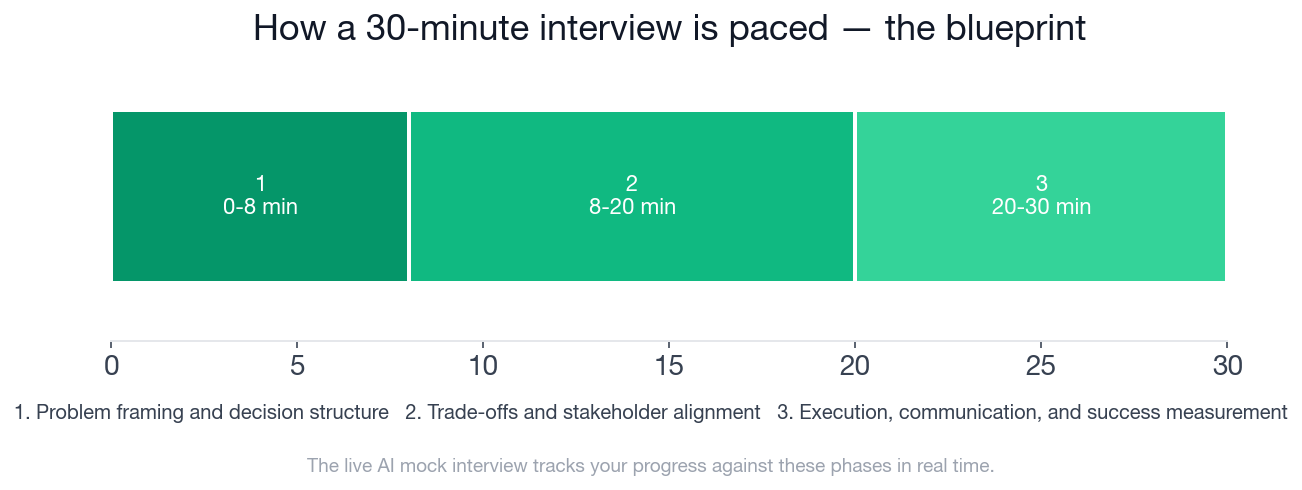
The timeline above shows how the phases distribute. Below is the complete blueprint the AI mock interview tracks you against in real time, phase by phase.
- ✓Clarifies the team goal for the quarter in terms of activation/repeat usage, not just generic growth
- ✓Recognizes limited team capacity and the need to choose one major initiative
- ✓Proposes a comparison framework such as user impact, business impact, effort, confidence, urgency, and risk
- ✓Segments the proposals by where they affect the user journey: acquisition, first successful experience, onboarding conversion
- ✓Requests relevant evidence such as failed pickup rates, onboarding completion, first ride conversion, referral conversion, city-level severity, and implementation cost
- ✓Explains how they would compare severity versus scale, including whether reliability is a blocker to growth
- ✓Describes a process to align stakeholders: gather inputs, make criteria explicit, review trade-offs, recommend a decision, and document rationale
- ✓Shows willingness to make a call even with incomplete data, including assumptions and contingency plans
- ✓Addresses how to manage executive pressure or functional bias without becoming purely consensus-driven
- ✓Outlines what happens to non-selected initiatives, such as parking them, breaking off low-cost mitigations, or revisiting next planning cycle
- ✓Explains how they would communicate the decision and rationale to affected stakeholders with transparency and next steps
- ✓Defines success metrics tied to the selected initiative and the team goal, such as signup-to-first-ride conversion, failed pickup rate for new riders, day-30 repeat rate, or referral-driven activated users
- ✓Includes a plan for monitoring leading indicators and revisiting the decision if results or assumptions change
Practice the Call Before the Interview
The full 30-minute AI mock interview for Product Manager: Prioritization and Stakeholder Alignment runs this scenario live with timed follow-ups and real-time scoring against the blueprint above. It is the fastest way to find out whether your answer stalls at consensus or commits to a call.
If you want to drill specific questions before running a full session, the PM prioritization and stakeholder alignment question bank covers the full topic with sample answers and scoring notes.
FAQ
Q. What is the most common mistake mid-level PMs make in a prioritization interview?
The most common mistake is defaulting to consensus-seeking when stakeholder pressure mounts. Mid-level PMs are expected to gather input from engineering, marketing, and operations, then make a clear recommendation even when the data is incomplete. Stalling for perfect consensus costs points on the 30-point Interviewer Objectives Alignment dimension.
Q. What frameworks should I use in a PM prioritization and stakeholder alignment interview?
Lightweight frameworks like RICE (Reach, Impact, Confidence, Effort) or a simple impact-vs-effort comparison work well for mid-level scope. The key is not the framework name but using it to make trade-offs explicit: show that you compared user impact, business urgency, implementation risk, and confidence level for each option before recommending one.
Q. How should I handle executive pressure favoring one initiative over another?
Acknowledge the business context the executive brings, then redirect to shared criteria: frame it as wanting to solve the highest-leverage problem for the team goal. Make the trade-off explicit rather than lobbying for a different outcome. The rubric rewards candidates who manage upward without becoming purely consensus-driven.
Q. How do I communicate a deprioritization decision without alienating the team?
State the rationale tied to the decision framework, not personal preference. Acknowledge the value of the deprioritized proposal, confirm it is parked with a revisit condition such as a specific metric threshold or next planning cycle, and share next steps in writing. The rubric rewards transparency and a clear path forward for affected stakeholders.
Q. What metrics should I define at the end of a PM prioritization interview?
Metrics should tie directly to the team goal and the selected initiative. For a consumer activation team, examples include signup-to-first-ride conversion rate, failed pickup rate for new riders, day-30 repeat usage, and referral-driven activated users. Include a leading indicator you can monitor weekly, not just a lagging outcome at quarter-end.
Q. How long is the product manager prioritization and stakeholder alignment interview?
The interview runs 30 minutes, structured across three phases: problem framing and decision structure (0-8 minutes), trade-offs and stakeholder alignment (8-20 minutes), and execution, communication, and success measurement (20-30 minutes). The stakeholder alignment segment is the longest phase and carries the highest rubric density, with 5 checklist items.
Q. How is the product manager prioritization interview scored?
The rubric allocates 100 points across four dimensions: Interviewer Objectives Alignment (30 points), Level-Specific Expectations (30 points), Technical Proficiency (20 points), and Communication and Problem Solving (20 points). The two 30-point dimensions both test decision quality and judgment under constraints, not framework name-dropping.
One Rep Beats a Hundred Read-Throughs
Knowing the blueprint and executing it under 30-minute pressure with unscripted follow-ups are different skills. The fastest path from understanding prioritization frameworks to handling them fluently in an interview is timed practice with real-time feedback. Browse open Product Manager roles to see what companies are hiring for, and use the prep guides to round out company-specific context before your next round.
Topics
Ready to practice?
Put what you've learned into practice with AI mock interviews and structured preparation guides.