
The Product Manager Background and Journey Interview Grades What Happens After You Ship
A mid-level Product Manager interview on background and journey has no whiteboard, no SQL, no system design diagram. It is 30 minutes of you telling one story, and the rubric is built to catch a very specific failure mode: candidates who narrate the launch as if it were the finish line, instead of reporting what happened to a real metric afterward. That distinction, launch activity versus actual outcome, is a named checklist item in the interview blueprint, and missing it costs points no matter how polished the rest of the story is.
Below is a turn-by-turn walkthrough built on the real blueprint InterviewStack.io's AI interviewer uses for this exact interview: mid-level Product Manager, Product Management Background and Journey topic. You'll see where a plausible, well-spoken answer quietly loses points, and what a stronger version sounds like instead.
Key Findings
- The interview runs 30 minutes across three phases: 6 minutes on framing your example, 14 minutes on product thinking and execution, and 10 minutes on impact and reflection.
- 60 of the 100 rubric points sit in Interviewer Objectives Alignment (30) and Level-Specific Expectations (30); Technical Proficiency and Communication & Problem Solving split the remaining 40.
- Phase 2 (minutes 6-20) alone carries 6 of the interview's 15 expected-checklist items, more than either of the other two phases.
- None of the six follow-up prompts touch code, SQL, or system design; the blueprint explicitly forbids all four as evaluation criteria for this topic.
- Phase 3 has just 5 checklist items, and two of them, quantifying impact and separating it from launch activity, are exactly the failure mode that caps your Interviewer Objectives Alignment score if you miss it.
- Candidates get roughly 6 minutes in Phase 1 to pick one example and state their personal scope before the interviewer starts probing prioritization.
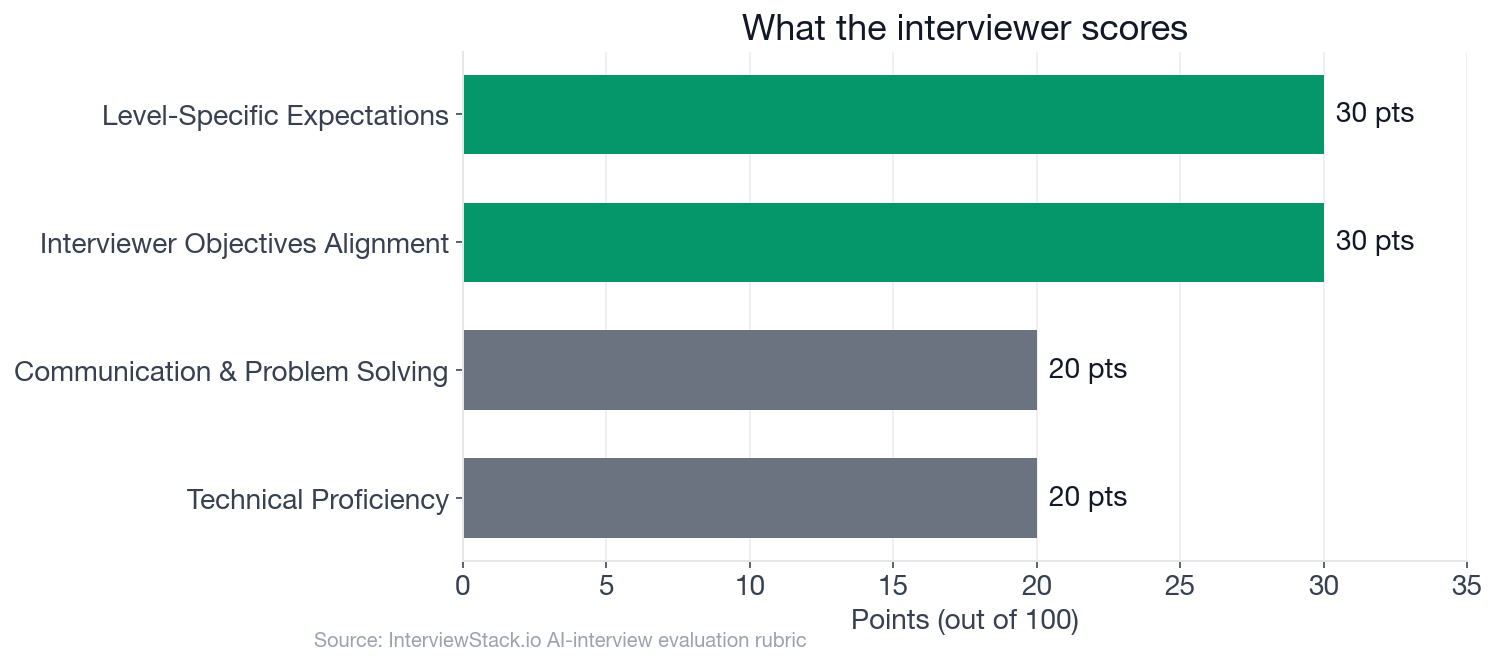 Interviewer Objectives Alignment and Level-Specific Expectations together decide 60% of the score, well before Technical Proficiency ever comes into play.
What Will the Interviewer Actually Ask?
The interview question
Walk me through your product management journey so far by focusing on one or two products or features you've owned, and explain how you took them from problem definition through prioritization and execution to measurable outcomes.
It reads like an easy opener, and that's the trap. Underneath it, the interviewer is testing whether you can pick a single example fast rather than narrate three, cleanly separate what you personally decided from what your team executed, connect a specific user problem to a business outcome, and show believable, level-appropriate ownership rather than portfolio-level scope. All of that has to happen before the first follow-up question even arrives.
Where Do Mid-Level PM Candidates Actually Lose Points?
The candidate in this walkthrough, Derek, picks a solid example: a "smart reminders" feature he owned for roughly two quarters. His opening answer is coherent and well-organized. The mistakes show up in the follow-ups, when the interviewer pushes past the summary and asks for the specifics the rubric is actually scoring.
Turn 1: Why This, Not Something Else
Interviewer: "How did you decide that this problem was worth prioritizing over other opportunities on your roadmap at the time?"
Turn 2: Whose Decision Was It
Interviewer: "What was your specific role versus the roles of engineering, design, data, or go-to-market partners in getting this shipped?"
Turn 3: The Launch Isn't the Outcome
Interviewer: "What metrics did you use to measure success, and how did those metrics move after launch?"
Turn 4: The Lesson Has to Change Something
Interviewer: "Looking back, what would you do differently now, and how has that shaped the way you operate as a PM today?"
Spotting the Mistake Is Easy. Avoiding It Live Isn't.
Reading these four turns, every mistake looks obvious in hindsight. That's the trap of reading a walkthrough: it's easy to nod along when the "we" language and the missing metric are highlighted in red. It's much harder to hear "how did that metric move" cold, thirty seconds after you finished describing the launch, and pull a real number out of memory instead of falling back on "it went well." The gap between recognizing a mistake on the page and not making it live, under time pressure, with unscripted follow-ups, is exactly what separates reading about an interview from being ready for one. Closing that gap takes reps, not more reading.
The Complete 30-Minute Blueprint
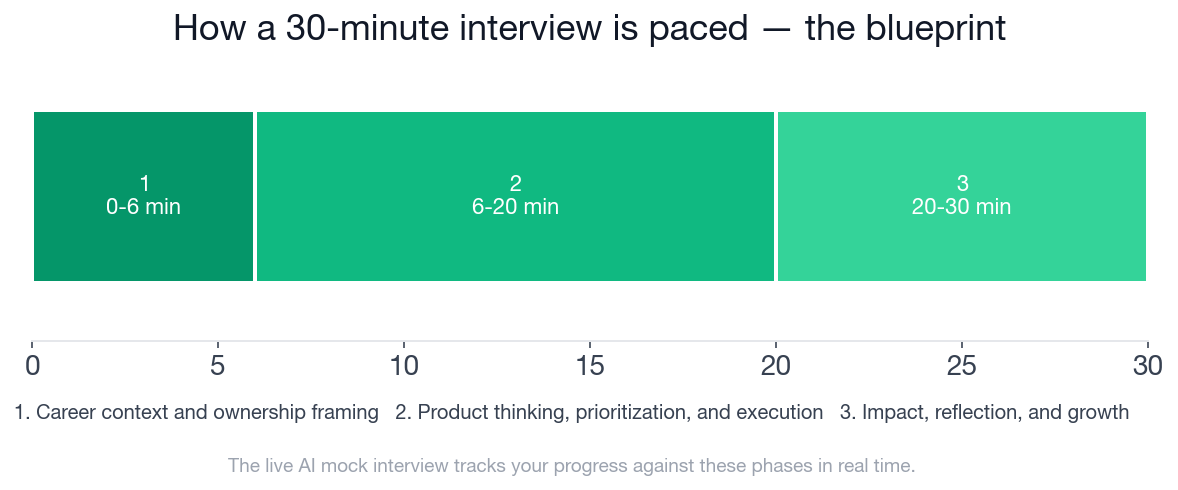 This is the pacing a strong candidate hits: a fast, scoped opening, a dense middle phase on product thinking and trade-offs, and a closing phase that has to land on real numbers and a real lesson.
- ✓Explains entry into PM or progression into current role in 1-2 concise steps
- ✓Selects a strong example quickly rather than listing many unrelated projects
- ✓Clearly distinguishes personal contributions from team accomplishments
- ✓Frames product area, user, business context, and scope without excessive background
- ✓Describes the user problem and why it mattered now
- ✓Explains what alternatives or competing priorities existed and how the decision was made
- ✓Mentions at least one discovery or validation input such as interviews, data analysis, prototype feedback, pilot, or experiment
- ✓Shows practical collaboration with engineering and design, including handling constraints or iteration
- ✓Provides at least one concrete trade-off involving scope, timeline, quality, technical complexity, or business goals
- ✓Demonstrates structured but level-appropriate execution ownership from concept to launch
- ✓Names success metrics relevant to the product problem such as activation, conversion, engagement, retention, churn, revenue, or NPS
- ✓Quantifies impact where possible and acknowledges mixed results if applicable
- ✓Separates launch activity from actual user or business outcomes
- ✓Shares a credible lesson learned and how it changed future PM behavior
- ✓Demonstrates increasing ownership or maturity across roles without overstating scope
This is the exact blueprint the AI interviewer tracks you against in real time when you take this interview live, phase by phase, checklist item by checklist item.
Practice This Exact Interview
Reading Derek's mistakes is a start. Fixing your own version of them out loud, on a clock, with follow-ups you can't predict, is what actually moves your score. Start the AI mock interview for Product Manager, Background and Journey, mid-level and get scored against this same blueprint, with turn-by-turn feedback on exactly where you lost points. If you want to warm up on individual questions first, the Product Management Background and Journey question bank covers the prioritization, ownership, and metrics questions this walkthrough is built from. For a broader look at how interviews are structured across roles, InterviewStack.io's preparation guides go deeper on company-specific process.
FAQ
Q. What does a Product Manager background and journey interview actually test?
It tests whether you can walk one real product story from problem definition through prioritization, execution, and measurable outcome in a structured 30-minute conversation: distinguishing your personal ownership from your team's, connecting the launch to a metric that moved, and reflecting on what you learned. It does not test coding, SQL, or system design.
Q. How long is a mid-level Product Manager background interview, and how is the time split?
The blueprint runs 30 minutes across three phases: 6 minutes establishing your example and personal scope, 14 minutes on product thinking, prioritization, and execution, and 10 minutes on measurable impact and reflection.
Q. What is the biggest mistake candidates make when describing product impact?
Treating the launch itself as the achievement instead of reporting how a specific metric moved afterward. The rubric explicitly separates launch activity from actual user or business outcomes, and conflating the two caps your score even if the rest of the story is strong.
Q. How many rubric points come from framing and judgment versus technical execution?
60 of 100 points come from Interviewer Objectives Alignment (30) and Level-Specific Expectations (30), which reward narrative structure, ownership clarity, and judgment. The remaining 40 split between Technical Proficiency (20) and Communication and Problem Solving (20).
Q. Should I describe multiple products in a Product Manager background interview?
No. The rubric rewards selecting one strong example quickly over listing several unrelated projects. Phase 1 gives you roughly 6 minutes to frame that single example with enough depth for the follow-up questions that come next.
Q. What is the difference between "we shipped it" and a strong Product Manager answer?
"We shipped it" describes an event. A strong answer names the metric, the baseline, the post-launch number, and the time window, and is honest if the results were mixed. Only the second version satisfies the checklist item on separating outcomes from launch activity.
Q. How can I practice this exact interview before the real thing?
Take a full AI mock interview built on this same blueprint (Product Management Background and Journey, mid-level), which tracks you against the same phases and rubric in real time, or drill individual follow-up questions in the question bank first.
The Number Is the Story
Every turn in this walkthrough traces back to the same idea: the interview isn't grading whether you shipped something, it's grading whether you can prove it mattered. Pick one story, own your specific slice of it, and close with a number, not a feeling. That's the version of the story that scores, and the only way to know if you can tell it under real pressure is to try.
Topics
Ready to practice?
Put what you've learned into practice with AI mock interviews and structured preparation guides.