
The Product Manager Skill Stack Has a Fault Line
Two skills define a Product Manager's floor in 2026: Product Strategy appears in nearly 2 in 3 active postings (65.8%), and Roadmapping is close behind at 60.0%. They appear together in 45.9% of all PM listings. They are prerequisites, not differentiators. Every candidate has them. Hiring managers filter on them but do not hire on them alone.
What the data reveals below that floor is a fault line between two very different types of Product Manager. Technical and analytical PMs, those who can design experiments, interpret ML outputs, and navigate API integrations, command the $145,000 US median or above. Process-oriented PMs whose resumes lead with Agile, Scrum, and Jira land well below: Agile-heavy postings cluster at $126,300, Scrum at $121,900. The gap between a process-only PM and a machine learning or LLM-proficient PM runs roughly $33,000 to $43,000 in base salary. That is a measurable career decision.
To put exact numbers on that divide, we looked at every active Product Manager posting on the InterviewStack.io job board as of May 2026: 9,617 listings, with skills extracted from descriptions, synonyms collapsed, and salary analysis restricted to US postings for comparability.
Key Findings
- 9,617 active Product Manager postings analyzed as of May 2026.
- Product Strategy (65.8%) and Roadmapping (60.0%) are the only true table stakes, appearing together in 45.9% of all postings (4,413 listings).
- Median US base salary: $145,000 (n=2,616 US postings with disclosed salary data).
- Machine Learning postings carry a $14,000 premium over baseline (median $159,000, n=195); LLM-related postings reach $12,000 to $20,000 above baseline.
- Agile postings have a median salary of $126,300 and Scrum $121,900, roughly $19,000 to $23,000 below the US median, reflecting how companies price pure process skills.
- A/B Testing (18.7% of postings) is the gateway quantitative skill: it commands a $6,200 premium (median $151,200, n=578) and pairs strongly with Prioritization and roadmapping work.
- Only 3.6% of postings are entry-level (348 of 9,617); mid-level roles dominate at 51.4% of the market.
- AI is ambient, not just specialty: 14.1% of postings explicitly require ML or AI skills, but 94% of product professionals already use AI tools daily (Productboard, 2025).
What Skill Families Define a Product Manager in 2026?
Product Manager is structurally different from most tech roles when you group skills by family. The dominant family is not a technical one: it is product-specific competency.
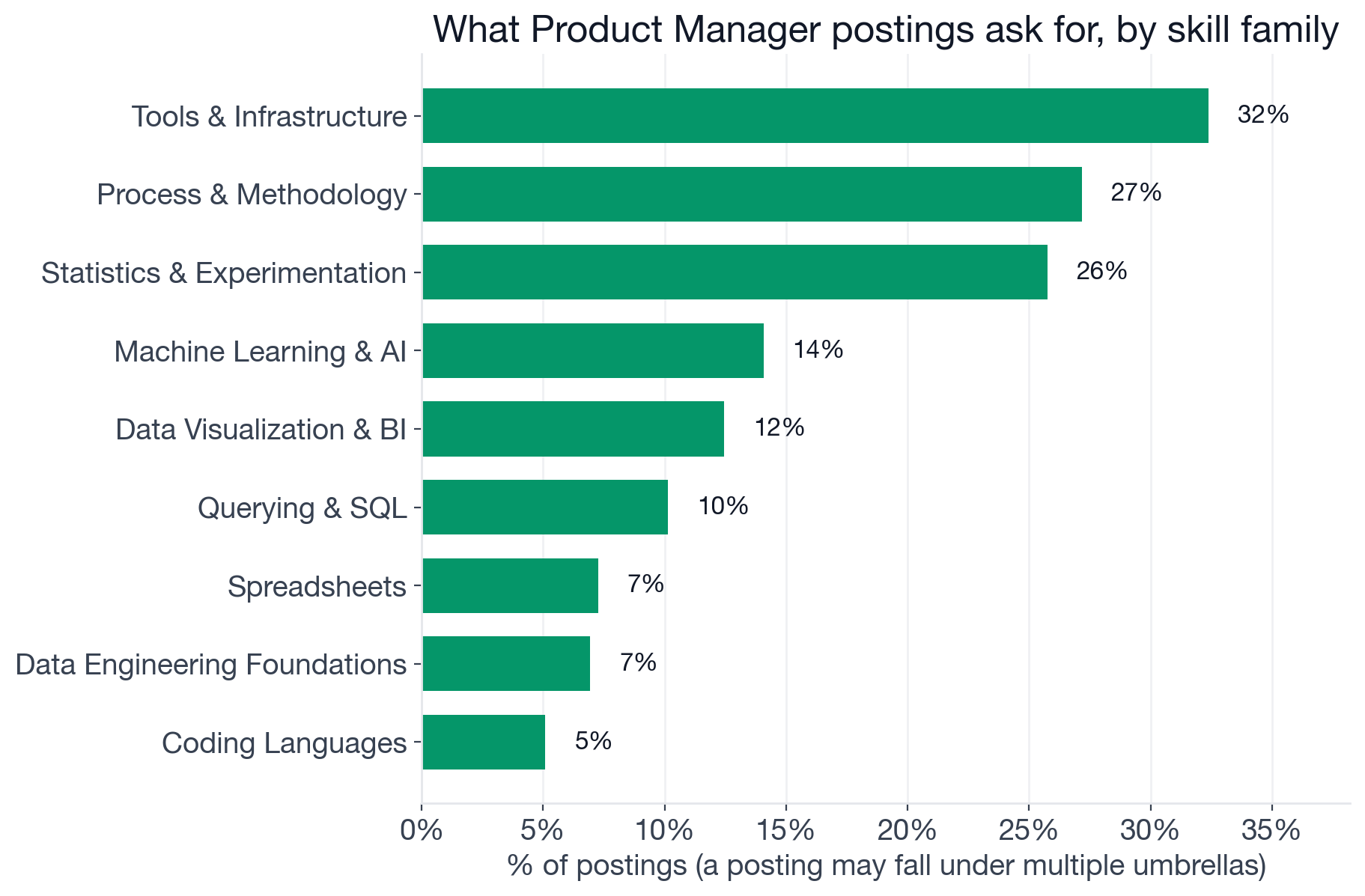
Share of Product Manager postings that ask for at least one skill in each family. A posting that mentions both A/B Testing and Forecasting counts once under "Statistics & Experimentation."
The chart labels the largest family "Other," but the content is product-specific skills that do not fit standard tech categories: product strategy, roadmapping, user research, APIs, scalability, OKRs, prototyping, and CRM all live here. At 88.8%, this family is effectively the job description itself.
The secondary layer tells the more interesting story:
- Tools & Infrastructure (32.4%): mostly automation, monitoring, and Jira. These are the execution systems PMs oversee without necessarily owning at an engineering level.
- Process & Methodology (27.2%): Agile and Scrum. In most modern tech orgs these are so assumed they often go unstated, so an explicit mention usually signals a more process-intensive context.
- Statistics & Experimentation (25.7%): a quarter of all PM postings ask for A/B testing or forecasting. This is no longer a data-team specialty; it is a hiring expectation for a meaningful share of PM roles.
- Machine Learning & AI (14.1%): the explicit layer, measuring PMs hired specifically to own AI product lines. More on the ambient layer below.
- Data Visualization & BI (12.5%) and Querying & SQL (10.1%): together, they signal that pulling your own data is crossing into standard expectation territory, not something left entirely to an embedded analyst.
The near-absence of Cloud Platforms (4.5%) and Coding Languages (5.1%) marks the boundary clearly: PM is not an engineering role. But 10-12% SQL and data visualization is a real and growing share.
What Are the Three Tiers of Product Manager Skills?
Zoom into individual skills and three distinct tiers emerge, each answering a different question about what gets you filtered in, what signals working experience, and what signals specialized value.
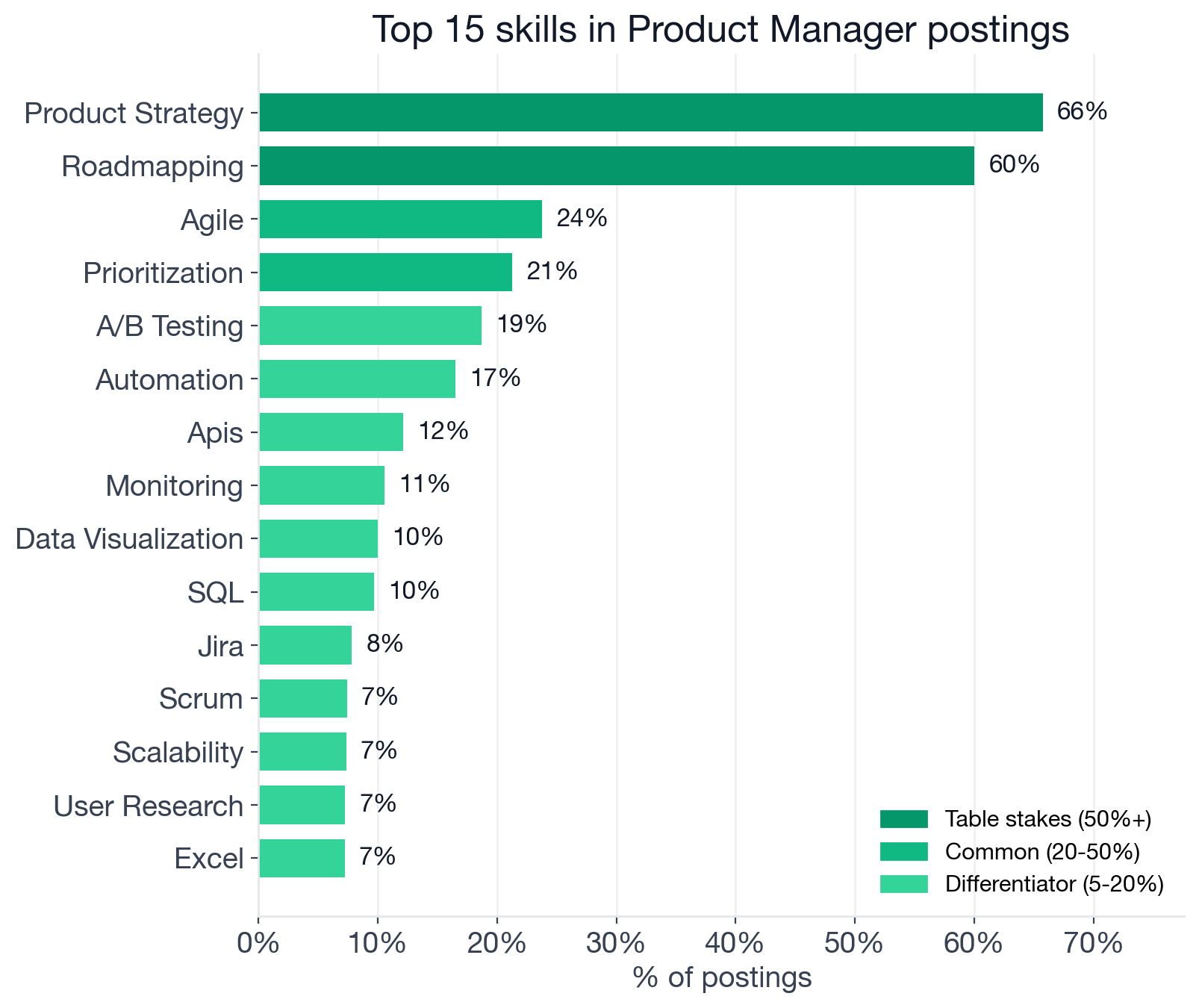
Top individual skills in Product Manager postings, by share of listings that mention them. Skills above 50% are table stakes; 20-50% are common; 5-20% are differentiators.
Table Stakes (50%+ of postings)
There are exactly two. Candidates without them are filtered before a hiring manager reads anything else.
- Product Strategy: 65.8% (6,324 postings)
- Roadmapping: 60.0% (5,771 postings) (browse PM openings that list Roadmapping)
The floor is unusually narrow for a major tech role. By comparison, Data Engineer has three table-stakes skills, and Data Analyst has four. PM compresses to two, but the differentiator tier is correspondingly wide and consequential.
Common Expectations (20-50% of postings)
Two skills live here, both in the process-and-methodology space:
- Agile: 23.8% (2,288 postings)
- Prioritization: 21.2% (2,043 postings)
Agile's position in the common tier, rather than table stakes, is itself informative. It is so assumed in most tech orgs that listing it explicitly tends to mean the hiring manager wants someone who can run ceremonies, maintain backlogs, and coach the team around the process, not just someone who has heard of sprints. Prioritization at 21% signals the same thing: an explicit mention usually means competing stakeholder demands are a real, daily challenge the PM will be expected to referee.
Differentiators (5-20% of postings)
Seventeen skills make up this tier, which is wider than in most engineering roles. PM differentiates along several independent axes depending on the company's product domain.
The data-analytic wing:
- A/B Testing: 18.7% (PM + A/B Testing openings)
- Data Visualization: 10.0%
- SQL: 9.7% (PM + SQL openings)
- Forecasting: 6.2%
The tools and process wing:
- Automation: 16.5%
- Monitoring: 10.5%
- Jira: 7.8%
- Scrum: 7.4% (process & methodology family alongside Agile; it surfaces in the differentiator tier because only a subset of companies state it as an explicit requirement)
- Excel: 7.2%
The technical wing:
- APIs: 12.1% (working knowledge of how products integrate with external services and internal systems)
- Scalability: 7.3%
- User Research: 7.2%
- Prototyping: 5.8%
The AI wing:
- Machine Learning: 6.3%
- Generative AI: 5.4%
- LLMs (Large Language Models, the foundation behind tools like ChatGPT): 5.2%
The business and sales tools layer:
- CRM: 5.0% (customer relationship management platforms such as Salesforce; most prevalent for PMs overseeing enterprise or sales-facing product lines, not an AI skill despite appearing at similar frequency to the AI cluster above)
The 5-6% AI explicit mention rate measures one specific thing: PM role specs for AI-native products, where the job is to write LLM feature specs, manage ML model roadmaps, and make product decisions around generative AI capabilities. That is a real and growing segment.
The ambient layer is an entirely different number. The Productboard State of AI in Product Management report (2025, n=379) found that 94% of product professionals already use AI tools daily, with 100% of surveyed teams using at least one AI model and 88% using two or more. (This is a vendor survey of Productboard's own user base, a self-selected, AI-forward sample, so treat the specific percentages as directional rather than representative of all PMs industry-wide.) Product professionals report saving an average of 4 hours per task with AI tools across PRD writing, stakeholder communication, and user research synthesis.
For Product Managers, AI is not a specialty you add to your resume for 1 in 7 roles. The 14.1% figure measures where you build AI products. The 94% figure measures how everyone in the role already works.
Which Skills Pay More Than the PM Baseline?
Among US postings with disclosed salary data (where wage-transparency laws produce consistent reporting), the median Product Manager base salary is $145,000 (n=2,616). This covers base pay only: equity, bonuses, RSUs, and sign-on are not disclosed in job postings, so total compensation at top employers runs meaningfully higher.
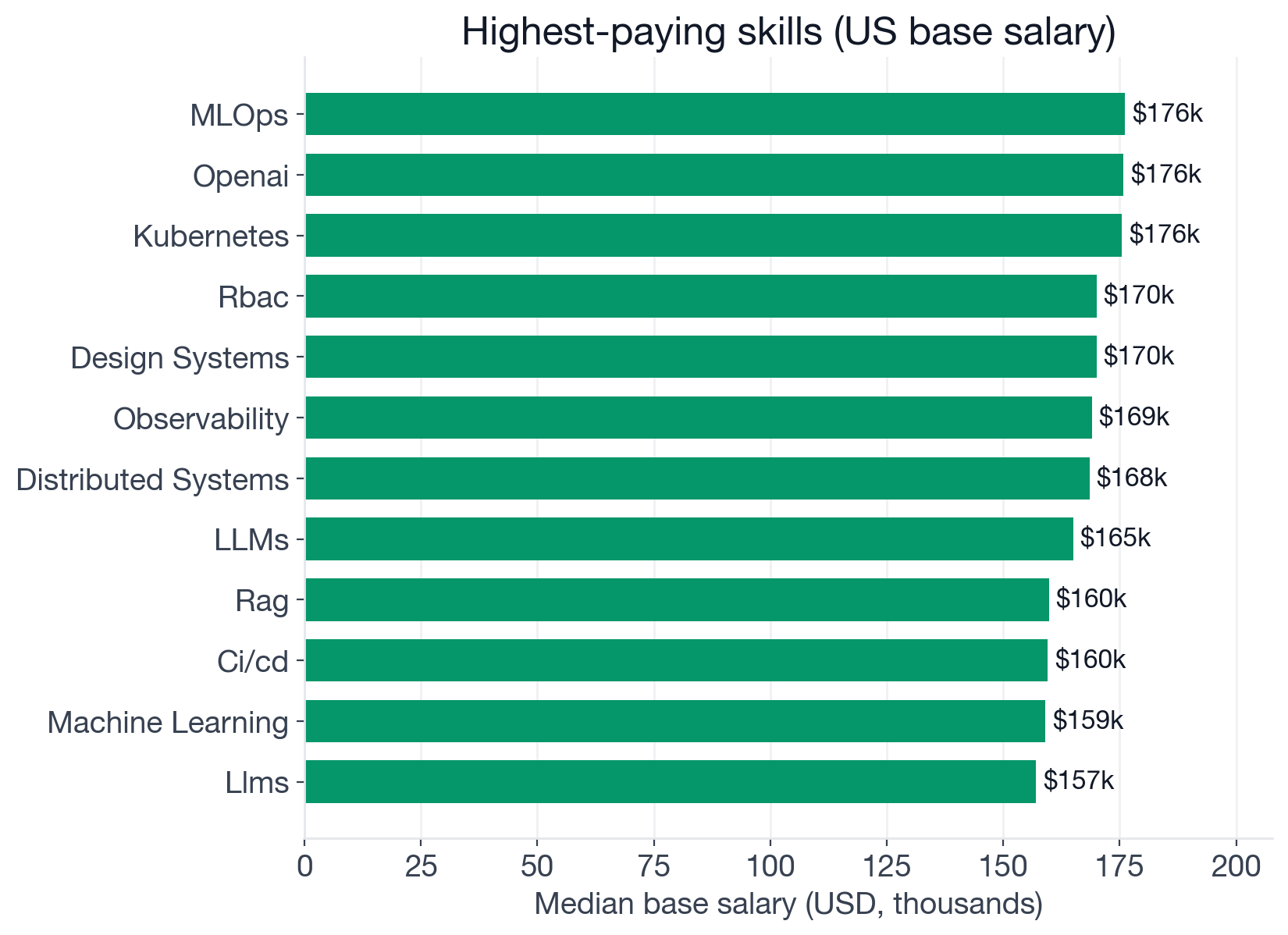
Median US base salary for Product Manager postings that mention each skill. US postings only; base salary only.
Technical and AI skills command the clearest premiums, but the salary picture is more nuanced than a clean analytic-vs-process split: quantitative experimentation (A/B Testing, SQL) pays above baseline, while BI and reporting tools (Data Visualization, Forecasting) pull below it despite their analytical label. The premium leaders:
Largest premiums ($10,000 or more above baseline):
- Machine Learning: $159,000 (n=195), +$14,000
- LLM-related skills: $157,000 to $165,000 (n≈279), +$12,000 to +$20,000
- Funnel Analysis: $156,000 (n=118), +$11,000
Moderate premiums ($5,000 to $9,000 above baseline):
- Prototyping: $153,300 (n=160), +$8,300
- A/B Testing: $151,200 (n=578), +$6,200
- APIs: $150,000 (n=335), +$5,000
- SQL: $150,000 (n=306), +$5,000
- Prioritization: $150,000 (n=608), +$5,000
Near baseline (+$3,000 to +$5,000):
- Automation: $149,800 (n=504), +$4,800
- Roadmapping: $148,100 (n=1,815), +$3,100
- Generative AI: $148,100 (n=205), +$3,100
- Product Strategy: $147,500 (n=2,017), +$2,500
The table stakes themselves sit $2,500 to $3,100 above the median. They are necessary to be hired but do not move the offer. The skills that pull the median up are the ones only 6-19% of postings ask for.
Skills that pull below the baseline:
- Scalability: $143,000 (n=226), $2,000 below baseline
- User Research: $141,200 (n=162), $3,800 below baseline
- Monitoring: $136,000 (n=289), $9,000 below baseline
- Data Visualization: $134,100 (n=308), $10,900 below baseline
- Jira: $129,300 (n=204), $15,700 below baseline
- Agile: $126,300 (n=637), $18,700 below baseline
- CRM: $126,000 (n=146), $19,000 below baseline
- Excel: $125,800 (n=187), $19,200 below baseline
- Forecasting: $125,000 (n=183), $20,000 below baseline
- Scrum: $121,900 (n=159), $23,100 below baseline
Agile, Scrum, and Jira sitting $16,000 to $23,000 below baseline does not mean companies penalize those skills. It reflects market segmentation: methodology-heavy postings disproportionately appear in enterprise, healthcare, and financial-services contexts that hire at lower base salary ranges, while the high-base roles in tech and fintech are less likely to call out process methodology explicitly. The pattern holds regardless of cause: if your resume is Agile-heavy and process-oriented, you are positioned for a different segment of the PM market than if it is A/B Testing and SQL-heavy. That is worth knowing before you start applying.
Two skills from the data-analytic grouping in Section 3 also land below baseline: Forecasting ($125,000, n=183) and Data Visualization ($134,100, n=308). The same market-segmentation logic applies: BI and reporting work is common in enterprise, healthcare, and financial services, where base salary ranges sit lower than in tech and fintech. The salary split that actually matters for positioning is between skills that run experiments or build AI products versus skills that visualize and report on outcomes, not simply "analytical" versus "process."
What Is the Core Product Manager Skill Stack?
We computed co-occurrence across the top 25 skills to find the combinations that appear together more often than chance. Lift greater than 1 means the pair shows up more often than their individual frequencies would predict independently.
| Skill pair | Postings with both | % of postings | Lift |
|---|---|---|---|
| Agile + Scrum | 606 | 6.3% | 3.57 |
| Agile + Jira | 505 | 5.3% | 2.82 |
| Agile + Prioritization | 700 | 7.3% | 1.44 |
| Prioritization + Roadmapping | 1,618 | 16.8% | 1.32 |
| Roadmapping + Scalability | 552 | 5.7% | 1.30 |
| APIs + Roadmapping | 867 | 9.0% | 1.24 |
| A/B Testing + Prioritization | 467 | 4.9% | 1.22 |
| A/B Testing + Roadmapping | 1,275 | 13.3% | 1.18 |
| Product Strategy + Roadmapping | 4,413 | 45.9% | 1.16 |
| Machine Learning + Product Strategy | 459 | 4.8% | 1.16 |
Each pair tells you something specific about how companies compose the PM role:
- Agile + Scrum (lift 3.57) is the strongest co-occurrence in the entire dataset. Postings that mention Agile are 3.57 times more likely to also mention Scrum than chance would predict. These are not two independent preferences: they are a methodology tandem, called out together when a company wants a PM who can own sprint ceremonies and backlog discipline, not just "work in Agile."
- Agile + Jira (lift 2.82): Jira is practically assumed when Agile is on the list. Treat them as a package in your preparation.
- Prioritization + Roadmapping (lift 1.32): the most common differentiator pair at 16.8% of all postings. Companies that want roadmapping almost always want someone who can defend the ordering under stakeholder pressure.
- APIs + Roadmapping (lift 1.24): the technical PM marker. A roadmapping PM who understands API integrations is hired for platform or growth product lines, not purely consumer features.
- A/B Testing + Prioritization (lift 1.22): the analytical PM stack. The combination signals: you run experiments to decide what to build next, rather than defaulting to intuition or loudest stakeholder. It is also the stack correlated with above-baseline salary.
- A/B Testing + Roadmapping (lift 1.18): experimentation-minded PMs are frequently expected to own the roadmap as well, not just run tests. This pair appears in 13.3% of all postings, nearly 1 in 8, making it one of the most common skill combinations in the dataset.
- Machine Learning + Product Strategy (lift 1.16): only 4.8% of postings ask for both, but when they do, the ML-PM hybrid is an explicit part of the mandate and corresponds to the highest salary tier in the dataset.
Who's Hiring at Which Seniority Level?
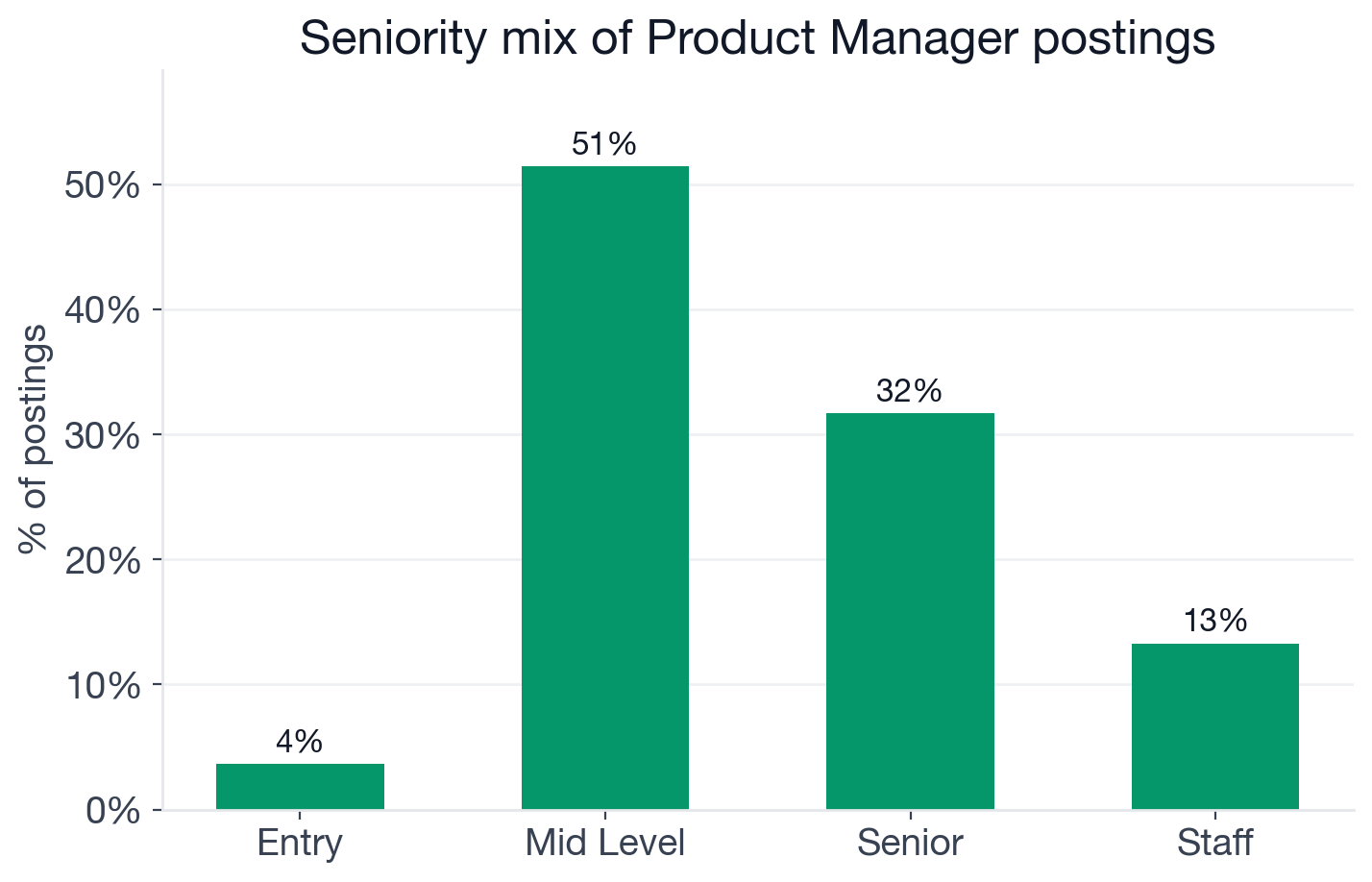
Seniority distribution of Product Manager postings.
- Mid-level: 51.4% (4,946 postings)
- Senior: 31.7% (3,047) (senior PM openings)
- Staff / Lead / Principal: 13.3% (1,276)
- Entry: 3.6% (348)
Only 1 in 28 PM postings is explicitly entry-level. The path in is typically an associate PM program at a larger company, a growth-analyst or product-ops role that converts to PM internally, or a technical background strong enough to enter mid-level at a smaller company. Career switchers who approach PM from non-technical backgrounds are not being hired at scale into entry-level roles; the seniority curve makes that visible.
The senior-and-above slice tells a more encouraging story: senior plus staff together is 45.0% of the market, comparable to Data Engineer and well above what most "soft" professional roles look like. There is real IC ladder depth, with staff and principal PM roles making up 13.3% of all postings and representing genuine product-leadership career destinations.
Where Are PM Jobs Located, and How Remote-Friendly Are They?
Product Manager hiring skews strongly toward developed English-speaking markets, a different distribution from roles like Data Engineer where India accounts for nearly a quarter of postings.
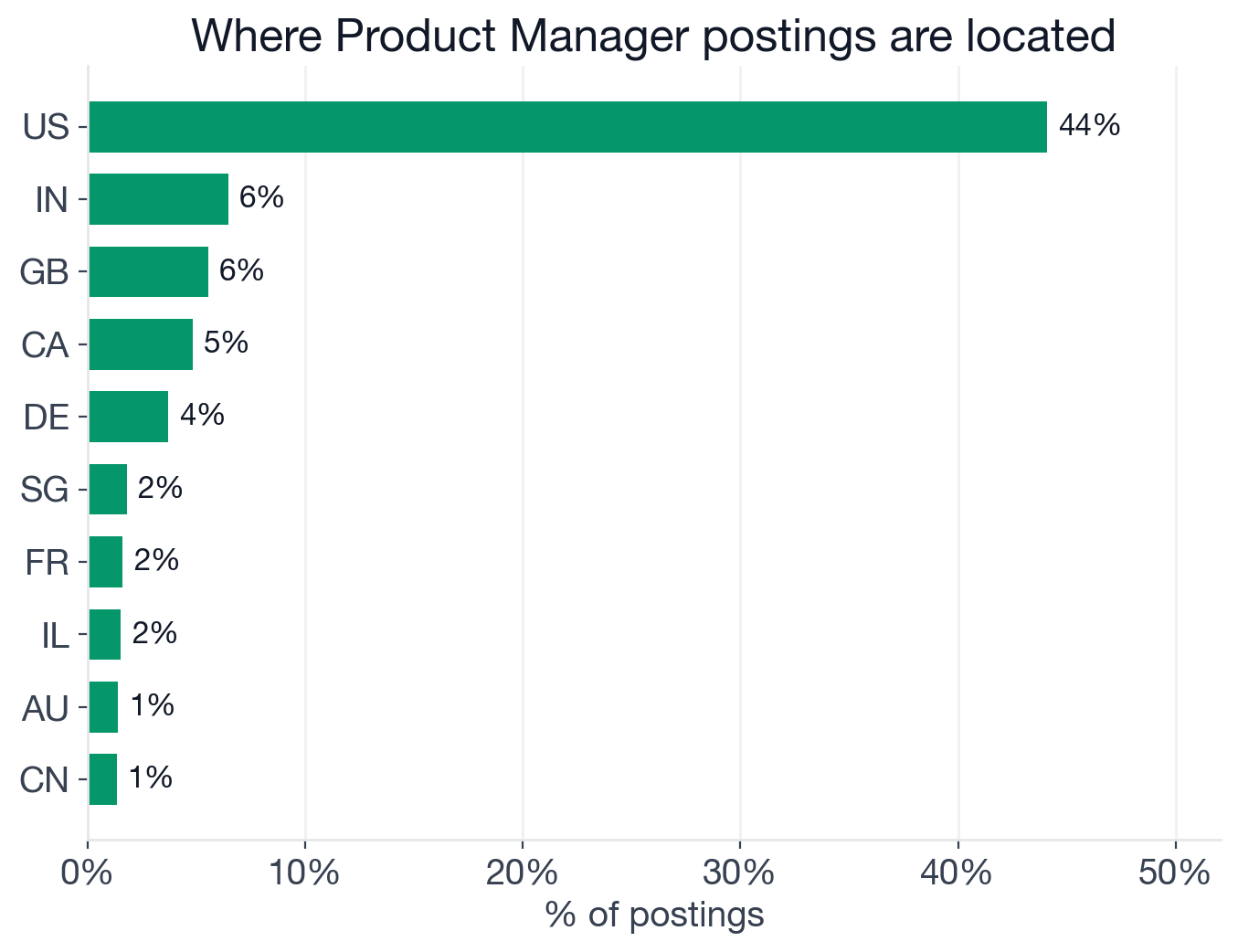
Top countries by share of Product Manager postings.
- United States: 44.1% (US Product Manager openings)
- India: 6.5%
- United Kingdom: 5.6%
- Canada: 4.8%
- Germany: 3.7%
- Singapore: 1.8%
- France: 1.6%
- Israel: 1.5%
- Australia: 1.4%
The US at 44.1% is nearly seven times the next largest market. PM is defined by proximity to customers, engineering, and business stakeholders, and companies are less willing to hire PMs across large time-zone gaps than they are for technical individual-contributor roles. This also shapes the remote picture.
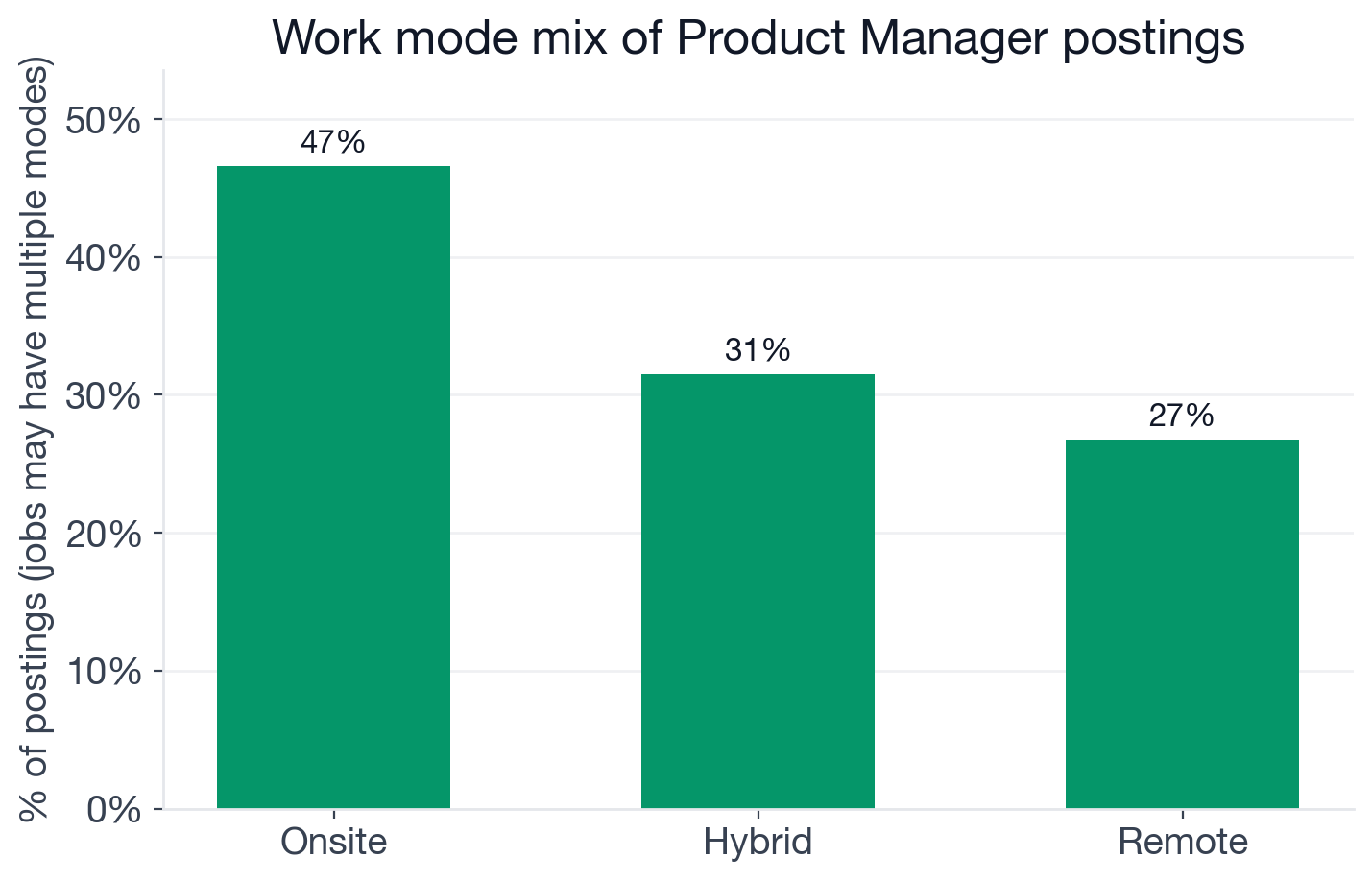
Share of Product Manager postings tagged with each work mode.
- Onsite: 46.6% (4,481 postings)
- Hybrid: 31.5% (3,028)
- Remote: 26.7% (2,572) (fully remote PM openings)
Onsite is the plurality default at 46.6%. Hybrid plus remote reach 31.5% and 26.7% of postings respectively (note: a posting can carry more than one work mode tag, so these shares are not mutually exclusive and sum above 100%), meaning flexibility exists but the role tilts more onsite than most knowledge-work roles. Fully remote PM roles exist and are findable, but they compete in a smaller pool. The remote share concentrates in growth-stage tech and SaaS companies; enterprise, healthcare, and financial services default to onsite or hybrid.
Who's Hiring Product Managers in 2026?
The employer mix for PM hiring is strikingly diverse by industry, unlike Data Engineer hiring, which is dominated by consulting and software-services firms.
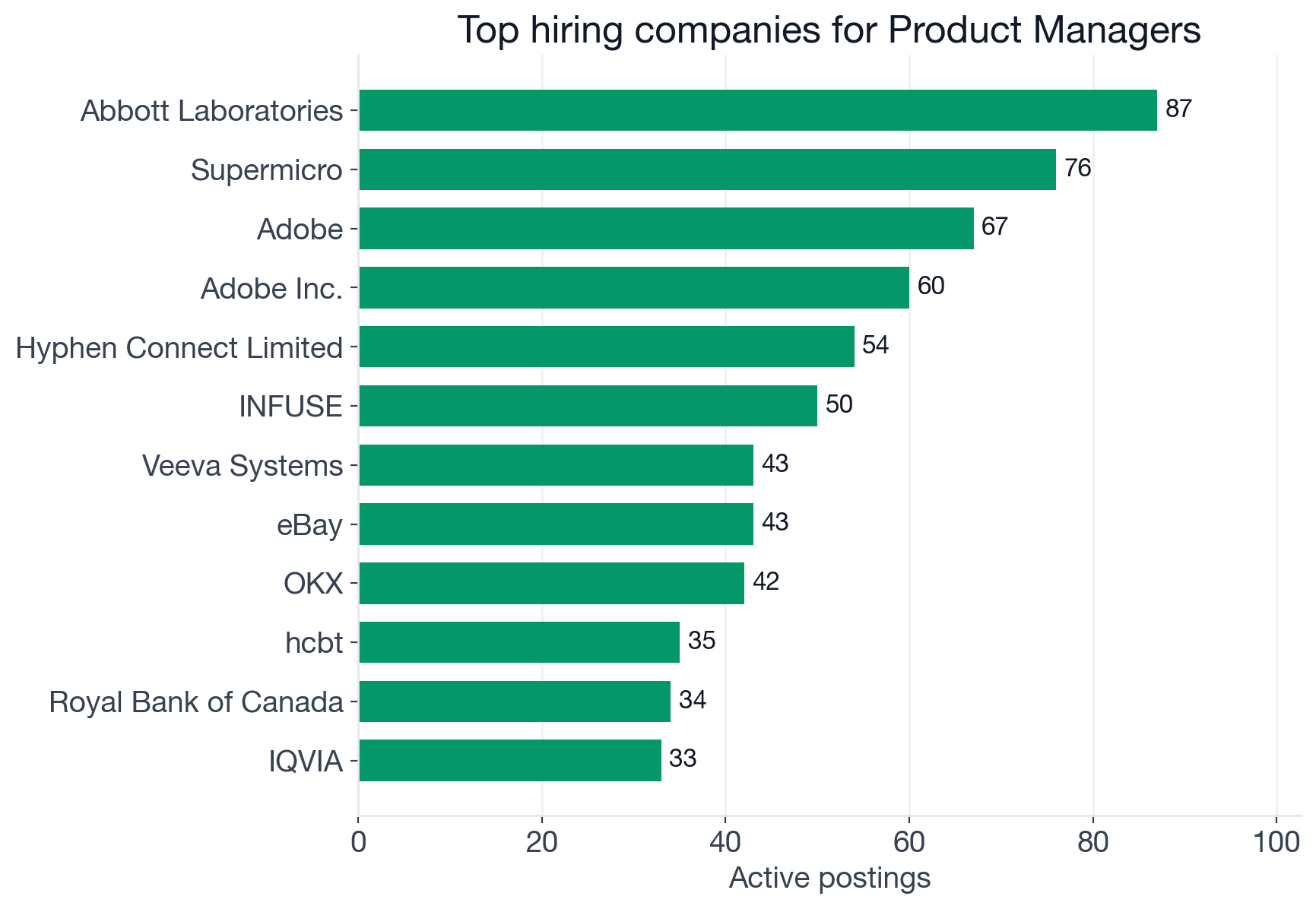
Top companies by active Product Manager postings. Note: the chart also includes Hyphen Connect Limited (54 postings, a staffing and recruiting firm), INFUSE (50 postings, a B2B marketing services company), 35 postings from an employer that could not be identified, and RELX Group (29 postings, a global information analytics publisher); these are excluded from the editorial discussion below, which focuses on direct-hire product employers.
- Adobe: ~127 postings (software, appears under two listing variants)
- Abbott Laboratories: 87 (medical devices and diagnostics)
- Supermicro: 76 (server and hardware infrastructure)
- Veeva Systems: 43 (life sciences SaaS)
- eBay: 43 (e-commerce)
- OKX: 42 (crypto exchange)
- Royal Bank of Canada: 34 (banking)
- IQVIA: 33 (life sciences data and analytics)
- Airwallex: 32 (global payments fintech)
- Mastercard: 31 (payments)
- Johnson & Johnson: 30 (healthcare)
- Medtronic: 28 (medical devices)
The healthcare and life sciences presence is notable: Abbott, Veeva, IQVIA, J&J, and Medtronic together represent a sustained demand for PMs in regulated, domain-specific environments. These roles often require familiarity with FDA compliance processes, clinical workflows, or pharmaceutical go-to-market structures. They tend to be less competitive on pure PM generalist skills and more competitive on domain knowledge, which creates a real opening for candidates with a healthcare or life sciences background.
The fintech cluster (OKX, Airwallex, Mastercard, Royal Bank of Canada) reflects a structural shift: financial products are now software products, and banks and payment networks need PMs who can own digital roadmaps end-to-end. For company-specific interview preparation, our preparation guides break down what many of these employers' processes look like.
How to Use This in Your Job Search
Build the analytical layer on top of the foundation. The table stakes (product strategy and roadmapping) get you considered; they do not get you paid above median. The clearest upskilling path from the salary data is toward A/B Testing, SQL, and funnel analysis, the skills that sit $5,000 to $11,000 above baseline with large sample sizes. If you are preparing for interviews in roles where experimentation is expected, practice with AI mock interviews on product case and metrics questions: the speed and structure of your thinking on experiment design matters as much as knowing the formulas.
Drill the topics that come up in your target sector. Healthcare PM interviews emphasize regulatory tradeoffs and clinical workflows. Fintech interviews emphasize payments compliance and risk-aware product decisions. Tech and SaaS PM interviews lean on growth experiments, A/B testing frameworks, and API product decisions. The question bank lets you drill by topic area so you can target the specific question types that surface in your target sector's screening rounds rather than preparing for everything at once.
Build foundational competence on the concepts that matter most. If your background is light on statistics, experimentation, or data literacy, interactive courses covering statistics and data concepts are the most direct bridge from process PM to analytical PM. The salary gap between the two profiles is large enough to justify the investment before your next job search cycle.
Filter the job board to your actual stack. Browse current Product Manager openings and combine skill filters to narrow to your profile: PM + A/B Testing for data-centric roles, PM + SQL for analytics-forward companies, and PM + Machine Learning for AI-native product lines. Remote roles are filterable at remote PM openings. The board updates daily so listings are current.
FAQ
Q. What skills do companies want for Product Manager roles in 2026?
Product Strategy and Roadmapping are table stakes, appearing in 65.8% and 60.0% of postings respectively. Agile (23.8%) and Prioritization (21.2%) are common-tier expectations. A/B Testing (18.7%), Automation (16.5%), APIs (12.1%), Data Visualization (10.0%), and SQL (9.7%) make up the top of the differentiator tier alongside Machine Learning (6.3%) and Generative AI (5.4%).
Q. What is the median salary for a Product Manager in 2026?
The median US base salary across 2,616 Product Manager postings with disclosed salary data is $145,000. That number covers base pay only; equity, bonuses, and sign-on are excluded, so total compensation at top-paying employers runs meaningfully higher.
Q. Which Product Manager skills pay the highest salary premium?
Technical and AI skills carry the largest premiums over the $145,000 US baseline. Machine Learning postings show a median of $159,000 (n=195), about $14,000 above baseline. LLM-related postings reach $157,000 to $165,000, a $12,000 to $20,000 premium. A/B Testing (n=578) sits at $151,200, about $6,200 above baseline. In contrast, the process-methodology skills pull below median: Agile ($126,300), Scrum ($121,900), and Jira ($129,300) all land $15,000 to $23,000 below the baseline.
Q. Is Product Manager a good entry-level role to break into?
It is a moderate barrier to entry. Only 3.6% of Product Manager postings are explicitly entry-level (348 of 9,617), and the mid-level tier dominates at 51.4% of the market. Most new PMs enter through associate PM programs at larger companies, growth-analyst or product-ops roles, or internal transfers from engineering, UX, or business analysis.
Q. Where are most Product Manager jobs located, and how remote-friendly are they?
The United States accounts for 44.1% of postings, followed by India (6.5%), the UK (5.6%), Canada (4.8%), and Germany (3.7%). Work mode splits to 46.6% onsite, 31.5% hybrid, and 26.7% remote, putting Product Manager broadly in line with other hybrid-friendly professional roles.
Q. How important is AI for Product Managers in 2026?
About 14.1% of Product Manager postings explicitly require AI or ML skills, measuring the segment hired to own AI product lines. But survey data shows 94% of product professionals use AI tools daily (Productboard State of AI in Product Management, 2025, n=379), and 100% of the teams surveyed use at least one AI tool. ChatGPT for drafting PRDs, AI-assisted user research synthesis, and AI roadmapping tools are now baseline expectations, not listed requirements.
Q. What is the core Product Manager skill stack in 2026?
Product Strategy plus Roadmapping is the universal base, appearing together in 45.9% of all postings (4,413 listings) with a co-occurrence lift of 1.16. Agile and Scrum form the strongest methodology pair by lift (3.57), meaning companies that ask for Agile almost always want Scrum alongside it. Agile and Jira follow at lift 2.82. Adding A/B Testing to a Prioritization or Roadmapping foundation (lift 1.22 and 1.18) characterizes the analytical PM profile that commands a salary premium above the role baseline.
Final Thoughts
Product Manager in 2026 is two markets sharing a title. Companies hiring for execution and process management pay below the $145,000 US median; companies hiring for analytical depth, AI product ownership, or technical platform work pay meaningfully above it. The skill split is measurable: roughly $33,000 to $43,000 separates the Agile and Scrum-heavy end of the salary distribution from the ML and LLM-proficient end. The AI question has a clear answer too: 14% of postings ask for it explicitly, but 94% of PMs are already using AI tools daily. The real question is not whether to build AI literacy into your PM toolkit; it is which tier of capability you are targeting and whether your current skill mix is positioned for the segment of the market that matches where you want your career to go.
Topics
Ready to practice?
Put what you've learned into practice with AI mock interviews and structured preparation guides.