
Two Premium Zones, One $40K Salary Gap
Product Manager and UX Designer sit on opposite sides of the same product team org chart: one owns the "what and why," the other owns the experience of using it. In practice they collaborate constantly and influence each other's decisions. In the job market, though, they're not comparable in scale or pay.
We looked at 15,442 active Product Manager postings and 3,844 UX Designer postings on the InterviewStack.io job board as of June 2026. The salary gap is $40,200 at the US median (40% in PM's favor), the posting volume is 4-to-1 in PM's favor, and the two roles share only 36% of their top-30 skill sets. But the most useful finding isn't the size of the gap: it's what's driving it. PM postings increasingly reward technical and AI fluency at the premium end, while UX Designer postings reward craft mastery. These are two distinct premium structures, not simply one role lagging the other.
A note on the UX Designer dataset: The platform's "UX Designer" classifier captures a broad range of roles with "designer" in the title, including graphic design, motion design, instructional design, and some non-digital disciplines (industrial, apparel, fire-protection engineering) alongside core UX/UI/product design postings. Skill frequencies and salary figures for "UX Designer" reflect this mixed population. The $100,200 US salary median likely understates what specialized digital UX roles command in the current market, since contamination from lower-paid non-digital design roles pulls the median down. Read UX salary figures as a lower bound rather than a precise midpoint; the true salary gap with PM is probably narrower than $40,200 for experienced digital UX practitioners.
Key Findings
- Product Manager median US base salary: $140,400 (n=3,760 US postings with disclosed salary).
- UX Designer median US base salary: $100,200 (n=615), a $40,200 (40%) difference. (Dataset includes non-digital design disciplines; this figure is a lower bound for specialized digital UX (see dataset note above).)
- PM has 4x the active openings: 15,442 vs. 3,844.
- Skill overlap is 36% (Jaccard coefficient on top-30 skill sets): these roles are more distinct than similar.
- Entry barrier is nearly identical: 4.4% of PM postings vs. 4.3% of UX Designer postings are explicitly entry-level.
- Among top-30 PM skills, Observability commands the highest salary premium at $168,800 (+$28,400); LLMs follow at $168,000 (+$27,600) as the top AI-specific skill, with System Design and Machine Learning adding $21,100 and $19,600.
- Prototyping adds $30,800 to the UX Designer median; Design Systems adds $27,800; Figma adds $20,900.
- UX Designer roles are more onsite-heavy: 52% onsite vs. 47% for PM; remote share is 18% vs. 23%.
| Product Manager | UX Designer | |
|---|---|---|
| Median US base salary | $140,400 | $100,200 |
| Active postings | 15,442 | 3,844 |
| Top skill | Agile (27%) | Figma (31%) |
| Entry-level share | 4.4% | 4.3% |
| Remote share | 23% | 18% |
| Skill overlap (Jaccard) | 36% shared | - |
What Each Role Actually Does
A Product Manager's week centers on the problem space: writing product specs and PRDs, facilitating sprint ceremonies, negotiating backlog priorities against business metrics, and aligning engineering, design, and leadership on what gets built next. The exclusive skills in the data confirm this: APIs (10.2% of PM postings), SQL (8.2%), Jira (9.1%), and Monitoring (9.2%) are all tools for reading what's been built, tracking what's planned, and reasoning about technical systems. A PM who can query a database and read a system diagram is worth more than one who can't.
A UX Designer's week centers on the solution space: synthesizing user research, building wireframes and high-fidelity prototypes, running usability sessions, and iterating on interaction flows inside Figma. The exclusive skills tell the same story: Figma (31.1%), Design Systems (20.2%), HTML (9.9%), CSS (9.5%), and Sketch (9.2%). The role is more tool-specific than PM, and some of those tools (HTML, CSS) signal an expectation that designers can work close to or inside code, not just hand off static files.
Both roles hand work to each other constantly: a PM surfaces the business problem, a UX Designer returns a proposed solution. But they rarely need each other's core tools to do the job.
What Skills Do Both Roles Share?
Agile is the clearest common ground, appearing in 27% of PM postings and 14% of UX Designer postings. Both roles ship iteratively in sprint-based environments, which is why process vocabulary travels freely across the product org chart.
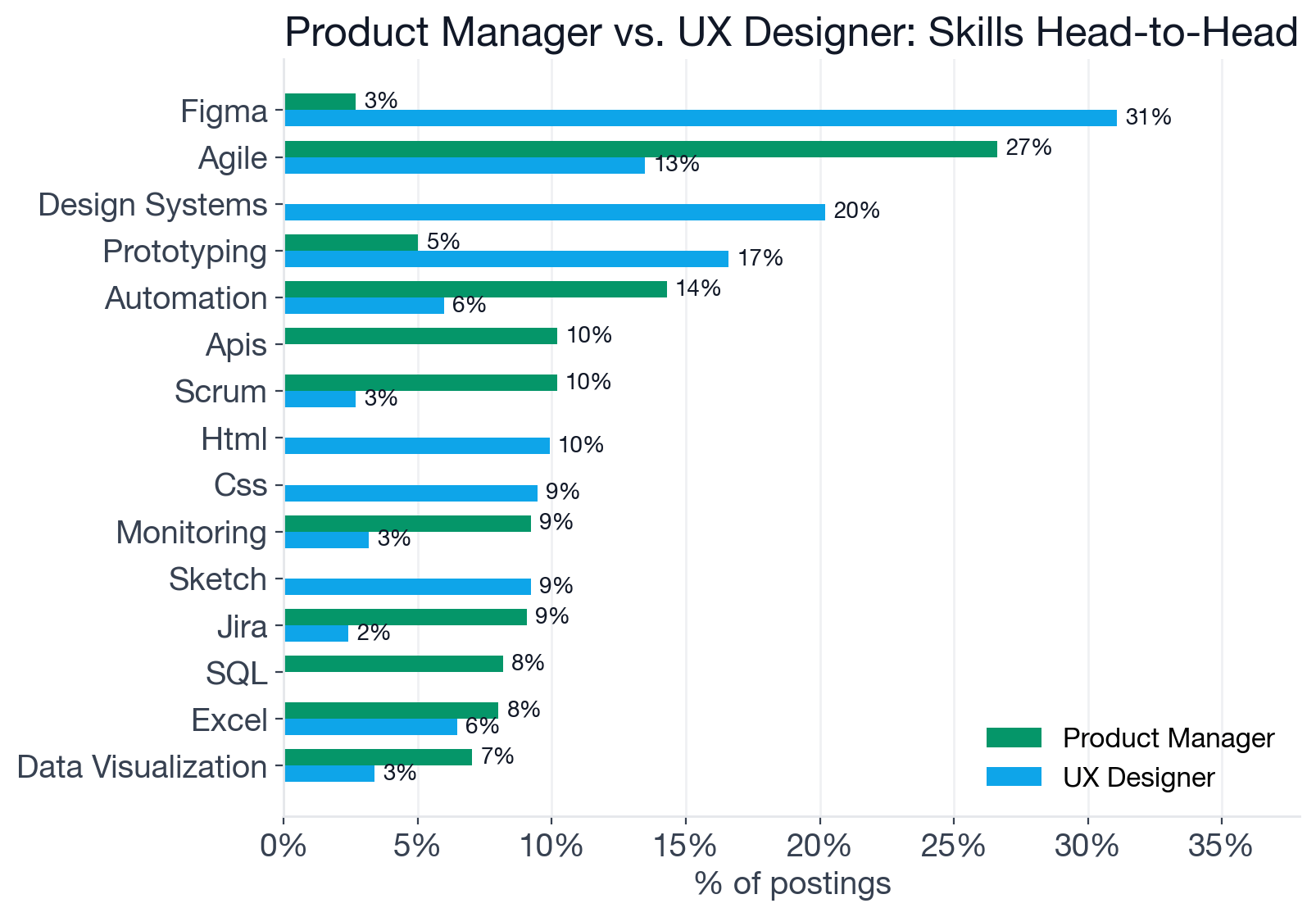
Top skills for each role from a combined pool of 19,286 postings. Shared skills appear in both bars; exclusive skills appear in only one.
Prototyping is the other shared signal, though its emphasis is inverted: it appears in 17% of UX Designer postings vs. 5% for PM. For UX, prototyping means high-fidelity interactive flows in Figma or Framer; for PM it typically means lightweight mockups to communicate direction to engineering. Automation (14% PM, 6% UX) and Excel (8% PM, 6.5% UX) round out the shared tier, representing operational fluency rather than defining skills in either role.
What this means for a potential switcher: Agile fluency and some prototyping experience cover the transferable foundation. The divergent skills below are where the real reskilling investment lands.
Where Do the Skill Sets Split?
Product Manager exclusives (frequent in PM, near-absent in UX): APIs (10.2%), Scrum (10.2%), Monitoring (9.2%), Jira (9.1%), SQL (8.2%). Together, these signal a role that needs to read data, write structured requirements, track work, and communicate fluently with engineering. Scrum and Jira appearing together tell you the PM is running ceremonies, not just attending them. SQL at 8.2% tells you data retrieval is no longer delegated entirely to analysts. Browse PM roles that require SQL to see this pattern in practice.
UX Designer exclusives (frequent in UX, near-absent in PM): Figma (31.1%), Design Systems (20.2%), HTML (9.9%), CSS (9.5%), Sketch (9.2%). Figma is the primary tool; Design Systems is how you make designs consistent and scalable across a maturing product; HTML and CSS mark a subset of UX roles where production-level implementation or realistic prototyping is expected. The cluster is coherent: this is craft work that requires tool fluency, not just taste. Browse Figma-required UX Designer roles to see where the tool bar sits.
Which Role Pays More, and What Drives the Premium?
Among US postings with disclosed salary, the median PM base is $140,400 (n=3,760) and the median UX Designer base is $100,200 (n=615). That $40,200 gap reflects base salary only. Equity, bonuses, and sign-on are not captured in job posting data, so total compensation at top employers runs materially higher for both roles, particularly in tech. The UX Designer salary sample (n=615) is drawn from a broad dataset that includes non-digital design disciplines; the $100,200 median is likely understated for specialized digital UX roles, which means the true gap between experienced digital UX designers and product managers is probably narrower than $40,200.
The more useful question is what skills move each role's salary upward.
For Product Managers, the largest premiums in the top-30 skill set concentrate in technical infrastructure and AI fluency. Observability leads at $168,800 (+$28,400 over the $140,400 baseline), with LLMs close behind at $168,000 (+$27,600) as the top-earning AI-specific skill in the group. System Design follows at $161,500 (+$21,100) and Machine Learning at $160,000 (+$19,600). PMs who can reason about technical systems and AI pipelines earn significantly more than those managing backlogs without that layer.
For UX Designers, the salary premium concentrates in craft tools: Prototyping at $131,000 (+$30,800 over the $100,200 UX baseline), Design Systems at $128,000 (+$27,800), and Figma at $121,100 (+$20,900). A UX Designer who has mastered interactive prototyping and design systems is not incrementally better at the role: they're earning $28-31K more.
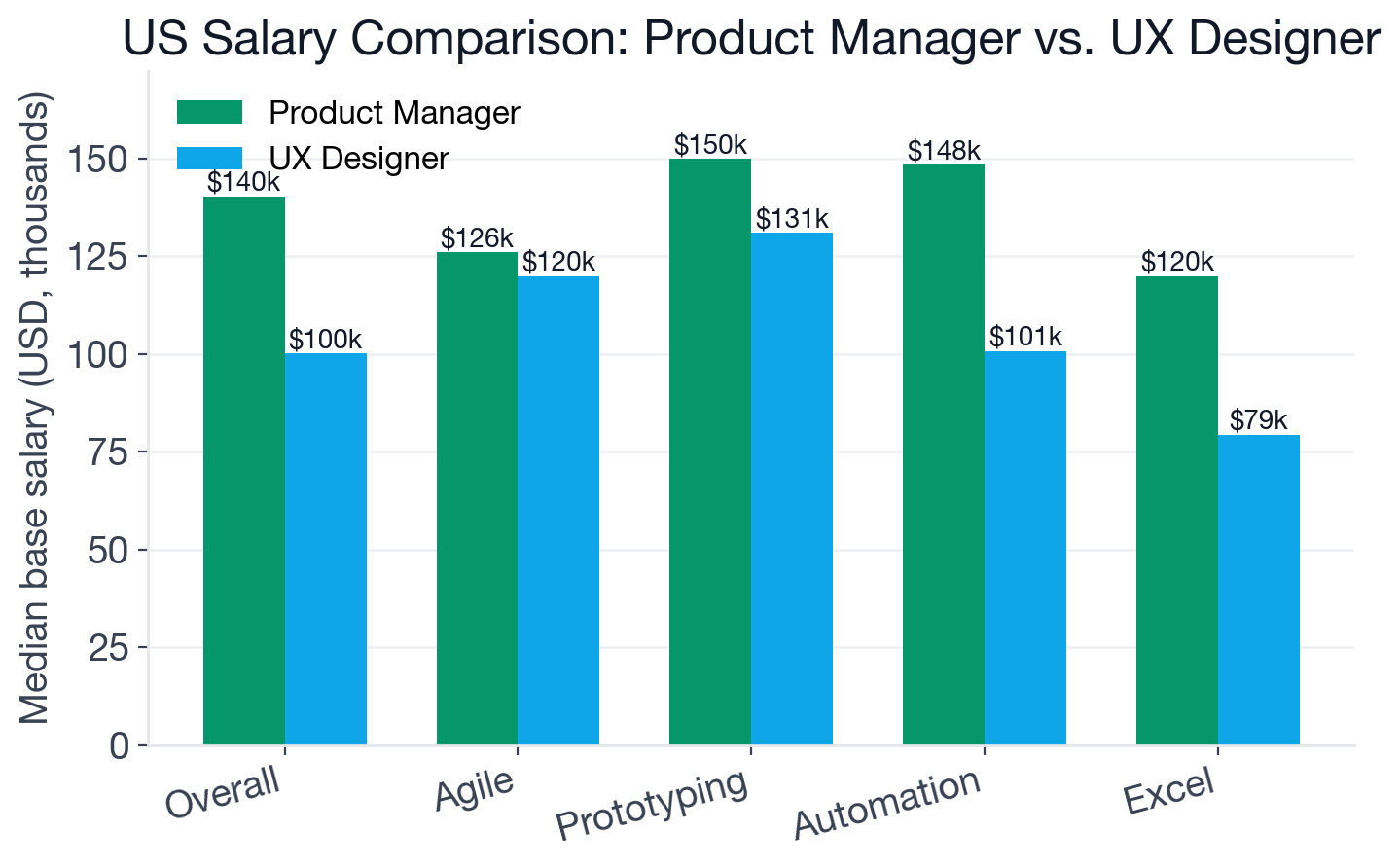
US base salary medians for each role and selected high-premium skills. Salary data from US postings with disclosed base salary only (PM: n=3,760; UX Designer: n=615). Equity and bonus excluded.
The AI dimension adds context to the gap. Only 4.9% of PM postings explicitly list Generative AI and 1.8% of UX Designer postings mention it. But those figures measure roles hired specifically to build or architect AI-powered products: they're a floor, not a ceiling. A 2025 Productboard survey of enterprise PMs found 94% use AI tools daily, primarily for PRD writing, research, and specification. Among designers, only 31% use AI for core design work (asset generation, first-draft interfaces), though 89% say AI improved their workflow in the past year, with ChatGPT now the second-most-used design tool after Figma. For both roles, AI tools are a baseline expectation, not a differentiator. The salary premium in PM postings attaches to knowing how to build and architect AI-driven products, not merely to using ChatGPT for research.
Which Has More Openings, and How Hard Is Entry?
PM is the larger market by a 4-to-1 ratio: 15,442 active openings vs. 3,844 for UX Designer. The practical implication is simple: PM opens more doors across more types of companies, including organizations that would never fund a dedicated UX team.
The entry barrier, though, is nearly identical. Just 4.4% of PM postings (679 of 15,442) and 4.3% of UX Designer postings (164 of 3,844) are explicitly entry-level. Neither role invites career changers to walk in without demonstrated experience. Mid-level postings dominate both pipelines: 59.8% for PM and 68.6% for UX Designer. If you were planning to use UX Design as a lower-barrier path compared to PM, the posting data does not support that assumption.
Geography and remote access: the US accounts for 43% of PM postings vs. 35% for UX Designer. UX Designer roles skew more onsite (52% vs. 47%), and the remote share is lower too (18% vs. 23%). PM opens modestly more remote flexibility if that factor matters.
Choosing Between Product Manager and UX Designer
Choose Product Manager if you:
- Are drawn to strategy, prioritization, and aligning stakeholders on what to build
- Want to work close to technical systems and AI without being the engineer
- Need a larger pool of openings and a higher base salary ceiling
- Are comfortable in a role where your primary output is decisions and specifications, not visual artifacts
Choose UX Designer if you:
- Want to own the visual and interaction quality of a product directly
- Are motivated by craft mastery: interaction design, prototyping, accessibility, and design systems
- Are open to building front-end literacy (HTML, CSS) as part of the role
- Prefer work centered on users and usability rather than business metrics and roadmap negotiation
Both paths lead to the same product teams, often sitting in adjacent desks. The 36% skill overlap means a PM-to-UX or UX-to-PM move requires real investment rather than a career restart: the foundation of agile fluency and prototyping experience is already shared. The divergence is in whether you want to be the person who owns the problem or the person who owns the solution.
For either path, the InterviewStack.io job board has active Product Manager postings and UX Designer postings filtered to quality-gated openings. AI mock interviews let you practice role-specific scenarios, and the question bank covers the topic areas that come up most often in both interview types.
FAQ
Q. What is the salary difference between Product Manager and UX Designer in 2026?
Product Managers earn a median US base salary of $140,400 vs. $100,200 for UX Designers, a $40,200 gap (40% premium in favor of PM). Both figures are base salary only; equity and bonus are not captured in job posting data, so total compensation at top employers runs higher. Note that the UX Designer figure is drawn from a broad dataset that includes non-digital design disciplines; the $100,200 median is likely understated for specialized digital UX roles, and the true salary gap for experienced digital practitioners is probably narrower than $40,200.
Q. How many job openings exist for Product Manager vs UX Designer?
There are roughly 4 times as many active Product Manager openings (15,442) as UX Designer openings (3,844) on the InterviewStack.io job board. Both roles skew heavily mid-level, with only 4.3 to 4.4% entry-level postings each.
Q. How much skill overlap is there between Product Manager and UX Designer?
The Jaccard similarity on the top-30 skill sets is 0.36, meaning 36% of the combined skill catalog is shared. Shared skills include Agile, Prototyping, Automation, and Excel. The roles diverge sharply: PM by APIs, Scrum, SQL, and Jira; UX Designer by Figma, Design Systems, HTML, and CSS.
Q. Which Product Manager skills command the highest salary premium?
Among the top-30 PM skills by posting frequency, Observability commands the highest premium at $168,800 (a $28,400 premium over the $140,400 PM baseline). LLMs follow at $168,000 (+$27,600) and are the highest-earning AI-specific skill in the group. System Design earns $161,500 (+$21,100) and Machine Learning $160,000 (+$19,600). Technical and AI skills drive the biggest salary lifts for PMs.
Q. Which UX Designer skills command the highest salary premium?
Prototyping leads with a median of $131,000 (+$30,800 over the $100,200 UX baseline), followed by Design Systems at $128,000 (+$27,800) and Figma at $121,100 (+$20,900). Craft mastery, not AI skills, is where the UX salary premium concentrates.
Q. Is it easy to break into Product Management or UX Design as a beginner?
Neither role is entry-level-friendly. Only 4.4% of PM postings (679 of 15,442) and 4.3% of UX Designer postings (164 of 3,844) are explicitly entry-level. Mid-level roles dominate both: 59.8% for PM and 68.6% for UX Designer.
Q. Can Product Managers transition into UX Designer roles, or vice versa?
With only 36% skill overlap, a direct lateral move requires deliberate reskilling. The transferable core is Agile and prototyping fluency. A PM moving to UX needs Figma, Design Systems, and front-end literacy (HTML, CSS). A UX Designer moving to PM needs SQL, APIs, and product analytics fluency.
Where to Start in 2026
The PM path looks compelling on the raw numbers: more jobs, 40% higher base pay, and a market actively pricing AI fluency at $20-28K above the baseline. But the premium comes with a specific expectation: you need to understand how technical systems work, not just what users want from them. The UX Designer path is a narrower market with a clearer craft premium: a designer who masters Prototyping, Design Systems, and some front-end implementation earns $128-131K, competitive with PMs who never develop the technical layer.
Neither role is being marginalized by AI. PMs are expected to shape what AI gets built into products. Designers are expected to use AI tools to accelerate their craft, with 89% already saying it improved their workflow. The differentiation is in depth: PMs who understand AI architecturally earn the biggest lifts; designers who own the full craft stack from research through high-fidelity prototyping earn theirs. Use our courses to close the specific skill gaps the data identifies above, then browse the job board to see how the market is actually pricing them.
Topics
Ready to practice?
Put what you've learned into practice with AI mock interviews and structured preparation guides.