
Two hours after a release, checkout failures jump from 0.4% to 3.8%, leadership is debating a rollback, and they want your plan now. In a mid-level QA Engineer debugging interview, a candidate who names a likely culprit in the first minute can sound sharp and still lose points. The scoring rewards the process that finds the cause, not the guess.
This is a simulated mock interview built on one AI interview blueprint, with illustrative mistakes and coaching. It is not a transcript of a real person or of any company's actual questions.
Key Findings
- The interview is scored out of 100 points across 4 dimensions, and Technical Proficiency is only 20 of them.
- Interviewer Objectives Alignment and Level-Specific Expectations carry 30 points each, 60 of 100 combined.
- The 30 minutes split into 3 phases: problem framing (minutes 0 to 8), narrowing the failure domain (8 to 20), and root cause validation and prevention (20 to 30).
- Narrowing the failure domain gets the longest slot, 12 minutes, or 40% of the interview.
- The blueprint has 15 checklist items, 5 per phase, and one of the first 5 is naming mitigation options before diagnosis is finished.
- The failure rate rose nearly tenfold, from 0.4% to 3.8%, while the payment provider's success rate looked normal.
- The interviewer has 6 prepared follow-ups; this walkthrough dramatizes 4 of them.
The Average Failure Rate Is Hiding the Bug
Read the known facts before the ask. Three of them narrow where to look (the release timing, mobile web, the three changed components), and two of them, no full outage and a normal payment provider, tell you where not to look first.
The interview question
You are the QA engineer on call for a consumer web product at a large tech company. A release went out 2 hours ago. Support and monitoring show that checkout failures have increased from 0.4% to 3.8%, but only for a subset of users. Engineering leadership wants a clear debugging plan quickly because the team is deciding whether to roll back.
What is currently known:
- The spike started shortly after release 2026.11.27.2.
- Failures are concentrated on mobile web, but not all mobile users are affected.
- API p95 latency is slightly higher than normal, but there is no full outage.
- Payment provider success rate appears normal from their dashboard.
- A recent change touched the checkout frontend, an experiment flag, and address-validation service integration.
- Logs exist from frontend events, API gateway, checkout service, and address-validation service, but dashboards are incomplete.
- You do not yet know whether this is a test gap, bad rollout, data issue, browser-specific issue, or backend regression.
You are asked to lead the investigation for this checkout failure spike; walk me through how you would debug it end to end and get to a credible root cause.
Where Do the Points Go in a QA Engineer Debugging Interview?
The interviewer wants a repeatable structure: clarify the blast radius, tie the timeline to the release and the flag change, segment who is affected, rank a few hypotheses, and run checks that tell them apart. The phrase "only for a subset of users" is the key. A 3.8% average across everyone is a blend of a healthy majority and a badly broken group, and the mid-level bar expects you to reach for the slices (release version, experiment cohort, browser, device class, region, request outcome) without excessive prompting.
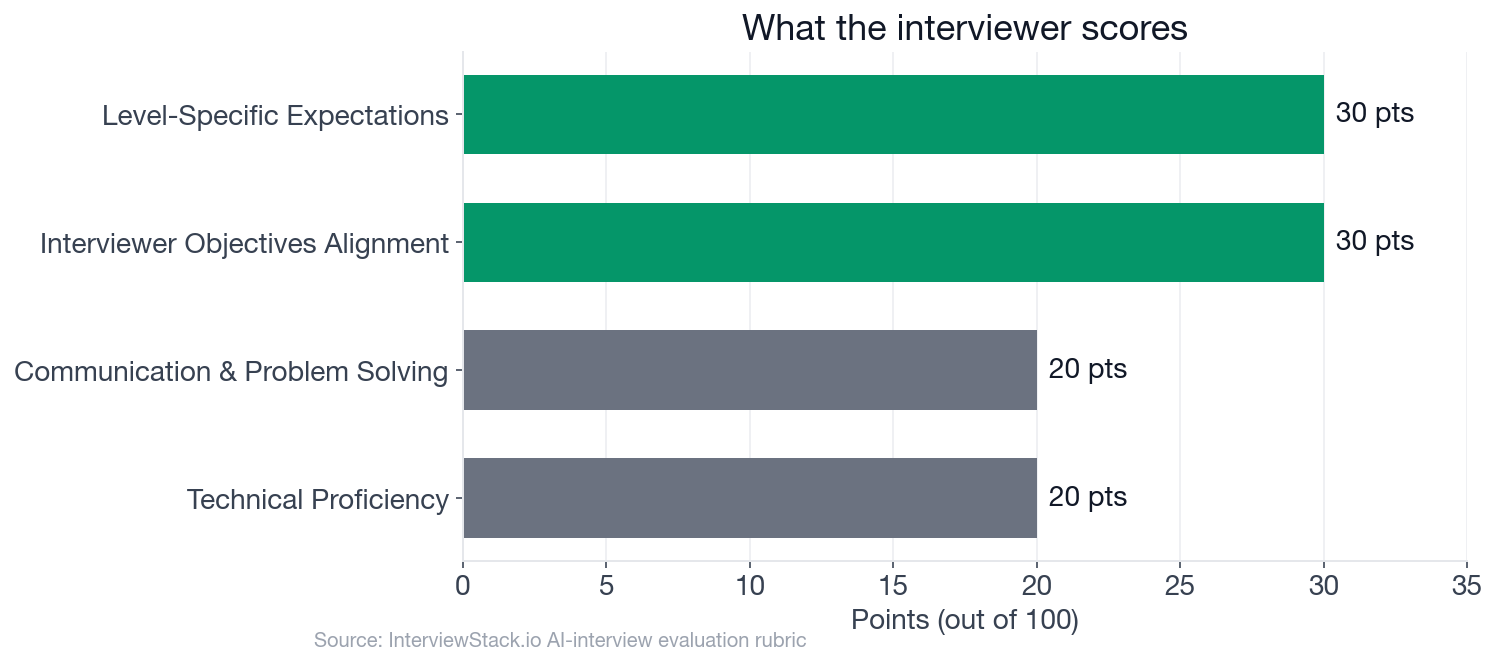
The four rubric dimensions by point weight, out of 100.
Sixty points ride on meeting the stated objectives and the level bar: driving the investigation on your own, judging when the evidence is good enough to escalate or roll back, and reasoning about causality and confounders. The blueprint also rules some territory out, including deep payment compliance, native app internals and redesigning the checkout architecture, so time spent there earns nothing.
Four Follow-Ups That Separate Guessing From Debugging
Bastian is our illustrative candidate: comfortable with logs and test tooling, and quick to commit to an answer. Each turn shows a typical response, what it costs, and a stronger move.
Turn 1: Roll back or keep digging
Interviewer: "How would you decide whether to recommend rollback, partial rollback, or continue investigating while mitigating impact?"
Turn 2: Pay clicked, nothing arrived
Interviewer: "Suppose frontend logs show users clicking Pay, but the checkout service never receives some requests. What hypotheses would you test next?"
Turn 3: Staging stays green
Interviewer: "If the issue cannot be reproduced reliably in staging, how would you use production-safe techniques to narrow it down?"
Turn 4: Immediate cause is not enough
Interviewer: "Once you find the immediate cause, how would you determine whether that is the true root cause and prevent this class of issue from recurring?"
Why Does Knowing the Steps Not Hold Up Under the Clock?
Every stronger move above reads as obvious once it is written down. In the room, the interviewer reorders these questions, pushes on whatever you said last, and adds new facts mid-answer, such as "it is mostly Safari in one region." Meanwhile leadership in the scenario wants a rollback call, and the instinct is to name a suspect so the silence ends. Holding a structure while someone pressures you for an answer is a skill, and like any incident skill it comes from repetitions, not from reading.
What Does the 30-Minute Investigation Look Like When It Goes Right?
This is the blueprint a strong candidate hits, and it is exactly what the AI mock interview tracks you against in real time. Notice that the longest phase is not about the fix; it is about narrowing where the failure lives.
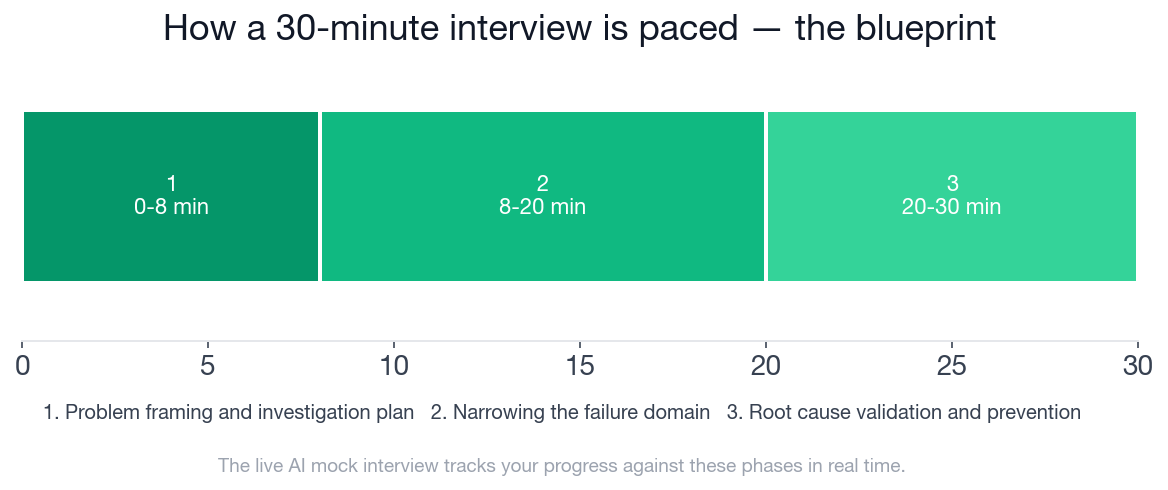
The three phases of the 30-minute interview, by minute.
- ✓Asks or states the need to quantify impact by release version, platform, browser, region, and experiment cohort
- ✓Establishes a timeline tied to the release and any config or flag changes
- ✓Prioritizes a small set of plausible hypotheses instead of listing many unrelated possibilities
- ✓Distinguishes user-facing symptom from possible failing stage in the checkout flow
- ✓Mentions immediate mitigation options while preserving evidence for diagnosis
- ✓Breaks the flow into stages such as page render, form validation, click event, request dispatch, gateway receipt, service processing, dependency calls, and final response
- ✓Explains what evidence from each log source would help eliminate or support a hypothesis
- ✓Uses segmentation to compare failing versus successful cohorts rather than relying on aggregate metrics
- ✓Suggests bisection by release, flag state, or config exposure to isolate the triggering change
- ✓Identifies at least one production-safe way to reproduce or sample failures, such as shadow logging, targeted tracing, or internal test accounts
- ✓Defines what would count as proof of root cause, such as error rate dropping after disabling a flag or a trace showing deterministic failure at one step
- ✓Discusses rollback or partial mitigation in terms of blast radius, confidence, and recovery speed
- ✓Separates immediate fix from long-term corrective actions
- ✓Proposes concrete prevention steps such as targeted regression coverage, release health gates, missing dashboards, and experiment safety checks
- ✓Communicates a concise incident summary with suspected cause, evidence, user impact, mitigation, and next actions
Run the Checkout Incident Yourself
Start the AI mock interview for a mid-level QA Engineer on systematic debugging and root cause analysis and talk through this incident out loud against the clock. The AI interviewer asks its own follow-ups, notices which checklist items you cover and which you skip, and scores you on the same four dimensions shown above. One session will show you whether you slice before you guess.
Want to warm up on single concepts first? Work through the debugging and root cause analysis question bank for QA Engineers, or browse the preparation guides for the wider topic map. When you are ready to apply, the QA Engineer job board lists current openings.
FAQ
Q. What does a QA Engineer debugging interview test?
It tests whether you can run a structured investigation, not whether you can guess the bug. In this 30-minute blueprint you frame impact and hypotheses, narrow the failure across client, service and data layers, then prove the root cause and propose prevention. Technical Proficiency is 20 of 100 points; Interviewer Objectives Alignment and Level-Specific Expectations are worth 30 each.
Q. Should you recommend a rollback before you know the root cause?
You can, and often should. Mitigation and diagnosis are separate decisions. Weigh blast radius, your confidence that the release is involved, and how reversible each option is; a partial rollback such as disabling an experiment flag can cut user impact while you keep investigating. Capture logs and failing request samples first so the evidence survives.
Q. Which slices should you segment a production failure by?
The blueprint lists release version, experiment cohort, browser, device class, region and request outcome. The point is to compare failing users against successful users on each dimension, because an aggregate error rate hides which group is actually broken.
Q. What instrumentation would you add first during an incident?
Start with what lets you follow one checkout attempt end to end: a correlation ID from the frontend click through the gateway and the checkout service, plus error rates broken down by release, flag state, browser and region. Add only what you can get in the next hour; a mid-level QA engineer coordinates this with developers or SREs rather than building new tooling.
Q. How do you debug an issue you cannot reproduce in staging?
Use production-safe techniques: targeted tracing on the affected cohort, shadow logging, or internal test accounts placed in the same browser, region and experiment conditions as failing users. Also say why staging may differ, such as flag exposure, real address data or traffic mix, because that difference is itself a clue.
Q. How do I practice this kind of interview?
Run it live. The AI mock interview for this role, level and topic asks its own follow-ups and tracks you against the same three-phase blueprint in real time. The question bank is a good warm-up for single questions on hypothesis-driven debugging, bisection and root cause analysis.
Your First Slice Decides the Next Twenty Minutes
Split the failing users from the healthy ones before you name a suspect, and keep the rollback call separate from the hunt for the cause. Practice it out loud a few times, and the structure will still be there when the pressure arrives.
Topics
Ready to practice?
Put what you've learned into practice with AI mock interviews and structured preparation guides.