
The QA Engineer Cross-Browser and Cross-Platform Testing Interview Rewards Judgment, Not Coverage
A mid-level QA Engineer sits down for a 30-minute interview built around one release: new navigation, a rebuilt auth entry point, responsive layout changes, and a checkout-style multi-step flow, all shipping at once, with limited time before launch. The interview package behind this session, generated the same way the InterviewStack.io AI interviewer builds every live session, tracks four scoring dimensions and 15 checklist items across three phases. Most candidates can name the four major browsers without hesitation. The interview isn't testing that. It's testing what you do when the analytics say one of those browsers barely matters, and the history on that browser says otherwise.
That tension shows up directly in one follow-up: a browser carrying just 4% of traffic, with a track record of severe checkout bugs, on a release that touches checkout. A candidate who ranks coverage by traffic share alone will deprioritize it. That's the trap.
Key Findings
- The interview runs 30 minutes across 3 phases: strategy framing (0-8 min), coverage matrix (8-18 min), defect handling and release trade-offs (18-30 min).
- Level-Specific Expectations carries 30 of 100 rubric points, tied with Interviewer Objectives Alignment for the heaviest weight.
- Phase 2, just 10 minutes long, packs 6 of the interview's 15 expectedChecklist items, more than any other phase.
- The scenario's sharpest trap: a browser with only 4% of traffic but a documented history of severe checkout bugs, on a release that rewrites checkout.
- Phase 3 (18-30 min, 12 minutes) explicitly requires a concise go, no-go, or conditional launch recommendation with named residual risk.
- Technical Proficiency and Communication & Problem Solving are each worth 20 points, together outweighing either single 30-point dimension by 10 points.
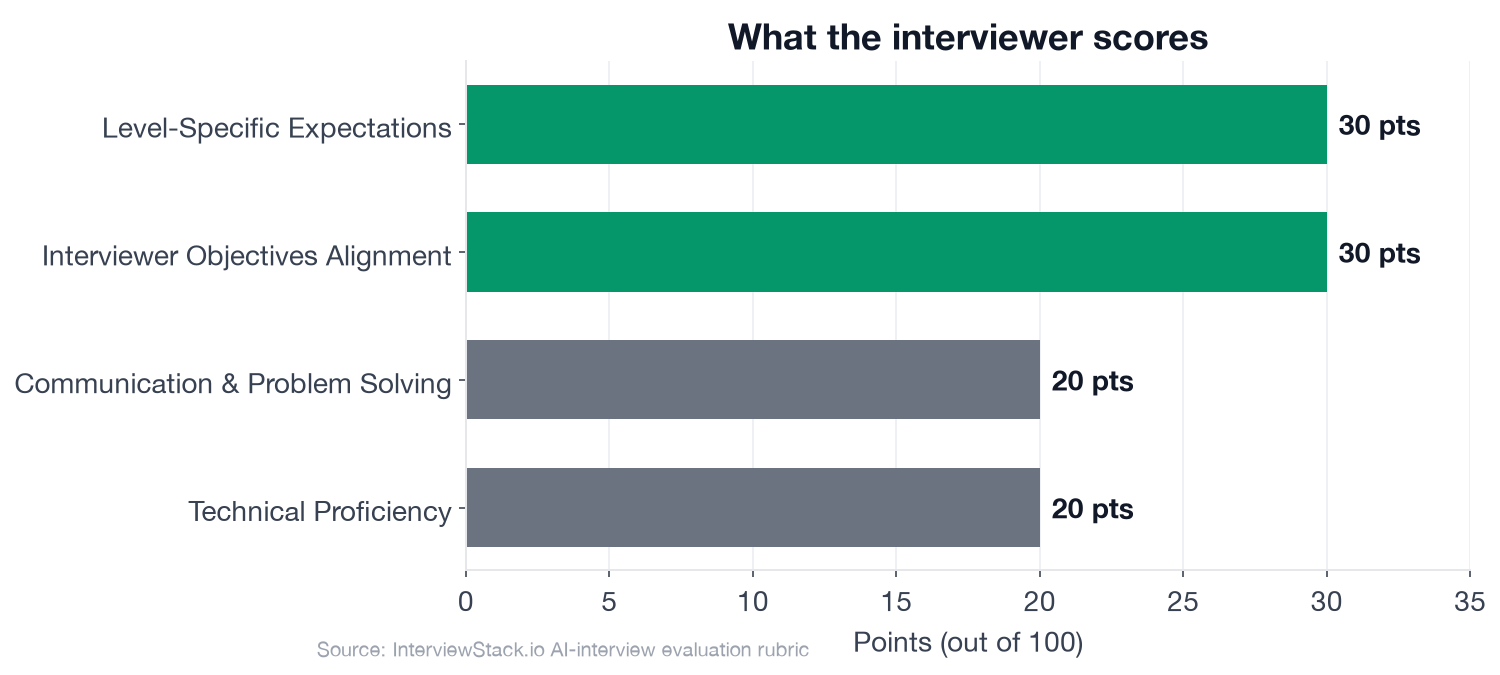 Interviewer Objectives Alignment and Level-Specific Expectations together account for 60 of the 100 points, three times the weight of Technical Proficiency, the dimension that judges tool and automation choices.
What Is the Interview Actually Screening For?
The interview question
You are joining a team responsible for a high-traffic consumer web application that users access from desktop and mobile browsers worldwide. The team is preparing a major release that changes navigation, authentication entry points, responsive layouts, and a new checkout-style multi-step flow. Recent analytics show traffic is split across Chrome, Safari, Edge, and Firefox, with a meaningful share from mobile web on both iOS and Android. Engineering has limited time before launch, and the team wants confidence that the release behaves consistently across platforms without exhaustively testing every possible combination.
How would you design and execute a cross-browser and cross-platform testing approach for this release?
Underneath that prompt, the interviewer is evaluating something narrower than "do you know the browsers." They want to see a risk-based coverage strategy instead of an attempt at exhaustive combination testing, prioritization built on observable signals like traffic share, business-critical flows, and known defect history, working knowledge of the failure modes that are unique to cross-browser and cross-platform work (rendering, input, cookies and storage, auth redirects, touch behavior), sound manual-versus-automation trade-offs, and a structured way to communicate release risk. None of that is stated in the prompt's wording. All of it shows up in the score.
Where the Score Actually Slips
The opening answer is table stakes. The interview's real signal comes from four follow-ups that push past a general strategy into concrete prioritization, automation trade-offs, live defect triage, and a release call under a hard deadline. Below is a common version of how a candidate named Diego handles each one, and what a stronger answer looks like.
Turn 1: The Matrix You Build First
Interviewer: "How would you decide which browser, OS, device, and screen-size combinations belong in your initial coverage matrix versus deferred coverage?"
Turn 2: The Browser Everyone Wants to Cut
Interviewer: "If analytics show only 4% of users on a browser that has historically produced severe checkout bugs, how would that affect your prioritization?"
Turn 3: The Intermittent Bug on iPhone
Interviewer: "Suppose the flow works on Chrome and Edge but intermittently fails on Safari on iPhone. How would you investigate, isolate, and communicate that defect?"
Turn 4: Two Days, One Recommendation
Interviewer: "If you had only two days before release, what would your minimum confidence plan look like and what risks would you explicitly call out?"
Why Isn't Reading This Enough?
Every mistake above is easy to spot on the page. You have the interviewer's question, a beat to think, and no clock counting down. Live, the follow-up lands cold, mid-sentence, while you're still holding the rest of your strategy in your head, and the interviewer doesn't tell you which axis you forgot. The gap between believing you'd weigh severity over traffic share and actually doing it at minute 15 of a 30-minute session is exactly what reps close. Reading the trap once doesn't install the reflex; running the interview does.
The Complete Blueprint for This Interview
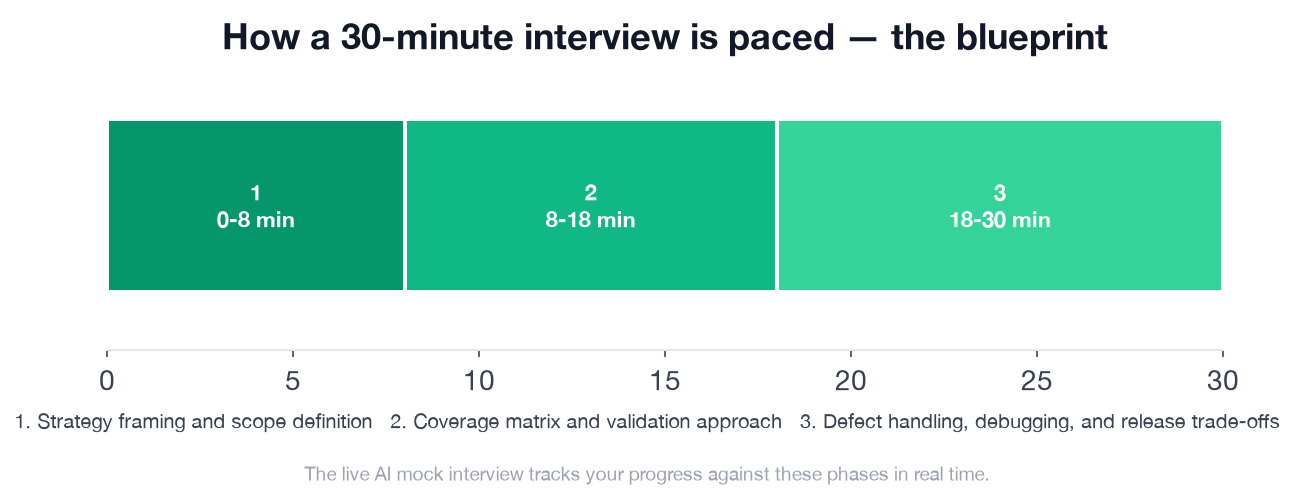 Strategy framing gets 8 minutes, the coverage matrix gets 10, and defect handling plus release trade-offs get the final 12, with the middle phase carrying the most checklist items of the three.
This is the blueprint a strong candidate hits, phase by phase, and it's the exact structure the InterviewStack.io AI interviewer tracks you against in real time during a live session, not just at the end.
- ✓Asks or states assumptions about user traffic, critical flows, supported platforms, and release timeline
- ✓Identifies the most business-critical areas affected by the release such as auth, navigation, responsive behavior, and checkout/multi-step flow
- ✓States that exhaustive testing is infeasible and proposes a prioritization framework
- ✓Frames testing in terms of browser + OS + device class + viewport/input method, not just browser names
- ✓Proposes a tiered matrix such as primary, secondary, and fallback coverage or equivalent
- ✓Explains prioritization using observable factors like usage data, revenue impact, known weak platforms, and changed components
- ✓Includes both desktop and mobile web coverage with meaningful distinctions such as iOS Safari versus Android Chrome
- ✓Covers representative viewport/screen-size testing rather than only named devices
- ✓Separates smoke, critical path, regression, and exploratory validation with reasonable ownership for each
- ✓Gives concrete examples of what to automate across browsers and what to manually validate on real or cloud devices
- ✓Describes how to reproduce and isolate a browser-specific issue using version, device, viewport, network, and interaction details
- ✓Mentions collecting actionable evidence such as screenshots, console/network logs, video capture, and exact environment metadata
- ✓Distinguishes severity from user reach and business impact when recommending fix-now versus post-launch mitigation
- ✓Suggests mitigations such as feature flags, browser-specific workaround, graceful degradation, or temporary support guidance when appropriate
- ✓Provides a concise go/no-go or conditional launch recommendation under time pressure with explicit residual risks
Turn This Into Practice, Not Just Reading
You now know the trap: a browser's traffic share and its risk to the release are two different numbers, and the interview scores whether you can act on both at once, not just recite a coverage matrix. Reading that is step one. Start the AI mock interview on Cross-Browser and Cross-Platform Testing now and the same phases, the same rubric, and unscripted follow-ups will find out whether it stuck. If you want to drill the underlying patterns first, work through Cross-Browser and Cross-Platform Testing questions in the question bank, and browse QA Engineer prep guides for company-specific process notes.
FAQ
Q. What does a mid-level QA Engineer cross-browser and cross-platform testing interview actually test?
It tests whether you can build a risk-based browser, OS, device, and viewport coverage matrix instead of attempting to test every combination, prioritize using traffic share, revenue impact, and known weak platforms, and make sound manual-versus-automation and release-risk calls. The 100-point rubric weights Interviewer Objectives Alignment and Level-Specific Expectations at 30 points each, with Technical Proficiency and Communication & Problem Solving at 20 points each.
Q. Why would a browser with only 4% of traffic still be a top testing priority?
Because traffic share alone doesn't measure risk. In this scenario, that 4% sits on a browser with a documented history of severe checkout bugs, on a release that rewrites the checkout flow. Multiplying reach by the severity and business impact of a likely failure, not ranking by raw traffic share, is the expected reasoning at the mid-level bar.
Q. What's the difference between primary, secondary, and fallback browser coverage?
Primary coverage gets full smoke, critical-path, and regression testing before release. Secondary coverage gets smoke and exploratory testing only. Fallback coverage is deferred and monitored post-launch. The interview rewards candidates who state this tiering explicitly and justify which browser, OS, and device combinations land in each tier, rather than treating test everything as a plan.
Q. How should a candidate investigate a bug that only reproduces intermittently on Safari on iPhone?
By isolating variables one at a time (iOS version, Safari version, network conditions, orientation, keyboard state) rather than re-running the same test and hoping it repros again, and by capturing exact environment metadata plus screenshots, console and network logs, and screen recording before filing. That evidence is what lets engineering reproduce the failure without redoing the investigation.
Q. What should a two-day, pre-release testing plan include?
A named minimum-confidence set (smoke on the primary tier, full regression on the changed critical flow across the top few browser and device combinations, exploratory testing on any historically weak platform), an explicit list of what gets cut, and a concise go, no-go, or conditional-launch recommendation with the residual risk stated out loud, not left implied.
Q. How long does the interview run and how is it scored?
30 minutes across three phases: strategy framing and scope definition (0-8 minutes), coverage matrix and validation approach (8-18 minutes), and defect handling, debugging, and release trade-offs (18-30 minutes). A 100-point rubric spans four dimensions, with the three phases mapping to 15 specific checklist items an interviewer is watching for.
Q. What's the fastest way to prepare for this exact interview?
Practice it live under time pressure. Reading a walkthrough shows you the prioritization trap; an AI mock interview forces you to make the same call in real time, with an interviewer pushing back the way this one will.
The 4% Was Never the Whole Story
Naming the four major browsers is the easy part; almost every mid-level candidate can do that in the first thirty seconds. What separates a strong score from an average one is whether you can rank risk instead of volume, defend that ranking under a two-day deadline, and say out loud what you're choosing not to test. That's a judgment call, and judgment calls only sharpen with reps.
Topics
Ready to practice?
Put what you've learned into practice with AI mock interviews and structured preparation guides.