
Framework Design Looks Different on Paper Than in the Room
A mid-level QA engineer interview on test automation framework architecture has a counterintuitive scoring shape: 60 of the 100 available points measure whether you addressed the right problem at the right depth, not whether you named the correct tool. An answer that lists Page Object Model, Screenplay, and dependency injection without connecting them to layering decisions, multi-team adoption, or reliability trade-offs will score in the 40s. That gap, between knowing the vocabulary and applying it under time pressure, is what this walkthrough is about.
The scenario below mirrors how a strong 30-minute interview on this topic runs. Every follow-up maps to a real phase in the QA Engineer test automation framework design interview. The mistakes are the ones that actually cost points, and the rubric dimension is named at the end of each mistake so you can see exactly what is at stake.
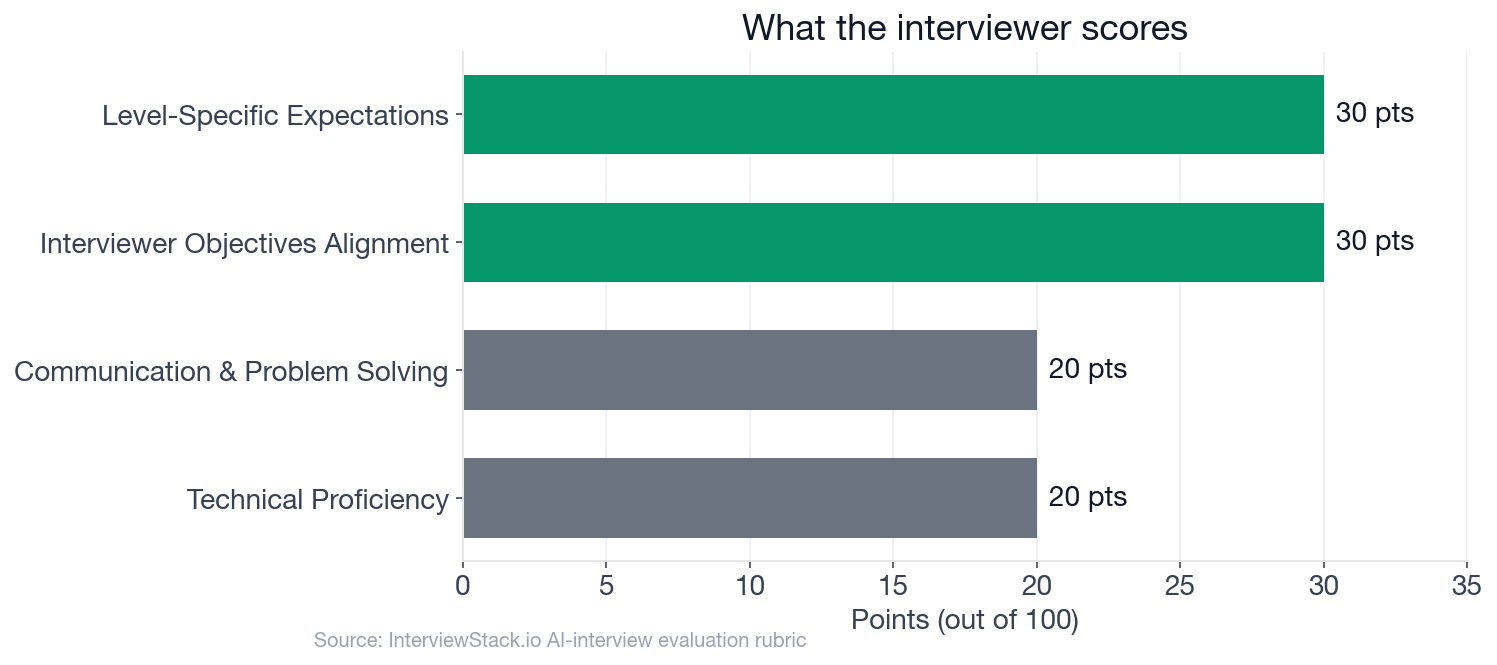
Objectives Alignment and Level-Specific Expectations together make up 60 of 100 points, the two dimensions most sensitive to reasoning depth rather than tool selection.
Key Findings
- 60 of 100 rubric points measure Interviewer Objectives Alignment (30 pts) and Level-Specific Expectations (30 pts), not raw technical detail.
- The 30-minute interview has 4 scored phases; the Design Choices phase runs the longest at 10 minutes (8-18 min), while the Reliability, Scale, and CI Readiness phase carries the most checklist items with 5.
- Mid-level candidates are expected to propose a layered framework structure and justify design patterns, but not produce a company-wide platform strategy.
- Retries appear explicitly in the rubric as "a controlled mitigation rather than the primary reliability mechanism," so leading with retries as your flakiness fix is a scored mistake.
- Failure to define measurable outcomes (flake rate, execution time, diagnosability) in the wrap-up phase misses the only scored checklist item in Phase 4 for metrics.
- Pattern questions (POM vs. Screenplay, Builder vs. factory) are graded on trade-off reasoning: the right pattern with no rationale scores below a defensible choice with clear justification.
What Does the Interviewer Actually Ask?
The interview question
You are joining a team that supports a consumer web product with frequent releases. Today, different squads own different parts of the product, and test automation is inconsistent across teams. Some tests are UI-based, some are API-based, and the current suite is slow, flaky, and hard to maintain. The engineering organization wants a common automation framework that can be adopted by multiple squads, integrated into CI, and still be simple enough that SDETs and software engineers can contribute to tests without deep framework knowledge.
How would you design a test automation framework for this organization?
The interviewer is evaluating two things at once: whether you can propose a coherent layered structure (not a flat helpers folder), and whether you establish reasonable assumptions before diving in. Candidates who jump straight to tools without framing the scope, supported test types, and who the framework serves typically lose Phase 1 points before the first follow-up even starts.
The QA Engineer Test Automation Framework Design Interview, Turn by Turn
Turn 1: Sharing Without Coupling
Interviewer: "How would you structure the framework so UI tests and API tests can share common capabilities without becoming tightly coupled?"
Turn 2: Designing Against Flakiness
Interviewer: "Suppose the UI suite becomes flaky in CI due to timing and environment instability. How would your framework design help reduce and diagnose that?"
Turn 3: Choosing Between Patterns
Interviewer: "How would you decide between patterns like Page Object Model, Screenplay, factories, builders, or dependency injection in this framework?"
Turn 4: Measuring What Actually Matters
Interviewer: "How would you measure whether this framework is actually improving quality and engineering productivity over time?"
Why Does Knowing the Mistakes Not Prevent Them Live?
The mistakes above are obvious when labeled on a page. In the room, they are the natural, instinctive answers. "Add retry logic" is what comes to mind when someone says flaky tests. "POM is the industry standard" is technically true. "Shared BaseTest" is how most engineers have seen it done. The rubric is not testing whether you know the alternatives exist; it is testing whether you reach for the better answer first, without prompts, without seeing the question in advance, and with the interviewer watching whether you adapt when they push back. That only comes from repetitions where the follow-up questions are unscripted and you do not know which phase you are in.
The Complete Blueprint for This Interview
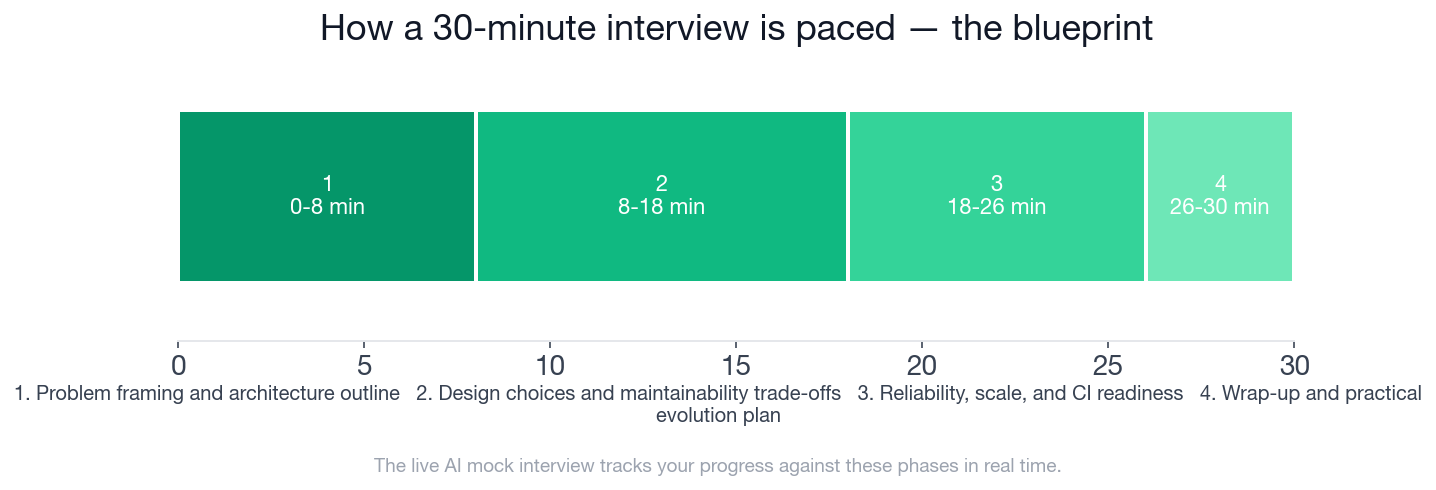
This is the blueprint a strong candidate hits across the 30 minutes, and the exact structure the AI mock interview scores you against in real time.
- ✓Asks or states assumptions about product scope, users of the framework, supported test types, and CI expectations
- ✓Proposes a high-level design with distinct layers or modules rather than a flat collection of test helpers
- ✓Identifies core shared components such as runner setup, configuration, reporting, test data, and reusable interaction/service abstractions
- ✓Explains how the framework will be consumed by multiple teams in a consistent way
- ✓Discusses at least one suitable framework style, such as modular, data-driven, keyword-driven, hybrid, or BDD-style organization, with rationale
- ✓Uses design patterns appropriately, for example Page Object Model or Screenplay for UI abstraction, builders for test data, factories for environment/client creation, or dependency injection for decoupling
- ✓Explains where assertions, locators, business flows, and low-level interactions should live
- ✓Calls out anti-patterns such as duplicated flows, assertions inside low-level page classes, static shared state, or overly generic wrappers
- ✓Describes synchronization and waiting strategy that avoids naive sleeps and reduces UI flakiness
- ✓Includes logging, screenshots or traces, and actionable reporting for failed test diagnosis
- ✓Explains how tests can run in parallel and how environment or test data isolation is handled
- ✓Mentions CI gating strategy, suite segmentation such as smoke versus broader regression, or execution triggers by change type
- ✓Shows awareness of retries as a controlled mitigation rather than the primary reliability mechanism
- ✓Outlines a sensible rollout plan, such as starting with core abstractions and one test type before expanding
- ✓Mentions documentation, examples, or templates that help engineers contribute correctly
- ✓Defines a few measurable outcomes such as flake rate, execution time, authoring speed, failure diagnosability, or maintenance reduction
How Can You Practice the QA Test Automation Framework Interview?
The AI mock interview runs this exact format: an opening design question, four phases of follow-ups, and real-time scoring against every checklist item above. Start the QA engineer test automation framework design interview to see where your answers score before it counts.
For focused drilling between sessions, the QA Engineer test automation question bank covers the full range of framework design, pattern selection, reliability concepts, and metrics questions that come up across mid-level interviews. You can also browse open QA Engineer roles to see how companies are describing the framework design expectations they actually hire for.
FAQ
Q. What are the four phases of a QA test automation framework design interview?
The 30-minute interview breaks into: Problem Framing and Architecture Outline (0-8 min), Design Choices and Maintainability Trade-offs (8-18 min), Reliability, Scale, and CI Readiness (18-26 min), and Wrap-up and Practical Evolution Plan (26-30 min). Each phase has a checklist the AI interviewer scores against in real time.
Q. What is the most common mistake when answering the UI/API framework sharing question?
Most candidates propose a shared BaseTest class that couples UI and API concerns together. The correct approach is a thin shared kernel (config, auth helpers, test data builders) that both stacks import independently, with separate UI and API layers that never reference each other's internals.
Q. How should a mid-level QA engineer handle the flaky test mitigation question?
Avoid leading with retry logic. The rubric treats retries as a controlled last resort, not the primary mechanism. Start with explicit waits over hard sleeps, failure artifact hooks (screenshots, traces) in the base runner, and environment state isolation. Retries belong at the end of that list, with logging.
Q. Which design patterns are expected in a QA automation framework interview for mid-level candidates?
Page Object Model or Screenplay for UI abstraction, Builder pattern for test data construction, Factory for client and environment creation, and Dependency Injection for decoupling test setup from test logic. Mid-level candidates should explain the trade-offs between patterns, not just name them.
Q. What metrics should you propose when asked how to measure automation ROI?
The three highest-signal metrics are: flake rate trend (is the ratio of flaky tests decreasing over time?), time-to-green in CI (is the feedback loop getting faster?), and mean-time-to-diagnose a failure (can a developer identify the root cause from the failure artifact in under five minutes?). Vanity metrics like test count or code coverage do not measure the framework's actual goals.
Q. How is a test automation framework design answer scored in the AI mock interview?
The rubric has four dimensions: Interviewer Objectives Alignment (30 points), Level-Specific Expectations (30 points), Technical Proficiency (20 points), and Communication and Problem Solving (20 points). Objectives Alignment and Level-Specific Expectations together account for 60 of 100 points, making architectural reasoning and appropriate depth more important than raw technical detail.
Ship the Layer, Not the Pattern
The pattern you choose matters less than whether you know why you chose it and what it protects against. A test automation framework interview is really asking: can you think in layers, make decisions under time pressure, and connect your choices to the team that will live with them? The checklist above is the map. Practice against it live with the QA Engineer mock interview, and you will close the gap between reading the map and running the route.
Topics
Ready to practice?
Put what you've learned into practice with AI mock interviews and structured preparation guides.