
The Question Is Really "Will Anyone Act on This?"
Six weeks of ranking research, a significant offline gain, a promising but small A/B result, and a director who wants the answer in one sentence. In this mid-level Research Scientist interview, nobody asks you to derive anything. They ask whether your work can change a decision, and the communication part is easy to underestimate.
This walkthrough is a dramatized simulation anchored on one AI mock interview blueprint. The mistakes are illustrative, not a transcript of a real candidate.
Key Findings
- The rubric totals 100 points: 30 for Interviewer Objectives Alignment, 30 for Level-Specific Expectations, 20 for Technical Proficiency, 20 for Communication and Problem Solving.
- 60 of 100 points reward judgment and level-appropriate scope; only 20 reward technical accuracy.
- The interview runs 30 minutes in 3 phases: 0-8, 8-20, and 20-30 minutes.
- Tailoring the story and handling tradeoffs gets 12 minutes, the longest phase.
- The scenario has 3 audiences: research scientists, product and engineering leads, and a director.
- The blueprint carries 13 expected checklist items across the 3 phases.
- 4 skills are explicitly out of scope, including live coding and deep model derivation.
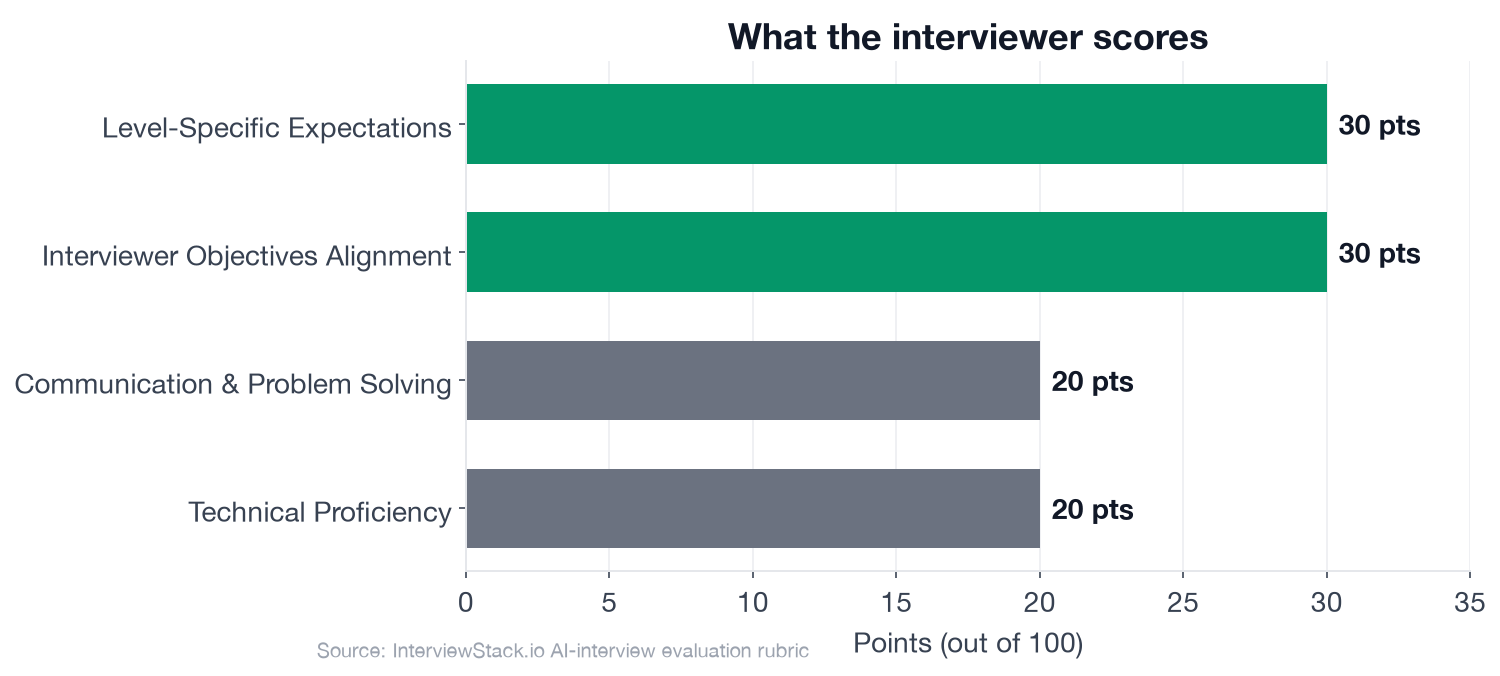
Technical Proficiency carries only 20 of 100 points; communication-shaped dimensions carry the rest.
What Does the Interviewer Put in Front of You?
Here is the scenario the AI interviewer opens with.
The interview question
You have spent 6 weeks on a new ranking approach for a large consumer product's recommendation feed. The research shows a statistically significant improvement in offline metrics and a small but promising online A/B result, but the method is more complex than the baseline, adds some serving cost, and has known limitations for cold-start users.
Your next review includes research scientists who will scrutinize methodology, product and engineering leads deciding whether to invest in launch work, and a director who wants the headline, risks, and recommendation quickly.
How would you present and document this work so that this review leads to a good decision and the team can effectively build on it afterward?
Underneath, the interviewer is probing whether you can find the core message, adapt it per audience, choose the right level of evidence, and handle skepticism without turning academic or vague.
Turn by Turn: Where Do Mid-Level Candidates Lose Points?
Meet Dev, a capable scientist with strong results. Watch where the points leak.
Turn 1: The First Three Minutes
Interviewer: "What would you put in the first three minutes of the presentation for this audience, and what would you deliberately leave out until later?"
Turn 2: The Director Interrupts
Interviewer: "Suppose the director interrupts and asks, 'Should we launch this or not?' How would you answer in a way that is appropriately decisive but still scientifically honest?"
Turn 3: Cold-Start, Two Audiences
Interviewer: "How would you explain the cold-start limitation differently to a research peer versus a product lead?"
Turn 4: Six Months Later
Interviewer: "What artifacts would you leave behind so that another scientist or engineer could reproduce the work and understand its constraints six months later?"
Why Isn't Reading This Enough?
Spotting these mistakes on the page is easy. Avoiding them live is the real skill: the director interrupts mid-sentence, the engineer pushes on complexity, and your clean outline has to bend in real time. Level expectations include revising your framing on the fly, and that only comes from reps with follow-ups you cannot predict.
The Complete Blueprint a Strong Candidate Hits
This is the blueprint a strong candidate covers, and exactly what the AI mock interview tracks you against in real time.
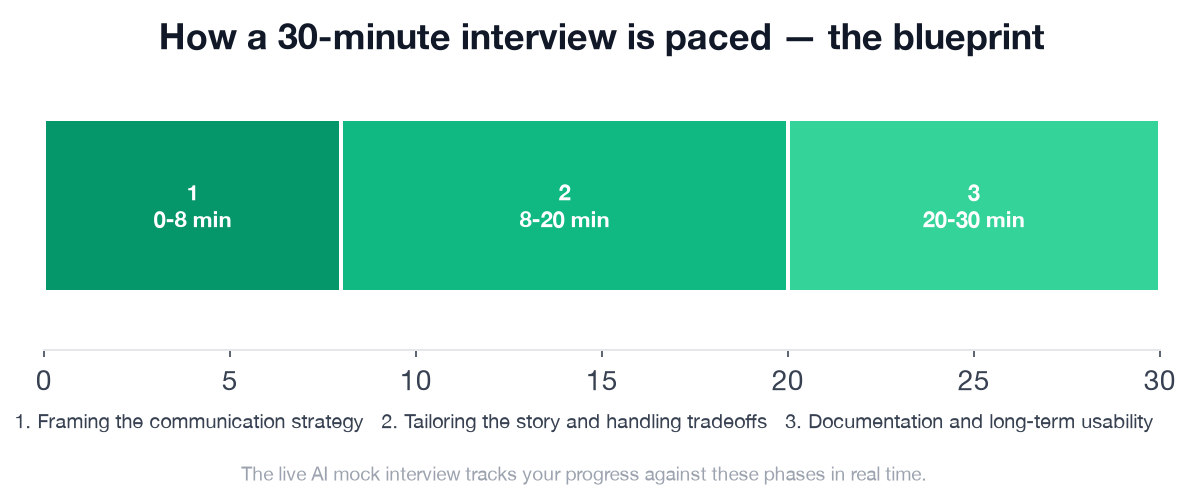
Three phases, 8, 12, and 10 minutes, paced the way the live Blueprint tracks them.
- ✓Clarifies or states the objective of the review (decision, alignment, next steps, or launch recommendation)
- ✓Identifies meaningful differences between scientist, engineering/product, and director audiences
- ✓Proposes a top-level structure such as headline, evidence, tradeoffs, recommendation, and open risks
- ✓Avoids starting with low-level methodological detail before establishing the main takeaway
- ✓States a plausible headline that integrates impact, complexity, and limitations
- ✓Explains what evidence belongs in the executive summary versus appendix or deeper technical section
- ✓Frames cold-start limitations and serving cost in business- and engineering-relevant language
- ✓Gives a recommendation that is neither evasive nor overstated
- ✓Responds to skepticism by acknowledging uncertainty while preserving decision usefulness
- ✓Mentions concrete artifacts such as experiment summary, assumptions, metrics definitions, model/version details, ablation results, launch recommendation, and known failure cases
- ✓Describes how documentation would separate headline conclusions from detailed methodology and caveats
- ✓Includes enough detail that another scientist or engineer could reproduce or safely extend the work
- ✓Addresses how future readers would understand why certain decisions were made, not just what was done
Practice It Live Before the Real Loop
Start the AI mock interview for this exact role, level, and topic. You get the same scenario, unscripted follow-ups, and real-time tracking against the blueprint above. If you want more material first, work through the research communication question bank or browse the Research Scientist preparation guides. Then check open Research Scientist roles to see what teams are hiring for.
FAQ
Q. What does a Research Scientist communication and storytelling interview test?
It tests whether you can turn a messy result into a decision for three audiences at once: methodology-minded scientists, product and engineering leads, and a director. In this blueprint, 60 of 100 rubric points go to objectives alignment and level-specific expectations, and only 20 go to technical proficiency.
Q. How is a mid-level version different from a senior one?
A mid-level candidate should independently structure a presentation and written summary for mixed audiences and make a practical recommendation with stated assumptions and risks. An organization-wide communication strategy is not expected, and neither is flawless polish.
Q. How long is the interview and how is it paced?
30 minutes in 3 phases: framing the communication strategy (0-8 minutes), tailoring the story and handling tradeoffs (8-20), and documentation and long-term usability (20-30). The middle phase is the longest at 12 minutes.
Q. How decisive should I be when a director asks whether to launch?
Decisive enough to give a recommendation, honest enough to name the conditions. The blueprint rewards an answer that is neither evasive nor overstated. A practical version is a clear call, the evidence behind it, the main risk, and what would change your mind.
Q. What should I leave behind so someone else can build on my research?
Concrete artifacts: an experiment summary, assumptions, metric definitions, model and version details, ablation results, a launch recommendation, and known failure cases. Separate the headline conclusion from the methodology and caveats, and record why decisions were made, not only what was done.
Q. Do I need to code or derive models in this interview?
No. Live coding, deep model architecture derivation, SQL writing, and distributed systems implementation details are all out of scope for this blueprint.
Q. How can I practice this interview live?
Start an AI mock interview on this exact role, level, and topic. It tracks you against the same three-phase blueprint in real time and asks unscripted follow-ups.
Where Your Next Rep Goes
Your results are probably fine already. What decides this interview is whether a director can act on them in one sentence, so rehearse that sentence out loud, with interruptions.
Topics
Ready to practice?
Put what you've learned into practice with AI mock interviews and structured preparation guides.