
A Result Nobody Can Rerun Is Not a Result
You are three weeks past a paper-ready offline gain, and two teammates cannot reproduce it. The original run lived in a notebook, a hand-edited config, an ad hoc feature-store extract, and a checkpoint in personal cloud storage. Now you are in a mid-level Research Scientist interview, and the question is how you would stop this from happening again on a team of 6 researchers and 3 research engineers. A tempting shortcut is to name tools instead of designing a workflow.
This walkthrough follows the 30-minute blueprint the InterviewStack.io AI mock interview uses for this topic, with a dramatized candidate named Riley. A common answer here is illustrative, not a transcript of a real person.
Key Findings
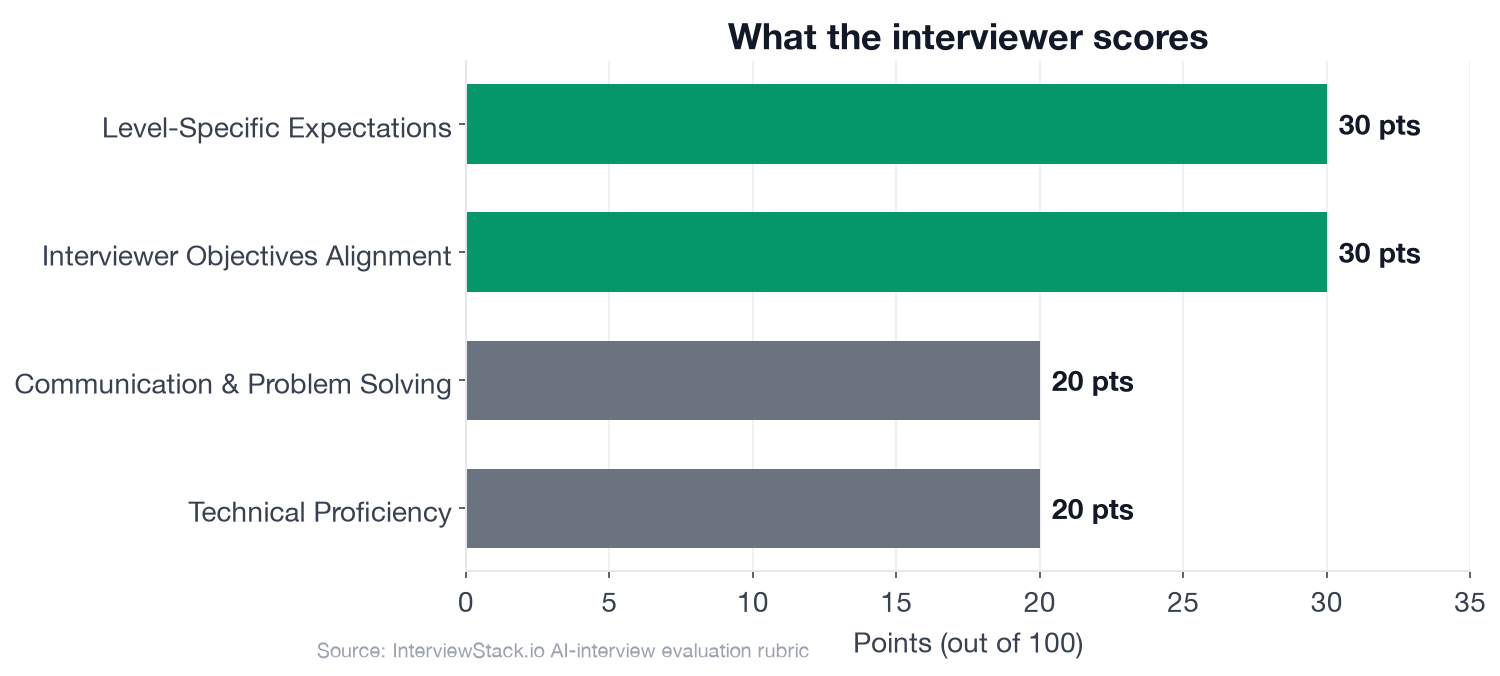
- The rubric totals 100 points: Interviewer Objectives Alignment (30), Level-Specific Expectations (30), Technical Proficiency (20), and Communication and Problem Solving (20).
- Only 20 of 100 points reward technical accuracy. 60 points reward meeting the objectives and showing mid-level judgment.
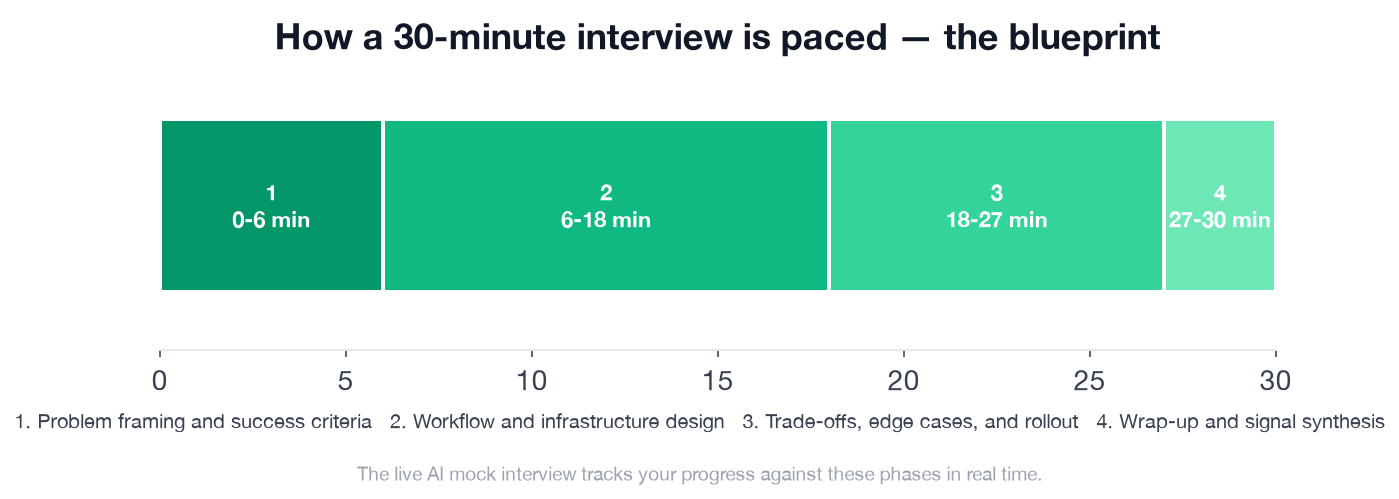
- The interview runs 30 minutes across 4 phases; workflow and infrastructure design is the longest at 12 minutes (minutes 6-18).
- 14 checklist items are scored: 3 in framing, 4 in design, 4 in trade-offs and rollout, and 3 in wrap-up.
- The interviewer has 6 scripted follow-ups; this walkthrough dramatizes 4 of them.
- Level-Specific Expectations lists 5 bars for a mid-level candidate, including defining a minimal adoption path.
- 4 topics are explicitly out of scope, including novel ranking model architecture and GPU kernel optimization.
What Does a Research Scientist Reproducibility Interview Actually Score?
The rubric weights judgment over raw technical accuracy: 30 points go to Level-Specific Expectations and another 30 to the interviewer's objectives, against only 20 for Technical Proficiency.
Here is the scenario as the candidate sees it.
The interview question
You are joining a research team that trains ranking and recommendation models for a large consumer product. A paper-ready offline gain was reported by one researcher, but two teammates cannot reproduce the result three weeks later. The original run used a mix of notebook code, ad hoc data extracts from a feature store, manually edited config files, and model checkpoints saved to personal cloud storage. The team has 6 researchers and 3 research engineers, runs dozens of experiments per week, and needs a workflow that supports fast iteration without creating heavy process overhead.
How would you design a reproducible research workflow for this team so that a result can be reliably recreated and audited by someone else a month later?
Behind that question, the interviewer is probing whether you can reason across code, data, environments, and model artifacts, pick lightweight but reliable tracking, name the failure modes that block reproduction, and balance rigor against overhead.
Four Follow-Ups, One Habit: Design for the Person Who Reruns It
Turn 1: What Must Every Run Capture?
Interviewer: "What exact artifacts and metadata would you require every experiment run to capture before you would consider it reproducible?"
Turn 2: Data Too Big for Git
Interviewer: "How would you handle datasets or feature snapshots that are too large or too dynamic to version directly in Git?"
Turn 3: Same Code, Different Metrics
Interviewer: "Suppose two reruns with the same code and config still produce slightly different metrics. How would you investigate and decide whether the result is reproducible enough?"
Turn 4: Minimum Viable Infrastructure
Interviewer: "If the team resists a heavyweight platform migration, what is the minimum viable infrastructure you would put in place first?"
Why Would Reading This Be Enough to Pass?
It would not. Every mistake above is easy to spot on the page. Under a 30-minute clock, with a follow-up you did not script, the instinct is to name a familiar tool and keep talking. The skill is holding the whole checklist in your head while you answer, and that only comes from repetition.
What Does the Full Blueprint Check Across All 30 Minutes?
This is the blueprint a strong candidate hits, phase by phase. It is also what the AI mock interview tracks you against in real time.
- ✓Asks or states reasonable assumptions about experiment scale, compute environment, and expected reproduction fidelity
- ✓Defines a concrete target such as rerunning a past experiment and matching metrics within an acceptable tolerance
- ✓Surfaces at least a few likely root causes from the scenario instead of jumping straight to tools
- ✓Covers versioned code commits, structured configs, dataset or feature snapshot identifiers, environment capture, model artifact storage, and metric logging
- ✓Explains how notebook exploration graduates into a reproducible pipeline or script for important results
- ✓Proposes a source of truth for runs and artifacts that teammates can access after the original author is gone
- ✓Mentions deterministic or controlled execution practices such as seed capture, hardware/software metadata, or tolerance bands for stochastic training
- ✓Prioritizes a minimum viable set of controls rather than proposing only an ideal future-state platform
- ✓Addresses large or mutable datasets with practical lineage approaches such as snapshots, partition/version IDs, manifests, or reproducible queries
- ✓Explains how to respond when exact determinism is not feasible, including robustness checks and comparison thresholds
- ✓Includes adoption mechanisms like templates, CI checks, run review expectations, or lightweight documentation standards
- ✓Summarizes a phased plan with immediate actions and follow-on improvements
- ✓Makes ownership boundaries clear across researchers and research engineers
- ✓Shows a balanced view of reproducibility as both an engineering and research quality concern
Run the Rerun Test Yourself
Start the AI mock interview for Research Scientist on reproducibility and research infrastructure. It asks this scenario, follows up on what you actually say, and scores you on all four rubric dimensions. If you want more reps first, the Research Scientist question bank covers the same topic question by question.
FAQ
What does a Research Scientist reproducibility interview actually test?
It tests whether you can design a team-friendly workflow that lets someone else recreate and audit a result a month later. The 100-point rubric gives 30 points to Interviewer Objectives Alignment, 30 to Level-Specific Expectations, 20 to Technical Proficiency, and 20 to Communication and Problem Solving.
How long is this interview and how is the time split?
It runs 30 minutes across 4 phases: problem framing (minutes 0-6), workflow and infrastructure design (6-18, the longest at 12 minutes), trade-offs and rollout (18-27), and wrap-up (27-30).
Do I need to name specific experiment-tracking tools?
No. The mid-level bar says you may not know every specialized tool, but you should translate principles into workable team processes. Naming a tracker without explaining what it must capture and who owns it earns little.
What should every experiment run capture to count as reproducible?
A code commit, a structured config, a dataset or feature snapshot identifier, the environment, seeds and hardware metadata, the model artifact, and the logged metrics. The blueprint's design phase covers these across two checklist items: one for commits, configs, snapshots, environment, artifacts, and metrics, and one for seed capture and hardware/software metadata.
What if two reruns with identical code and config give slightly different metrics?
Investigate the sources of nondeterminism, then agree on a tolerance band and run robustness checks such as multiple seeds. The blueprint rewards a comparison threshold, not a demand for bit-exact results.
What is out of scope for this interview?
Four areas: designing a novel ranking model architecture, deep distributed systems internals unrelated to reproducibility, pure product strategy or launch decisions, and low-level compiler or GPU kernel optimization.
How can I practice this interview before the real thing?
Run the InterviewStack.io AI mock interview for Research Scientist on reproducibility and research infrastructure. It follows the same phase-by-phase blueprint, asks follow-ups based on what you actually say, and scores you on all four rubric dimensions.
The Artifact Outlives the Author
A workflow is reproducible only if the person who wrote it can leave and the result still reruns. Practice saying that out loud, with the checklist in mind, before the interviewer asks.
Topics
Ready to practice?
Put what you've learned into practice with AI mock interviews and structured preparation guides.