
A Complete Threat Model Can Still Fail This Interview
A mid-level Security Architect gets handed a familiar-sounding scenario: a B2B SaaS platform wants to let enterprise admins connect Google Drive, OneDrive, or Box so employees can search and preview files inside the product. OAuth, multi-tenant data, cached previews, an 8-week deadline. The instinct is to be thorough: enumerate every threat, cover every STRIDE category, cite the compliance frameworks. That instinct is exactly what costs points.
We built this walkthrough from a real AI-interview blueprint for a mid-level Security Architect on threat modeling and risk assessment, the same structured package (phases, checklist items, rubric weights) that the AI mock interviewer scores against live. The scenario, phase timing, and follow-up questions below are pulled directly from that blueprint.
Key Findings
- The 100-point rubric splits 30/30/20/20 across Interviewer Objectives Alignment, Level-Specific Expectations, Technical Proficiency, and Communication.
- The 30-minute interview runs four phases: 0-6, 6-18, 18-27, and 27-30 minutes.
- Threat modeling and scenario analysis (minutes 6-18) is the longest phase at 12 minutes and carries 4 explicit checklist items.
- Risk prioritization and mitigation planning (minutes 18-27) runs 9 minutes and is graded on ranking risks, not just listing them.
- Only 3 of the 30 minutes (27-30) are reserved for landing a clear go, go-with-conditions, or no-go recommendation.
- 4 topics, including reverse engineering and exploit-code writing, are explicitly out of scope and cost time if a candidate wanders into them.
- Every recommended mitigation is judged against a fixed constraint: engineering has 8 weeks to ship the MVP.
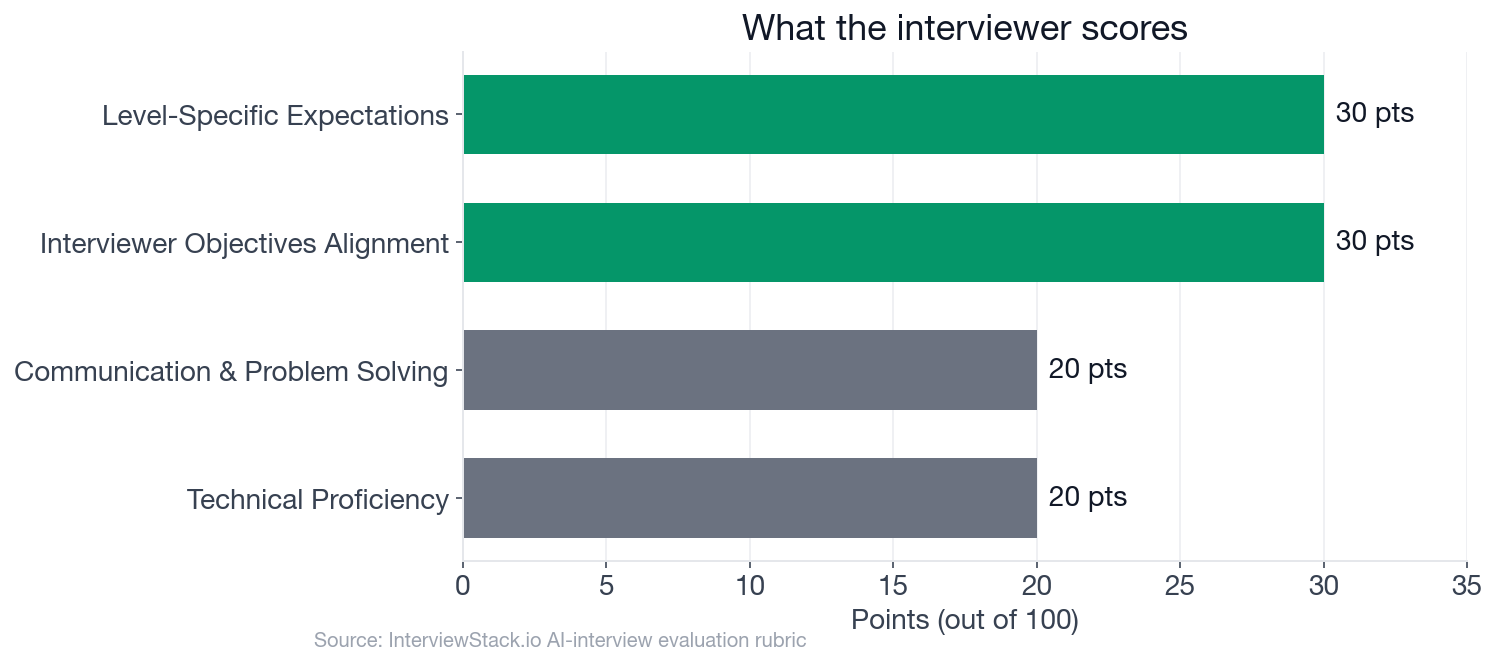 The two framing-and-judgment dimensions carry 60 of the 100 points, more than technical accuracy and communication combined.
Inside a Security Architect Threat Modeling and Risk Assessment Interview
This is the question a mid-level Security Architect candidate is given, word for word from the blueprint:
The interview question
A product team is preparing to launch a new feature for a B2B collaboration platform used by enterprise customers. The feature lets customer admins connect their company Google Drive, OneDrive, or Box account so employees can search for and preview documents from those providers directly inside the platform.
Current environment: the platform is a multi-tenant SaaS application running in a public cloud. Authentication into the platform is through SSO for most enterprise customers. The new integration will use OAuth to access third-party file providers. The system will store file metadata for search indexing and cache short-lived document previews. Some customers operate in regulated environments and are sensitive to data residency, insider access, and auditability. The engineering team wants to ship an MVP in 8 weeks and is asking Security for a threat model and risk assessment before launch.
Walk me through how you would threat model and assess the risk of this feature before launch, and what recommendations you would give the team.
The interviewer isn't scoring whether you can list threats. The objective is narrower and harder: build a structured threat model of this specific architecture, reason about likelihood and business impact rather than generic severity, prioritize a small set of MVP-appropriate mitigations, and communicate a launch recommendation that engineering and compliance stakeholders can both act on, all inside 30 minutes.
Where the 8-Week Deadline Starts Costing Points
The blueprint scores four follow-up moments especially hard. Here's how a technically capable candidate, we'll call him Marcus, loses points at each one, and what the stronger version of the same answer looks like.
Turn 1: Assets Before Architecture Diagrams
Interviewer: "What assets, trust boundaries, and entry points would you identify first in this design, and which ones matter most for the MVP decision?"
Turn 2: Scenarios Tied to This Architecture, Not a STRIDE Recitation
Interviewer: "How would you reason about the highest-risk abuse scenarios involving OAuth tokens, cross-tenant access, and cached previews?"
Turn 3: Ranking, Not Just Listing
Interviewer: "If the product team says they need fast search quality and wants to retain metadata and previews longer, how would you evaluate that trade-off, and how would you prioritize findings if engineering can only address a small number of issues before the 8-week launch?"
Turn 4: One Set of Risks, Two Audiences
Interviewer: "How would you explain the top risks and launch recommendation differently to the engineering manager versus a security or compliance stakeholder?"
Why Reading This Isn't Enough
Spotting Marcus's mistakes on the page is easy; the answers are laid out right next to the questions. Spotting them live, in your own words, while the interviewer is already asking the next follow-up, is a different skill entirely. There's no pause button on a real interview, and no green box telling you which sentence just cost you points. That gap only closes with reps under real time pressure, which is what the Security Architect question bank and interactive courses are built for, and what a live mock interview actually tests.
The Blueprint a Strong Candidate Hits
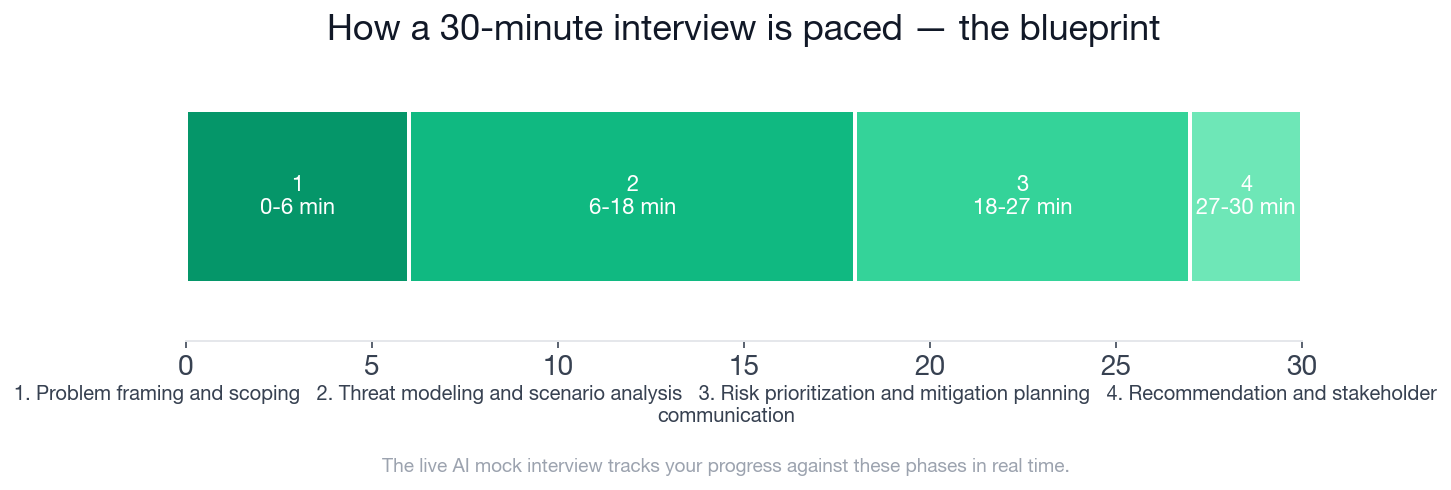 Threat modeling and scenario analysis alone claims 12 of the 30 minutes, more than the other three phases combined.
This is the exact blueprint the AI mock interviewer tracks in real time, phase by phase, checklist item by checklist item, as you talk:
- ✓Clarifies or states reasonable assumptions about OAuth integration, metadata indexing, preview caching, and multi-tenant boundaries
- ✓Identifies key assets such as OAuth tokens, document contents, metadata, tenant identity context, search index, cached previews, and audit logs
- ✓Names relevant actors such as enterprise admins, end users, external attackers, malicious insiders, compromised customer accounts, and third-party provider dependencies
- ✓Calls out major trust boundaries between SaaS application, customer tenant context, third-party storage providers, cloud storage/cache, and internal admin access
- ✓Uses a structured lens such as STRIDE, attack trees, or data-flow-based analysis to organize threats
- ✓Surfaces realistic scenarios such as over-broad OAuth scopes, token theft or replay, broken tenant isolation in indexing or caching, insecure preview generation, stale authorization after user offboarding, excessive admin access, and malicious file content or preview rendering abuse
- ✓Considers both direct technical threats and operational threats such as third-party API outages, logging gaps, and misconfiguration by customer admins
- ✓Explains why some threats are lower priority for MVP while keeping focus on document confidentiality, authorization integrity, and tenant separation
- ✓Ranks top risks with explicit likelihood and impact reasoning rather than generic severity labels only
- ✓Recommends concrete MVP controls such as least-privilege OAuth scopes, encrypted and tightly scoped token storage, service-to-service identity hardening, per-tenant authorization checks on indexing and preview retrieval, short TTL and isolation for caches, regional storage constraints where needed, and auditable admin actions
- ✓Suggests sensible compensating controls such as feature flags, tenant allowlisting, limited file type support, reduced preview retention, manual review for regulated customers, or phased rollout
- ✓Includes logging and monitoring requirements such as anomalous token use, cross-tenant access attempts, preview access logs, admin consent changes, and detection for bulk extraction behavior
- ✓States a clear launch recommendation such as go, go with conditions, or no-go
- ✓Separates must-fix items from post-launch improvements
- ✓Explains residual risk and business trade-offs in concise, stakeholder-appropriate language
Practice the Interview, Not Just the Read
Everything above is illustrative coaching, not a transcript to memorize, and this scenario is built to be representative of how a mid-level Security Architect interview runs, not a real company's actual question set. The value is in running it live: start a free AI mock interview on threat modeling and risk assessment and get scored against this exact blueprint in real time, with follow-up questions that adapt to what you actually say. Want more reps on individual concepts first? Work through the threat modeling and risk assessment question bank before you go live.
FAQ
Q. What does a Security Architect threat modeling interview actually test?
Less than half the score is about technical accuracy. The rubric splits 100 points as 30 for Interviewer Objectives Alignment, 30 for Level-Specific Expectations, 20 for Technical Proficiency, and 20 for Communication and Problem Solving, so 60 of 100 points reward how well you frame, prioritize, and communicate the threat model, not just whether you can name STRIDE categories.
Q. How long is a typical Security Architect threat modeling interview?
30 minutes, structured into four phases: problem framing and scoping (0-6 minutes), threat modeling and scenario analysis (6-18 minutes, the longest phase), risk prioritization and mitigation planning (18-27 minutes), and recommendation and stakeholder communication (27-30 minutes).
Q. Do I need to use STRIDE or a formal risk framework to pass?
You need to use at least one structured lens, such as STRIDE or attack trees, and apply it pragmatically to the actual architecture in front of you. A mid-level candidate is not expected to run a full enterprise risk-governance process or formal FAIR-style quantification unless the interviewer asks for it.
Q. What's the biggest mistake candidates make when prioritizing risks?
Treating every finding as equally critical. The rubric explicitly rewards ranking risks by likelihood and business impact, not by technical severity alone, and expects a candidate to separate must-fix issues from items that can wait until after launch.
Q. How much threat-modeling detail does an 8-week MVP launch need?
Enough to cover the assets and trust boundaries that matter for this specific launch, such as OAuth tokens, tenant isolation, and cached previews, plus a small set of concrete, shippable mitigations. Enterprise-wide risk programs and exhaustive compliance interpretation are explicitly out of scope for a mid-level candidate.
Q. What should I avoid discussing in a Security Architect interview like this one?
The blueprint marks deep reverse engineering or malware analysis, writing exploit code, detailed legal or contractual privacy interpretation, and low-level cloud infrastructure performance tuning as out of scope. Time spent there is time not spent on the checklist items that are actually graded.
Q. How can I practice a threat modeling interview like this before the real one?
Run a live mock interview that follows the same phase structure and rubric described here, so you get timed practice building and defending a prioritized threat model under follow-up questions instead of just reading about one.
The Deadline Was Always Part of the Rubric
The 8-week constraint in this scenario isn't set dressing. It's the filter the rubric uses to separate a candidate who knows threat modeling from one who can practice security architecture under real business pressure. A complete threat model that ships in 8 weeks beats an exhaustive one that doesn't ship at all, and that judgment call is exactly what gets scored in the last three minutes.
Topics
Ready to practice?
Put what you've learned into practice with AI mock interviews and structured preparation guides.