
Your Severity Call Is Graded Before You Touch a Dashboard
You are the on-call SRE. It is 19:40 during a product launch, and the public API gateway in one region has gone from 0.2% to 12% errors in 8 minutes. You know severity matrices cold. The interviewer still asks for your first call and your paging order, and a prepared candidate loses points on exactly those two answers.
This post walks one 30-minute, mid-level SRE mock interview turn by turn, built from a real AI interview blueprint. The candidate answers are dramatized and illustrative, never a transcript of a real person or a real company's questions.
Key Findings
- The interview is scored out of 100 points; Interviewer Objectives Alignment and Level-Specific Expectations are worth 30 points each, so 60 points reward judgment over tooling.
- Technical Proficiency is only 20 of 100 points, the same weight as Communication and Problem Solving.
- The blueprint runs 30 minutes in 3 phases: 8 minutes of triage, 10 minutes of responder engagement, and 12 minutes of thresholds, communication, and authority limits.
- The scenario starts with errors rising from 0.2% to 12% in 8 minutes in 1 region while other regions stay healthy.
- A traffic-routing config rollout completed 15 minutes before the scenario begins, and the blueprint expects you to name it as an early hypothesis.
- The 3 phases list 15 checklist items (5 each), and the opening question asks for your plan for the first 15 minutes.
What Is the SRE Incident Severity Interview Really Testing?
It tests whether you can make a defensible first severity call from partial signals, then escalate without overpaging or going quiet.
The interview question
You are the primary on-call SRE for a large consumer platform. It is 19:40 on a weekday during a major product launch. Alerts fire for elevated 5xxs on the public API gateway in one region. Initial dashboards show request failures rising from 0.2% to 12% over 8 minutes in us-central, while other regions remain healthy. Customer support has started reporting login failures and intermittent checkout errors, but the internal admin console is still working. A recent config rollout to traffic routing completed 15 minutes ago. The product team has a launch event in progress, and leadership is sensitive to customer-visible disruption.
Your environment has a documented severity model, regional service ownership, a network on-call rotation, an application on-call rotation, and an incident commander role that is expected to be activated for higher-severity incidents. Walk me through how you would classify this incident and drive escalation in the first 15 minutes.
Under the surface, the interviewer is probing judgment under incomplete information: customer impact, business criticality, responder load, and escalation speed, at the scope of authority of a mid-level SRE.
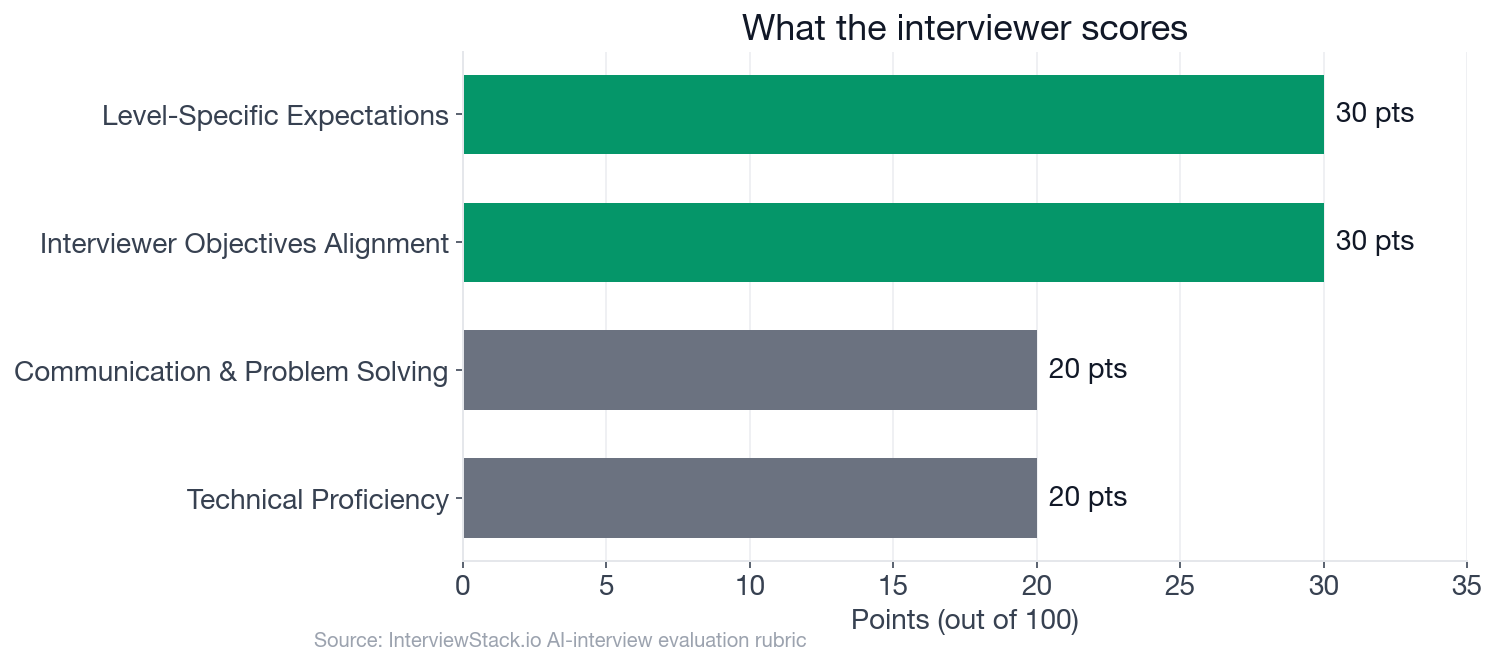
The chart makes the point: 60 of 100 points sit on objectives and level expectations. Judgment under uncertainty outweighs any tool you can name.
Four Turns Where Prepared Candidates Slip
Turn 1: Sev2 or Sev1?
Interviewer: "What signals would make you keep this as a regional Sev2 versus escalating it to a company-wide Sev1?"
Turn 2: Network or application first?
Interviewer: "Who would you page first, and in what order, if you were still uncertain whether this was a network issue or an application regression?"
Turn 3: Silence from the owner
Interviewer: "Suppose the application owner does not acknowledge within the expected SLA; what would you do next?"
Turn 4: Risky rollback decision
Interviewer: "If rollback is possible but carries risk of shifting traffic instability to other regions, how would that affect severity and escalation decisions?"
Why Isn't Reading This Enough?
Spotting these mistakes on the page took seconds. Avoiding them live is different: the clock is running, the interviewer changes a fact mid-answer, and "page both teams in parallel" has to come out of your mouth unprompted. That fluency only comes from reps. You can run this exact scenario as an AI mock interview and get scored on the same four dimensions.
The Complete Blueprint a Strong Candidate Hits
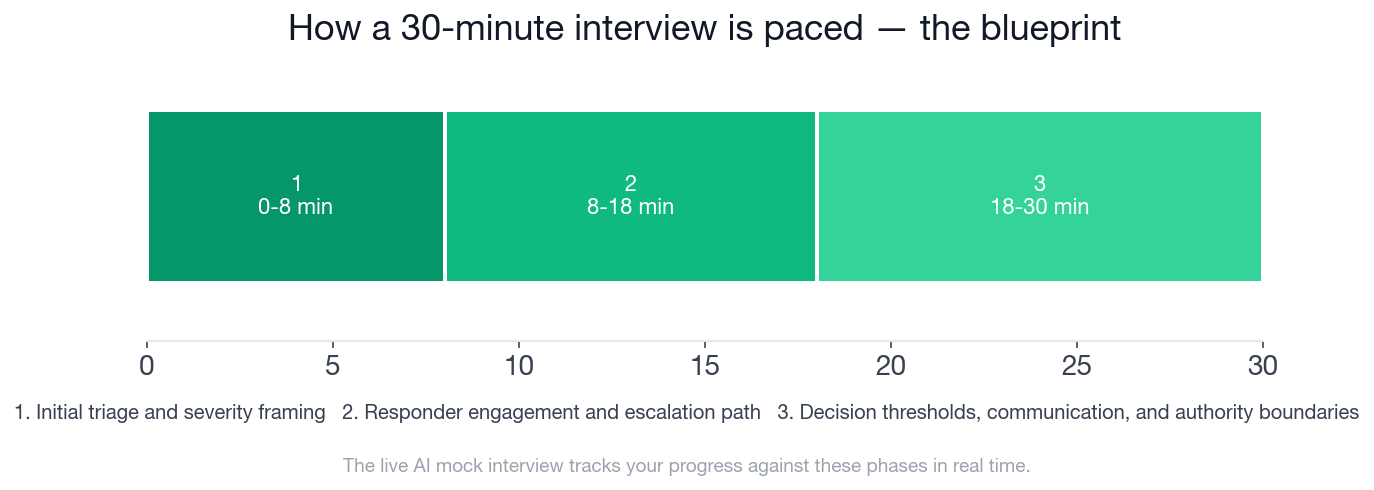
This is the blueprint a strong candidate hits, and it is the same structure the AI mock interview tracks you against in real time.
- ✓States a tentative severity level and explains why
- ✓Distinguishes regional impact from global impact
- ✓References customer-visible failures and affected critical journeys like login or checkout
- ✓Mentions validating whether metrics are real versus alert noise
- ✓Recognizes recent config rollout as an important early hypothesis
- ✓Pages the most likely owning teams based on current evidence
- ✓Uses parallel escalation if network versus application ownership is unclear
- ✓Mentions incident channel/bridge creation or equivalent coordination mechanism
- ✓Defines acknowledgment timeout and fallback escalation behavior
- ✓Identifies when to activate incident commander for higher-severity or cross-team incidents
- ✓Describes explicit triggers for escalating to higher severity
- ✓Explains what status update they would send and to whom
- ✓Balances urgency against risk when discussing rollback or traffic shifts
- ✓Shows awareness of personal authority limits and when to pull in senior help
- ✓Mentions revisiting severity as blast radius or business impact changes
Where to Start Practicing
Start with the live run. Start the AI mock interview for this scenario and see which checklist items you hit unprompted. Then use the Incident Severity Classification and Escalation question bank to rehearse the follow-ups you stumbled on, and browse SRE roles on the job board to see what teams ask for.
FAQ
How long is the SRE incident severity and escalation mock interview?
The blueprint runs 30 minutes in three phases: initial triage and severity framing (minutes 0-8), responder engagement and escalation path (8-18), and decision thresholds, communication, and authority boundaries (18-30).
How is an SRE incident severity interview scored?
Out of 100 points: 30 for Interviewer Objectives Alignment, 30 for Level-Specific Expectations, 20 for Technical Proficiency, and 20 for Communication and Problem Solving. Judgment and seniority signals carry 60 of the 100 points.
Should an SRE page the network team or the application team first?
When the evidence does not separate them, page both in parallel and open one shared incident channel. Serial paging burns minutes you do not have, and the cost of one extra responder is small next to a slow diagnosis.
When should a regional incident become a company-wide Sev1?
Name the triggers in advance: a second region showing errors, a critical journey such as login or checkout failing broadly, error rates still climbing, or a mitigation that risks shifting load. Then say you will revisit severity as blast radius changes.
What do you do when the application owner does not acknowledge a page?
Define the acknowledgment window up front, then fall back to the secondary on-call, then the owning team's manager or an escalation policy, while keeping the incident channel updated. Waiting silently is the failure.
What separates a mid-level SRE answer from a junior one on severity?
A mid-level SRE makes a first severity call alone, with reasons, and knows when to pull in an incident commander rather than carrying a broad incident solo. Redesigning the company's incident framework is not expected.
The Bottom Line
Severity calls are made on incomplete data, so the interview rewards candidates who commit, explain, and name what would change their mind. Rehearse saying that out loud before the real clock starts.
Topics
Ready to practice?
Put what you've learned into practice with AI mock interviews and structured preparation guides.