
The Site Reliability Engineer Incident Command and Leadership Interview Rewards Control, Not a Diagnosis
It's 11:20 AM during a major product launch. Error rates on a consumer-facing API platform have jumped from 0.2% to 18% in the last seven minutes, p99 latency is up 6x, and support is fielding complaints from multiple regions. You're the primary on-call SRE. A dashboard shows elevated saturation in a shared request-routing layer, but nobody knows why yet. Engineers from three different teams are piling onto the bridge, and product leadership wants an ETA in ten minutes. This is the moment a mid-level Site Reliability Engineer incident command interview actually begins, and the instinct that feels most natural, start diagnosing, is the one that costs the most points.
This walkthrough is built from a real InterviewStack.io mock interview blueprint (the same interview_package the AI interviewer scores you against) for the Incident Command and Crisis Leadership topic at the mid-level SRE track. The thesis is in the data itself: three of the four skills this interview explicitly forbids, deep hands-on debugging of the failure mode, low-level network or kernel internals, writing code or infrastructure-as-code live, are precisely the root-causing moves a candidate might reach for under pressure. Being told not to do them is the tell. It's a test of who runs the room while the cause is still unknown, not who finds the bug first.
Key Findings
- The rubric weighs judgment over tooling: Interviewer Objectives Alignment (30 of 100 points) and Level-Specific Expectations (30 of 100 points) outweigh Technical Proficiency (20) and Communication (20) combined.
- Phase 1, "Initial command and stabilization," runs from minute 0 to minute 8 and packs 5 checklist items in before root cause is even discussed.
- The scenario opens with error rates jumping from 0.2% to 18% in 7 minutes and p99 latency up 6x, severe enough to justify full incident command.
- Product leadership asks for an ETA within 10 minutes while root cause is still unconfirmed, and the checklist explicitly penalizes a speculative answer.
- Phase 2, "Decision-making under ambiguity," is the longest stretch at 12 minutes (8-20) and carries 5 checklist items, including making an authority call on disagreement.
- Phase 3, "Stakeholder leadership and incident closure," closes out the 30-minute interview (20-30) and still tests monitoring discipline and postmortem scheduling, not just a stabilized dashboard.
- The interview explicitly forbids deep hands-on debugging of the routing-layer failure mode and low-level network internals, the two most tempting root-cause detours, confirming the interview measures command, not diagnosis.
What Is the Interviewer Actually Watching For at Minute Zero?
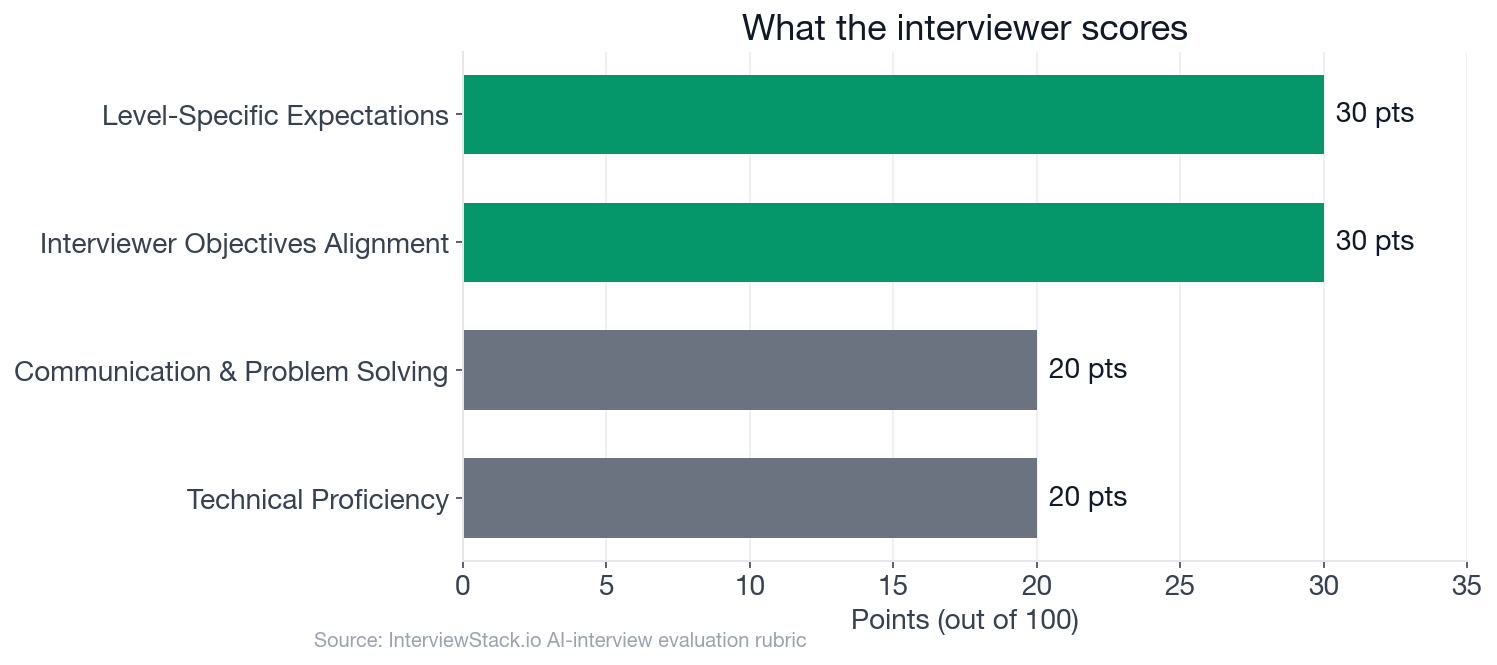
Judgment carries 60 of the 100 points; technical accuracy and communication split the rest evenly. Here's the prompt a mid-level SRE candidate receives, in structure though the company itself is deliberately left unnamed:
The interview question
You are the primary SRE on call for a consumer-facing API platform that serves mobile and web traffic globally. It is 11:20 AM on a weekday during a major product launch. Error rates have jumped from 0.2% to 18% over the last 7 minutes, p99 latency is up 6x, and support has started reporting customer complaints across multiple regions. The dashboard shows elevated saturation in a shared request-routing layer, but the root cause is not yet clear. Several engineers from different teams are joining the incident bridge, and product leadership is asking for an ETA within the next 10 minutes.
Walk me through how you would lead this incident from the moment you take command.
The interviewer isn't grading whether you can name the failing component. Interviewer Objectives Alignment is scored on whether you establish a command structure, create clarity under ambiguity, make timely calls with incomplete information, coordinate technical and non-technical stakeholders, and adapt the plan as new information lands, not whether you correctly guess the routing layer is the culprit.
Four Moments That Separate Command From Chaos
Below are four of the six follow-ups a mid-level candidate, we'll call her Grace, actually gets asked on this topic. Each one tests a different phase of the interview and a different way candidates who know the material still lose points live.
Turn 1: Naming the Command Structure
Interviewer: "How would you structure the bridge in the first few minutes, and what roles would you assign as more people join?"
Turn 2: The Rollback Standoff
Interviewer: "If two senior engineers strongly disagree on whether to roll back a recent change or keep investigating, how would you make the call?"
Turn 3: The ETA Trap
Interviewer: "What would you communicate to leadership and customer-facing teams in the first 15 minutes if you still do not know the root cause?"
Turn 4: Closing Without Cutting Corners
Interviewer: "After service is stabilized, what would you do before closing the incident to ensure the handoff and follow-through are solid?"
Why Isn't Watching This Enough?
Spotting Grace's mistakes on the page is easy, you're reading them with the answer key open. Live, the pressure comes from four directions at once: a bridge full of people looking to you, a leadership channel demanding certainty you don't have, a clock that keeps moving while you think, and follow-ups you haven't seen coming, unscripted, the way the four above actually are in a real session. That combination, not any single fact above, is what this interview is testing, and it only gets built through reps under real time pressure.
What Does a Strong 30-Minute Answer Actually Cover?
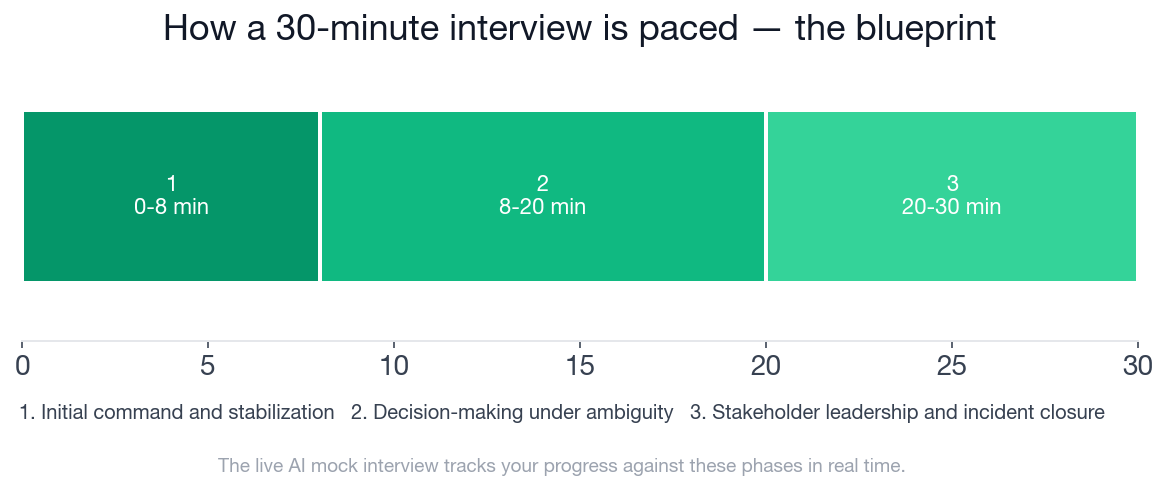
The 30-minute interview is paced into three phases, each with its own checklist; the command decisions made in the first 8 minutes set up everything that follows.
- ✓States they would explicitly assume or confirm incident commander ownership
- ✓Assigns at least core roles such as ops/technical lead and communications lead; may also assign scribe
- ✓Defines immediate objective as reducing customer impact before root cause certainty
- ✓Requests a single source of truth for status and asks responders to avoid ad hoc changes
- ✓Sets a short update cadence such as every 5-10 minutes
- ✓Frames decision options in terms of impact, reversibility, blast radius, and time to execute
- ✓Makes a concrete authority call when presented with disagreement rather than deferring indefinitely
- ✓Distinguishes facts from hypotheses and asks for targeted data to reduce uncertainty
- ✓Explains what success or failure signals would cause them to continue, roll back, or change course
- ✓Reprioritizes if mitigation only partially works or if load continues increasing
- ✓Provides a concise status format including customer impact, actions in progress, current confidence, and next update time
- ✓Avoids giving speculative ETAs when root cause is unknown; gives conditional or milestone-based expectations instead
- ✓Identifies triggers for broader escalation such as prolonged impact, multi-region effects, or executive/customer commitments
- ✓Covers controlled recovery steps, monitoring after mitigation, and decision criteria for stepping down severity
- ✓Mentions incident notes, ownership for follow-up actions, and scheduling or initiating a postmortem
This is the exact blueprint the InterviewStack AI interviewer tracks you against in real time during the live mock interview, phase by phase, checklist item by checklist item, not just a single score revealed at the end.
Run the Bridge Before It's Real
Reading the blueprint tells you what a strong answer includes. Running it live is what tells you whether you can actually produce one while the clock is moving and the follow-ups aren't scripted. Start the mid-level Incident Command and Crisis Leadership mock interview and get scored against this exact rubric, turn by turn, with feedback on the same four dimensions above. If you'd rather build the underlying judgment first, work through the Incident Command and Crisis Leadership question bank, or if you're also prepping the adjacent operational side of the role, see our SRE SLO and error budget interview walkthrough.
FAQ
Q. What does the Site Reliability Engineer incident command and leadership interview actually test?
It tests whether a candidate can run an incident, not whether they can diagnose one. The rubric splits 100 points across Interviewer Objectives Alignment (30), Level-Specific Expectations (30), Technical Proficiency (20), and Communication and Problem Solving (20), rewarding command structure, decision-making under ambiguity, and stakeholder communication over finding the technical root cause.
Q. How long is the mock interview and how is it paced?
The interview runs 30 minutes across three phases: Initial command and stabilization (0-8 minutes), Decision-making under ambiguity (8-20 minutes), and Stakeholder leadership and incident closure (20-30 minutes). Each phase has its own checklist the interviewer scores against in real time.
Q. Do I need deep debugging skills to pass this interview?
No. Deep hands-on debugging of the specific distributed systems failure, writing code or infrastructure-as-code, and low-level network or kernel internals are explicitly outside the scope of this interview. The focus is command, coordination, and decision quality, not root-causing the routing-layer saturation.
Q. Should I give leadership an ETA if I don't know the root cause yet?
No. The rubric explicitly penalizes speculative ETAs when root cause is unknown. A stronger answer gives a structured status (impact, working theory, mitigation in progress, next update time) with conditional or milestone-based language instead of a fabricated resolution time.
Q. What happens if two engineers disagree about rolling back a change?
A mid-level candidate is expected to make a concrete authority call rather than let the disagreement run unresolved. Framing the decision around reversibility, blast radius, and time to execute, then owning the call publicly, is what the Decision-making under ambiguity phase rewards.
Q. What level of incident command is expected at the mid-level?
Mid-level candidates are expected to competently lead a straightforward but high-pressure incident: create structure, gather the right people, and choose between a small number of plausible mitigations without perfect information. They are not expected to invent deep cross-organization command frameworks, but should recognize when to escalate for broader coordination.
Q. How is incident closure evaluated in this interview?
Closure is scored on operational follow-through, not just a recovering dashboard: a concise status update, controlled recovery and monitoring, clear criteria for stepping down severity, and mentioning incident notes, action-item ownership, and scheduling a postmortem before ending the bridge.
Command First, Cause Later
The routing layer eventually gets fixed either way. What decides this interview is who owns the bridge in the first ninety seconds, who makes the rollback call at minute twelve, and who has the discipline to say "no ETA yet" instead of a guess. Practice that under a clock, not just on the page.
Topics
Ready to practice?
Put what you've learned into practice with AI mock interviews and structured preparation guides.