
This Role's Own Name Isn't Its Top Requirement
If you assume "site reliability" experience is what gets a resume through the door for a Site Reliability Engineer posting, the data says otherwise. Across 3,491 active SRE postings on the InterviewStack.io job board, the phrase "site reliability" itself shows up in 43.5% of listings, and "site reliability engineering" in just 21.7%. Neither clears the 50% mark we use to call a skill table stakes. The only three skills that do: Automation (57.9%), Monitoring (56.9%), and Python (50.3%), none of which are unique to SRE at all.
That's not a data quirk. It's a real signal about what this role has become: a generalized ops and automation discipline that happens to carry a specific title, hired against a checklist of platform tools rather than a vocabulary match. And the skills that actually move salary tell a sharper story still, with a handful of specialized platform tools paying two to three times the premium of the skills every posting asks for.
Key Findings
- Automation (57.9%), Monitoring (56.9%), and Python (50.3%) are the only skills that clear the 50% table-stakes bar across 3,491 postings; "site reliability" itself sits at 43.5%.
- Pulumi carries the single largest US salary premium at $192,400 median (+$40,400 over the $152,000 baseline, n=27).
- Datadog appears in just 15.7% of postings but adds $32,700 to the median, more than double what Automation or Python add.
- Kubernetes (39.2%) and Terraform (36.4%) form the highest-lift skill pair in the dataset at 1.94x co-occurrence.
- Entry-level postings are just 1.9% of the market (65 of 3,491), one of the thinnest entry paths on the board.
- Onsite work dominates at 56.3% of postings; only 17.8% are fully remote.
- The US accounts for 40.2% of postings, followed by India at 12.6%.
What Actually Counts as Table Stakes for an SRE in 2026?
Only three skills clear the 50% threshold we use to define table stakes: a skill so common that not having it is disqualifying. Automation leads at 57.9% (2,020 of 3,491 postings), Monitoring follows at 56.9% (1,986), and Python rounds it out at 50.3% (1,756). Everything else, including the tools most people associate with SRE work by default, sits in the common tier (20-50% of postings) or the differentiator tier (5-20%).
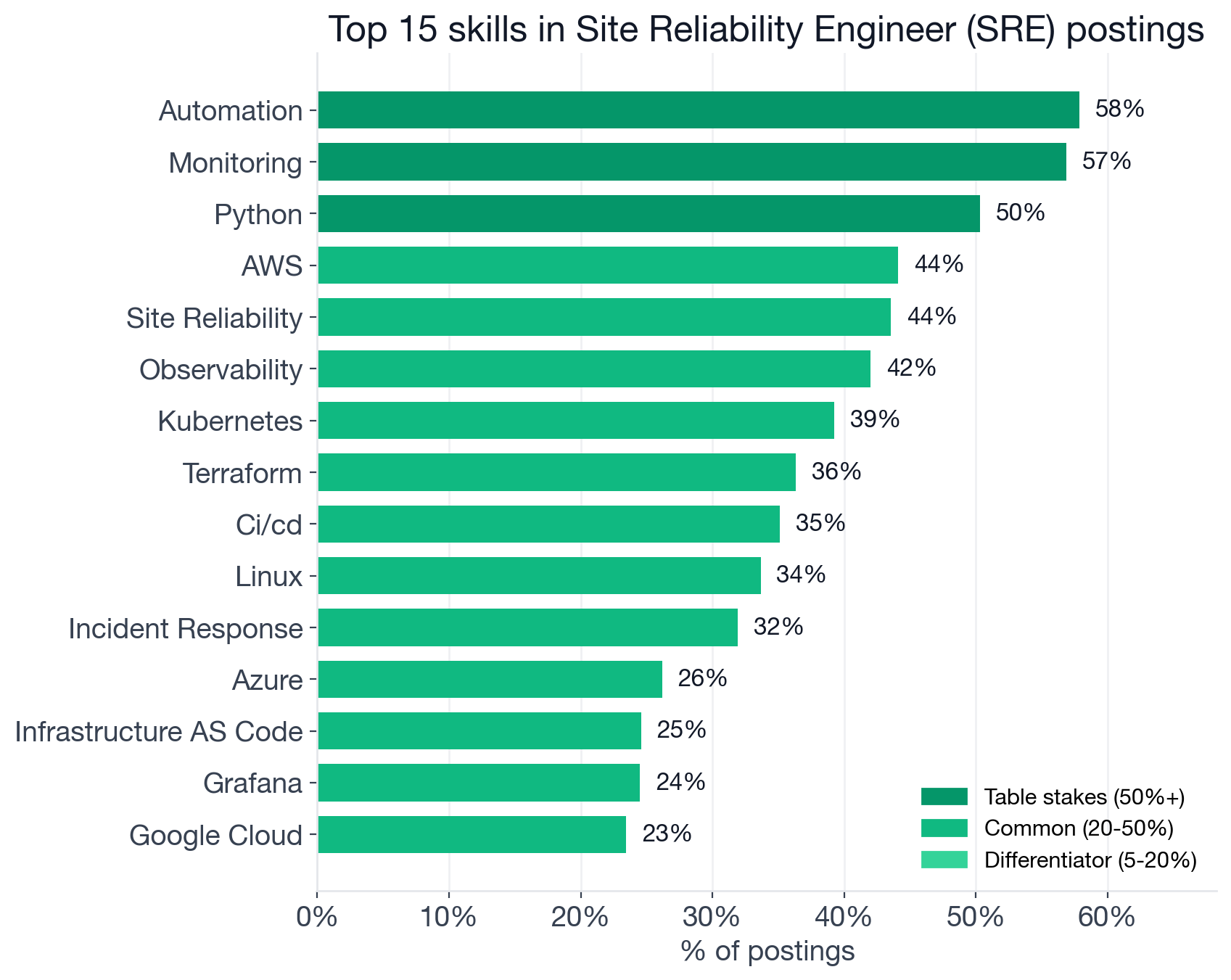 Automation, Monitoring, and Python are the only skills above the 50% table-stakes line; everything else, including "site reliability" itself, falls into the common tier.
| Tier | Skill | % of Postings |
|---|---|---|
| Table stakes (50%+) | Automation | 57.9% |
| Table stakes (50%+) | Monitoring | 56.9% |
| Table stakes (50%+) | Python | 50.3% |
| Common (20-50%) | AWS | 44.1% |
| Common (20-50%) | Site Reliability | 43.5% |
| Common (20-50%) | Observability | 42.0% |
| Common (20-50%) | Kubernetes | 39.2% |
| Common (20-50%) | Terraform | 36.4% |
| Common (20-50%) | CI/CD | 35.1% |
The practical read: a candidate coming from a general DevOps, platform, or backend-ops background who can script automation, has read a monitoring dashboard in anger, and knows Python is more qualified on paper than the raw skill match suggests, even without "SRE" anywhere on their resume. What separates a strong SRE candidate from a generalist isn't the vocabulary; it's what shows up next in the differentiator tier: Ansible (19.0%), Docker (18.6%), Incident Management (17.6%), and Datadog (15.7%). Those are the skills that actually separate candidates once the table-stakes bar is cleared, and, as the salary data below shows, they're also where the money is.
Which Skills Actually Pay More Than the SRE Baseline?
Among US postings, where wage-transparency laws produce consistent disclosure, the median Site Reliability Engineer base salary is $152,000 (n=851). This figure is base pay only: equity, bonus, and sign-on aren't disclosed in job postings, so total compensation at well-funded employers runs meaningfully higher than what's reported here.
The premium structure has three distinct bands, and the table-stakes skills sit at the bottom of it. Automation (+$12,500), Python (+$10,500), and Monitoring (+$8,700) each add less than $13,000 over baseline, despite being required in a majority of postings. Cloud-native infrastructure skills like Kubernetes (+$20,000) and Terraform (+$18,800) bridge the middle. But the real premium lives in a small cluster of specialized platform tools: Pulumi (a code-first infrastructure-as-code tool, an alternative to Terraform using real programming languages instead of a config DSL), ArgoCD (a GitOps continuous-delivery tool that syncs Kubernetes clusters to a Git repository), CloudFormation (AWS's native infrastructure-as-code service), Okta (an identity and access management platform), and Datadog each add $32,700 to $40,400 over the baseline, roughly three times what the required skills add.
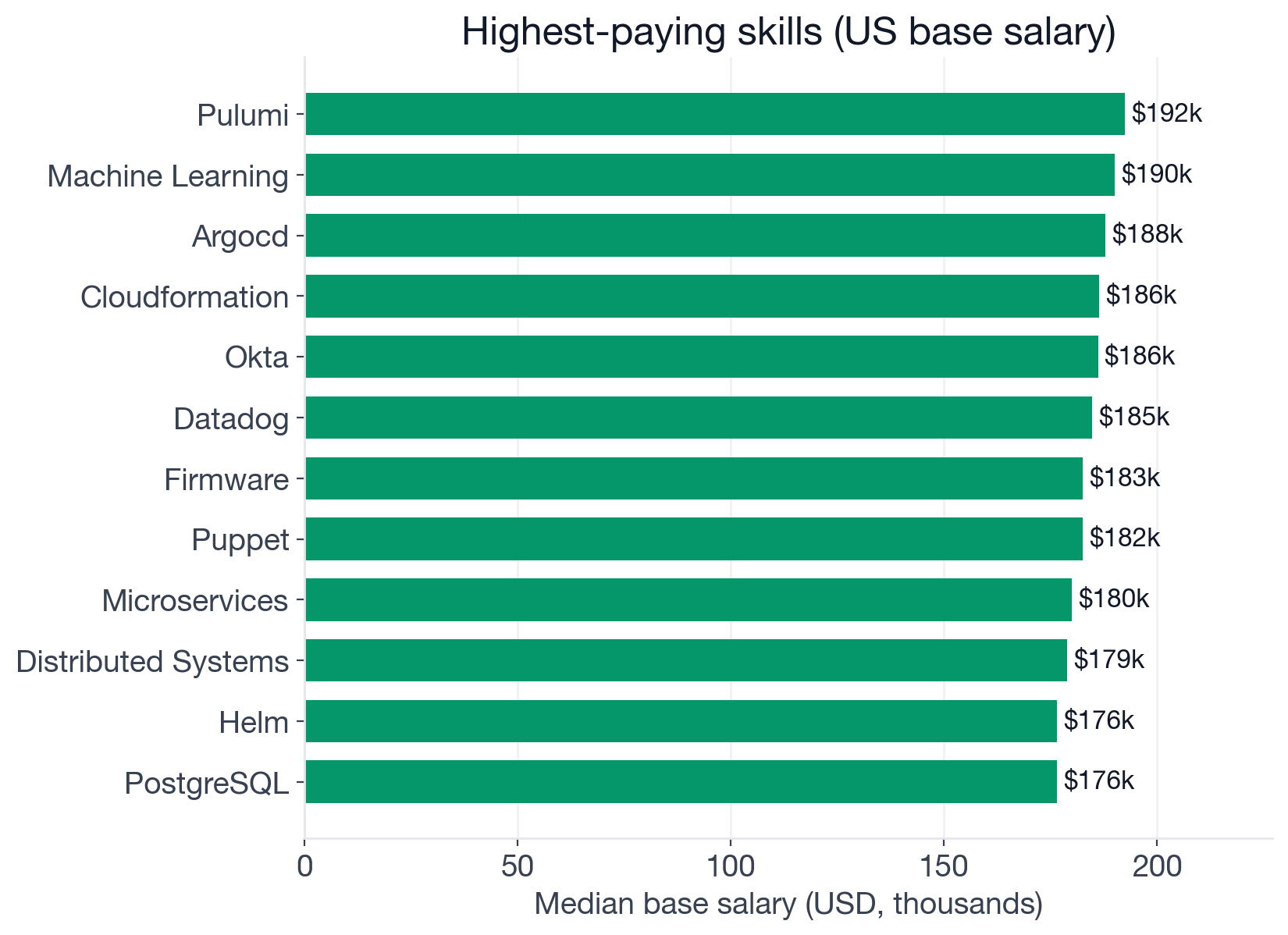 The skills every posting requires pay the smallest premiums; the skills that separate SRE tiers, GitOps-native deployment tooling and identity platforms, pay two to three times more.
| Skill | US Median Salary | Premium vs. Baseline | Sample Size |
|---|---|---|---|
| Pulumi | $192,400 | +$40,400 | 27 |
| ArgoCD | $187,800 | +$35,800 | 44 |
| CloudFormation | $186,400 | +$34,400 | 38 |
| Okta | $186,100 | +$34,100 | 25 |
| Datadog | $184,700 | +$32,700 | 76 |
| Kubernetes | $172,000 | +$20,000 | 301 |
| Terraform | $170,800 | +$18,800 | 270 |
| Automation | $164,500 | +$12,500 | 504 |
| Python | $162,500 | +$10,500 | 413 |
| Monitoring | $160,700 | +$8,700 | 465 |
Datadog, the only one of the top five paying skills with measurable posting frequency, shows up in just 15.7% of postings; the other four, Pulumi, ArgoCD, CloudFormation, and Okta, are specialized enough that they fall outside the 50 skills we track for frequency at all. That's the fault line: employers expect Automation, Monitoring, and Python from everyone, but they pay for Datadog, GitOps tooling, and identity platform depth, the layer that shows up once a team has outgrown basic scripting and needs someone who can own a modern deployment and access-control stack end to end.
The Skill Stack Behind a Job That Has No Single Definition
The umbrella taxonomy bundles most SRE-native vocabulary, Site Reliability, Observability, CI/CD, Incident Response, SLO/SLI (service-level objectives and indicators), Scalability, and Disaster Recovery, into a generic catch-all because these practices don't map cleanly onto categories built for other engineering roles. Read literally, 93.9% of postings touch at least one term from that bucket; read practically, it confirms the role is defined by a cluster of operational practices rather than one flagship skill.
The two umbrellas that do map cleanly are more informative. Tools & Infrastructure appears in 81.2% of postings (Automation, Monitoring, Kubernetes, Terraform, Linux, Ansible, Docker) and is the closest thing to a coherent "SRE toolchain." Coding Languages shows up in 57.1% (Python, Bash, Java), confirming scripting fluency is assumed rather than optional. Cloud Platforms rounds out the core stack at 53.1%, split across AWS (44.1%), Azure (26.2%), and Google Cloud (23.5%), meaning most SREs need working familiarity with more than one provider rather than deep specialization in a single one.
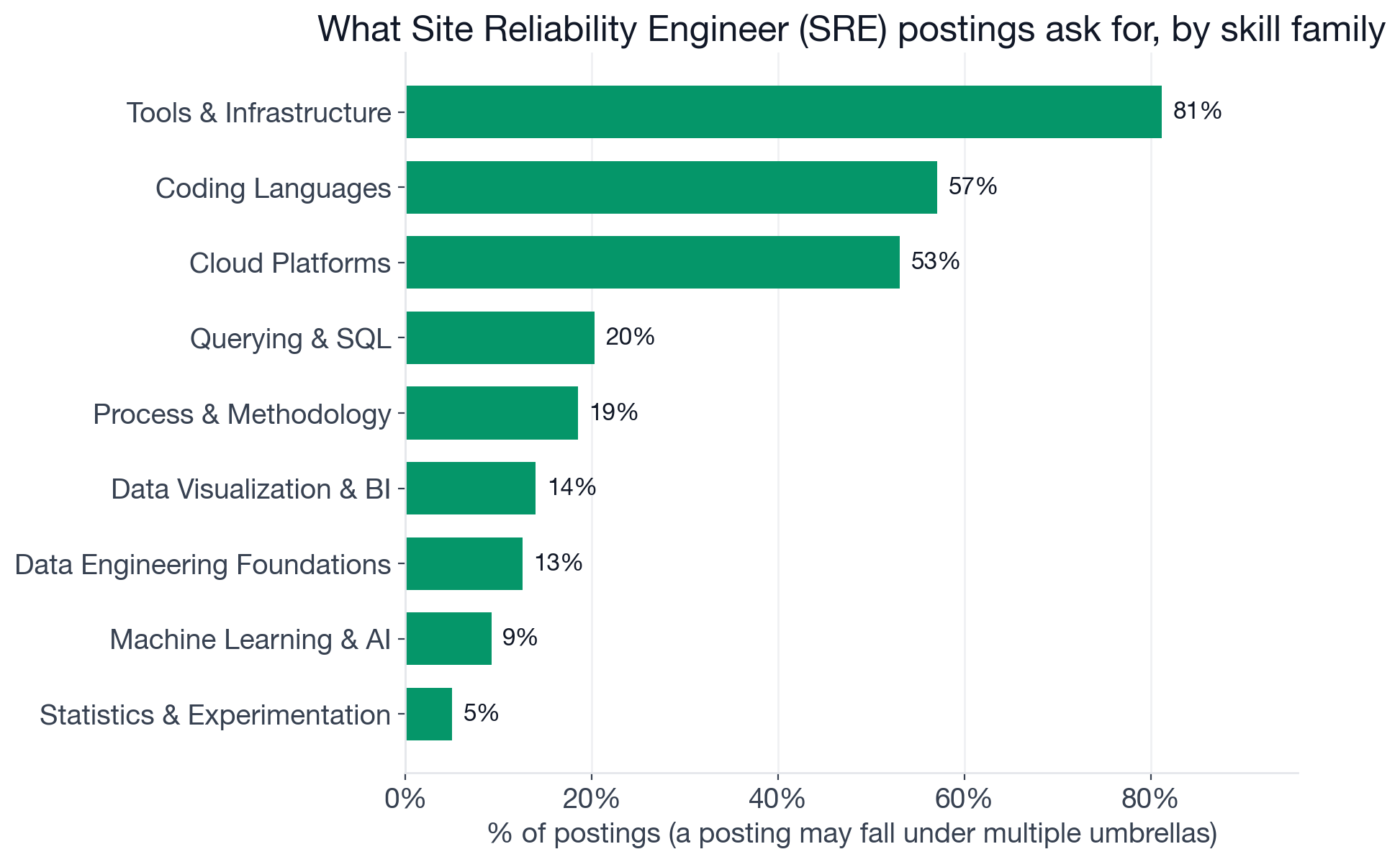 Tools & Infrastructure (81.2%) and Coding Languages (57.1%) are the two umbrellas with a clean read: SRE is an operations-and-scripting discipline first.
The Kubernetes and Terraform Pairing Defines Modern Ops
Among the 25 most-demanded skills, one pair stands out from every other combination in the dataset. Kubernetes and Terraform co-occur in 27.6% of postings (965 of 3,491), a lift of 1.94x, nearly double what independent demand for each skill would predict. No other pair in the dataset comes close: AWS and Terraform (1.67x), Kubernetes and Observability (1.66x), and AWS and Kubernetes (1.55x) are the next tier down.
| Skill Pair | Co-Occurrence | Lift |
|---|---|---|
| Kubernetes + Terraform | 27.6% | 1.94x |
| AWS + Terraform | 26.8% | 1.67x |
| Kubernetes + Observability | 27.4% | 1.66x |
| AWS + Kubernetes | 26.8% | 1.55x |
| Kubernetes + Site Reliability | 26.6% | 1.56x |
| Observability + Site Reliability | 28.0% | 1.53x |
| Automation + Incident Response | 27.9% | 1.51x |
| CI/CD + Python | 26.3% | 1.49x |
The story here is straightforward: cloud-native orchestration and infrastructure-as-code have merged into a single expected competency. If a posting mentions container orchestration, it's asking for the ability to provision that infrastructure declaratively too, not just run kubectl commands against a cluster someone else built. That combination, plus the Observability and Incident Response pairing right behind it, is the practical definition of what "SRE" means operationally in 2026, even when the words "site reliability" never appear in the listing.
Where Does AI Actually Fit for This Role Right Now?
Machine Learning & AI skills appear explicitly in just 9.2% of SRE postings (322 of 3,491), the smallest umbrella share in the dataset. Read narrowly, that's correct: most SRE postings are about keeping existing, non-AI systems reliable, not building AI products, so 9.2% measures SREs hired specifically for AI-adjacent infrastructure work (MLOps-flavored reliability, AI-serving uptime), not whether SREs use AI tools day to day.
On the ambient-usage side, the picture is different. General developer surveys put AI tool adoption at 84% to 85% across engineering roles, with roughly half of developers using AI tools daily (Stack Overflow 2025 Developer Survey). For SREs specifically, adoption sentiment has swung hard in one direction: Catchpoint's 2026 SRE Report, surveying 418 SRE practitioners, found optimism about AI's impact on the role climbed from 25% to 60% year over year while skepticism dropped from 44% to 21%. The actual toil-reduction impact is more contested: 49% of respondents report AI has genuinely reduced their toil, while the rest report no change or more work, a real split rather than a rounding error, and individual contributors are notably more skeptical (38% report reduced toil) than their engineering directors (60%). Agentic "AI resolves the incident autonomously" tooling is still early: Gartner projects that 70% of enterprises will deploy agentic AI as part of IT infrastructure operations by 2029, up from under 5% in 2025, a broader I&O category that covers the AIOps and incident-automation tooling SRE teams are just starting to evaluate, not an SRE-specific figure.
For a working SRE, "AI-literate" currently means comfortable using Copilot or ChatGPT for scripting and IaC, evaluating emerging AIOps and incident-response tooling as it matures, and staying appropriately cautious about trusting autonomous remediation you can't fully audit, not a line item most postings state outright.
Who's Hiring at Which Seniority Level?
Mid-level roles dominate at 50.2% of postings (1,754 of 3,491), with senior at 33.8% (1,179) and staff at 14.1% (493). Entry-level is nearly nonexistent at 1.9% (65 postings), one of the thinnest entry paths among the roles we've analyzed.
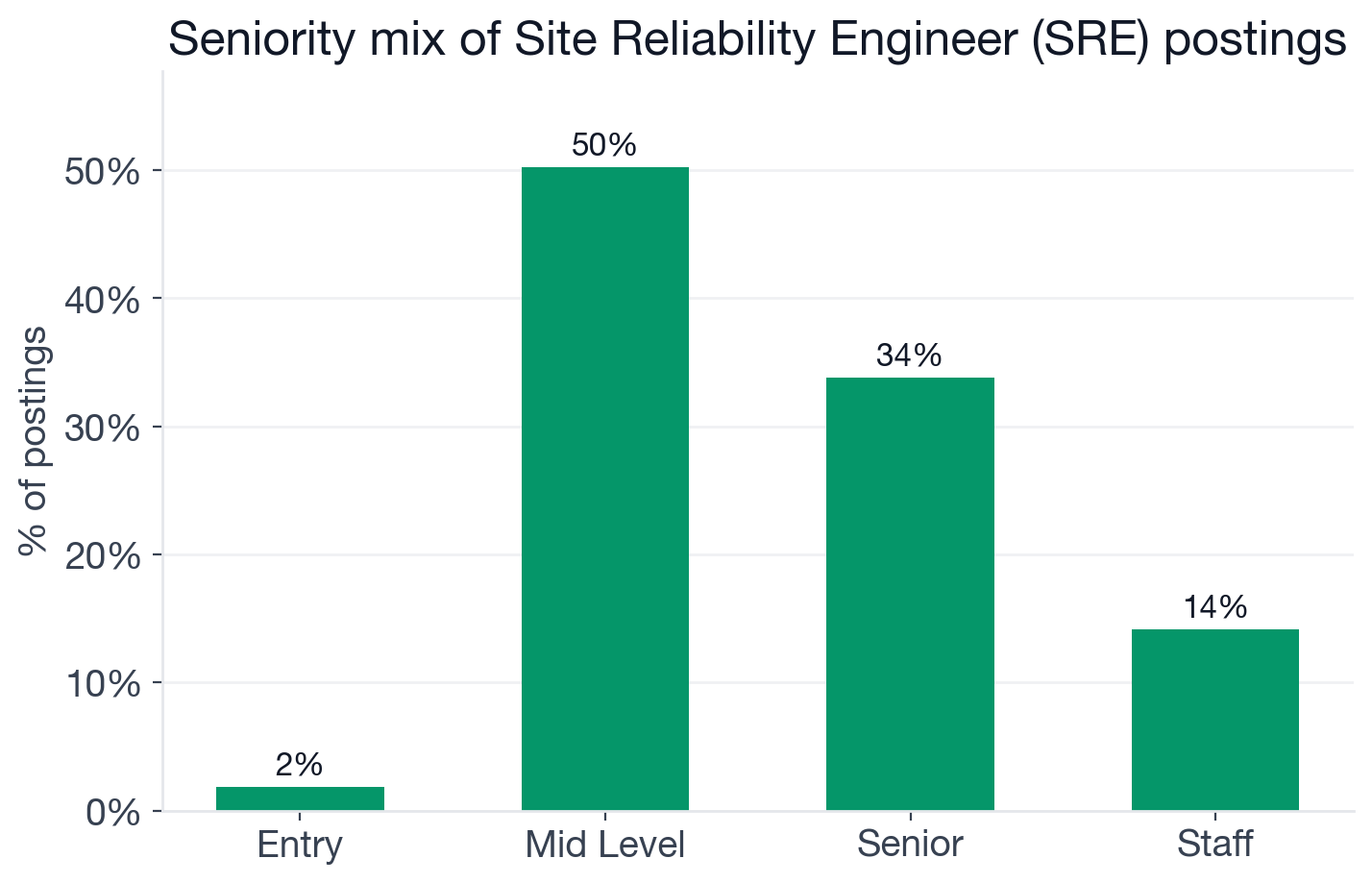 Mid-level and senior postings together account for 84% of the market; entry-level is a rounding error at 1.9%.
This tracks with what the skills data already implies: employers aren't hiring SREs as a first job. They're hiring people who already have automation, monitoring, and Python experience from somewhere, a sysadmin role, a DevOps team, a backend engineering job, and are ready to layer SRE-specific practices (SLOs, incident response, capacity planning) on top of an existing operational foundation. If you're trying to break in, the path runs through an adjacent title first, not through applying to "Site Reliability Engineer" postings directly.
Where Are These Jobs, and Can You Work Remotely?
The US accounts for 40.2% of postings (1,405 of 3,491), with India a distant second at 12.6% (439), then the UK (3.8%), Australia (3.4%), Canada (3.2%), and Germany (3.2%) rounding out the next tier.
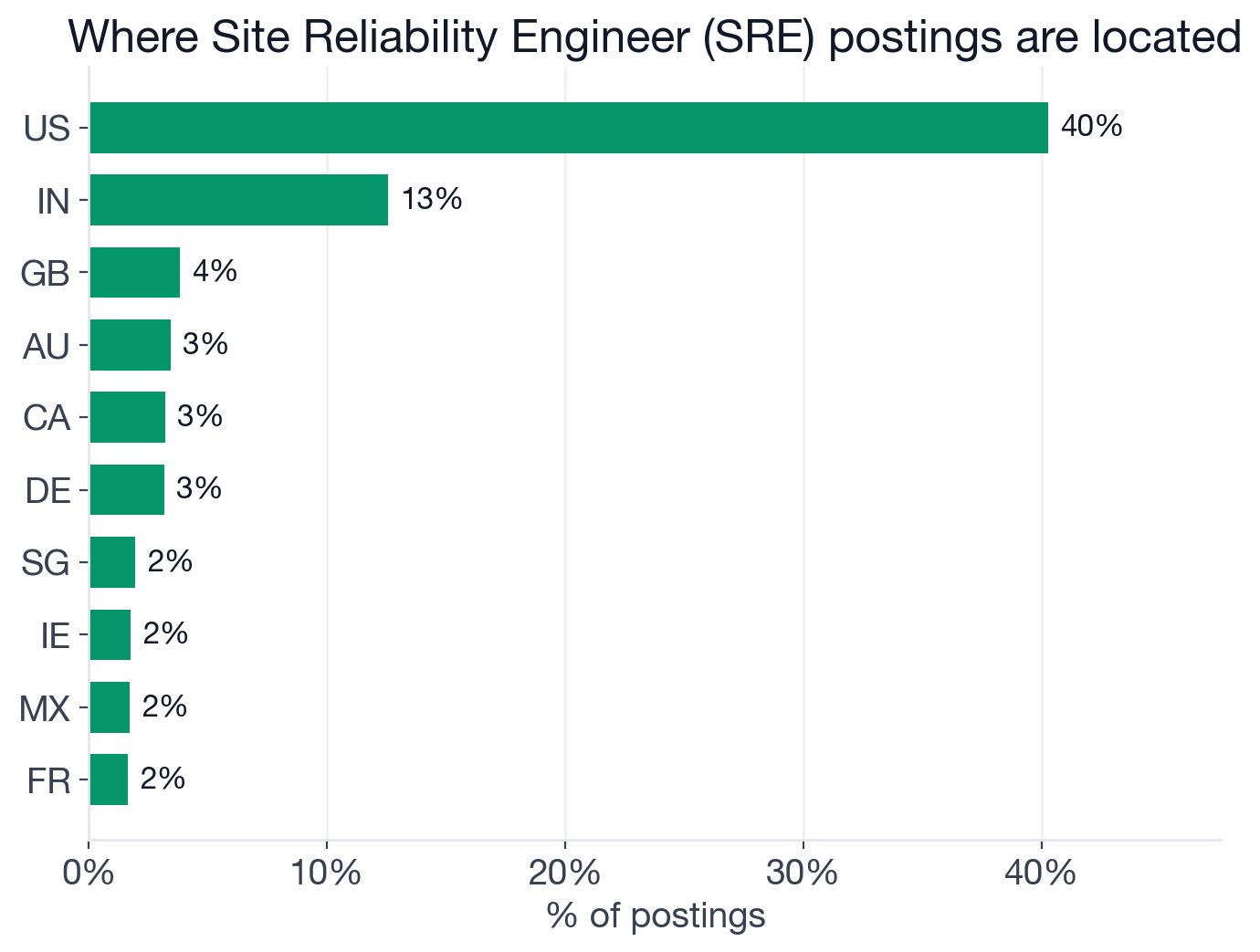 The US and India together account for over half of all SRE postings analyzed; every other country sits below 4%.
Work mode is the more surprising number here. Despite SRE's reputation as one of the more remote-friendly infrastructure roles, 56.3% of postings are onsite, 31.0% hybrid, and only 17.8% fully remote. Part of that is explained by the employer mix: several of the largest hirers in this dataset (aerospace, defense, and physical infrastructure operators) run data centers and regulated environments where on-prem access and on-call physical presence are structural requirements, not preferences.
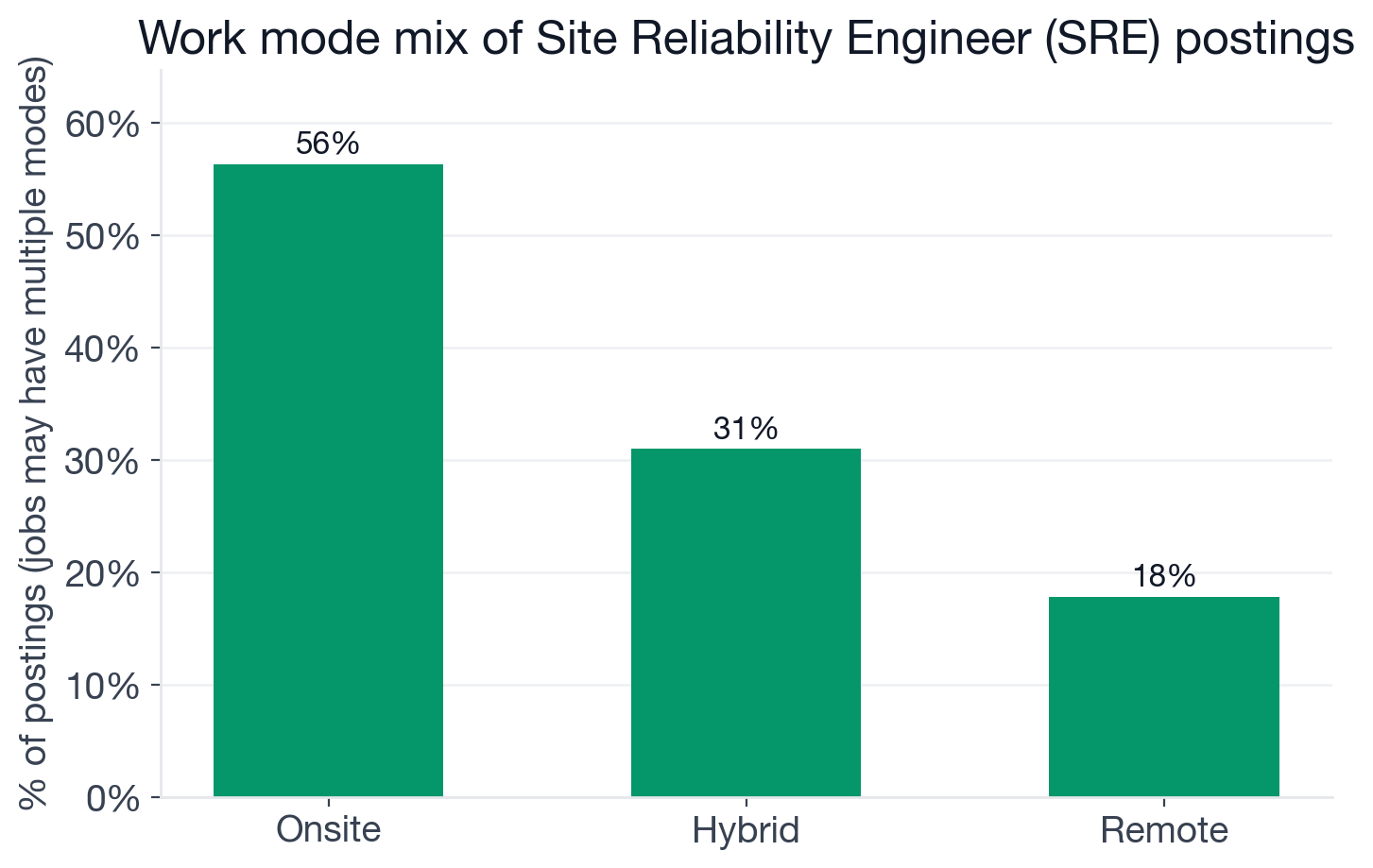 Onsite work is the majority mode at 56.3%; remote-only postings are a minority at 17.8%.
Who Is Actually Hiring SREs?
Ranked by distinct openings, the roster is dominated by large, established employers rather than repost-heavy staffing firms: Amazon leads with 148 openings, followed by Mastercard (124 combined across its listed corporate entities), London Stock Exchange Group (53), Oracle (51), SpaceX (50), Thales (48 combined across its listed entities), Google (47), Anduril Industries (41), TE Connectivity (37), Apple (29), NVIDIA (24), and Okta (23).
| Company | Distinct Openings |
|---|---|
| Amazon | 148 |
| Mastercard | 124 |
| London Stock Exchange Group | 53 |
| Oracle | 51 |
| SpaceX | 50 |
| Thales | 48 |
| 47 | |
| Anduril Industries | 41 |
| TE Connectivity | 37 |
| Apple | 29 |
| NVIDIA | 24 |
| Okta | 23 |
The mix skews toward fintech (Mastercard, London Stock Exchange Group, Barclays), aerospace and defense (SpaceX, Anduril Industries, Thales, TE Connectivity), and large-scale cloud and hardware providers (Amazon, Google, Oracle, NVIDIA, Apple), consistent with the onsite-heavy work mode above: these are largely organizations running critical infrastructure at a scale, and under regulatory or physical constraints, that favor in-person operations teams.
One caveat on that employer mix: at hyperscale employers, "Site Reliability Engineer" postings can shade into facilities-adjacent titles, electrical engineers and data center operations technicians who keep the physical building running, alongside software-focused SRE roles, and both get captured under the same role tag. That's part of why the onsite share above skews as high as it does; readers targeting a software-first SRE path should weight the skills and salary data (which stay consistent with a software role) over the raw work-mode split.
How to Use This in Your Job Search
If your resume doesn't say "site reliability" anywhere, that's less of a gap than it looks. Focus on demonstrating Automation, Monitoring, and Python fluency first, since those clear the table-stakes bar in more than half of all postings, then layer in Kubernetes and Terraform together, given how strongly they co-occur. Practice explaining an incident-response scenario end to end with AI mock interviews, where an interviewer-style conversation will push on how you'd actually triage a paging alert, not just whether you know the vocabulary.
To drill the specific topics that show up across these postings, SLO/SLI design, capacity planning, root cause analysis, use the question bank to work through targeted practice sets rather than generic behavioral prep. If Terraform, Kubernetes, or a GitOps workflow like ArgoCD is new to you, our interactive courses build the foundational competence before you're tested on it in an interview loop. And when you're ready to see what's actually open, browse current Site Reliability Engineer postings filtered by the skills and seniority level that fit where you are today.
FAQ
Q. What is the median Site Reliability Engineer salary in 2026?
Among US postings with salary disclosed, the median Site Reliability Engineer base salary is $152,000 (n=851). This is base pay only; equity, bonus, and sign-on aren't disclosed in postings, so total compensation at well-funded employers runs higher.
Q. Is "site reliability" itself a required skill for SRE jobs?
Not in the majority of postings. The literal skill terms "site reliability" and "site reliability engineering" appear in 43.5% and 21.7% of postings respectively, both below the 50% table-stakes threshold. Only Automation (57.9%), Monitoring (56.9%), and Python (50.3%) clear that bar, meaning general ops and automation literacy, not SRE vocabulary specifically, is the real entry requirement.
Q. What skills pay the most for Site Reliability Engineers in 2026?
Pulumi ($192,400), ArgoCD ($187,800), CloudFormation ($186,400), Okta ($186,100), and Datadog ($184,700) carry the largest premiums, each $32,700 to $40,400 above the $152,000 US baseline. Datadog is the only one of the five with measurable posting frequency, at 15.7%; the other four are specialized enough that they fall outside the 50 skills we track for frequency at all.
Q. Do Kubernetes and Terraform need to be learned together?
They're the highest-lift skill pair in the dataset at 1.94x (appearing together in 27.6% of postings, well above what independent demand would predict), making Kubernetes plus Terraform the closest thing to a defining combination for modern SRE roles.
Q. Is Site Reliability Engineer a remote-friendly role?
Less than commonly assumed. 56.3% of postings are onsite, 31.0% hybrid, and only 17.8% fully remote, likely reflecting the number of postings tied to physical infrastructure, defense, and regulated-industry employers in the dataset.
Q. Is there an entry-level path into Site Reliability Engineering?
Barely. Entry-level postings make up just 1.9% of the market (65 of 3,491 analyzed), with mid-level roles dominating at 50.2%. Most SREs enter from adjacent roles, systems administration, DevOps, backend engineering, rather than as a first job.
Q. Do Site Reliability Engineers need AI or machine learning skills?
Only 9.2% of postings explicitly require Machine Learning & AI skills, and that figure measures SREs hired to build or operate AI-adjacent infrastructure, not day-to-day AI tool use. Broader developer surveys put AI tool adoption at 84-85% across engineering roles, and Site Reliability Engineer specific research (Catchpoint's 2026 SRE Report) found optimism about AI's impact has more than doubled year over year, even as measured toil reduction remains an even split.
The Bar Isn't the Vocabulary, It's the Stack
The title says "site reliability," but the hiring bar says automation, scripting, and cloud-native infrastructure, with a real pay jump waiting for anyone who adds GitOps deployment tooling or identity platform depth on top. Treat the job title as a label, not a checklist, and build toward the stack that actually shows up in the premium numbers.
Topics
Ready to practice?
Put what you've learned into practice with AI mock interviews and structured preparation guides.