
The SDET Assertions and Behavior Verification Interview Doesn't Trust a Green Build
A checkout suite can pass every single test and still ship a broken order. That's not a hypothetical for this scenario, it's the backstory: the service below already caused production bugs because its tests kept passing while user-visible behavior was broken. InterviewStack.io's AI interviewer hands a mid-level Software Development Engineer in Test (SDET) candidate that exact service and asks them to fix the test strategy so it fails for the right reasons.
We pulled the real interview package the AI interviewer runs for this scenario, the same blueprint, rubric, and follow-up questions used in a live 30-minute session, and walked it turn by turn: a common but flawed assertion choice, what it costs on the rubric, and the stronger move instead.
Key Findings
- The rubric splits 100 points across 4 dimensions: 30 to Interviewer Objectives Alignment, 30 to Level-Specific Expectations, 20 to Technical Proficiency, and 20 to Communication & Problem Solving.
- The interview runs 30 minutes across 4 phases: 0-7 min on framing, 7-18 min (11 minutes) on core assertion design, 18-27 min (9 minutes) on trade-offs and diagnostics, and 27-30 min (3 minutes) on wrap-up.
- Phase 2 (7-18 min) packs 5 checklist items, more than any other phase in the interview.
- One checklist item names the exact pattern to avoid: assertions like "result not equal to null" or checks that only verify a method was invoked.
- Candidates face 1 initial question plus up to 6 follow-up prompts spanning weak-assertion critique, path-specific verification, over-specification, and interaction-verification judgment.
- 4 skill areas sit outside this scenario's scope: UI automation, performance and load testing design, distributed systems architecture beyond the service boundary, and CI/CD pipeline setup.
What Is the Checkout Service Actually Asking You to Verify?
The scenario hands the candidate the service that caused the original problem, then asks them to redesign the tests around it.
The interview question
Service used by a checkout API in an e-commerce platform. The team recently had flaky tests and production bugs caused by tests that passed even when user-visible behavior was broken.
public class CheckoutService {
    private final PaymentGateway gateway;
    private final OrderRepository orderRepository;
    private final EmailSender emailSender;

public CheckoutService(PaymentGateway gateway,
                       OrderRepository orderRepository,
                       EmailSender emailSender) {
    this.gateway = gateway;
    this.orderRepository = orderRepository;
    this.emailSender = emailSender;
}

public CheckoutResult placeOrder(Cart cart, User user) {
    if (cart == null || cart.items().isEmpty()) {
        return CheckoutResult.failure("EMPTY_CART");
    }

    PaymentResult payment = gateway.charge(user.id(), cart.totalPrice());
    if (!payment.success()) {
        return CheckoutResult.failure("PAYMENT_FAILED");
    }

    Order order = orderRepository.save(new Order(user.id(), cart.items(), cart.totalPrice()));
    emailSender.sendOrderConfirmation(user.email(), order.id());
    return CheckoutResult.success(order.id());
}

}
You're reviewing and improving the test strategy for the checkout flow above after several false-positive and brittle tests were found. How would you design the assertions and behavior verification for this service so the tests fail for the right reasons?
The interviewer isn't grading whether the candidate knows what an assertion is. They're probing whether the candidate can design assertions centered on outcomes a user would actually notice (the returned result, what got persisted, what email went out), tell a strong assertion from a weak one by name, and justify when checking an internal call is worth the coupling it creates. Four follow-ups push on different edges of that same judgment.
Turn 1: Grading an Existing Test
Interviewer: "If you saw an existing test that verifies save() and sendOrderConfirmation() were each called once, what would you keep, change, or remove, and why?"
Turn 2: The Wrong Order ID Slips Through
Interviewer: "If a test passes even when the confirmation email contains the wrong order ID, what assertion gap does that suggest and how would you fix it?"
Turn 3: Fields That Change Every Run
Interviewer: "Suppose orderRepository.save() starts adding generated fields like timestamps and IDs. How would you avoid over-specifying assertions while still verifying the important behavior?"
Turn 4: Deciding When Interactions Count
Interviewer: "When would verifying interaction details be appropriate here, and when would it make the test too coupled to implementation?"
Can a Green Build Still Fail You in the Room?
Every mistake above is easy to spot once it's labeled and color-coded on a page. The real interview doesn't hand out labels. A follow-up lands, the clock keeps running, and there's maybe ten seconds before a pause reads as not knowing the answer. The skill being measured isn't recognizing a weak assertion in hindsight, it's catching yourself before you propose one out loud. That only comes from doing this live, under real time pressure, against follow-ups nobody previewed for you.
What Does This Assertions Review Actually Reward, Phase by Phase?
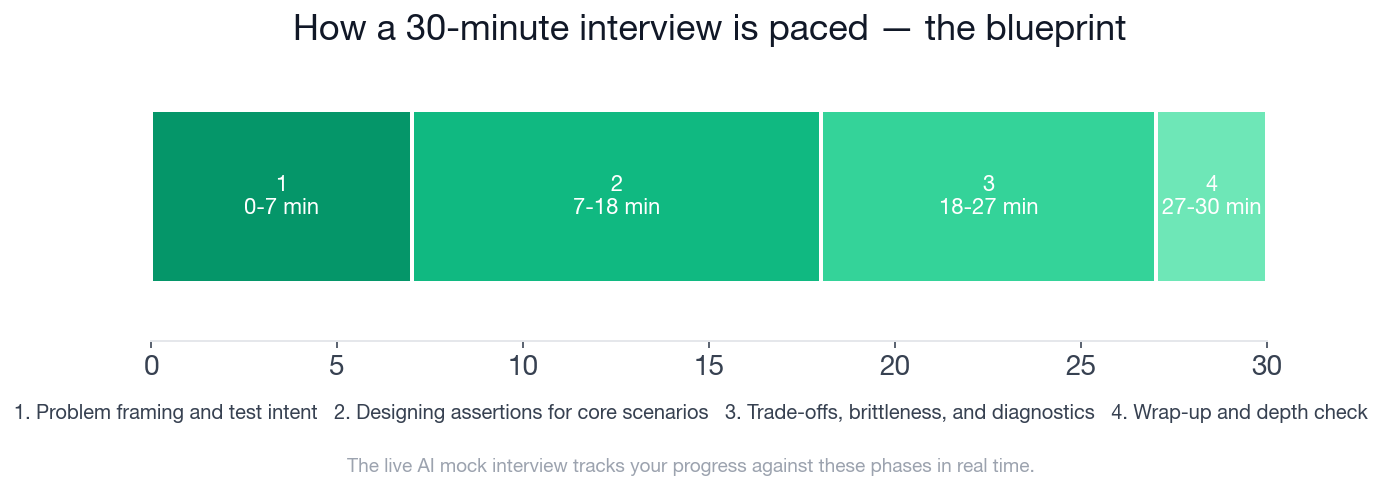 Framing comes first, core assertion design gets the largest block at 11 minutes, then trade-offs and diagnostics, then a short wrap-up. That's the same pacing the AI interviewer tracks against in real time.
- ✓States that tests should validate meaningful behavior of checkout rather than mirror implementation line-by-line
- ✓Identifies core observable outcomes for success and failure paths
- ✓Mentions risk of brittle tests caused by over-verifying method calls or internal construction details
- ✓For success path, proposes assertions on CheckoutResult success and correct order ID propagation
- ✓Verifies persisted order contents meaningfully, such as user ID, items, and total price, while avoiding unnecessary checks on generated fields
- ✓Includes verification that confirmation email is sent with the correct recipient and order ID, not merely that some email was sent
- ✓For payment failure, asserts failure result and absence of downstream side effects like saving orders or sending emails
- ✓Calls out weak assertions such as result != null or only verifying invocation counts
- ✓Explains when interaction verification is justified for side effects or guardrail behavior and when it over-couples tests to implementation
- ✓Suggests use of argument capture, custom matchers, recursive comparison with ignored fields, or grouped assertions where appropriate
- ✓Discusses making failures diagnosable by asserting one business concept at a time or by using descriptive assertions/messages
- ✓Mentions balancing coverage with resilience to refactoring
- ✓Summarizes a concise testing approach covering success, failure, and side-effect validation
- ✓Prioritizes highest-value assertions if time is limited
- ✓Demonstrates clear reasoning for why the proposed tests would catch user-impacting regressions
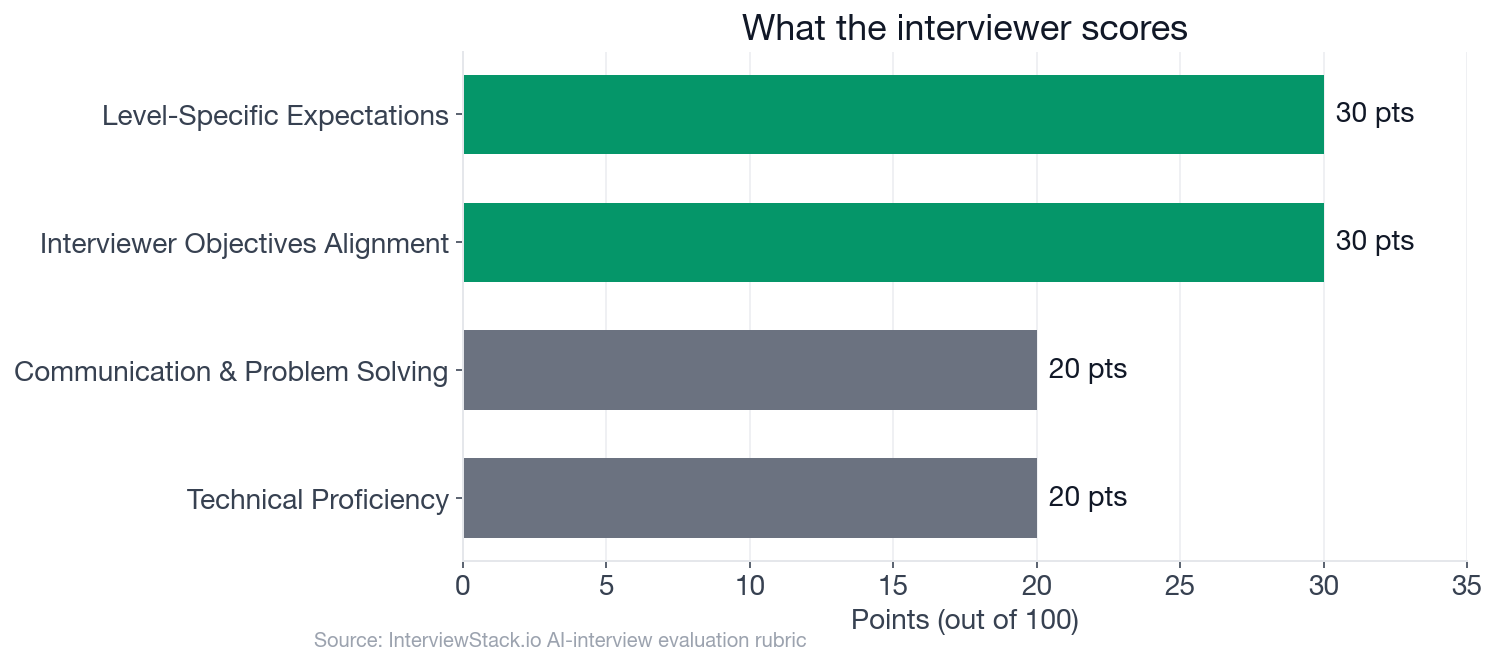 Interviewer Objectives Alignment and Level-Specific Expectations carry 30 points each, the two largest slices of the rubric.
This is the exact blueprint InterviewStack.io's AI mock interview scores you against turn by turn, phase timing, checklist items, and all, not a simplified summary of it.
Take the Same Checkout Scenario Live
Reading Quinn's mistakes is the easy part. The version of this interview that actually counts is the one where the follow-up you didn't expect just landed and you have to decide, in real time, whether your next assertion checks what happened or just whether something got called.
Start the AI mock interview for this exact SDET scenario and get scored against this same 100-point rubric with live, adaptive follow-ups. If you want to drill the underlying concepts first, the assertions and behavior verification question bank breaks the topic into individual practice questions, and InterviewStack.io's interactive courses cover test design and mocking fundamentals if any of the stronger-move answers above felt unfamiliar. When you're ready to see what teams are actually hiring an SDET to own, current SDET openings are a useful gut check on what "behavior verification" means in practice.
FAQ
Q. What does the SDET assertions and behavior verification interview actually evaluate?
It evaluates whether a candidate can design assertions that verify observable checkout behavior, like the returned result, the persisted order, and the confirmation email, rather than relying on internal call patterns. The 100-point rubric splits 30 points to Interviewer Objectives Alignment, 30 to Level-Specific Expectations, 20 to Technical Proficiency, and 20 to Communication & Problem Solving.
Q. How long does this interview run and what happens in each phase?
It runs 30 minutes across four phases: 0 to 7 minutes on problem framing and test intent, 7 to 18 minutes (11 minutes) on designing assertions for the success and failure paths, 18 to 27 minutes (9 minutes) on trade-offs, brittleness, and diagnostics, and 27 to 30 minutes on a wrap-up and depth check. The 7-to-18-minute phase carries 5 checklist items, more than any other phase.
Q. How should assertions differ between the successful checkout path and the payment failure path?
On the success path, a strong answer asserts the returned result is a success with the correct order ID, plus meaningful persisted order content and a confirmation email sent to the right recipient with the right order ID. On the failure path, it asserts a failure result and, just as importantly, the absence of side effects: no order saved and no email sent. Missing that second half is a specific checklist item in this interview's design-assertions phase.
Q. How do you make a failing assertion easy to diagnose when checkout persists the wrong total price?
Assert one business concept per check, so a wrong total price fails a total-price assertion specifically, not a single broad object-equality check that could fail for a dozen unrelated reasons. Descriptive assertion messages and grouped, labeled assertions are what the interview's trade-offs phase is looking for when it grades diagnosis quality.
Q. What's the most common mistake candidates make in this interview?
Treating a passing test as proof the behavior works, when the test is only checking that a method was called or that a result is not null. The rubric explicitly calls out 'result != null' and call-count-only verification as weak assertion patterns, because both can stay green while the actual behavior, like a correct order ID in a confirmation email, is wrong.
Q. Do I need to design a full testing framework architecture to pass at mid-level?
No. The level-specific bar for this interview expects solid judgment on what fields matter to assert, practical use of common assertion and mocking libraries, and awareness of a few important edge cases, not a complete testing framework architecture or deep contract-testing strategy.
Q. Where can I practice this exact interview scenario?
InterviewStack.io's AI mock interview runs this same checkout assertions scenario live, asks the same follow-up questions in real time, and scores the response against the identical 100-point rubric described here.
Green Doesn't Mean Correct
Every turn above traces back to the same question: does this assertion fail when something a user would notice is wrong, or does it just fail when a method wasn't called? That's not a trivia question about test theory, it's the actual bar this rubric was built to measure. The fastest way to find out which answer you'd give under pressure is to take the interview live.
Topics
Ready to practice?
Put what you've learned into practice with AI mock interviews and structured preparation guides.