
Reciting the Test Pyramid Doesn't Prove You've Owned One
The scenario sounds routine: a team ships multiple times a week, the regression suite has grown unwieldy, and end-to-end tests fail intermittently in CI. Any candidate who has read a testing blog can sketch a layered strategy on a whiteboard. That's exactly the problem. This interview isn't grading whether you know the test pyramid exists; it's grading whether you've actually built and maintained something like it, under real constraints, with a result you can point to.
We pulled the real interview package InterviewStack.io's AI interviewer runs for a mid-level Software Development Engineer in Test (SDET) on automation testing and SDET background, the same blueprint, rubric, and follow-up questions used in a live 30-minute session. Below, we walk it turn by turn: a common but shallow answer, what it costs, and what a stronger answer sounds like instead.
Key Findings
- The interview runs 30 minutes across 3 phases: 0-7 min on background framing, 7-19 min (12 minutes) on framework and CI depth, and 19-30 min (11 minutes) on reliability and impact.
- Interviewer Objectives Alignment and Level-Specific Expectations each carry 30 of the 100 rubric points; Technical Proficiency and Communication & Problem Solving carry 20 each.
- Phase 2 (7-19 min) and Phase 3 (19-30 min) each pack 5 expectedChecklist items, tied for the most of any phase; Phase 1 has 4.
- The reliability phase's first checklist item requires isolating product defects, test issues, and environment instability as three distinct causes before proposing a fix.
- Two separate checklist items, one in phase 1 and one in phase 3, specifically grade whether you tie your answer to personal past contribution rather than team-level outcomes.
- Candidates face 1 initial question plus up to 6 follow-ups spanning test-layer strategy, framework maintainability, flaky-test diagnosis, CI/CD integration, measurable impact, and stakeholder pushback.
Inside a Mid-Level SDET Automation Testing Interview
The interview question
You are joining a product engineering team that owns a customer-facing web application and a set of backend APIs. The team deploys multiple times per week, has a growing regression suite, and frequently sees release delays because test runs are slow and some end-to-end tests are flaky. The team wants an SDET to take ownership of improving the automation strategy and test infrastructure over the next two quarters.
Walk me through how you would approach building and evolving the automation strategy for this team, based on what you've done in your past SDET roles.
Notice the last clause: "based on what you've done in your past SDET roles." The interviewer isn't asking for a strategy in the abstract. They're evaluating whether you can translate real prior work into a concrete, scalable approach for this team, including tool choice, flaky-test handling, and the API-versus-UI coverage trade-off. Answers that stay theoretical lose points before the first follow-up even lands.
Turn 1: Picking the Test Layers
Interviewer: "How would you decide what should be covered at the unit, API, integration, and UI layers for this team?"
Turn 2: Framework Architecture and Maintainability
Interviewer: "What would your automation framework architecture look like, and how would you keep it maintainable as more engineers contribute tests?"
Turn 3: Diagnosing the Flaky Two-Hour Suite
Interviewer: "Suppose the existing end-to-end suite takes 2 hours and fails intermittently in CI. How would you diagnose and improve it?"
Turn 4: Proving Measurable Impact
Interviewer: "Tell me about a specific example where your automation work improved either defect escape rate, execution time, or release confidence. What changed and how did you measure it?"
Can You Actually Avoid These Mistakes Live?
Spotting Casey's mistakes on this page is easy; you saw the answer key first. Catching yourself mid-sentence, thirty seconds after a follow-up lands, with no page to reread, is the actual skill this interview is testing. That gap between recognizing a mistake and not making it under time pressure is exactly what reps close, and reading about it isn't a substitute for practicing it.
The Blueprint This Interview Is Actually Scoring
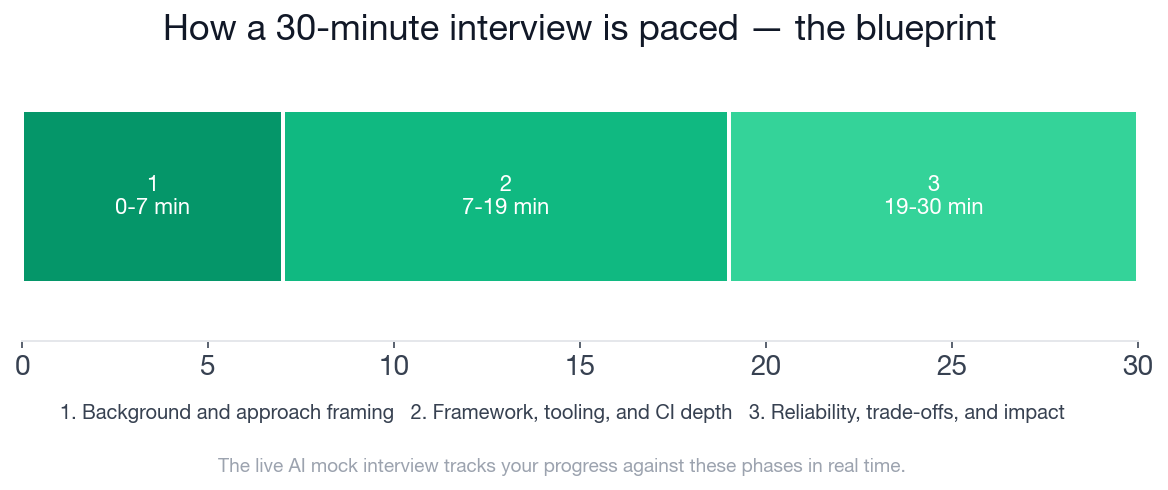 This is the same phase pacing the AI interviewer tracks against in real time, background framing first, then framework depth, then reliability and impact last.
- ✓Asks or states reasonable assumptions about product architecture, release cadence, and current pain points
- ✓Frames the strategy in layers such as unit/API/integration/UI rather than jumping straight to tools
- ✓Connects proposed approach to prior real-world experience
- ✓Identifies at least one key goal such as speed, stability, coverage, or release confidence
- ✓Describes a plausible framework structure such as test layers, reusable clients/pages/helpers, configuration, and reporting
- ✓Explains how tests are triggered in CI, separated by signal level, and used as release gates
- ✓Mentions practical maintainability mechanisms like coding standards, review patterns, utilities, ownership, or documentation
- ✓Discusses environment or test data concerns, not just test scripts
- ✓Shows awareness of runtime optimization techniques such as parallelization, sharding, selective execution, or API-heavy coverage
- ✓Provides concrete steps for triaging flaky tests, including isolating product defects vs test issues vs environment instability
- ✓Uses measurable indicators such as pass rate, mean execution time, defect escape rate, false failure rate, or deployment frequency
- ✓Makes reasonable trade-offs between broad coverage and fast feedback
- ✓Explains a real example with clear personal contribution and outcome
- ✓Handles prioritization questions pragmatically, aligning automation investment to release risk and team velocity
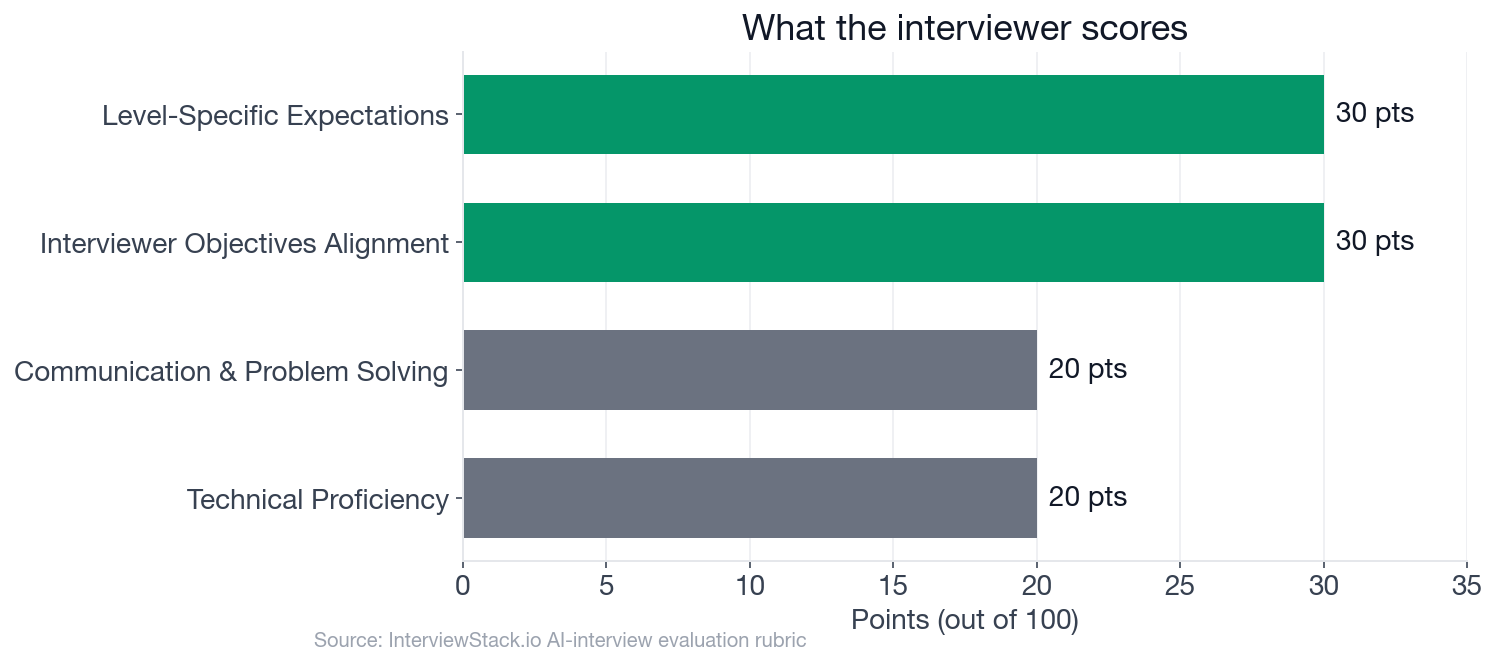 Interviewer Objectives Alignment and Level-Specific Expectations carry 30 points each; Technical Proficiency and Communication & Problem Solving carry 20 each, the same four dimensions every turn above was graded against.
This is the exact blueprint InterviewStack.io's AI mock interview tracks you against turn by turn, phase timing, checklist items, and all, not a simplified summary of it.
Ready to Take This Interview for Real?
Reading Casey's mistakes is the easy part. The version of this interview that actually matters is the one where you're on the clock, the follow-up you didn't expect just landed, and you have to decide in real time whether to name a tool or describe a system.
Start the AI mock interview for this exact SDET scenario and get scored against this same 100-point rubric with live, adaptive follow-ups. If you want to drill the underlying concepts first, the automation testing and SDET background question bank breaks the topic into individual practice questions, and InterviewStack.io's interactive courses cover CI/CD and framework design fundamentals if any of the stronger-move answers above felt unfamiliar. When you're ready to see what teams are actually hiring for, current SDET openings are a useful reality check on what "automation strategy" means in practice right now.
FAQ
Q. What does a mid-level SDET automation testing interview actually evaluate?
It evaluates whether you can turn your past SDET experience into a concrete, layered automation strategy for a specific team, not whether you can recite testing theory. The 100-point rubric splits 30 points to Interviewer Objectives Alignment, 30 to Level-Specific Expectations, 20 to Technical Proficiency, and 20 to Communication and Problem Solving, and two separate checklist items explicitly require personal contribution rather than team-level claims.
Q. How long does this SDET interview run and what happens in each phase?
It runs 30 minutes across three phases: 0 to 7 minutes on background and approach framing, 7 to 19 minutes (12 minutes) on framework, tooling, and CI depth, and 19 to 30 minutes (11 minutes) on reliability, trade-offs, and impact. Phase two and phase three each carry 5 expectedChecklist items, tied for the most of any phase; phase one carries 4.
Q. What's the most common mistake candidates make in this interview?
Answering with generic test-pyramid theory or naming tools without grounding either in the team's actual constraints or in a specific thing the candidate personally built. Two separate expectedChecklist items, one in phase one and one in phase three, specifically grade whether you connect your answer to real prior experience with a measurable outcome.
Q. How should I answer the flaky, 2-hour end-to-end suite question?
Start by isolating the failure category before proposing a fix: is it a real product defect, a test implementation issue, or environment instability? That triage step is an explicit checklist item in the reliability phase, and skipping straight to "add retries" costs points on Level-Specific Expectations and structured problem solving.
Q. Do I need staff-level, organization-wide strategy depth to pass at mid-level?
No. The rubric explicitly caps expectations at sound judgment on a scoped framework component, a regression area, or a CI workflow, with 2 to 5 years of hands-on ownership. It does require that the ownership be yours, not just something your team did.
Q. What automation stacks are acceptable to discuss in this interview?
Any common stack works: Java, Python, or TypeScript paired with Selenium, Playwright, Cypress, or REST tooling. The interviewer is not grading tool choice; they're grading whether you can speak to implementation details in whichever stack you pick.
Q. Where can I practice this exact interview scenario?
InterviewStack.io's AI mock interview runs this same automation-strategy scenario live, asks the same follow-up questions in real time, and scores you against the identical rubric described here.
The Question Was Always About Your Own Work
Every turn above traces back to the same gap: a technically correct answer that stays generic versus one grounded in something the candidate actually built and measured. That's not a trick of this one scenario; it's what the rubric is built to find. The fastest way to know which answer you'd actually give is to take the interview live and find out before it counts.
Topics
Ready to practice?
Put what you've learned into practice with AI mock interviews and structured preparation guides.