
The Points You're Not Prepping For
You know your Big O. You can walk through a linked list reversal, trace through a two-pointer sweep, explain why a heap gives you O(log n) insertion. You feel ready. Then an interview ends, and something went sideways that you cannot quite name.
For most candidates, the explanation lives in the scoring rubric. Software Engineer data structures and complexity interviews are scored across four dimensions totaling 100 points. Technical Proficiency accounts for 20 of those points. Communication and Problem Solving accounts for another 20. The remaining 60 points come from two dimensions most candidates underestimate: Objectives Alignment (30 pts) and Level-Specific Expectations (30 pts). These test judgment and articulation under pressure, not recall of algorithms.
That 60% is where prepared candidates lose interviews they expected to pass.
Key Takeaways
- 60% of the interview score (60 of 100 points) comes from Objectives Alignment and Level-Specific Expectations, not technical accuracy.
- Objectives Alignment (30 pts) measures whether you answered the question actually asked, not a similar question you rehearsed.
- Level-Specific Expectations (30 pts) measures whether your depth, trade-off reasoning, and ownership of ambiguity match the target seniority.
- Technical Proficiency and Communication each contribute 20 pts: correctness alone is not enough for a passing score.
- The data structures and complexity question bank has 60 active questions: 23 easy (38%), 18 medium (30%), and 19 hard (32%).
- Expected answer times range from 7 to 15 minutes per question; clarifying before coding is expected behavior, not a delay.
- Silent prep builds knowledge but not delivery: the gap between knowing the answer and delivering it live is the one most candidates never close before the real interview.
What Does the Interviewer Actually Score?
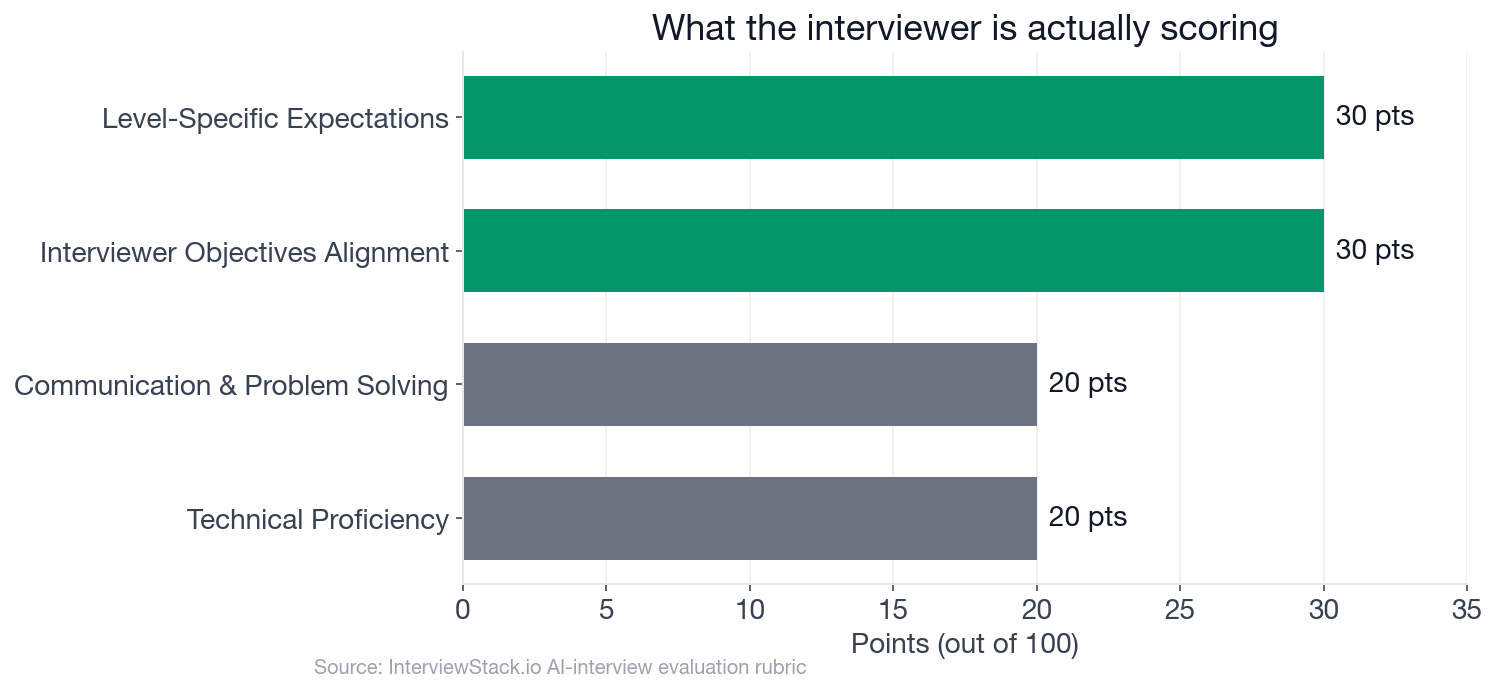
The rubric above defines what moves the needle. Each dimension has a specific, non-overlapping meaning.
Objectives Alignment (30 pts): Did you answer the question that was actually asked? Not the adjacent question you memorized. Not the version you answered in a previous interview. This prompt, with its specific deliverables. If the question asks you to state amortized time complexities and you explain worst-case only, you have partially addressed the question. That shortfall lives here.
Level-Specific Expectations (30 pts): Did your answer demonstrate the seniority the role requires? At the junior level, a correct implementation with accurate complexity is enough. At the senior level, the interviewer expects you to own the problem scope, name trade-offs proactively, surface edge cases before being asked, and reason about implications beyond the immediate solution (cache behavior, concurrency, scale). The same technically correct answer earns different scores at different levels because the bar is different. This dimension captures whether you calibrated to that bar.
Technical Proficiency (20 pts): Is your solution correct? Are your complexity claims accurate? Do you catch your own bugs? This is where most prep time goes. It matters at 20 points, but it is the smallest primary dimension.
Communication and Problem Solving (20 pts): Can you think out loud in a followable way? Do you ask clarifying questions before diving in? When the interviewer nudges you toward a better approach, do you adjust or push back?
The implication is worth sitting with: a perfect technical solution with thin objectives coverage and junior-calibrated depth still fails. Correctness is the entry fee. The other 60% of the score requires something harder to build through silent study.
What Mistakes Actually Cost Candidates Points?
Most interview post-mortems focus on the wrong failure. "I blanked on the algorithm" is rarely the actual problem. These are the patterns that reliably cost points, mapped to the rubric dimensions they hit.
Answering the adjacent question. This is the most common Objectives Alignment failure. The question asks for amortized complexity; you explain worst-case. The question specifies O(1) extra space; your solution uses O(n). The question lists multiple deliverables; you address one and stop. Read every word of the prompt before you respond.
Going silent, then code-dumping. Extended silence during problem-solving feels professional. It is not. Interviewers score on thinking process, not just output. A candidate who says "I'll use two pointers here because the array is sorted, so I can converge from both ends and eliminate candidates monotonically" gives the interviewer a window into the reasoning. A candidate who disappears for three minutes and produces correct code gives them almost nothing. Communication scores the process, not just the result.
Skipping clarification. "I'll just start coding" reliably costs points. For a sorted two-sum problem, there are real constraints worth confirming: is the array mutable, can indices repeat, are values distinct? Asking before coding signals that you understand the problem space. Skipping signals the opposite, even if your solution happens to handle the edge cases.
Depth-level mismatch. This is the Level-Specific Expectations failure mode. A senior-level candidate who implements a correct solution but never names trade-offs, alternative structures, or failure modes has technically answered the question but has not demonstrated senior judgment. Conversely, a junior candidate who spirals into advanced amortized analysis on a question that expected a clean O(n log n) solution has also miscalibrated. Match the depth to the level.
Reciting facts rather than reasoning. Knowing that a hash set has O(1) average lookup is different from knowing when to choose it over a tree set for a specific problem. Follow-up questions expose the difference: "Why did you choose that structure?" and "What breaks at scale?" are standard. If your answer was a memorized fact, the follow-up reveals it quickly.
Defending the wrong approach. When an interviewer says "what if we had a memory constraint?" or "could you do this without the extra space?", that is information, not a challenge. Getting defensive costs points in the Communication dimension. The expected response is to acknowledge the constraint and redirect your approach.
A Blueprint for Live Delivery
Knowledge only converts to interview performance when you can deploy it consistently under time pressure. This sequence applies to every data structures question, from a short conceptual comparison to a full coding problem.
1. Parse the full prompt before responding. Read or listen completely through. Note every constraint, every deliverable, every qualifier. This costs 15 seconds and saves five minutes.
2. Clarify before building. State the assumptions that would change your approach: input size, memory constraints, sorted vs unsorted, distinct vs duplicate values. "I'll assume the array fits in memory and elements are distinct unless that changes things." Explicit, brief. This is expected behavior, not stalling.
3. State your approach before implementing. One or two sentences: what you're doing and why. "I'll use two pointers from both ends because the array is sorted, so I can eliminate candidates monotonically in O(n) time with O(1) space." Get agreement before you code.
4. Narrate the implementation. Talk through your pointer updates, loop invariants, and base cases as you work. This gives the interviewer something to engage with and makes the Communication dimension easy to score well.
5. State complexity as you go. When you make a structural choice, name the cost immediately. "Using a hash map here adds O(n) space but brings lookup from O(n) to O(1)." This also protects you from forgetting complexity analysis at the end.
6. Validate and name trade-offs. Before declaring done, walk through an example or edge case. Then ask yourself: what is the space cost, what fails under concurrency, what changes at 10x input size? For senior roles, proactively surfacing these is how you earn Level-Specific Expectations points without being asked.
What Will You Actually Be Asked?
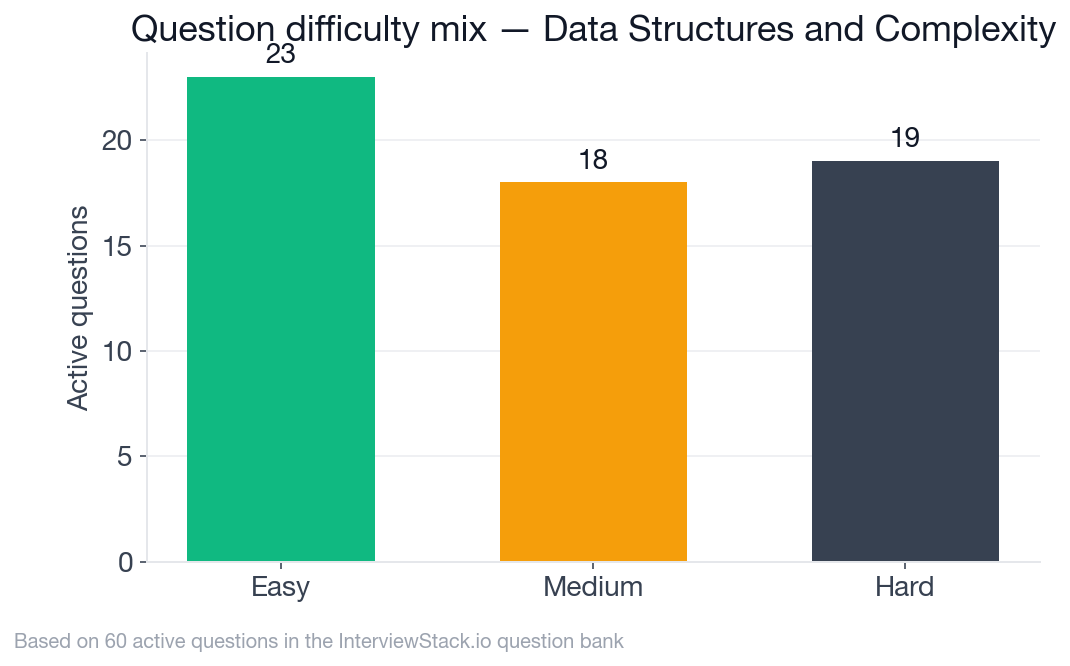
The 60 active questions span the full structure of the topic. As the chart shows, the distribution is nearly even: 23 easy (38%), 18 medium (30%), and 19 hard (32%). Do not expect a single difficulty band.
Here are three representative stems from the question bank, without their model answers:
- "Compare the time complexity and memory characteristics of a hash set and an ordered tree-based set for insertion, deletion, and membership check. When would you prefer the tree despite its slower average-case operations?"
- "Implement a queue using two stacks. Provide the algorithmic steps and explain the amortized time complexities of enqueue and dequeue operations."
- "Given an undirected graph as an adjacency list and as an adjacency matrix, compare memory usage and BFS performance. Which representation would you choose for sparse graphs, and why?"
None of these are gotchas. They test whether you can reason about structure choices and complexity trade-offs, not whether you memorized an API. For the full 60 questions with worked model answers, see the Software Engineer data structures and complexity question bank.
The expected time windows tell you something useful: conceptual comparisons run 7 to 10 minutes, coding problems with complexity analysis run 10 to 15. These windows assume you are clarifying, narrating, and validating as you go. If you are optimizing for silent speed, you are optimizing for the wrong thing.
Why Mock Reps Change the Outcome
Silent prep creates a specific failure mode. You work through the queue-from-two-stacks problem, understand the transfer logic, can recite the amortized complexity. In an interview, a follow-up comes that you did not rehearse: "How would you adapt this for a thread-safe concurrent environment?" Your knowledge was encoded as a fixed Q-A pair, not as transferable reasoning, and it breaks under the pivot.
This is not a knowledge gap. It is a performance gap. The difference between knowing a topic and deploying it live under observation, with follow-ups, hints, and time pressure, is not closed by more reading. It is closed by reps in conditions that resemble the real thing.
Mock interviews surface three things silent prep cannot:
Delivery gaps. You find out you go silent for 90 seconds before speaking. You find out you skip clarification even though you know you should ask. You find out your complexity analysis comes at the end when it should run through the whole solution.
Follow-up exposure. The interviewer's follow-ups are often the actual test. "Why that structure?" and "What breaks at scale?" are standard. Encountering them for the first time in a real interview is expensive.
Time calibration. A problem you thought would take 8 minutes takes 14. Or you spend 10 of them on an approach you abandon. Time awareness only develops through timed reps.
The AI mock interview for Software Engineer data structures draws from the same 60-question bank and scores you on all four rubric dimensions after each session. The feedback is tied to the specific dimensions, so you see exactly where the points went and which of the six failure patterns you are still carrying.
Use the question bank to understand what correct answers look like. Then shift to mock interviews to close the gap between knowing the answer and delivering it.
If you want to cover the broader Software Engineer interview landscape alongside data structures, the Software Engineer preparation guides map the full interview process for common target companies.
FAQ
Q. What does a Software Engineer data structures interview actually score?
The rubric has four dimensions totaling 100 points. Objectives Alignment (30 pts) tests whether you answered the question that was actually asked. Level-Specific Expectations (30 pts) tests whether your depth and judgment match the target seniority. Together they account for 60% of the total score. Technical Proficiency covers another 20 pts and Communication and Problem Solving the final 20. A technically correct answer with poor objectives coverage can still fail.
Q. What topics are covered in data structures and complexity interviews for Software Engineers?
The topic spans arrays, strings, linked lists, stacks, queues, hash tables, sets, trees (including BSTs and balanced trees), tries, heaps, and graphs (adjacency list vs matrix representation). Candidates must analyze time and space complexity using Big O, including amortized analysis and worst-case vs average-case distinctions. Common patterns include two-pointer, sliding window, divide and conquer, recursion, dynamic programming, greedy approaches, and priority processing. The question bank has 60 active questions across 23 easy, 18 medium, and 19 hard problems.
Q. What are the most common mistakes in data structures interviews?
The most common mistakes are jumping to code before fully parsing the question and clarifying constraints, going silent during problem-solving instead of narrating the reasoning, mismatching the depth of the answer to the target seniority level, and getting defensive when the interviewer hints at a better approach. Most candidates over-invest in technical knowledge and under-invest in the mechanics of delivering that knowledge live under time pressure.
Q. How long should a data structures interview answer take?
Expected times in the question bank range from 7 minutes for a conceptual comparison question to 15 minutes for a full coding problem with complexity analysis. Budget roughly 1 to 2 minutes for clarifying constraints and edge cases, 3 to 5 minutes for explaining your approach, and 5 to 8 minutes for implementation or detailed reasoning. Skipping the clarification phase often costs more time than it saves.
Q. Why do prepared candidates still fail data structures interviews?
Most data structures prep happens silently: reading, watching videos, solving problems alone. That builds knowledge but not delivery. In a live interview you need to clarify constraints, narrate reasoning in real time, calibrate depth to the expected level, and adapt when the interviewer redirects. These are performance skills that only develop through repeated live-format practice, not silent review of model answers.
Q. What is the difficulty spread for Software Engineer data structures questions?
The 60 active questions in the InterviewStack.io question bank are split across 23 easy (38%), 18 medium (30%), and 19 hard (32%) problems. Easy questions test correct implementation and standard complexity analysis. Medium questions add constraints, combinations, or optimization requirements. Hard questions require custom structure design, amortized or concurrency reasoning, and senior-level trade-off analysis.
Q. How do I practice data structures and complexity for a Software Engineer interview?
The most effective approach combines two layers: study the worked model answers in the question bank to understand correct structure and reasoning, then rehearse delivery out loud through a mock interview. Silent review reveals what to say; live practice surfaces whether you can say it under pressure, handle follow-up questions, and recover from hints. The AI mock interview on InterviewStack.io targets this gap specifically.
Start There, Not Here
Data structures and complexity is one of the broadest topics in the Software Engineer interview landscape. Most candidates feel ready because they know the material. The scoring rubric says that is not the same thing as being ready to perform. The 60% of the score that covers objectives alignment and level-fit does not get built by reading another article about Big O. It gets built by the next mock interview where a follow-up question you did not rehearse forces you to reason live, and you either can or you find out you cannot. That finding is the prep.
Topics
Ready to practice?
Put what you've learned into practice with AI mock interviews and structured preparation guides.