
Picture a bookmark button. Users click it, a job lands in a list, done. It feels like a ten-minute whiteboard warm-up, and that is exactly why prepared mid-level candidates lose points on it. The round is a 30-minute, mid-level Software Engineer feature design interview, and the interviewer is not grading how clever your database is. They are grading whether your user flow, API, backend, and schema tell one consistent story, and whether you notice the double-click, the closed job, and the second device before they do.
The scenario below comes from one AI mock interview blueprint, written to illustrate how a strong round runs (it is not a real company's question). Every candidate answer is dramatized, a "common answer" rather than a transcript. If you want to see how you would fare, you can start the live AI mock interview for this exact scenario at any point.
Key Findings
- The rubric totals 100 points, and 60 of them (30 + 30) go to objectives alignment and level-specific expectations, versus 20 for Technical Proficiency.
- The interview runs 30 minutes across 4 phases; the end-to-end design block is the longest at 14 minutes (minutes 6-20).
- Requirement clarification is a scored phase on its own: 6 minutes (0-6) and 4 checklist items before any design begins.
- Edge cases, trade-offs, and operations get 8 minutes (20-28) and 5 checklist items, including idempotent saves and stale-write handling.
- The full blueprint holds 18 checklist items; wrap-up has only 2 minutes (28-30) to summarize and name v1 versus later.
- Communication & Problem Solving carries 20 points, the same weight as Technical Proficiency.
Why a Tiny Feature Is the Hardest Round to Fake
This format tests breadth with coherence. A candidate who is strong in one layer and vague in the others loses ground, because the interviewer checks each choice against the others: does the API shape match the schema, does the index match the page that reads it? The weighting reflects that.
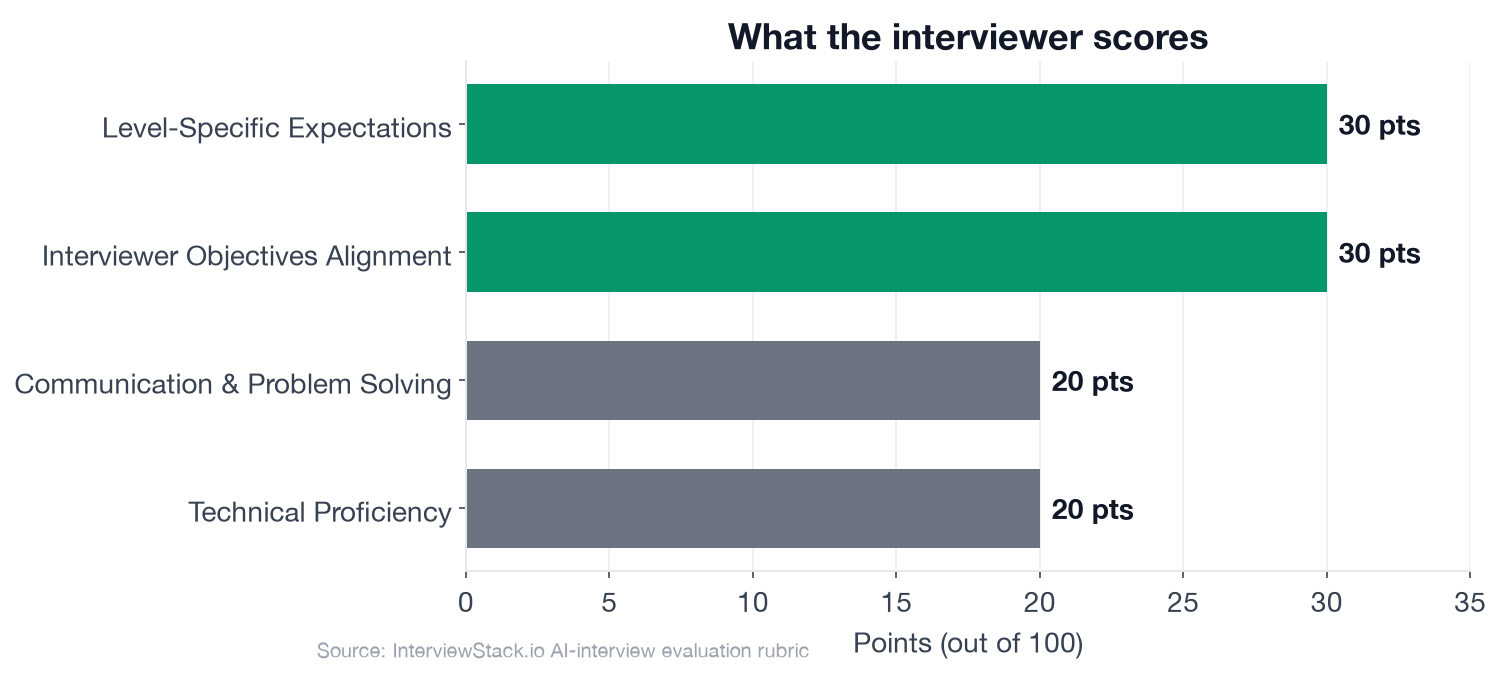
The chart makes the priority plain: designing the right thing and designing it at the right level is worth three times the points of getting any single technical detail right.
What Is the Interviewer Actually Asking You to Build?
The prompt places you on a large professional networking platform. Users can save jobs but cannot organize them, so product wants a saved-jobs feature with an optional private note and a status.
The interview question
You are working on a large professional networking platform. Users can save job postings they want to come back to later, but today there is no way to organize or track them. The product team wants to launch a new feature: users can save a job, optionally add a short private note, and mark the saved job with a status like interested, applied, or archived. The feature should be available in the job detail page and in a dedicated "My Jobs" page where users can view and update their saved jobs. Assume the system already has:
User(id)
Job(id, company_id, title, status)
Here Job.status reflects whether the job posting itself is active or closed. Design this saved-jobs feature end to end, from the user flow through the API, backend behavior, data model, and storage choices, as you would for a production launch at our company.
Behind that ask, the interviewer is probing four things: whether you can clarify requirements and set a realistic scope, whether your choices stay consistent across layers, whether you spot correctness, latency, and failure concerns, and whether you communicate and prioritize like a mid-level engineer.
The Walkthrough: Four Turns Where Points Quietly Disappear
Priya is a composite candidate, prepared and capable. The answers below are illustrative of patterns we see in mid-level prep, not a transcript of any real person.
Turn 1: Clarify before you design
Interviewer: "What assumptions would you clarify first about user behavior, product constraints, and expected usage before locking the design?"
Turn 2: Survive the double-click
Interviewer: "How would your API and backend handle the case where a user tries to save the same job multiple times from different clients or repeated clicks?"
Turn 3: When the job disappears
Interviewer: "How would you model and handle jobs that later become closed or are deleted from the main jobs catalog?"
Turn 4: Two devices, one note
Interviewer: "How would you support updating note and status safely without overwriting changes from another device or session?"
Two follow-ups did not make this cut: loading My Jobs for users with thousands of saves (the pagination and index question) and launch metrics and alerts. Both live in the same 8-minute edge-case phase, and both are fair game in a live round.
Why Isn't Reading This Enough?
Every mistake above is easy to spot with the answer sitting in a red box. Live, the interviewer interrupts, changes a constraint, and asks about the closed-job case while you are still on the schema. The skill is not knowing that a unique constraint exists; it is reaching for it in the right sentence, with a clock running and no stronger-move box to peek at. That only comes from repetitions where you speak your design aloud and take unscripted follow-ups.
The Complete Blueprint a Strong Candidate Hits
This is the blueprint a strong candidate covers across the 30 minutes: the same four phases and 18 checklist items the AI mock interview tracks you against in real time. Read it once, then try to produce it from a blank page.
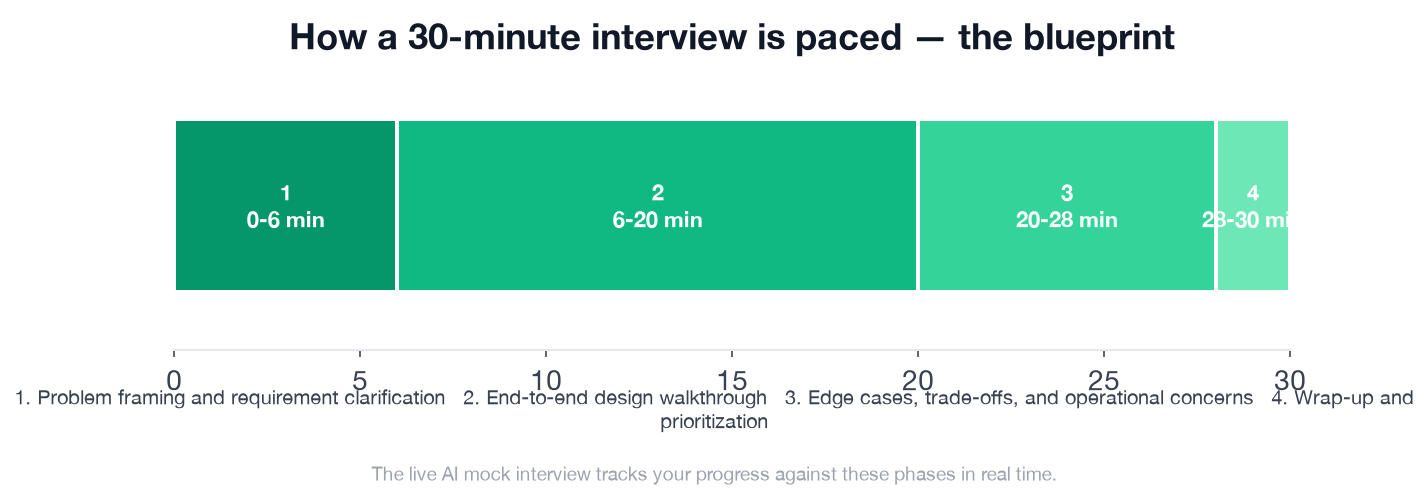
The timeline shows where the clock actually goes: nearly half the interview (14 of 30 minutes) is the design walkthrough, so requirements and edge cases have to be efficient.
- ✓Asks what actions users can take from job detail versus My Jobs page.
- ✓Clarifies whether notes are private and whether statuses are fixed or extensible.
- ✓Asks about expected scale such as saves per user and read/write patterns.
- ✓States a reasonable v1 scope and explicitly deprioritizes nonessential features if needed.
- ✓Describes core user flows: save job, list saved jobs, update note/status, unsave or archive behavior.
- ✓Defines clear API endpoints or RPCs with request/response shapes at a useful level of detail.
- ✓Introduces a saved-jobs data model with fields such as user_id, job_id, note, user_status, created_at, updated_at.
- ✓Specifies uniqueness on user-job pair or an equivalent mechanism to prevent duplicates.
- ✓Mentions indexes supporting My Jobs listing and job-detail save-state lookup.
- ✓Explains validation rules such as note length, allowed statuses, and handling closed jobs.
- ✓Addresses duplicate requests with idempotent create/upsert semantics or equivalent protection.
- ✓Explains behavior when underlying jobs become closed, unavailable, or deleted.
- ✓Discusses pagination or sorting for My Jobs and performance implications for large saved-job counts.
- ✓Mentions concurrency or stale-write handling for note/status updates.
- ✓Names a small but meaningful set of metrics and logs for launch health.
- ✓Summarizes the proposed design in a concise, structured way.
- ✓Identifies what belongs in v1 versus later enhancements like labels, reminders, or search/filter improvements.
- ✓Calls out one or two main risks or open questions that would need follow-up after the interview.
Practice It Live, With the Blueprint Watching
The fastest way to close the gap is to run this exact scenario out loud. Start the AI mock interview for this feature design round and you will get unscripted follow-ups, phase-by-phase tracking against the blueprint above, and rubric feedback on all four dimensions. Do one run, read the feedback, and run it again.
If you want to drill the underlying topics first, the End-to-End Feature Design question bank has more scenarios at this level, and the preparation guides cover company-specific loops. Aiming for roles that run this round? Browse current Software Engineer openings. For a different angle on the same level, see our object-oriented design walkthrough.
FAQ
Q. What is an end-to-end feature design interview for a Software Engineer?
It is a single-question round where you take one feature from user flow through API, backend logic, data model, and storage in about 30 minutes. It tests whether your choices stay consistent across layers rather than how deep you go in any one layer.
Q. How is a mid-level feature design interview scored?
Our AI interview rubric totals 100 points: 30 for Interviewer Objectives Alignment, 30 for Level-Specific Expectations, 20 for Technical Proficiency, and 20 for Communication & Problem Solving. Connecting layers and making trade-offs earns 60 points; raw technical accuracy earns 20.
Q. How should I split 30 minutes in a feature design interview?
A strong pacing is 0-6 minutes on requirements, 6-20 on the end-to-end design, 20-28 on edge cases and operations, and 28-30 on a wrap-up. The design walkthrough gets the longest block at 14 minutes.
Q. How do you prevent duplicate saves in a saved-jobs feature?
Enforce uniqueness on the user and job pair in the database, then make the create call idempotent so a repeated request returns the existing record instead of an error. Application-level checks alone fail when two requests race.
Q. What should happen to a saved job when the posting closes?
Keep the user's saved record and note, and keep the user's own status separate from the job's active or closed state. Surface the closed state at read time so My Jobs stays accurate without rewriting user data.
Q. How do you handle concurrent edits to a note from two devices?
Use optimistic concurrency: send a version or updated_at value with each update and reject the write if it no longer matches. The client can then refetch and let the user resolve the conflict, which avoids silent overwrites.
Q. What do interviewers expect from a mid-level engineer in this round?
Drive requirement clarification without heavy steering, pick sensible defaults for keys, uniqueness constraints, and indexes, and keep scope grounded in a v1 launch. You are not expected to design a complex multi-service architecture.
Where to Start This Week
Pick one small feature you use daily, give yourself 30 minutes, and walk it from user flow to index: requirements, API, schema, edge cases, wrap-up. The candidates who do well are not the ones with the fanciest storage choice. They are the ones whose layers agree with each other and who saw the double-click coming.
Topics
Ready to practice?
Put what you've learned into practice with AI mock interviews and structured preparation guides.