
The Software Engineer Recursion and Backtracking Interview Tests What You Can't Optimize Away
A mid-level Software Engineer sits down for a 30-minute interview built around one prompt: generate every possible letter combination a string of phone-keypad digits could represent, in input order, in a way that survives the mapping changing later. It sounds like a warm-up. It is not. The interview package behind this session, generated the same way the InterviewStack.io AI interviewer builds every live session, tracks four scoring dimensions and 15 checklist items across three phases, and the sharpest trap in it isn't a coding bug at all.
It shows up when the interviewer says the feature is timing out at longer inputs and asks what's fixable. A candidate who has spent the last 18 minutes writing clean backtracking code will, almost on reflex, reach for an optimization. There usually isn't one to reach for.
Key Findings
- The interview runs 30 minutes across 3 phases: framing (0-6 min), implementation (6-18 min), validation and extensions (18-30 min).
- Scoring splits 100 points across 4 dimensions: Interviewer Objectives Alignment (30), Level-Specific Expectations (30), Technical Proficiency (20), Communication & Problem Solving (20).
- Phase 2 alone, 12 minutes, carries 6 of the interview's 15 expectedChecklist items, the most of any of the three phases.
- A 10-digit input can generate up to 4^10, or 1,048,576, letter combinations, meaning the runtime floor is set by the output, not the algorithm.
- The rubric explicitly does not expect candidates to "invent advanced pruning beyond what the problem naturally allows" at this level.
- 4 skill areas are explicitly out of scope: DP optimization unrelated to exhaustive generation, distributed systems design, ML or statistical modeling, and database or SQL work.
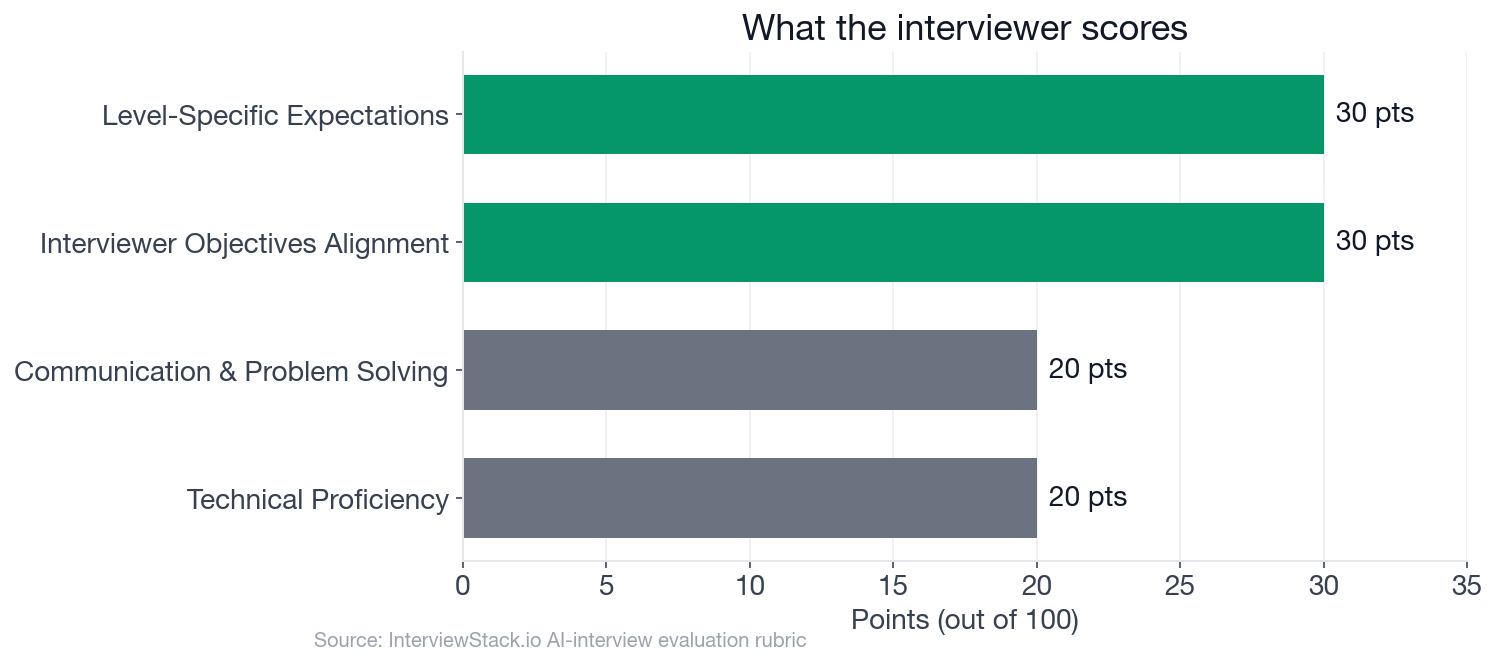 Interviewer Objectives Alignment and Level-Specific Expectations together account for 60 of the 100 points, three times the weight of Technical Proficiency, the dimension that judges raw code correctness.
What Is Actually Being Asked in This Recursion and Backtracking Interview?
The interview question
You're building a feature for an internal developer tool that lets engineers generate all valid test configurations from a short rule string. Given a string of digits from 2 to 9, return all possible letter combinations it could represent on a phone keypad, while preserving the input order of digits. Walk me through how you'd design and implement this in a way that would still be easy to maintain if the mapping changed later.
Underneath the phone-keypad framing, the interviewer is probing something narrower: can you recognize this as a backtracking problem instead of nested loops, manage a partial combination correctly as you build and undo it across recursive calls, reason about complexity in terms of branching factor and output size, and keep the digit-to-letter mapping cleanly separated from the traversal logic so it can change without a rewrite. None of that shows up in the prompt's wording. All of it shows up in the score.
Where the Follow-Ups Actually Cost Points
The main implementation is only the entry fee. The interview's real signal comes from four follow-ups that push past a working solution into edge cases, correctness guarantees, complexity, and whether the candidate understands their own code well enough to rebuild it a different way. Below is a common version of how a candidate named Owen handles each one, and what a stronger answer looks like.
Turn 1: The Input You Didn't Declare
Interviewer: "How would your solution behave for an empty input string, or if the input included a character outside 2 to 9?"
Turn 2: Order Is an Assumption, Not a Guarantee
Interviewer: "If product asked for the results in lexicographic order, would your approach already guarantee that, and under what assumptions?"
Turn 3: The Runtime Floor You Can't Engineer Around
Interviewer: "Suppose this feature starts timing out for inputs of length 10 or more. What parts of the runtime are unavoidable, and where could you still improve?"
Turn 4: Reciting Recursion Isn't Understanding It
Interviewer: "Can you show how you'd rewrite the same logic iteratively using an explicit stack or queue, and when you might prefer that version?"
Why Reading This Isn't Enough
Every mistake above is easy to spot on the page. You have the interviewer's question, a beat to think, and no clock counting down. Live, you get the follow-up cold, mid-sentence, while you're still holding the rest of your solution in your head. The gap between believing you'd have caught that and actually catching it, at minute 22 of a 30-minute session, is exactly what reps close. Reading the trap once doesn't install the reflex; running the interview does.
The Complete Blueprint
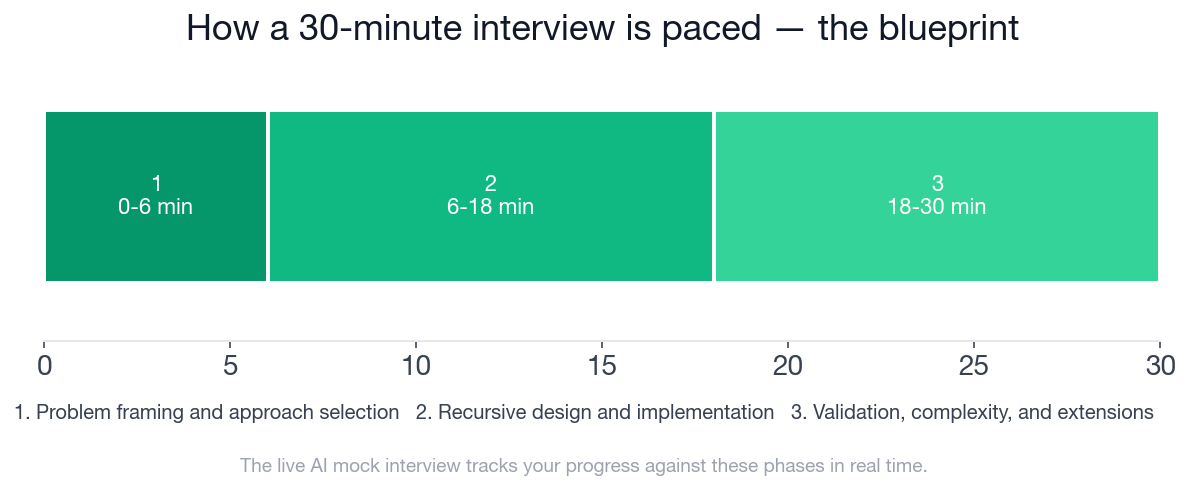 Framing gets 6 minutes, implementation gets 12, and validation plus extensions gets the final 12, with the middle phase carrying the most checklist items of the three.
This is the blueprint a strong candidate hits, phase by phase, and it's the exact structure the InterviewStack.io AI interviewer tracks you against in real time during a live session, not just at the end.
- ✓Restates the problem as exploring one digit at a time and building partial combinations
- ✓Asks or states a reasonable assumption for empty input behavior
- ✓Recognizes that hardcoding nested loops does not scale with input length
- ✓Proposes DFS/backtracking or an equivalent iterative frontier-building approach
- ✓Defines a helper with parameters representing current index and partial output state
- ✓Uses a correct base case when the current index reaches input length
- ✓Iterates over mapped letters for the current digit and recurses to the next index
- ✓Correctly appends and removes state when using a mutable path structure, or otherwise avoids shared-state bugs
- ✓Stores completed combinations in a result collection without missing or duplicating outputs
- ✓Keeps mapping logic readable and not tangled with traversal logic
- ✓Walks through a small example such as input '23' and produces the expected Cartesian-product-style combinations
- ✓States runtime as proportional to the number of generated combinations times combination length, or an equivalent precise formulation
- ✓Notes recursion depth is linear in the number of digits and discusses result-memory cost
- ✓Gives a sensible answer for invalid digits or empty mappings rather than ignoring them
- ✓Can outline an iterative queue/stack version or a generator/streaming variant when prompted
Go Run This Interview, Not Just Read It
You now know the trap: an output-size-driven timeout isn't a bug to optimize away, and every follow-up above tests whether you can defend your own code's assumptions under pressure, not just write it. Reading that is step one. Start the AI mock interview on Recursion and Backtracking now and the same phases, the same rubric, and unscripted follow-ups will find out whether it stuck. If you want to drill the underlying patterns first, work through Recursion and Backtracking questions in the question bank, and browse Software Engineer prep guides for company-specific process notes.
FAQ
Q. What does a mid-level Software Engineer recursion and backtracking interview actually test?
It tests whether you can recognize backtracking as the right pattern, build a correct recursive search with a clean base case and per-level state handling, and reason accurately about complexity and edge cases. The scoring rubric weights Interviewer Objectives Alignment and Level-Specific Expectations at 30 points each, Technical Proficiency and Communication & Problem Solving at 20 points each, for 100 total.
Q. Why does a letter-combinations backtracking problem 'time out' on longer inputs, and is that a bug?
It usually is not a bug. A 10-digit input can produce up to 4^10, or 1,048,576, letter combinations, and every one of them has to be generated and returned. The runtime floor is set by the size of the output, not by an inefficiency in the algorithm, so no amount of pruning removes it.
Q. Do you need to prune branches in this kind of backtracking problem?
No. Unlike N-Queens or Sudoku, where invalid partial states get cut early, every partial combination in a keypad letter-combinations problem is valid. There is nothing to prune. Candidates who reach for pruning here are solving a different problem than the one being asked.
Q. How is this different from a dynamic programming question?
This is an exhaustive generation problem: the goal is every valid combination, not a single optimal value. Dynamic programming techniques aimed at collapsing overlapping subproblems are explicitly out of scope for this interview; the difficulty lives in state management and complexity reasoning, not memoization.
Q. What is the most common mistake candidates make in this interview?
Two show up repeatedly: treating an output-size-driven timeout as an algorithmic flaw to optimize away, and being unable to rebuild the same logic iteratively, which reveals the recursive solution was memorized rather than understood.
Q. How long does the interview run and how is it scored?
30 minutes across three phases: problem framing (0-6 minutes), recursive design and implementation (6-18 minutes), and validation, complexity, and extensions (18-30 minutes). A 100-point rubric spans four dimensions, with the phases mapping to 15 specific checklist items an interviewer is watching for.
Q. What's the fastest way to prepare for this exact interview?
Practice it live under time pressure. Reading a walkthrough shows you the traps; an AI mock interview forces you to catch them in real time, the way the actual interview will.
The Runtime Was Never the Problem
The code in this interview is the easy part; most mid-level candidates can write a correct backtracking solution to a keypad-combinations problem without much friction. What separates a strong score from an average one is whether you can defend that code's edge cases, guarantees, and limits on demand, in a room, with the clock running. That's not a reading skill.
Topics
Ready to practice?
Put what you've learned into practice with AI mock interviews and structured preparation guides.