
Why Does the Software Engineer Title Mean So Many Different Things in 2026?
If you scrape every "Software Engineer" posting on the open web in 2026, the most surprising finding is what's missing: a single skill that every job asks for. Python tops the list, but only at 34.8% of postings. Nothing else clears that. There is no skill in the Software Engineer market that plays the role SQL plays for Data Analysts or Python-plus-pipelines plays for Data Engineers, no universal filter the resume must clear.
That absence is the story. "Software Engineer" in 2026 is less a single role than a job-family label, and the data reflects it: a frontend engineer at a SaaS startup and a principal embedded engineer at a defense contractor both wear the title, and so do the ML platform engineer at a self-driving company and the back-office Java developer at a bank. The result is a fragmented stack, a polyglot hiring posture, and real money paid to candidates who specialize without losing the breadth.
To put numbers on it, we looked at every active Software Engineer posting on the InterviewStack.io job board as of May 2026: 48,207 listings, with skills extracted from descriptions and synonyms collapsed (so etl and data pipelines count once, gcp and google cloud count once). It is the largest single-role dataset we have analyzed.
Key findings
- 48,207 active Software Engineer postings analyzed across the live job board as of May 2026: the largest single-role dataset in our coverage.
- No skill clears the 50% table-stakes line. Python leads at 34.8%, followed by Agile (29.8%), Java (27.3%), AWS (26.5%), and CI/CD (26.3%).
- The polyglot reality is in the data: Java (27.3%), JavaScript (19.2%), TypeScript (17.7%), C++ (12.3%), and C# (12.0%) all appear in roughly one in eight to one in four postings.
- Median US base salary is $140,000 (n=10,765), about $12K above the Data Engineer median and $53K above the Data Analyst median.
- Specialization pays $19K to $30K above baseline for the top tier: Deep Learning, Computer Vision, Rust, dbt, Distributed Systems, Observability, gRPC, BigQuery, and Apache Spark all sit at $159K-$170K (n at least 75 each). A second tier of $9K to $17K premiums adds C++, Go, System Design, Next.js, Snowflake, Scala, GraphQL, and PyTorch.
- Docker + Kubernetes is the strongest pair in the dataset at lift 3.75: about 70% of postings that mention Docker also ask for Kubernetes.
- Only 4.0% of postings are entry-level (1,915 of 48,207); senior plus staff together are 44% of the market.
- The US is 37.4% of postings, India 19.1%, and onsite remains the dominant work mode at 62.3% (hybrid 27%, remote 18%).
What Skill Families Define a Software Engineer Role in 2026?
Group every individual skill into the higher-level family it belongs to and count how many postings ask for at least one skill in that family. The picture is wide and shallow rather than narrow and deep.
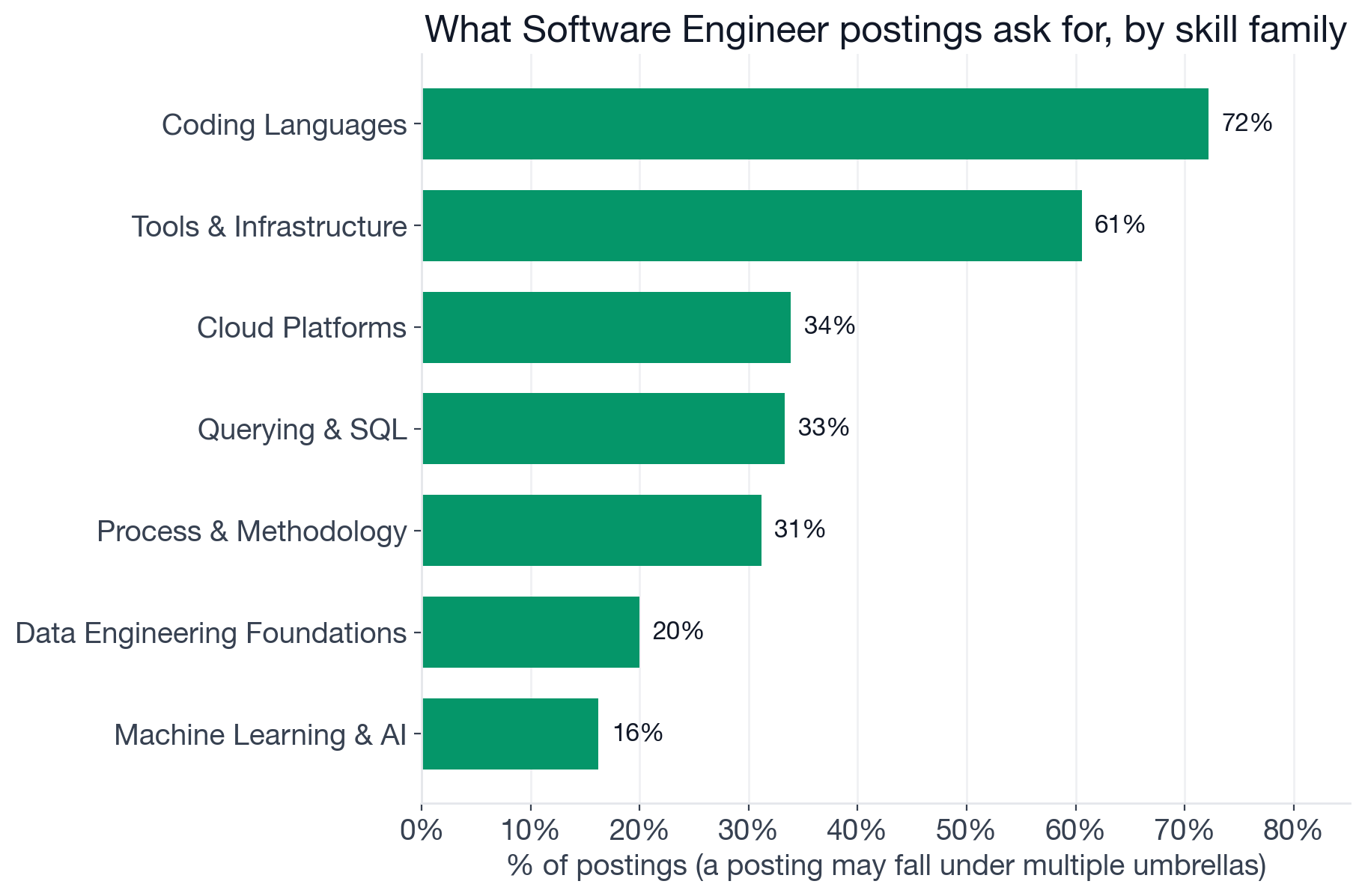
Share of Software Engineer postings that ask for at least one skill in each family. A posting that mentions both Python and Java counts once under "Coding Languages".
The families that actually define the role:
- Coding Languages: 72% of postings (Python, Java, JavaScript, TypeScript, C++, C#)
- Tools & Infrastructure: 61% (automation, Git, Docker, Kubernetes, monitoring, Terraform)
- Cloud Platforms: 34% (AWS, Azure, Google Cloud)
- Querying & SQL: 33% (SQL itself, PostgreSQL, NoSQL, MySQL)
- Process & Methodology: 31% (Agile, Scrum)
- Data Engineering Foundations: 20% (Kafka, data pipelines)
- Machine Learning & AI: 16% (machine learning, deep learning, generative AI)
Read the families against the Data Engineer post and the contrast is sharp. For Data Engineer, Data Engineering Foundations sits at 89% and Querying & SQL at 74%, because the role really is a stack. For Software Engineer, Coding Languages tops out at 72% and no other family clears two-thirds. The role does not converge on one thing.
The 34% cloud-platforms share is a useful pivot. Two-thirds of Software Engineer postings name no specific cloud at all, which fits the breadth of the title: client-side code, embedded systems, internal tooling, and on-premise enterprise work all still exist. But the postings that do name a cloud overwhelmingly cluster around AWS, with Azure and Google Cloud following.
What Are the Three Tiers of Individual Software Engineer Skills?
Drill into individual skills inside those families and three tiers emerge. The catch: the top tier is empty.
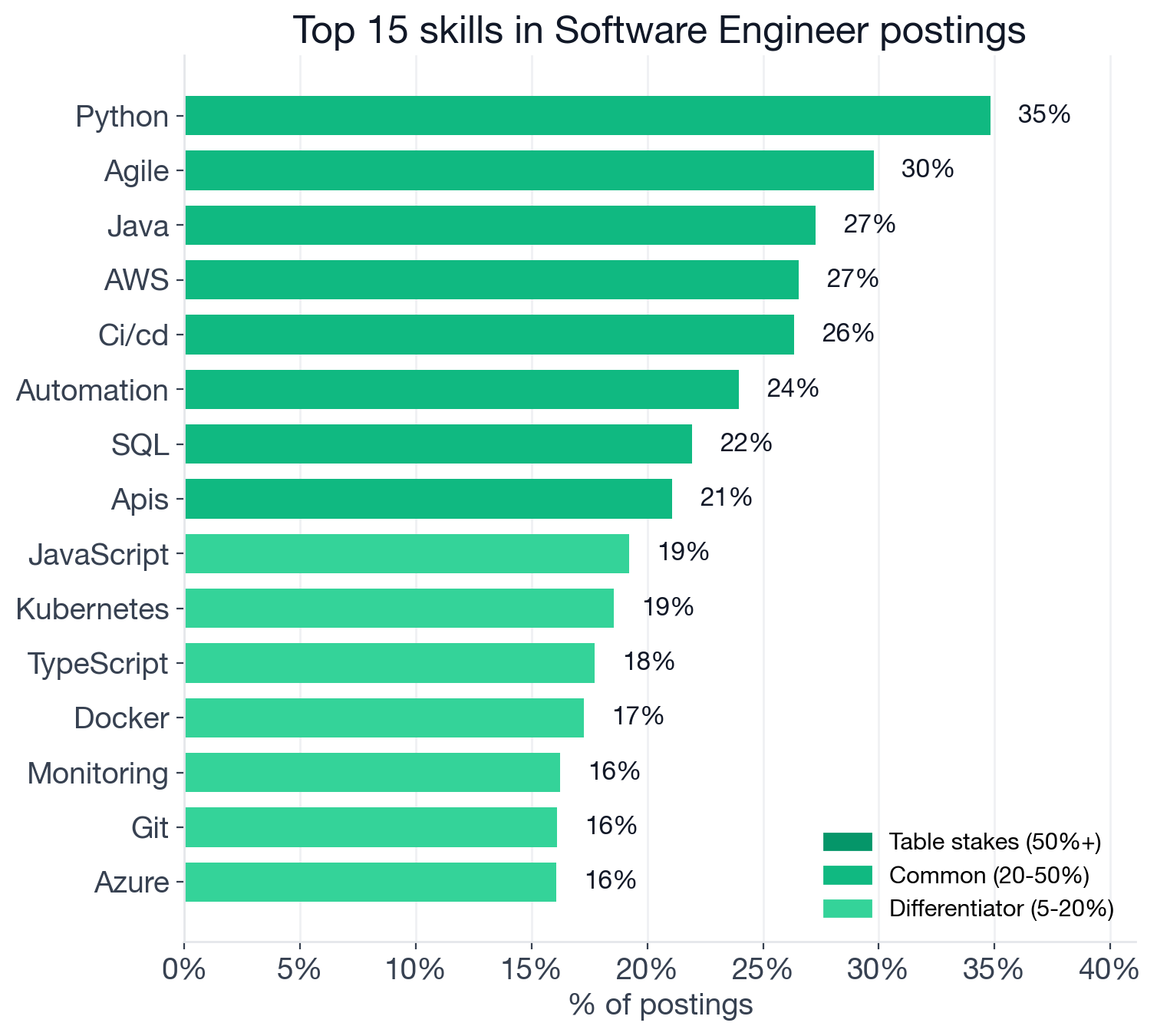
Top individual skills in Software Engineer postings, by share of listings that mention them. Skills above 50% would be table stakes; 20-50% are common; 5-20% are differentiators. No skill in this dataset clears the table-stakes threshold.
Table Stakes (50%+ of postings)
Empty. No individual skill appears in the majority of Software Engineer postings. The headline number is that Python, the most-demanded skill, shows up in just over a third of listings (34.8%). For comparison, Data Engineer postings have three skills above 70%, and Data Analyst postings have SQL above 80%. The Software Engineer market does not have a single hard filter.
What does that mean practically? It means there is no skill on a Software Engineer resume that screens you out of the majority of roles by being absent. It also means there is no skill that screens you in. Hiring filters happen lower in the stack: a Java backend posting filters for Java specifically, a React frontend role filters for React, an ML platform team filters for PyTorch. The role-level dataset shows the union, not the intersection.
Common Expectations (20-50% of postings)
This is where the role's center of gravity lives.
- Python: 34.8% (Software Engineer + Python openings)
- Agile: 29.8%
- Java: 27.3% (Software Engineer + Java openings)
- AWS: 26.5% (Software Engineer + AWS openings)
- CI/CD: 26.3%
- Automation: 24.0%
- SQL: 21.9%
- APIs: 21.1%
Two patterns jump out. First, Python has overtaken Java at the role level. Java has historically dominated enterprise SWE postings, but in this snapshot Python sits seven points ahead, pulled up by data tooling, ML platforms, internal scripting, and DevOps automation work that all sit under the "Software Engineer" umbrella. Java is still the second language of the role, not the first.
Second, Agile at 29.8% is the only soft-process skill in the common tier. That is high compared to most data roles and reflects how much SWE work happens in scrum-team org structures. Agile is a credentialing keyword in this market; calling it out on a resume is rarely wrong.
Differentiators (5-20% of postings)
This is where specialization shows up and where the salary curve starts to bend.
- JavaScript: 19.2%
- Kubernetes: 18.6%
- TypeScript: 17.7%
- Docker: 17.2%
- Monitoring: 16.2%
- Git: 16.1%
- Azure: 16.1%
- Debugging: 15.7%
- React: 15.2%
- Scalability: 14.5%
- Microservices: 14.0%
- Distributed Systems: 13.2% (Software Engineer + Distributed Systems openings)
- Linux: 12.8%
- C++: 12.3%
- C#: 12.0%
- Google Cloud: 11.8%
- Observability: 11.3%
- PostgreSQL: 10.9%
- Testing: 10.8%
- Nodejs: 8.7%
- Kafka: 7.8%
- System Design: 7.3%
- Terraform: 6.9%
- Machine Learning: 6.7%
- LLMs: 5.0%
The differentiator tier is dense with cloud-native infrastructure skills (Kubernetes, Docker, Terraform, monitoring, observability) and with architecture concepts (microservices, distributed systems, system design, scalability). These are the skills that move a Software Engineer from "writes the feature" to "owns the system", and as the salary section shows next, the market pays for that distinction.
The frontend tier (React, TypeScript, JavaScript) sits in the same band, with TypeScript at 17.7% nearly matching JavaScript at 19.2%, evidence that the typed-frontend default has won. LLMs at 5.0% are the newest entrant on the differentiator list, sitting just above the 5% noise floor. They show up specifically in postings asking the engineer to build retrieval pipelines, evaluation harnesses, or LLM-backed product features rather than train foundation models.
Which Software Engineer Skills Pay More Than the Baseline?
Salary numbers below are restricted to US postings only (where wage-transparency laws produce consistent disclosure) so they're directly comparable. The numbers are base salary: equity, RSUs, bonuses, and sign-on are not disclosed in postings, so total compensation at top employers is meaningfully higher than what we report here, especially in tech and finance.
The overall median US base salary for Software Engineer postings is $140,000 (n=10,765). That sits about $12,000 above the Data Engineer median ($128,300) and about $53,000 above the Data Analyst median ($87,200). The SWE premium reflects a deeper coding bar and broader architectural responsibility, not a different geography mix.
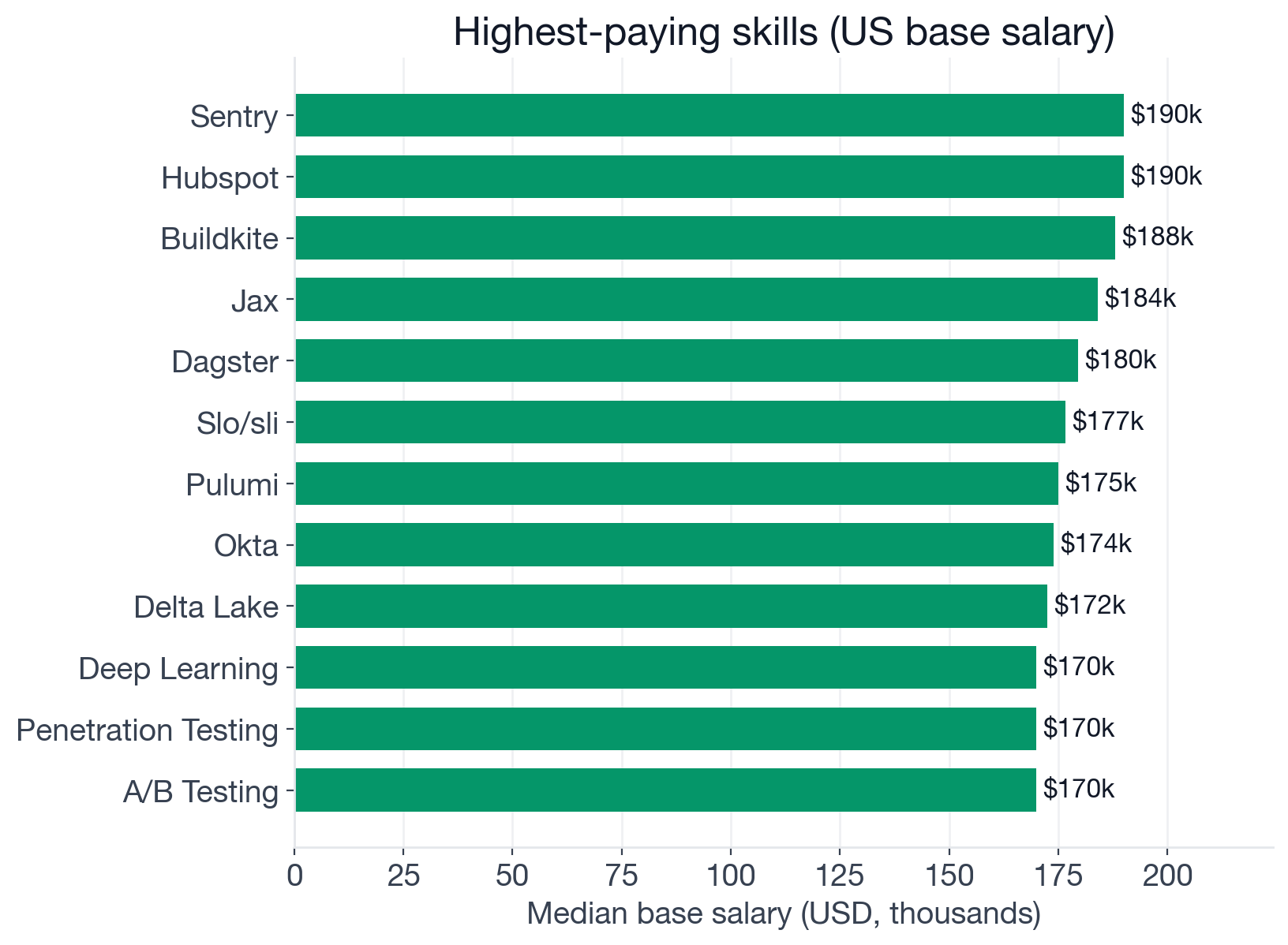
Median US base salary in USD for postings that mention each skill, among US Software Engineer postings with structured salary data.
The biggest premiums attach to research, infrastructure, and modern-stack specialties. Skills with premiums of roughly $26K to $30K above the $140,000 baseline:
- Deep Learning: $170,000 (n=182)
- Computer Vision: $166,000 (n=414)
Skills with premiums of roughly $20K to $24K:
- Rust: $164,400 (n=578)
- dbt (a SQL transformation framework that runs inside the data warehouse): $163,800 (n=77)
- Distributed Systems: $160,000 (n=2,017)
- Observability: $160,000 (n=1,513)
- gRPC (a high-performance remote-procedure-call framework used between backend services): $160,000 (n=291)
- Datadog: $160,000 (n=233)
- Incident Response: $160,000 (n=309)
- Design Systems: $160,000 (n=244)
- BigQuery: $160,000 (n=100)
- Apache Spark: $159,200 (n=565)
Skills with premiums of roughly $13K to $17K:
- PyTorch: $157,000 (n=237)
- OpenAI: $155,300 (n=210)
- Databricks: $155,000 (n=197)
- Machine Learning: $153,100 (n=1,052)
- GraphQL: $153,000 (n=399)
- Scala: $152,800 (n=273)
- LLM: $152,400 (n=577)
Smaller premiums of about $9K to $11K:
- Llms: $151,000 (n=582)
- Airflow (the open-source orchestrator most data teams use to schedule pipelines): $150,300 (n=253)
- System Design: $150,000 (n=918)
- Snowflake: $150,000 (n=251)
- Next.js: $150,000 (n=252)
- Go: $149,100 (n=422)
- C++: $149,000 (n=1,841)
- Data Pipelines: $149,000 (n=1,036)
Three patterns are worth naming. First, the AI/research stack pays the largest premiums. Deep Learning, Computer Vision, PyTorch, OpenAI, LLMs, and Machine Learning all sit $13K to $30K above baseline, which is the strongest signal in the dataset that companies are competing for engineers who can ship AI-adjacent product work. Second, the infrastructure stack still pays well: Distributed Systems, Observability, gRPC, and Apache Spark each sit at $160K, $20K above baseline. Third, the languages premium has shifted: Rust ($164.4K) and Go ($149.1K) are now the languages that move the needle, while traditional enterprise stacks (Java at $135K, C# at $124K) sit below the SWE baseline because they correlate with onshore-enterprise and global-services postings rather than the highest-paying tech segments.
The widely-asked skills sit close to baseline because they are the baseline. Python (n=4,867), TypeScript (n=2,568), AWS (n=3,115), Kubernetes (n=2,387), APIs (n=2,496), and React (n=1,724) all median exactly at $140,000. They are price-of-entry, not differentiators.
The practical takeaway: building the common-tier skills (Python or Java, AWS, CI/CD, SQL) keeps you in the running. Adding one differentiator that maps to a hiring concentration (Rust, distributed systems, observability tooling, or an AI specialty like PyTorch or LLM application work) is what moves your median offer by $20K or more. Our interview-prep courses cover the foundations across coding interviews, system design, and DSA; the question bank is where you drill the specific topics that come up in onsite rounds.
What Is the Dominant Software Engineer Skill Stack?
We computed every two-skill co-occurrence among the top 25 skills to find the combinations that show up together more often than chance.
The strongest pairs by lift, where lift greater than 1 means the two skills appear together more often than their individual frequencies would predict:
| Skill pair | Postings that mention both | % of postings | Lift |
|---|---|---|---|
| Docker + Kubernetes | 5,777 | 12.0% | 3.75 |
| AWS + Google Cloud | 4,519 | 9.4% | 2.99 |
| AWS + Azure | 5,277 | 10.9% | 2.57 |
| AWS + Kubernetes | 5,387 | 11.2% | 2.27 |
| AWS + Microservices | 4,009 | 8.3% | 2.24 |
| AWS + Docker | 4,868 | 10.1% | 2.21 |
| CI/CD + Docker | 4,618 | 9.6% | 2.11 |
| CI/CD + Kubernetes | 4,556 | 9.5% | 1.93 |
| AWS + CI/CD | 5,942 | 12.3% | 1.76 |
| Java + Kubernetes | 4,065 | 8.4% | 1.67 |
Each pair tells you something concrete about how postings actually compose skills:
- Docker + Kubernetes (lift 3.75) is the strongest pair in the entire dataset, by a wide margin. About 7 in 10 postings that mention Docker also ask for Kubernetes, and most postings that mention Kubernetes ask for Docker too. The two are effectively treated as one skill at the hiring filter, the container-orchestration competence.
- AWS + Google Cloud (lift 2.99) and AWS + Azure (lift 2.57) confirm that multi-cloud is a real hiring signal, not a buzzword. About 4 in 10 postings that name AWS also name Azure, and about 1 in 3 also name Google Cloud. Companies are asking for engineers who can move between providers, especially in enterprise and consulting work.
- AWS + Kubernetes (lift 2.27), AWS + Microservices (lift 2.24), and AWS + Docker (lift 2.21) sketch the modern cloud-native backend cluster. If you are building a stack around AWS, the postings overwhelmingly assume you know the container and microservices layer that sits on top of it.
- Python + SQL (lift 1.10, 4,034 postings) is barely above chance, a sharp contrast with Data Engineer postings where the pair has a lift of 1.15 and covers 58% of the market. For Software Engineers, the SQL-plus-Python base is just one of many bases.
- Agile + Python (lift 0.89) is the dataset's most notable anti-correlation. Python-heavy postings are slightly less likely to mention Agile than chance would predict, evidence that Python-leaning postings concentrate in ML, research, and platform work where the Agile-keyword vocabulary is less common than in mainstream enterprise dev.
The big pattern: companies want a base layer (a language plus a cloud) and an operations layer (Kubernetes plus Docker plus CI/CD plus monitoring) and either a depth specialty (distributed systems, observability, AI/ML) or a stack specialty (frontend, mobile, embedded). The "language plus IDE" world of an earlier era does not exist in 2026 SWE hiring.
Who's Hiring at Which Seniority Level?
We tagged each posting's seniority based on title keywords (Senior, Lead, Principal, Junior, Intern). Postings with no explicit signal default to mid-level.
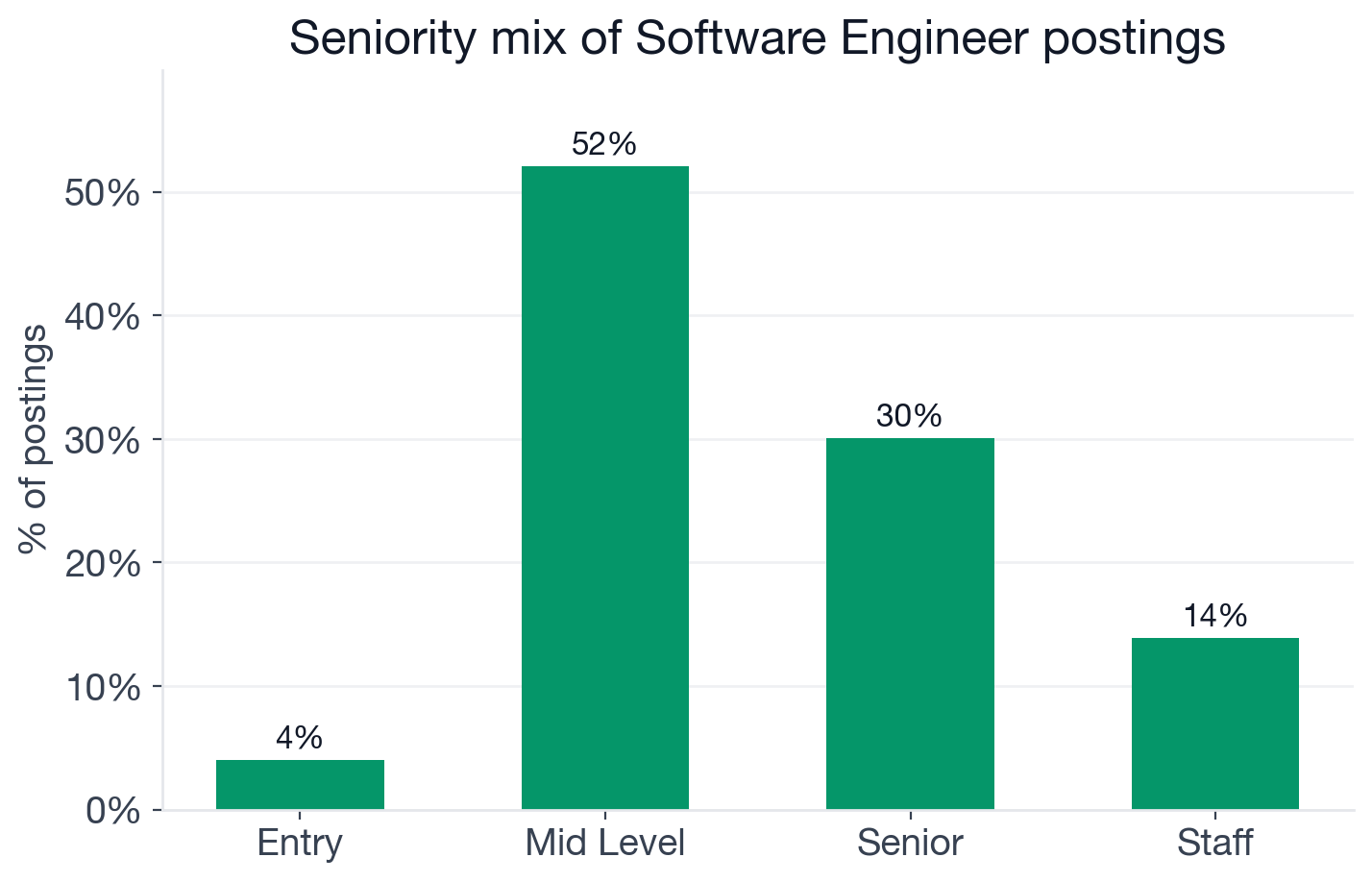
Seniority distribution of Software Engineer postings.
- Mid-level: 52.1% (25,112 postings)
- Senior: 30.1% (14,498) (senior Software Engineer openings)
- Staff / Lead / Principal: 13.9% (6,682)
- Entry: 4.0% (1,915)
Two things stand out. First, only 1 in 25 Software Engineer postings is explicitly entry-level. The market still hires juniors, but it does so under different titles (Junior Developer, Associate Engineer, Intern, internal training programs), so the "Software Engineer" label itself skews experienced. New-grad job seekers should expect to compete for a narrower share of postings than the dataset's headline suggests and should widen their search to Associate or Junior titles.
Second, the senior-and-above tiers (senior plus staff) make up 44% of postings, one of the deepest senior pipelines in tech. There is real career runway on the IC track, and the differentiator skills (distributed systems, system design, observability, multi-cloud) become required rather than nice-to-have once you cross into senior territory. Mid-to-senior is the largest single transition the dataset surfaces, and the salary curve bends there.
Where Are Software Engineer Jobs Located, and How Remote-Friendly Are They?
Geography for Software Engineer roles is more US-concentrated than for Data Engineer roles, where India and the US were nearly tied. The SWE market is still primarily a US market.
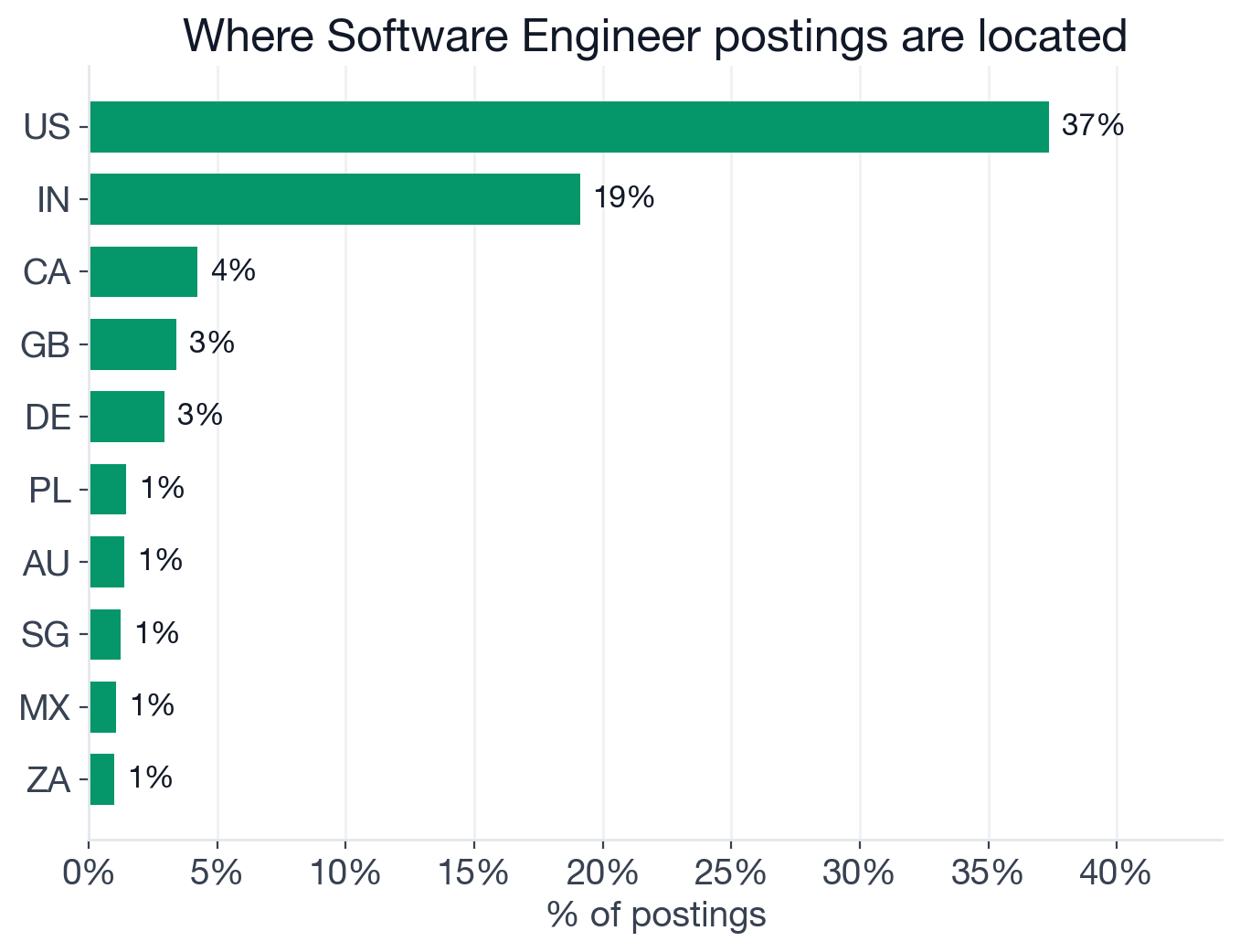
Top countries by share of Software Engineer postings.
- United States: 37.4% (US-only Software Engineer openings)
- India: 19.1%
- Canada: 4.2%
- United Kingdom: 3.4%
- Germany: 3.0%
- Poland: 1.5%
- Australia: 1.4%
- Singapore: 1.2%
The US has roughly twice the share of any other country, which is unusual: most other tech roles we have analyzed cluster the US and India closer together. The likely explanation is that the Software Engineer title in India is split across more local-language variants (Software Developer, Software Engineer L1/L2, Application Developer), so the resolved-role filter picks up fewer of them. Even so, India remains the second-largest single market by a wide margin.
The remote-first assumption holds less for Software Engineers than the headlines suggest.
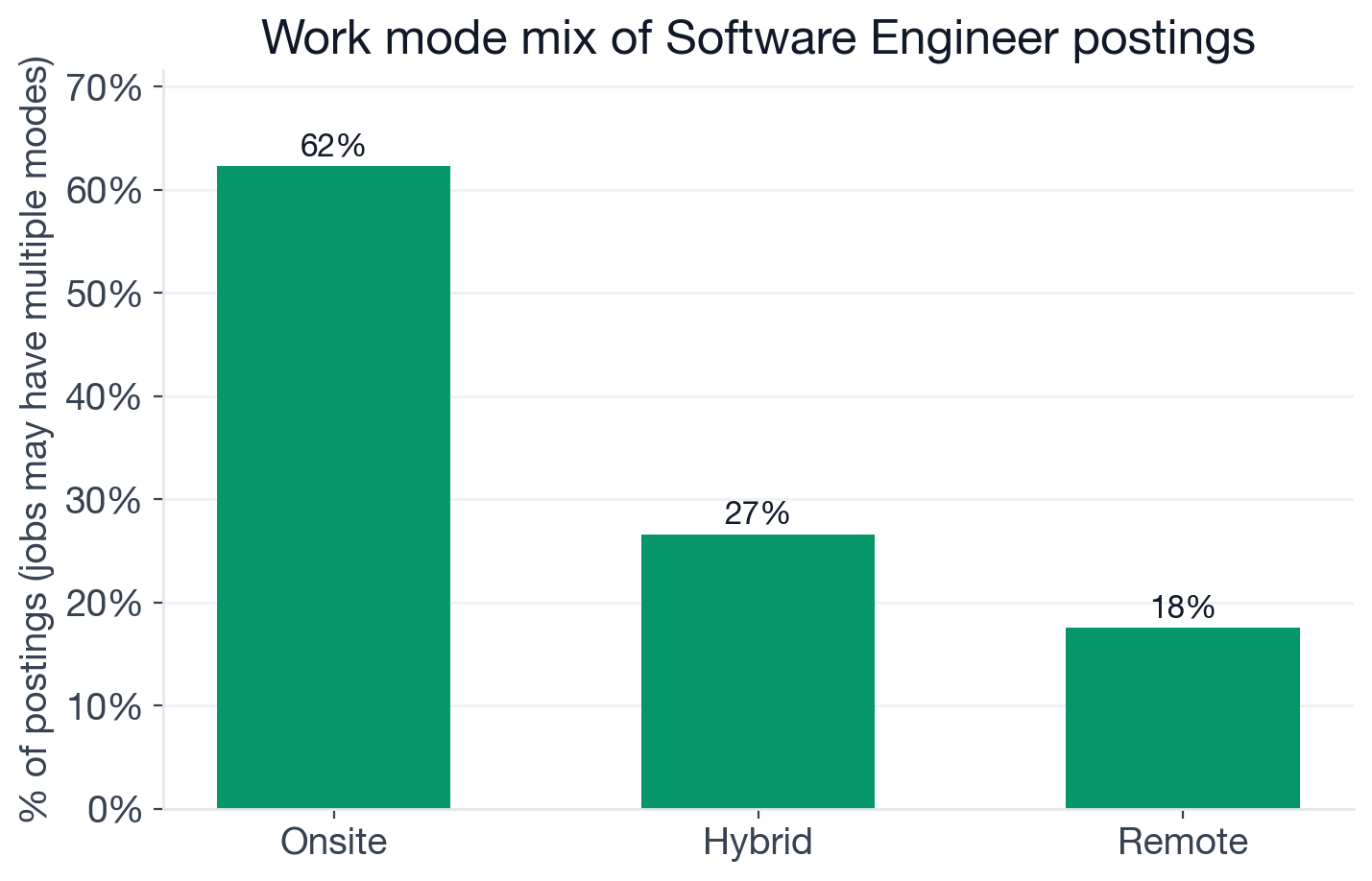
Share of Software Engineer postings tagged with each work mode. Some postings carry multiple tags (e.g., "Hybrid or Remote"), so percentages sum to more than 100%.
- Onsite: 62.3% of postings (30,030)
- Hybrid: 26.6% (12,826)
- Remote: 17.5% (8,453) (fully-remote Software Engineer openings)
Postings can carry multiple work-mode tags when a company says "Hybrid or Remote", which is why the percentages sum to more than 100%. The takeaway: nearly 2 in 3 Software Engineer postings still default to onsite, lower than other tech roles we have analyzed. The dataset is heavy with defense, aerospace, chip-design, and financial-services employers (visible in the top-companies list below), and those segments have remained onsite-first even as product SaaS has gone remote. The fully-remote share is concentrated in product tech and SaaS; if remote work is a hard requirement for your search, expect to filter down to roughly the same 17.5% of the market.
Who's Hiring Software Engineers in 2026?
The top hiring companies on our board span global consulting, GPU and chip design, defense and aerospace, banking, and product SaaS, a more diverse mix than any other tech role we have surveyed.
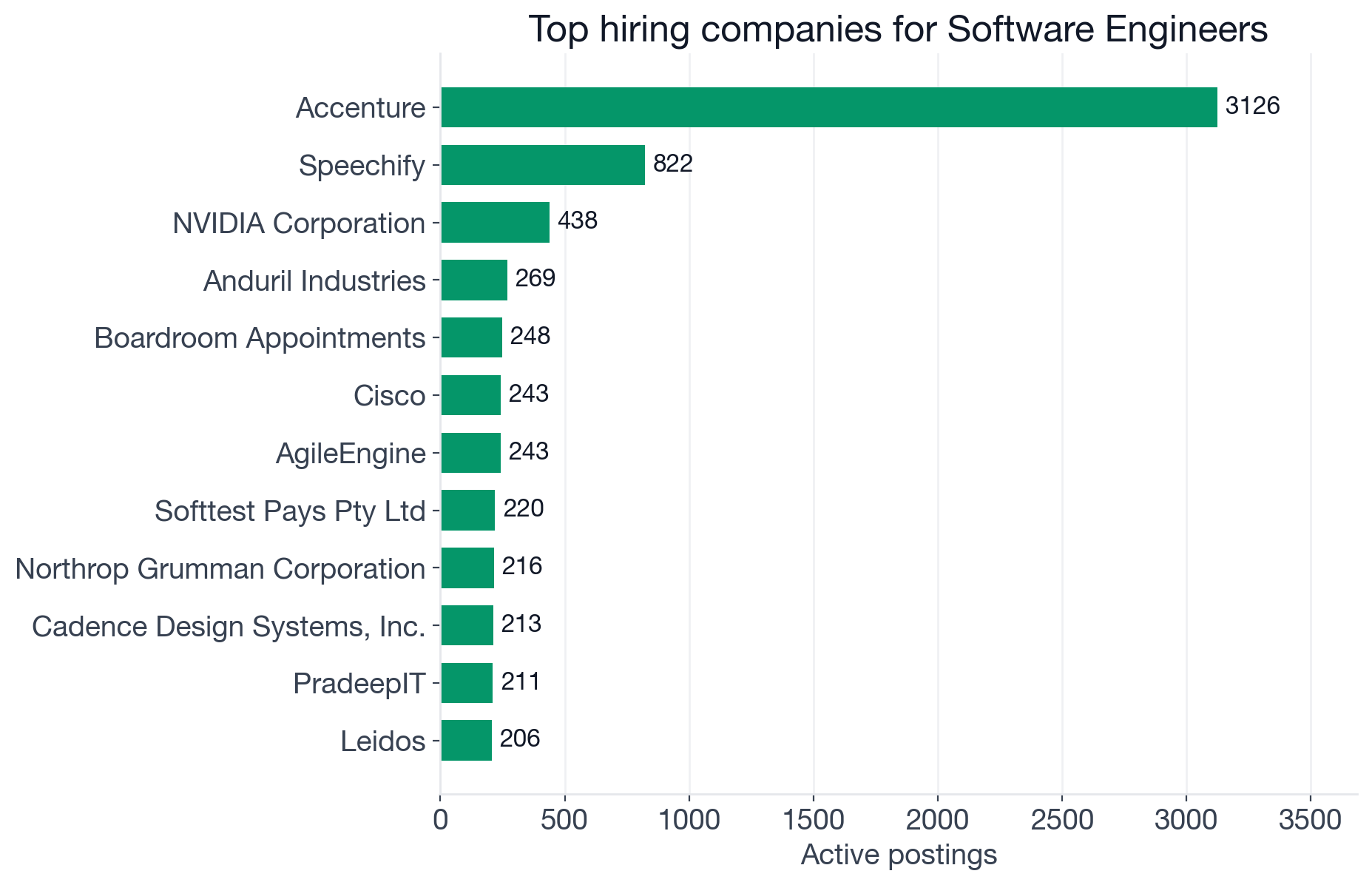
Top companies by active Software Engineer postings. Counts include all locations of the same job.
- Accenture: 3,126 postings (global consulting)
- Speechify: 822 (consumer AI / accessibility)
- NVIDIA Corporation: 438 (GPU and AI infrastructure)
- Anduril Industries: 269 (defense technology)
- Boardroom Appointments: 248 (staffing)
- Cisco: 243 (networking and security)
- AgileEngine: 243 (software services)
- Softtest Pays: 220 (QA and services)
- Northrop Grumman: 216 (defense and aerospace)
- Cadence Design Systems: 213 (chip-design EDA)
- PradeepIT: 211 (staffing)
- Leidos: 206 (defense and government IT)
- RELX Group: 188 (information services)
- Mastercard: 174 (payments)
- SpaceX: 166 (aerospace)
- Autodesk: 155 (engineering software)
- Barclays: 155 (banking)
- Exadel: 151 (software services)
A few specific takeaways. Accenture's lead is enormous: at 3,126 postings, the consulting firm is hiring nearly 4 times as many Software Engineers as the next-largest employer. Defense and aerospace is unusually well-represented for a SWE list (Anduril, Northrop Grumman, Leidos, SpaceX), reflecting the post-2024 buildup in defense-tech and space launch. Chip-design and GPU work shows up next (NVIDIA, Cadence), driven directly by the AI hardware build-out. The mainstream-tech companies you might expect to see at the top are present but smaller in posting volume than the consulting and defense players.
For specific company processes, our interview preparation guides break down the rounds, topic priorities, and behavioral expectations company by company.
How to Use This in Your Job Search
If you are preparing for a Software Engineer job hunt, the data points to a clear sequence.
1. Pick your stack, not just your skills. Because no skill is table stakes at the role level, the filter you actually face is at the stack level. A Java backend hire wants Java specifically. An ML platform team wants Python plus PyTorch plus distributed systems. A frontend role wants React plus TypeScript plus a design-system fluency. Pick the stack that matches the companies you actually want to work for, then optimize for that stack rather than for the union of every skill in the dataset.
2. Lock down the cloud-native cluster. Docker + Kubernetes is the strongest pair in the data, and AWS pairs strongly with both. If you are targeting backend or platform roles, the cloud-native cluster (Docker, Kubernetes, AWS or another cloud, CI/CD, observability) is what hiring managers assume you can speak to, even if no single skill is named in every posting.
3. Add one differentiator that moves the salary curve. The salary data is unambiguous: the skills that pay $20K or more above baseline are the differentiators, not the table stakes. Distributed Systems, Rust, gRPC, Apache Spark, observability tooling, and AI/ML specialties (PyTorch, LLMs, Machine Learning) all move your median US base salary by $13K to $30K. Pick one that fits the kind of system you want to build and learn it deeply enough to talk through trade-offs in an onsite.
4. Drill the topics, then practice the rounds. Reading about Software Engineer skills is easy; performing under interview conditions is the hard part. Our interview-prep courses cover the foundations across DSA, system design, and coding interviews. The question bank lets you drill specific topics (system design, distributed systems, concurrency, algorithms) one at a time. AI mock interviews let you practice the full round under realistic conditions, with on-demand feedback on coding and system-design questions specifically.
5. Filter the job board for your stack. Browse current Software Engineer openings on the InterviewStack.io job board and combine role and skill filters to narrow to your exact stack. For example, Software Engineer + Rust for systems work, or Software Engineer + Kubernetes + AWS for cloud-native backend. The board updates daily, so the listings are current.
FAQ
Q. What skills do companies want for Software Engineer roles in 2026?
No single skill is table stakes. The role is unusually fragmented across stacks. Python leads at 34.8% of postings, followed by Agile (29.8%), Java (27.3%), AWS (26.5%), CI/CD (26.3%), Automation (24.0%), SQL (21.9%), and APIs (21.1%). Below that, JavaScript, Kubernetes, TypeScript, and Docker each appear in 17-19% of postings. The pattern is polyglot: companies want fluency across languages, cloud, and DevOps rather than mastery of one stack.
Q. What is the median Software Engineer salary in 2026?
The median US base salary across 10,765 Software Engineer postings with disclosed US salary is $140,000. That figure excludes equity, bonuses, RSUs, and sign-on, so total compensation at top employers (especially in tech and finance) runs meaningfully higher than the base.
Q. Which Software Engineer skills pay the highest premium over the role baseline?
Among US postings, the largest premiums attach to research, infrastructure, and modern-stack specialties. Deep Learning ($170K, n=182) and Computer Vision ($166K, n=414) each sit $26K to $30K above the $140,000 baseline. Rust ($164.4K, n=578) and dbt ($163.8K, n=77) clear roughly $24K. Distributed Systems ($160K, n=2,017), Observability ($160K, n=1,513), gRPC ($160K, n=291), and BigQuery ($160K, n=100) each pay about $20K above baseline. PyTorch, GraphQL, Scala, LLMs, System Design, Snowflake, Next.js, Go, and C++ follow with premiums in the $9K to $17K range.
Q. Is Software Engineer a good entry-level role to break into?
Only 4.0% of Software Engineer postings are explicitly entry-level (1,915 of 48,207). That is higher than the 3% entry-level share in Data Engineer hiring, but still narrow. Mid-level (52.1%) and senior-or-above (44%) roles dominate, so most paths in start at junior internal-tools, support-engineering, or backend roles before competing for SWE-titled openings.
Q. Where are most Software Engineer jobs located, and how remote-friendly are they?
The United States is the largest market by a wide margin at 37.4% of postings (18,007), followed by India at 19.1% (9,210). Canada (4.2%), the United Kingdom (3.4%), Germany (3.0%), Poland (1.5%), Australia (1.4%), and Singapore (1.2%) round out the top countries. Onsite is the dominant work mode at 62.3% of postings; hybrid sits at 26.6% and fully-remote at 17.5%.
Q. Which companies hire the most Software Engineers in 2026?
Accenture leads by a wide margin with 3,126 active postings, followed by Speechify (822), NVIDIA (438), Anduril Industries (269), Boardroom Appointments (248), Cisco (243, with another 200 under a separate brand entry), AgileEngine (243), Softtest Pays (220), Northrop Grumman (216), Cadence Design Systems (213), PradeepIT (211), Leidos (206), RELX Group (188), Mastercard (174), and SpaceX (166). The mix spans global consulting, GPU and chip design, defense and aerospace, banking, and product SaaS.
Q. What is the dominant Software Engineer skill stack in 2026?
There is no single canonical stack. The strongest co-occurrence in the dataset is Docker + Kubernetes (lift 3.75, 12.0% of postings ask for both). AWS pairs strongly with Google Cloud (lift 2.99) and Azure (lift 2.57), evidence that multi-cloud fluency is genuinely valued. AWS combines with Kubernetes (lift 2.27), Microservices (lift 2.24), Docker (lift 2.21), CI/CD (lift 1.76), and Java (lift 1.56) to form the cloud-native cluster that defines modern backend roles.
Final Thoughts
The Software Engineer title in 2026 is the broadest one in tech hiring, and the data reflects that breadth: no skill clears the table-stakes line, the role spans frontend through embedded through ML platforms, and the salary curve rewards specialization rather than coverage. The most important move for a candidate is to stop optimizing for "Software Engineer" as one role and start optimizing for the specific stack you want to build a career on, with one differentiator (Rust, distributed systems, observability, or an AI/ML specialty) that bends the salary curve in your favor.
We will refresh this analysis quarterly so the trend lines stay current.
Topics
Ready to practice?
Put what you've learned into practice with AI mock interviews and structured preparation guides.