
The Short Answer
Software Engineers earn a median $143,000 US base vs. $130,000 for Frontend Developers, a 10% premium. But salary is the secondary story. The primary story is volume: there are 32 active Software Engineer postings for every Frontend Developer posting on the InterviewStack.io job board as of May 2026. "Software Engineer" is a broad umbrella that swallows dozens of specializations, including frontend work. "Frontend Developer" is a precise title that captures one specific slice of it.
Key Findings
- Software Engineer postings (32,310) outnumber Frontend Developer postings (1,019) by 31.7 to 1 on the InterviewStack.io job board as of May 2026.
- Median US base salary: $143,000 for Software Engineers (n=8,296) vs. $130,000 for Frontend Developers (n=31; small sample, treat as directional only).
- Skill overlap is low: a Jaccard coefficient of 0.22 means roughly 22% of the top-30 skill sets are shared between the two roles.
- JavaScript and React are table stakes for Frontend Developers (65.5% and 58.1% of postings) but appear in fewer than 1 in 5 Software Engineer postings.
- Python (36.2%), Java (27.1%), Kubernetes (18.7%), and Docker (18.4%) are effectively absent from Frontend Developer postings.
- Entry-level openings are scarce in both roles: 3.5% for Software Engineer, 5.0% for Frontend Developer.
- No AI skills appear in Frontend Developer postings' top-30 skill list; 51% of all professional developers use AI tools daily (Stack Overflow Developer Survey 2025), making AI tool fluency a baseline expectation even where postings don't mention it.
| Software Engineer | Frontend Developer | |
|---|---|---|
| Median US base salary | $143,000 | $130,000 (n=31) |
| Active postings (May 2026) | 32,310 | 1,019 |
| Top skill | Python (36.2%) | JavaScript (65.5%) |
| Remote share | 19.7% | 19.5% |
| Entry-level share | 3.5% | 5.0% |
What Does Each Role Actually Do?
A Software Engineer builds systems. The title is deliberately broad: embedded firmware, mobile apps, backend APIs, developer tooling, security infrastructure, ML pipelines, and yes, frontend interfaces all live under this label. The common thread is owning a component that runs in production and staying accountable for its correctness and reliability over time. The exclusive skills confirm this: Python, Java, SQL, Kubernetes, Docker, and observability tooling all point toward code that runs somewhere other than a browser, at scale, under operational pressure.
A Frontend Developer builds what users see. The job is translating design into functional browser interfaces: React components, CSS layouts, responsive breakpoints, form interactions, and client-side state. The exclusive skills (CSS, HTML, Angular, Next.js, Redux, Jest) are entirely in the presentation and interactivity layer. The handoff is typically to QA or directly to end users, not to downstream engineering teams.
If the question is "which offers more specialization options over a career," Software Engineer wins by scope. If the question is "which is most focused on the product surface a user actually touches," Frontend Developer is the answer.
What Skills Do Both Roles Require?
Both roles share a core of modern web development: JavaScript, React, TypeScript, Agile, CI/CD, and API integration.
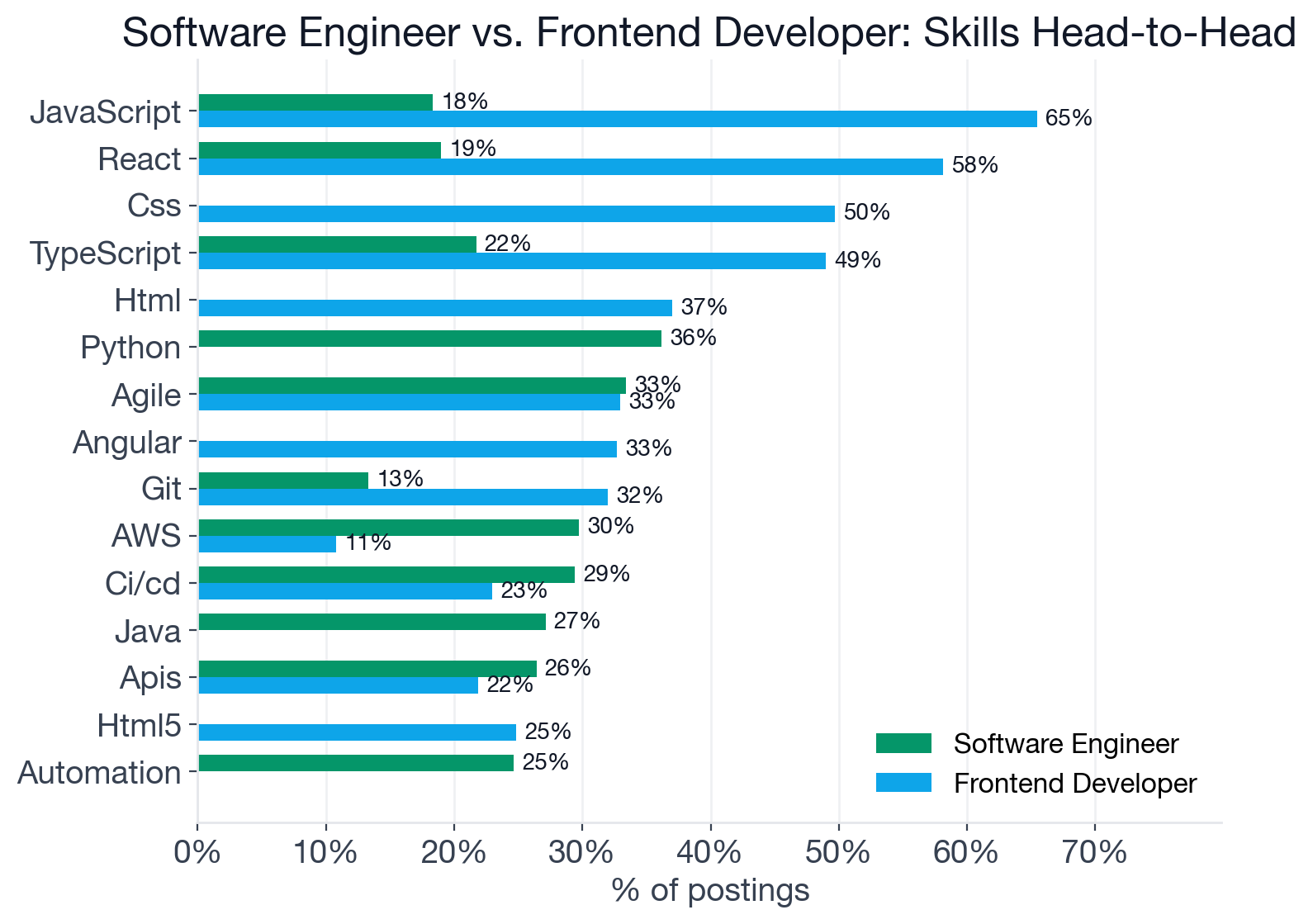
Top shared skills by frequency across Software Engineer (emerald) and Frontend Developer (blue) postings. Frequency gaps in JavaScript and React reflect how browser-layer work is table stakes for frontend but one specialization within the broader SE scope.
The "shared" label needs context. JavaScript appears in 65.5% of Frontend Developer postings but only 18.3% of Software Engineer postings. React: 58.1% vs. 19.0%. TypeScript: 48.9% vs. 21.7%. These skills clear the overlap threshold in both roles, but they signal different things: for a Frontend Developer, React and TypeScript are non-negotiable. For a Software Engineer, they mark a specific frontend or full-stack specialization among many possible paths.
One connection worth noting: per the GitHub Octoverse 2025 report, TypeScript overtook Python and JavaScript to become the most popular language on GitHub in late 2025, partly driven by AI coding tools. Strongly typed languages give AI assistants clearer constraints and produce more reliable generated code. Both roles are converging on TypeScript, and that convergence is accelerating as AI-assisted development becomes the default workflow.
The skills that genuinely overlap in frequency are Agile (Software Engineer 33.4%, Frontend Developer 33.0%) and CI/CD (29.4% vs. 23.0%). These transfer cleanly in either direction.
Where Do the Roles Diverge?
Skills exclusive to Software Engineer (high frequency in SE, rare or absent in FD):
- Python: 36.2% of postings
- Java: 27.1%
- Automation: 24.6%
- SQL: 20.2%
- Kubernetes: 18.7%
- Docker: 18.4%
- Monitoring: 17.8%
- Observability: 14.7%
This cluster reads as a backend and infrastructure portfolio. Python and Java signal general-purpose server-side work. SQL signals data access at the application layer. Kubernetes and Docker signal production container deployment. Monitoring and observability signal operational ownership: you are responsible not just for shipping code but for keeping it running. Companies posting these skills expect engineers who can debug a production incident, not just merge a PR.
Data note: Accenture (consulting/IT services) accounts for roughly 10.7% of Software Engineer postings in this dataset, the single largest employer in the sample. This modestly amplifies enterprise-common skills like Java and Agile relative to a purely product-company sample, though the overall skill distribution remains representative of the broad SE title.
Skills exclusive to Frontend Developer (high frequency in FD, rare or absent in SE):
- CSS: 49.7% of postings
- HTML: 37.0%
- Angular: 32.7%
- HTML5: 24.8%
- CSS3: 20.1%
- Jest: 17.5%
- Redux: 17.1%
- Next.js: 16.0%
The FD-exclusive list is entirely browser and UI layer. CSS and HTML appear in nearly half and more than a third of postings, meaning rendering and layout are non-negotiable, not background knowledge. Angular and Vue.js signal companies that have standardized on frameworks other than React. Jest signals that frontend testing is treated as a first-class discipline.
A note on AI skills: roughly 9.6% of Software Engineer postings explicitly mention LLM or generative AI skills (3,111 of 32,310 postings). Frontend Developer postings show virtually no explicit AI requirements in their top-30 skills. The distinction is meaningful: that ~10% of SE postings measures roles hired to build AI-powered systems, integrate LLM APIs, or operate ML pipelines. It does not measure ambient AI tool usage. The Stack Overflow Developer Survey 2025 found 84% of developers use or plan to use AI tools, and 51% use them daily, a floor that applies equally to frontend developers even though their job postings almost never state it. GitHub Copilot reached approximately 20 million users by mid-2025 and is present in 90% of Fortune 100 companies, meaning most engineers at major employers work in AI-augmented environments regardless of what their job posting says.
Which Pays More?
Among US postings with disclosed salary data (base salary only; equity, bonus, and sign-on are not included in job posting data and not in this dataset): Software Engineers earn a median $143,000 (n=8,296), compared to $130,000 for Frontend Developers (n=31). The $13,000 gap represents a 10% premium for the broader title.
Treat the Frontend Developer figure with care: 31 US salary disclosures is a very small sample, likely concentrated in states with wage-transparency laws. The Software Engineer figure, backed by 8,296 data points, is substantially more reliable as a market signal.
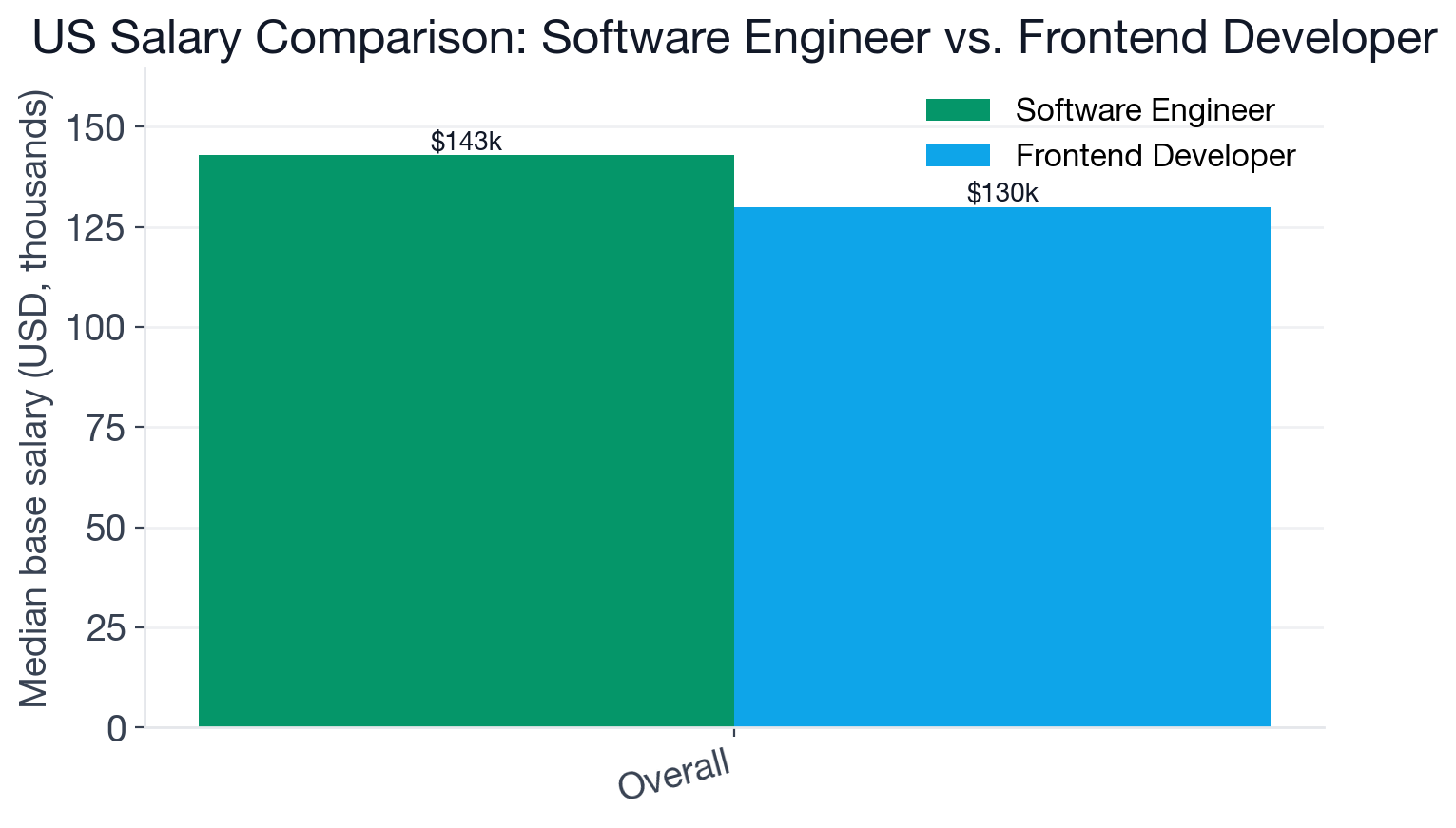
US base salary medians. Software Engineer salary by skill shown where n >= 25. Frontend Developer skill-level salary not shown (insufficient US disclosures for skill-level analysis).
Within Software Engineer, specializations that go deeper into systems-level or AI work command meaningful premiums above the $143,000 baseline. Distributed Systems postings show a median of $163,900 (+$21K, n=1,564). Machine Learning postings reach $157,000 (+$14K, n=921). LLM-related postings hit $153,000 (+$10K, n=504). These are the specializations that lift a generalist Software Engineer title toward the senior and staff compensation ceiling. Frontend-adjacent SE work sits much closer to the role baseline: React postings show a median of $146,600 (+$3,600 above baseline) and TypeScript postings $146,000 (+$3,000). Both are above baseline but well below the premium attached to systems and AI depth, reinforcing that the salary ceiling in the SE title correlates with how far from the browser layer the work sits.
Which Has More Job Openings?
Software Engineer postings (32,310) outnumber Frontend Developer postings (1,019) by 31.7 to 1. This is structural, not cyclical. "Software Engineer" absorbs a huge range of specializations. "Frontend Developer" is a precise label used by companies that explicitly differentiate frontend from the rest of their engineering org.
On entry: scarce openings in both markets. 3.5% of Software Engineer postings are explicitly entry-level (roughly 1,130 postings), and 5.0% of Frontend Developer postings are entry-level (roughly 51 postings). Mid-level dominates both: 48.2% of SE and 58.8% of FD postings target mid-level candidates. Staff-level openings are notably larger in SE (15.3%) than FD (4.1%), reflecting the broader career ladder the SE title supports.
Work mode is nearly identical across both roles: around 19-20% remote, 24-27% hybrid, and about 51% onsite. Neither role offers a meaningful remote advantage over the other.
Geography diverges. The US is the largest market for Software Engineers at 40% of postings, with India second at 23%. Frontend Developer postings are more internationally distributed: the largest markets are unknown/unspecified (15.7%), India (11.9%), and the US (10.3%), followed by Germany (4.3%), Canada (3.6%), and Portugal (3.1%). If you are outside the US, the Frontend Developer title may actually offer better geographic reach. That said, treat this distribution with some caution: the top Frontend Developer employers in this dataset are predominantly staffing and IT services firms: PradeepIT, Boardroom Appointments, Nexthire, HawodTech Solutions, ADI Recruitment, and Datamatics Technologies collectively appear among the top fifteen employers. A significant portion of FD openings likely represent contract or agency placements rather than direct-hire product roles; this context partly explains the broad international distribution and the very low US salary disclosure rate (n=31).
Which Should You Choose?
Choose Software Engineer if you:
- Want flexibility to specialize over time (backend, infra, ML, security, or frontend) without switching titles
- Have or plan to build a Python, Java, or backend-heavy foundation
- Want the largest absolute number of job opportunities and the widest company range to target
- Are interested in systems-level work, operational ownership, or AI-powered product development
Choose Frontend Developer if you:
- Know you want to work in the browser and care specifically about UI, design systems, and user-facing product quality
- Already have or are building fluency in CSS, HTML, and a major framework (React, Angular, or Vue.js)
- Are comfortable targeting a smaller but focused hiring market where browser-layer depth is the primary signal
- Are outside the US and want a title with broader international distribution
One practical note: many Software Engineer postings are implicitly or explicitly frontend-focused. React (19%) and TypeScript (21.7%) are among the top Software Engineer skills. If you want frontend work but want the larger job pool, searching "Software Engineer" and filtering by React or TypeScript surfaces a substantial slice of the same market without the title restriction.
Bottom Line
Software Engineer and Frontend Developer share a JavaScript and TypeScript surface, then diverge sharply: SE covers backend, infrastructure, and AI system-building; FD focuses on the browser layer. The salary gap is a modest 10%, though the SE figure is far more statistically reliable. The volume gap is not modest: 32 SE postings exist for every FD posting on the board.
Whichever path you choose, targeted practice is what converts market knowledge into offers. Use AI mock interviews to drill the specific role's technical and behavioral questions, and the Question Bank to work through the skill areas where postings show the most demand. Browse live Software Engineer openings and Frontend Developer openings on InterviewStack.io to see where the market stands today.
FAQ
Q. What is the median salary difference between Software Engineer and Frontend Developer in 2026?
Software Engineers earn a median US base salary of $143,000 (n=8,296 US postings with disclosed salary), vs. $130,000 for Frontend Developers (n=31 US postings). The $13,000 gap carries a caveat: the Frontend Developer sample is very small and may not be representative of the full market. Neither figure includes equity or bonuses.
Q. What skills do Software Engineers and Frontend Developers share?
Both roles commonly require JavaScript, React, TypeScript, Agile, CI/CD, and API integration. In Frontend Developer postings, JavaScript reaches 65.5% and React 58.1%, compared to 18.3% and 19.0% respectively in Software Engineer postings, where these are one slice of a much broader stack.
Q. Which is easier to break into: Software Engineer or Frontend Developer?
Frontend Developer roles have a slightly higher entry-level share (5.0% of postings) vs. Software Engineer (3.5%). But Software Engineer has 32 times more total postings (32,310 vs 1,019), so in absolute terms there are far more entry-level SE openings available. Both are competitive; the SE market simply offers more volume.
Q. What makes Frontend Developer skills different from Software Engineer skills?
Frontend Developer postings center on browser-layer work: CSS (49.7%), HTML (37.0%), Angular (32.7%), HTML5 (24.8%), CSS3 (20.1%), and Next.js (16.0%). Software Engineer postings emphasize backend and infrastructure: Python (36.2%), Java (27.1%), Kubernetes (18.7%), Docker (18.4%), and distributed-systems observability. Their Jaccard skill overlap is 0.22, meaning only about 22% of skills overlap.
Q. Which role has more job openings in 2026?
Software Engineer postings outnumber Frontend Developer postings 31.7 to 1 on the InterviewStack.io job board as of May 2026: 32,310 active SE postings vs. 1,019 FD postings. "Software Engineer" is the highest-volume engineering title on the board; "Frontend Developer" captures only postings using that specific label.
Q. Do Frontend Developers need AI skills in 2026?
No AI skills appear in the top-30 Frontend Developer skill list, but that measures roles hired to build AI systems, not ambient tool usage. The Stack Overflow Developer Survey 2025 found 51% of professional developers use AI tools daily, and GitHub Copilot reached roughly 20 million users by mid-2025, present in 90% of Fortune 100 companies. AI tool fluency is now a baseline expectation for frontend developers, even when job postings don't say so.
Topics
Ready to practice?
Put what you've learned into practice with AI mock interviews and structured preparation guides.