
The Short Answer
Software Engineers earn a $140,000 median US base salary vs. $130,000 for Full-Stack Developers: a $10,000 (7.7%) gap. That difference matters less than the volume story: Software Engineer postings outnumber Full-Stack Developer postings by nearly 7 to 1 (48,027 vs. 6,897). The two roles share 71% of their top-30 skill sets, so this comparison is more about specialization direction than a different career entirely.
We analyzed every active Software Engineer and Full-Stack Developer posting on the InterviewStack.io job board as of May 2026, with skills extracted from descriptions and synonyms collapsed.
| Software Engineer | Full-Stack Developer | |
|---|---|---|
| Active postings | 48,027 | 6,897 |
| Median US base salary | $140,000 | $130,000 |
| US salary sample | n=10,790 | n=664 |
| Top skill | Python (32.3%) | React (54.3%) |
| Remote share | 17.2% | 28.1% |
| Entry-level share | 3.8% | 2.4% |
| Skill overlap (Jaccard) | 71% shared | (same metric) |
Key Findings
- Software Engineer postings outnumber Full-Stack Developer postings 7 to 1 (48,027 vs. 6,897 active as of May 2026).
- 71% Jaccard skill overlap: 7 in 10 top skills are shared between the two roles.
- Median US base salary: $140,000 for Software Engineers (n=10,790) vs. $130,000 for Full-Stack Developers (n=664). Base only; equity and bonus excluded.
- React dominates Full-Stack Developer postings at 54.3%; it appears in only 15.3% of Software Engineer postings.
- Full-Stack Developer roles are far more remote-friendly: 28.1% remote vs. 17.2% for Software Engineers.
- Neither role is easy to break into: entry-level share is 3.8% for Software Engineers and 2.4% for Full-Stack Developers.
- LLM skills command a $30K premium for Full-Stack Developers ($160K median, n=58) vs. a $10K premium for Software Engineers ($150K median, n=597).
What Does Each Role Actually Do?
Software Engineers work across backend services, infrastructure, embedded systems, and platform engineering. Their output typically goes to other engineers or DevOps before it reaches a user. The job demands breadth and systems thinking: design an API, debug a production failure, review another engineer's architecture, write a postmortem.
Full-Stack Developers own the full vertical slice: database schema, backend API, and browser-rendered UI. They interact directly with product managers, ship both sides of the data flow, and are accountable when features break in production. "Full-stack" signals delivery accountability for the entire chain, not just a coding specialty.
The exclusive skills reveal this directly: Linux, C++, Distributed Systems, and Observability belong to Software Engineers. CSS, HTML, and Spring belong to Full-Stack Developers.
What Skills Do Both Roles Require?
Python, Agile, AWS, CI/CD, Java, SQL, APIs, Docker, and Git are shared with meaningful frequency across both roles. These are skills that will not require relearning if you move between the two titles.
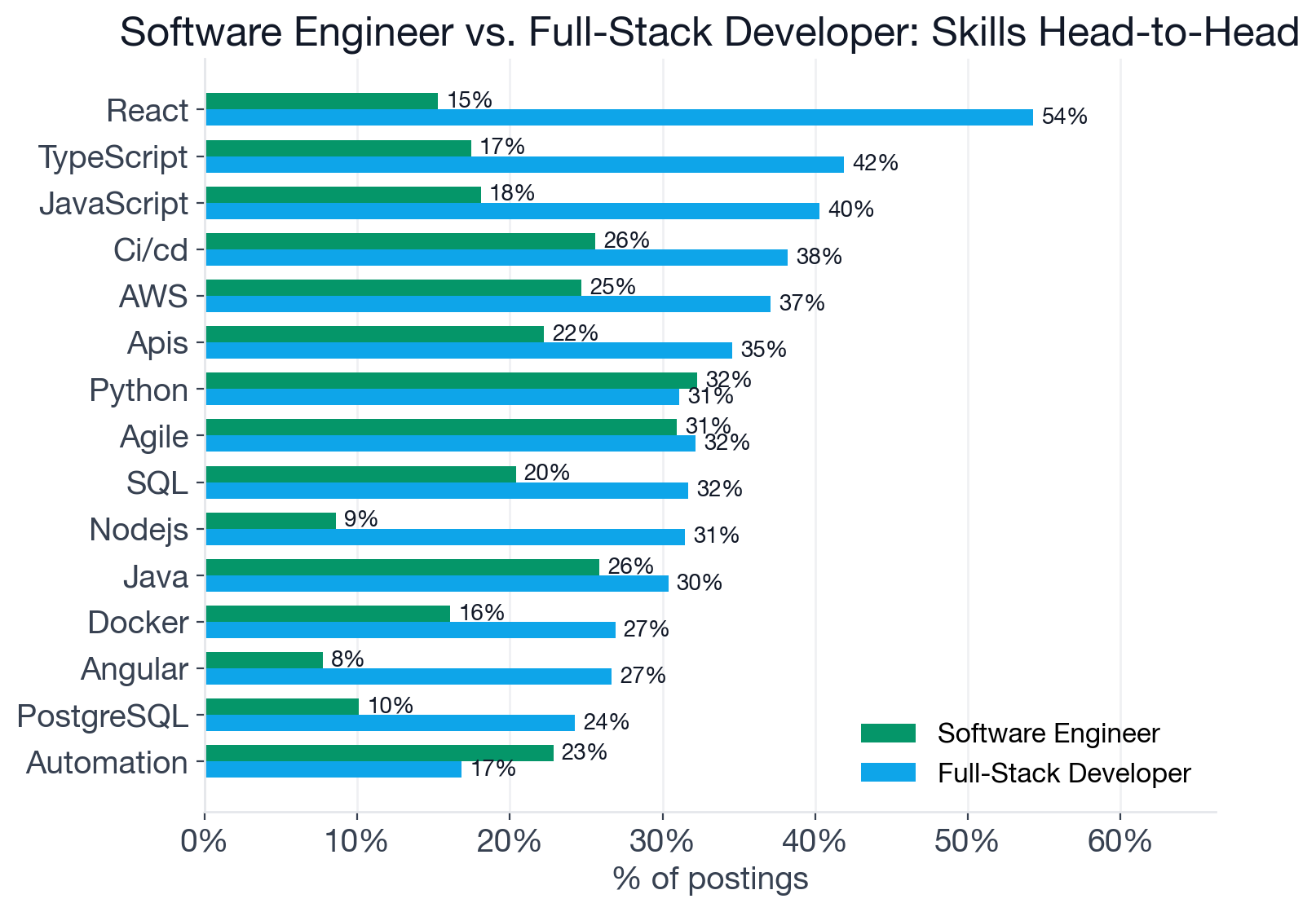
Share of postings mentioning each skill, from the union of both roles' top-30 lists. Where the bars converge is transferable foundation; where they diverge is specialization.
TypeScript (41.9% of Full-Stack Developer postings vs. 17.5% for Software Engineers) and JavaScript (40.3% vs. 18.1%) sit in the shared set but at dramatically different intensities. Full-Stack Developers are being hired specifically for them. The GitHub Octoverse 2025 report found TypeScript surpassed Python and JavaScript to become the most-used language on GitHub in August 2025, partly driven by AI tooling momentum, and Full-Stack Developers are at the center of that shift.
Where Do Software Engineer and Full-Stack Developer Skills Diverge?
Software Engineer exclusives signal systems and reliability engineering: Linux (12.6% of Software Engineer postings), C++ (12.1%), Observability (11.2%), Distributed Systems (10.8%), and Scrum (8.6%) all sit above the threshold for Software Engineers but not for Full-Stack Developers. These are infra, scale, and production-health concerns. Note: the Software Engineer dataset captures a broad spectrum of engineering specializations (including embedded, hardware-adjacent, and physical-systems roles), so Linux and C++ frequencies likely reflect a mix of software-systems and non-software engineering postings.
Full-Stack Developer exclusives complete the web delivery picture: CSS (18.3%), HTML (15.7%), Spring (14.3%), MySQL (13.3%), and RESTful APIs (13.3%). A Full-Stack Developer is expected to own the UI layout, the HTTP contract, and the relational schema. Spring's presence signals a substantial Java-on-the-backend cohort, particularly in enterprise and financial services.
Which Pays More?
The numbers below are US base salary only. Equity, bonuses, and sign-on are not disclosed in posting data, so total compensation at top employers is meaningfully higher for both roles.
Software Engineers earn $140,000 at the median (n=10,790 US postings with disclosed salary); Full-Stack Developers earn $130,000 (n=664). The $10K baseline gap is real but modest. Note that only 9.6% of Full-Stack Developer postings disclose a US base salary (vs. 22.5% for Software Engineers), so the $130,000 figure likely skews toward salary-transparent US employers and may not represent the global FSD market.
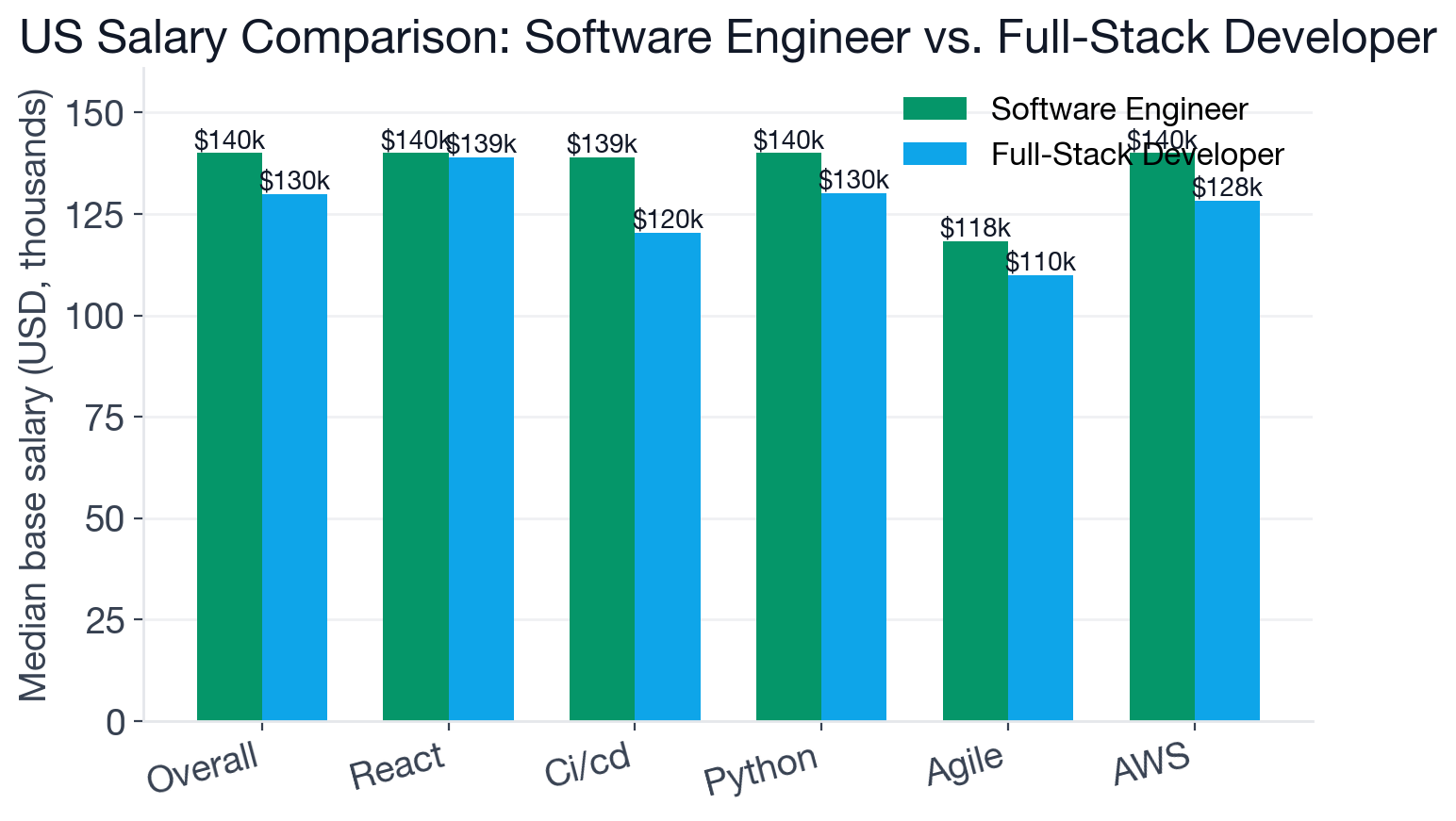
Median US base salary. Software Engineer: n=10,790. Full-Stack Developer: n=664. Base only; equity and bonus excluded.
Differentiator skills move both baselines substantially. For Software Engineers: Distributed Systems and Rust each reach $160,000 (+$20K), Observability $159,200 (+$19.2K), Machine Learning $153,100 (+$13.1K), and LLMs $150,000 (+$10K). For Full-Stack Developers: LLMs reach $160,000 (+$30K, n=58), System Design $159,900 (+$29.9K), API Design $159,600 (+$29.6K), and Next.js or Observability at $150,000 (+$20K each).
The AI skills pattern needs a direct statement: neither role lists LLMs in its top-30 skills by posting count, but that is not a signal that AI is optional. According to the Google DORA 2025 report, 90% of software development professionals already use AI tools, spending a median of 2 hours per day with AI. What the data captures is a premium sub-track: the LLM premium is $30K for Full-Stack Developers (vs. $10K for Software Engineers) because LLM-fluent full-stack candidates are scarce relative to startup demand for them.
Which Has More Job Openings?
Software Engineer has 7× more postings. Seniority distributions are similar for both: roughly 53-58% mid-level, 29-31% senior, and minimal entry-level (3.8% for Software Engineers; 2.4% for Full-Stack Developers). Only 1 in 41 Full-Stack Developer postings is explicitly entry-level. Neither path is easy to start without prior experience.
Work mode is the sharpest practical difference: 28.1% of Full-Stack Developer postings are tagged remote vs. 17.2% for Software Engineers, with onsite at 45.8% vs. 55.0%. If remote flexibility is a priority, the title framing matters.
Which Should You Choose?
Choose Software Engineer if you:
- Want to work on systems, infrastructure, or platform engineering, where Linux, C++, Distributed Systems, and Observability are in the role's DNA
- Are targeting the larger market (7× more postings) with pathways into defense, biotech, aerospace, and enterprise software
- Want higher senior-and-staff concentration: 43.2% of Software Engineer postings are senior or above, with real premiums for Distributed Systems and Rust expertise
Choose Full-Stack Developer if you:
- Have a web-first background: React (54.3%), TypeScript (41.9%), and Node.js (31.4%) are the core of the role
- Value remote flexibility: 28.1% remote vs. 17.2% for Software Engineers
- Want a well-defined technical target where interview prep maps directly to the job: one stack, two layers, ship to users
How to Use This in Your Job Search
The shared foundation (cloud, CI/CD, Python or TypeScript, and SQL) is where to start for either title. Practice system design and coding rounds with AI mock interviews, and use the question bank to drill distributed systems, API design, and database topics at your own pace. Browse live Software Engineer openings and Full-Stack Developer openings, and narrow by skill: Full-Stack Developer + React + TypeScript or Software Engineer + Distributed Systems.
FAQ
Q. What is the salary difference between Software Engineer and Full-Stack Developer in 2026?
Software Engineers earn a $10,000 (7.7%) higher median US base salary than Full-Stack Developers. The median across 10,790 US Software Engineer postings with disclosed salary is $140,000; the median across 664 US Full-Stack Developer postings is $130,000. Both figures exclude equity and bonus, which can add significantly at product and tech companies.
Q. How much overlap is there between Software Engineer and Full-Stack Developer skill sets?
The Jaccard similarity on the top-30 skill sets of both roles is 0.71, meaning 71% of the combined skill pool is shared. Python, Agile, AWS, CI/CD, SQL, and APIs all appear in both top-10 lists. The divergence is real but narrow: Software Engineers skew toward systems skills (Linux, C++, Distributed Systems, Observability); Full-Stack Developers skew toward web stack skills (React, TypeScript, JavaScript, CSS, HTML).
Q. Which role has more job openings: Software Engineer or Full-Stack Developer?
Software Engineer postings outnumber Full-Stack Developer postings by roughly 7 to 1 on the InterviewStack.io job board as of May 2026 (48,027 vs. 6,897 active postings). For most job seekers, Software Engineer is the more accessible title in terms of raw volume, even though neither role has an easy entry-level path (3.8% entry-level for Software Engineers vs. 2.4% for Full-Stack Developers).
Q. Is Full-Stack Developer easier to break into than Software Engineer?
Neither role is easy to enter: 3.8% of Software Engineer postings and 2.4% of Full-Stack Developer postings are explicitly entry-level. Full-Stack Developer postings concentrate heavily at mid-level (58.2%) with a clear web-stack requirement (React, TypeScript, Node.js), which makes the preparation path more predictable for candidates coming from a web background.
Q. What skills are unique to Full-Stack Developer roles that Software Engineers don't typically need?
CSS (18.3% of Full-Stack Developer postings), HTML (15.7%), Spring (14.3%), MySQL (13.3%), and RESTful APIs (13.3%) appear frequently enough in Full-Stack Developer postings to be role-specific, yet fall below the threshold that places them in Software Engineer's top-30 list. These skills signal that Full-Stack Developers own the full web delivery stack, from database to browser.
Q. How does remote work availability compare between Software Engineer and Full-Stack Developer roles?
Full-Stack Developer roles are significantly more remote-friendly: 28.1% of postings are tagged remote vs. 17.2% for Software Engineer roles. Full-Stack Developers also face a lower onsite rate (45.8% vs. 55.0% for Software Engineers). The gap likely reflects the outsourcing- and staff-augmentation-heavy hiring base in this dataset; several top Full-Stack Developer employers are staffing and nearshore development firms that commonly post remote-eligible positions for distributed client work.
Q. Which role pays more when you add AI skills like LLMs?
Postings that mention LLMs show a $150,000 median for Software Engineers (+$10K over the $140K baseline) and $160,000 for Full-Stack Developers (+$30K over the $130K baseline), based on US salary data with n≥25. The larger premium on the full-stack side reflects how scarce LLM-fluent full-stack candidates are relative to demand.
Final Thoughts
Seventy-one percent skill overlap means this comparison is less about which tools to learn and more about which problems to work on. Software Engineers get a larger market, a small salary advantage, and broad domain optionality. Full-Stack Developers get a sharper technical target, better remote odds, and faster feedback from shipping product directly to users. The data supports either path for the right candidate.
Topics
Ready to practice?
Put what you've learned into practice with AI mock interviews and structured preparation guides.