
The Solutions Architect Compute Options and Trade-offs Interview Rewards Segmentation, Not One Model
Ninety seconds into a mid-level Solutions Architect interview, most candidates have already picked a compute model: serverless, for everything. It handles bursts, it scales to zero, it's the safe modern default. Then the interviewer asks about GPU-bound transcoding jobs, and the model chosen for the whole system stops fitting a third of it.
That's what this interview actually tests. Not whether you can name serverless, containers, managed containers, VMs, and bare metal, but whether you can look at one product and see three or four different workloads hiding inside it, each with its own latency, duration, and hardware profile. Below is a live walkthrough of that interview, turn by turn, including exactly where a well-prepared candidate still gives away points.
Key Findings
- Interviewer Objectives Alignment and Level-Specific Expectations each carry 30 of the interview's 100 rubric points, 60 combined, and both reward how you segment the workload, not how many compute options you can name.
- The architecture-proposal phase (minutes 7 to 20) packs 5 separate checklist items into 13 minutes.
- The scenario's creator-event traffic spikes 20x within minutes, including a ramp from near-zero to peak within two minutes that recurs several times a week.
- If pushed on latency, the upload-confirmation path has to hold a 200ms p95 budget, a number unmitigated cold starts routinely miss.
- Stress-testing the trade-offs gets a dedicated 7-minute phase (minutes 20 to 27) built to check whether your first answer survives new constraints.
- The closing recommendation summary gets just 3 minutes (minutes 27 to 30) to state the compute mix, the trade-offs accepted, and the data still missing.
- Technical Proficiency and Communication & Problem Solving each carry 20 of the remaining 40 rubric points.
Here's the prompt a real mid-level candidate walks into, mirrored from the production interview generator:
The interview question
You are advising an internal product team at a large consumer tech company that is launching a new real-time media processing service. The service accepts user uploads, performs virus scanning and metadata extraction immediately, generates thumbnails and short previews, and then kicks off heavier asynchronous transcoding jobs. Traffic is highly uneven: normal baseline traffic is moderate, but major creator events can drive 20x bursts within minutes. Some API paths are latency-sensitive for the user experience, while the heavy processing pipeline can take longer. The team is small and wants to avoid unnecessary operational burden, but they also care about unit cost at scale and do not want to get locked into an option that will become problematic six months later.
How would you choose the compute model or models for this service, and what architecture would you recommend?
What the interviewer is actually scoring is whether you can pick an appropriate compute model for each piece of a realistic workload, reason through the trade-offs among virtual machines, containers, managed container services, serverless functions, and bare metal, and land on a recommendation that balances latency, scaling behavior, operational load, cost, and control, not whether you can recite a vendor's feature list.
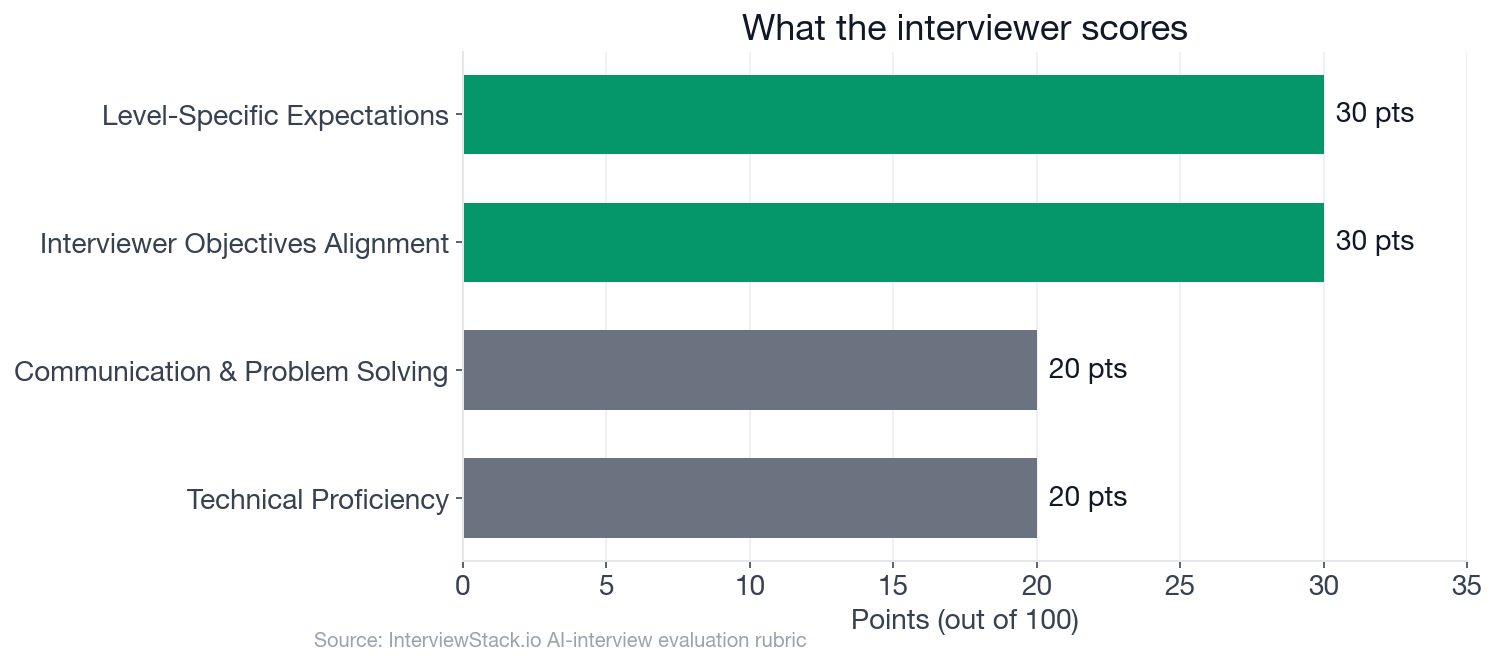 Sixty of the interview's 100 points reward how you frame and segment the problem; the other forty reward execution and communication.
Where Does the Compute Answer Actually Fall Apart?
Below are four moments from this interview where a well-prepared mid-level candidate, call her Nadia, gives an answer that sounds reasonable and still costs rubric points.
Turn 1: The Latency Floor
Interviewer: "If the product team says the upload confirmation path must stay under 200 ms p95, how does that change your compute choices?"
Turn 2: The Two-Minute Ramp
Interviewer: "Suppose burst traffic arrives from near-zero to peak within two minutes several times a week. Which options worry you most, and how would you mitigate scaling or cold-start risk?"
Turn 3: The GPU Pivot
Interviewer: "If the transcoding workers need access to GPUs or specialized codecs, would you change your recommendation?"
Turn 4: The Managed Line
Interviewer: "Where would you draw the line between managed services and self-managed infrastructure for this team, and why?"
Spotting the Mistake Is the Easy Part
Every mistake above is easy to see once it's laid out on a page, with the wrong sentence highlighted in red and the fix in green. Under real interview conditions, you don't get that framing. You get an interviewer asking a plain question, a clock that doesn't pause while you weigh five compute options, and follow-ups that don't announce which checklist item they're testing. The gap between reading this walkthrough and passing this interview is reps: running the scenario live, out loud, under real pressure, until segmenting a workload by latency, duration, and hardware becomes the first thing you do instead of the thing you remember only after the interviewer pushes.
The Full 30-Minute Blueprint
Here's how the phases break down against the clock:
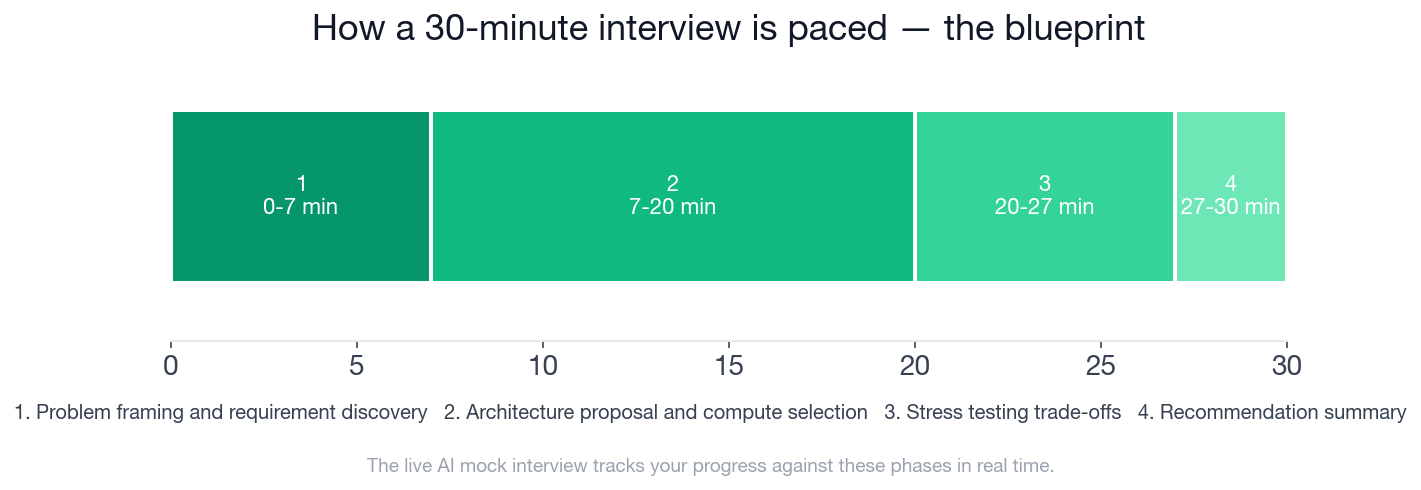 Requirement discovery gets 7 minutes, architecture proposal gets the most time at 13 minutes, stress-testing gets 7, and the recommendation summary is compressed into a final 3.
- ✓Asks clarifying questions about latency targets, job duration, burst profile, concurrency, statefulness, and hardware needs
- ✓Separates user-facing request path from offline/background processing
- ✓Surfaces team-size or operational-capacity concerns without prompting
- ✓Avoids prematurely selecting a single compute model before understanding constraints
- ✓Proposes a coherent end-to-end design, such as synchronous lightweight processing separated from queued asynchronous heavy jobs
- ✓Selects compute models matched to workload traits, for example serverless for short bursty stateless steps, managed containers for always-on APIs or moderate customization, VMs/bare metal for specialized or sustained heavy workloads
- ✓Discusses cold starts, autoscaling behavior, and timeout/runtime limits where relevant
- ✓Explains managed-versus-self-managed rationale in terms of team size, operational burden, and control needs
- ✓Mentions at least one evolution path if traffic shape or workload characteristics change over time
- ✓Adjusts recommendation when given stricter latency or faster burst-scaling constraints
- ✓Identifies scenarios where serverless becomes a poor fit, such as long-running, GPU-bound, or consistently high-utilization jobs
- ✓Compares steady-state economics versus burst economics across compute models
- ✓Offers mitigation ideas such as provisioned capacity, warm pools, queue buffering, or workload partitioning
- ✓Summarizes the recommended compute mix in a few clear points
- ✓States the primary trade-offs accepted by the design
- ✓Names the top missing data points that would validate or adjust the recommendation
This is the blueprint a strong candidate hits, phase by phase, checklist item by checklist item, and it's the exact structure the AI mock interview tracks you against in real time, not just at the end.
Ready to Run This Interview for Real?
Reading the mistakes above is the easy 10%. The other 90% is doing this live, out loud, on a clock, with follow-ups you can't see coming. Start the Solutions Architect compute options and trade-offs mock interview and get scored against this exact rubric, with feedback on where you actually lost points. If you want to drill the underlying concepts first, work through the Solutions Architect compute options and trade-offs question bank, build foundational judgment with the interactive courses, or browse open Solutions Architect roles to see what teams are actually asking for.
FAQ
Q. What does a Solutions Architect interview on cloud compute options actually test?
It tests whether you can segment a workload into pieces with different characteristics, such as latency-sensitive, bursty, long-running, or GPU-bound, and assign each piece the right compute model, rather than picking one abstraction and defending it everywhere. Two of the four rubric dimensions, worth 60 of the interview's 100 points combined, reward exactly that segmentation.
Q. Is serverless always the wrong first answer in a compute trade-offs interview?
No. Serverless is a strong default for short, bursty, stateless work, like the media pipeline's virus-scanning and metadata steps in this scenario. It becomes the wrong answer only when it's applied uniformly, especially to GPU-bound, long-running, or steady high-utilization work, which the interview's stress-testing phase is specifically built to expose.
Q. How should you handle a strict latency requirement like a 200ms p95 target in this kind of interview?
Name the mechanism, not just the target. A synchronous path with a 200ms p95 budget usually needs a warmed managed-container service or serverless with provisioned concurrency, explicitly separated from the best-effort asynchronous work, because unmitigated cold starts routinely exceed 200ms.
Q. What's the right default between managed and self-managed infrastructure?
For a small team, default to managed services everywhere they cover the requirement, and reserve self-managed infrastructure for the segments where specialized hardware or predictable heavy load genuinely justifies the added operational burden. Naming that threshold explicitly is worth real points under the interview's Level-Specific Expectations dimension.
Q. How long is this interview and how is it paced?
Thirty minutes across four phases: requirement discovery in the first 7 minutes, architecture proposal and compute selection from minutes 7 to 20, stress-testing the trade-offs from minutes 20 to 27, and a closing recommendation summary in the final 3 minutes.
Q. What's the biggest mistake mid-level candidates make in this interview?
Committing to one compute model, usually serverless, before separating the workload's synchronous and asynchronous paths. Independently identifying that split is an explicit bar for this level, and skipping it costs points before the first follow-up question even arrives.
Q. Can I practice this exact interview?
Yes. The AI mock interview runs this same Solutions Architect compute options and trade-offs scenario live, asks unscripted follow-up questions, and scores your answers against the same rubric described here.
The Workload Decides, Not the Trend
There's no universally correct compute model in this interview, and there isn't one in production either. The right answer segments a workload by what it actually needs (latency, duration, concurrency, hardware) and lets each segment pick its own compute model, defaulting to managed services until a specific constraint says otherwise. That's a five-minute idea to explain and a genuinely hard habit to apply live under a ticking clock, which is exactly what the mock interview is for.
Topics
Ready to practice?
Put what you've learned into practice with AI mock interviews and structured preparation guides.