
The Fastest-Looking Fix Is the One the Rubric Penalizes
Vera is ninety seconds into a mid-level Systems Administrator interview and already has a plan: fold the acquired company straight into the existing forest, standardize everything, done. It sounds decisive. It is also the exact move this interview's rubric is built to catch. This walkthrough is built on a real interview package InterviewStack.io's production AI interviewer runs live, not a hypothetical, and it follows Vera through a simulated 30-minute Active Directory interview where the slower, staged answer scores higher than the clean-looking one.
The setup: a recently acquired business unit of about 1,200 employees has to be folded into the company's identity platform within a quarter. Its on-prem Active Directory is inconsistent, its legacy apps still lean on LDAP and Kerberos, and the parent company already runs a mature, standardized environment with cloud identity integrations. Move fast and you risk breaking legacy access; move too carefully and you miss the deadline. The interview scores how well Vera holds that line.
Key Findings
- The rubric splits 100 points across four dimensions: 30 for Interviewer Objectives Alignment, 30 for Level-Specific Expectations, 20 for Technical Proficiency, and 20 for Communication and Problem Solving.
- The interview runs 30 minutes across three timed phases: minutes 0-8, 8-20, and 20-30.
- Phase one (minutes 0-8) already carries 4 expected moves, before a single AD object gets touched.
- Phase two (minutes 8-20), the longest stretch at 12 minutes, packs 6 checklist items spanning trust models, OU and GPO design, and hybrid identity sync.
- The scenario centers on folding a roughly 1,200-employee acquired business unit into an existing enterprise AD environment inside one quarter.
- Four topics are explicitly out of scope: algorithmic coding exercises, machine learning model design, database query optimization, and unrelated network hardware deep-dives.
- Level-Specific Expectations (30 of 100 points) ask for a sound end-to-end plan and the major risks identified, not exhaustive coverage delivered instantly.
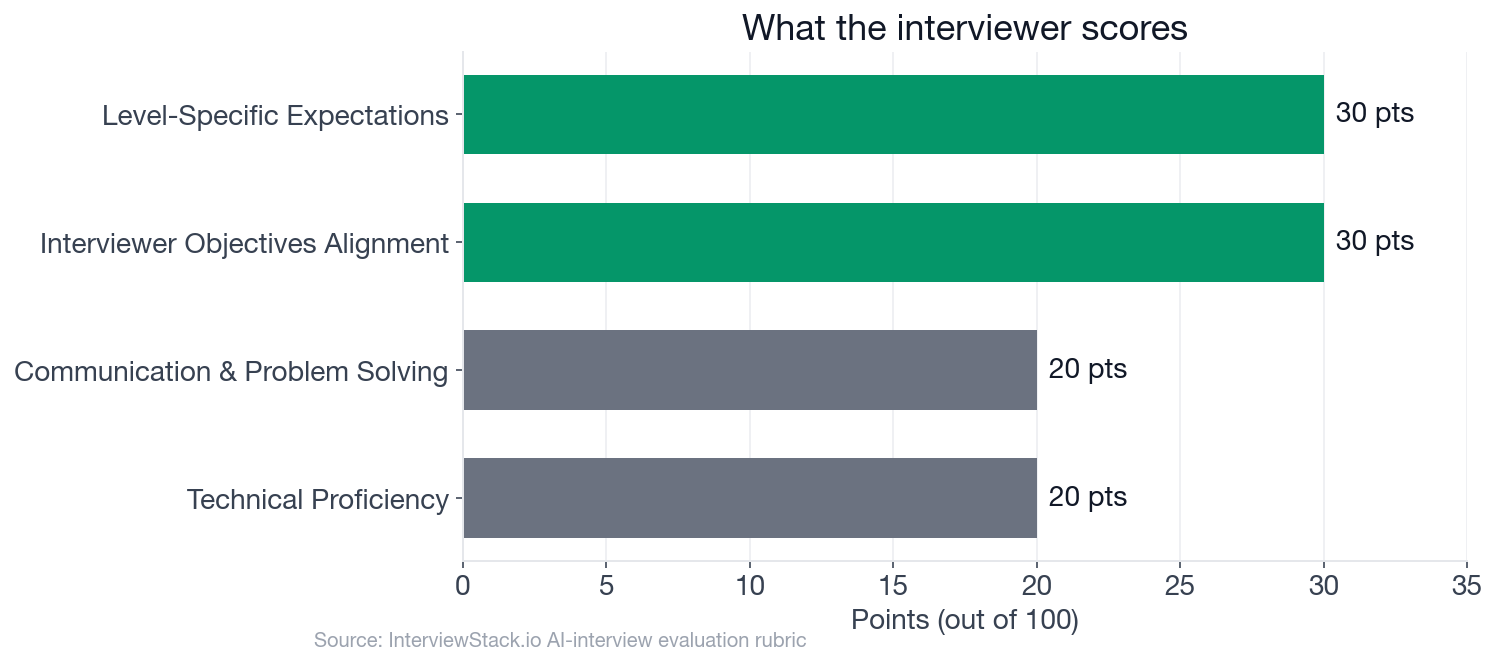 Interviewer Objectives Alignment and Level-Specific Expectations together hold 60 of the 100 points, one and a half times the combined weight of Technical Proficiency and Communication and Problem Solving (60 vs. 40).
Can This Merger Survive Contact With Legacy Kerberos?
Before the first follow-up, the candidate has to sit with the scenario itself. Here is what Vera is handed on the call.
The interview question
You are joining a central IT infrastructure team at a large tech company. A recently acquired business unit with about 1,200 employees must be integrated into the company's identity platform within the next quarter. The acquired company currently runs a small on-premises Active Directory with inconsistent OU structure, overlapping group usage, and a mix of Windows laptops, shared servers, and a few legacy applications that still rely on LDAP or Kerberos. Your company already has a mature multi-site Active Directory environment, standardized Group Policy, and cloud identity integrations for SaaS access.
Your team wants an approach that improves security and manageability without causing unnecessary disruption to users or breaking legacy access paths.
How would you plan and execute the integration of the acquired company's Active Directory and identity environment into the existing enterprise identity platform?
The interviewer is not grading whether Vera can define a forest or an OU. The real target is whether Vera can design and operate this integration end to end: architecture choices across domains, forests, and OUs, authentication and authorization flows, Group Policy design, identity lifecycle management, hybrid cloud integration, real troubleshooting, and communicating the operational trade-offs a mid-level admin at a large company is expected to own. If you want to drill these checks in isolation first, the Active Directory and Identity Management question bank breaks them out individually.
Four Turns Test Whether You Can Slow Down on Command
Four follow-ups turn the scenario into a real interview. Each one rewards the same discipline: resist the instinct to move fast and clean, in favor of the slower path that actually holds under a legacy environment nobody fully mapped yet.
Turn 1: Coexistence vs. Full Merge
Interviewer: "How would you decide whether to use a trust, a migration, or a longer-term coexistence model in this situation?"
Turn 2: The Undocumented Dependency
Interviewer: "If some legacy applications depend on LDAP binds, older service accounts, or Kerberos behavior that is poorly documented, how would you de-risk the cutover?"
Turn 3: The Rollback Nobody Named
Interviewer: "What operational checks, rollback options, and success metrics would you put in place for the migration weekend and the weeks after?"
Turn 4: One Remote Office, One Symptom
Interviewer: "If authentication starts failing only for users in one remote office after the migration, how would you troubleshoot it?"
What Does the Systems Administrator Active Directory and Identity Management Interview Actually Reward?
All four turns test the same discipline: treat the integration as a design decision shaped by real constraints, not a checklist to clear as fast as possible. Level-Specific Expectations explicitly asks for a sound end-to-end plan with the major risks identified, not exhaustive coverage delivered on the first try. The gap between Vera's fast answer and the stronger one is never about knowing more Active Directory trivia. It is about whether the pace of the plan matches the actual risk in the room: a tight deadline, an undocumented legacy app, a remote office nobody has visibility into yet.
What Happens When the Interviewer Adds a Second Remote Office?
Every mistake above is easy to spot laid out on the page, with the rubric line attached in a green box. Under a real clock, none of that scaffolding exists. If the interviewer adds a second remote office with a different symptom, moves the deadline up two weeks, or reveals a service account nobody inventoried, the same instinct to move fast reappears, and there is no pause button to go re-read the checklist. Reading the fix once does not install the discipline. Only running the AI mock interview live, against a follow-up you did not predict, does that.
Three Phases, Fourteen Checklist Items, One Coexistence-First Plan
This is the blueprint a strong candidate hits, phase by phase, and the exact thing InterviewStack.io's AI interviewer tracks in real time.
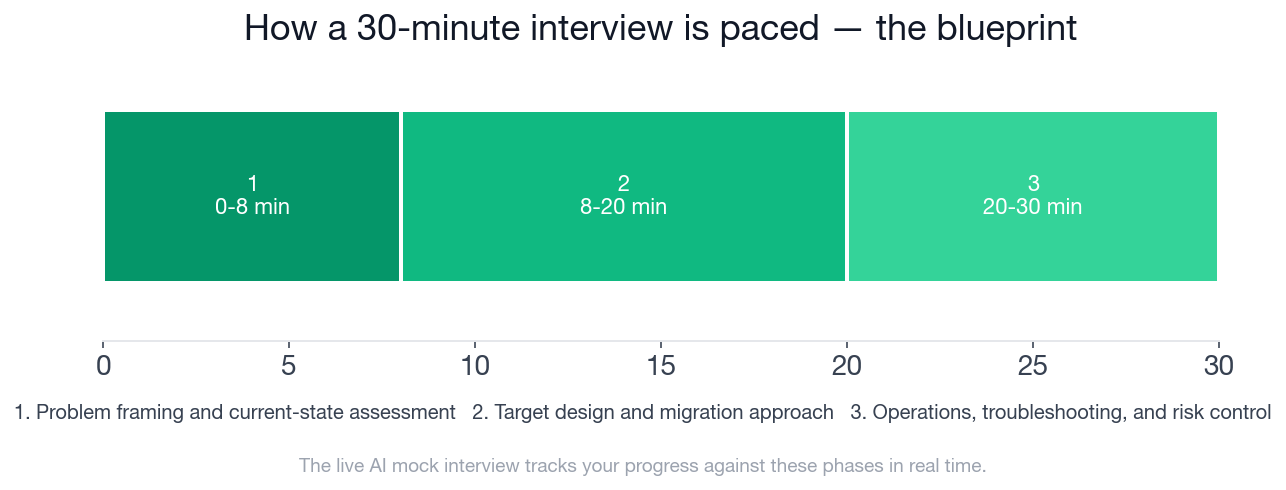 The 30-minute clock gives the target-design phase 12 minutes, the longest of the three, exactly where trust models, OU and GPO design, and hybrid identity sync all have to land.
- ✓Asks clarifying questions about domain/forest topology, user counts, sites, applications, trust relationships, and cloud identity setup
- ✓Identifies need to inventory users, groups, service accounts, GPOs, DNS dependencies, legacy auth methods, and privileged access paths
- ✓Distinguishes business constraints such as migration deadline, downtime tolerance, security requirements, and user impact
- ✓Recognizes that acquisition integration may require staged coexistence rather than immediate full consolidation
- ✓Proposes a coherent target-state design such as trust-first coexistence, staged migration into existing forest, or justified retention of separate boundary where needed
- ✓Explains rationale for OU structure, group cleanup, naming standards, delegated administration, and least-privilege access model
- ✓Describes how users, computers, groups, and service accounts would be migrated or rationalized, including access continuity concerns
- ✓Mentions GPO review and consolidation rather than blindly importing legacy policy objects
- ✓Accounts for DNS, replication, Kerberos/SPN issues, LDAP dependencies, profile or device impact, and remote site considerations
- ✓Covers hybrid identity implications such as sync order, immutable identity matching, SSO continuity, and SaaS access validation
- ✓Defines pre-cutover validation, pilot testing, communication plan, and rollback or coexistence safeguards
- ✓Names concrete checks such as authentication testing, replication health, DNS resolution, GPO application, cloud sign-in validation, and privileged access verification
- ✓Provides a plausible troubleshooting flow for partial authentication failures, including site/DC selection, replication lag, DNS misconfiguration, time skew, trust issues, and GPO scope
- ✓Uses measurable success criteria such as login success rates, ticket volumes, failed authentications, sync errors, and application access outcomes
Can You Migrate 1,200 Users Without a Redo?
Start the AI mock interview and run this exact acquisition scenario live, against the same 30-minute clock and the same four-dimension rubric, with turn-by-turn feedback on where the plan moved too fast. Prefer to warm up on individual checks first? Drill trust models, OU design, and hybrid sync one at a time in the question bank, then browse current Systems Administrator openings once you are ready to put the practice to work, or pair it with our preparation guides for company-specific process notes.
FAQ
Q. What does the Systems Administrator Active Directory interview actually evaluate?
It evaluates whether a mid-level admin can design and operate Active Directory in a realistic enterprise environment: architecture decisions across domains, forests, and OUs, authentication and authorization flows, Group Policy design, identity lifecycle management, hybrid identity integration with cloud providers, real troubleshooting, and communicating operational trade-offs, all at the level expected of a mid-level Systems Administrator at a large tech company.
Q. How is this 30-minute Active Directory interview scored?
A 100-point rubric splits into four dimensions: 30 points for Interviewer Objectives Alignment, 30 for Level-Specific Expectations, 20 for Technical Proficiency, and 20 for Communication and Problem Solving, tracked across three timed phases: minutes 0-8, 8-20, and 20-30.
Q. Should you always migrate an acquired company straight into the existing Active Directory forest?
No. The checklist explicitly rewards recognizing that an acquisition integration may require staged coexistence rather than immediate full consolidation. A trust-first or coexistence approach that validates dependencies before consolidating is usually the stronger answer than an immediate full merge, especially when legacy applications and a tight timeline are both in play.
Q. How should identity stay in sync between on-prem Active Directory and a cloud identity provider during a migration like this?
The checklist looks for candidates who address hybrid identity realities directly: sync order, which system is the source of authority for identity, matching identities consistently across the sync boundary, single sign-on continuity, and validating that SaaS access still works for migrated users, not just the on-prem side of the cutover.
Q. What OU and Group Policy design mistakes does this interview watch for?
The checklist penalizes blindly importing the acquired company's existing OU structure, overlapping groups, and legacy Group Policy objects. A stronger answer reviews and consolidates Group Policy rather than carrying it over wholesale, and designs OUs, naming standards, and delegated administration around least-privilege access rather than replicating the acquired company's sprawl.
Q. What topics are out of scope for this interview?
Low-level software development or algorithmic coding exercises, machine learning model design, database query optimization as the main focus, and network hardware configuration deep-dives unrelated to identity are all explicitly out of scope. The focus stays on Active Directory and identity management.
Q. How can candidates practice this exact interview?
The AI mock interview runs this same acquisition-integration scenario live, with the same 30-minute clock and rubric, and gives turn-by-turn feedback. You can also drill individual checks first in the Active Directory and Identity Management question bank.
The Right Pace Beats the Right Diagram
Vera knew the terminology from minute one; trusts, OUs, GPOs, Kerberos, none of it was new. What the rubric actually priced was pace: whether the plan slowed down exactly where an undocumented legacy dependency, an unnamed rollback, or a single remote office demanded it. That is the part no amount of reading installs on its own, and it is the part the live interview actually tests. See also our companion walkthrough on Windows System Administration interviews.
Topics
Ready to practice?
Put what you've learned into practice with AI mock interviews and structured preparation guides.